
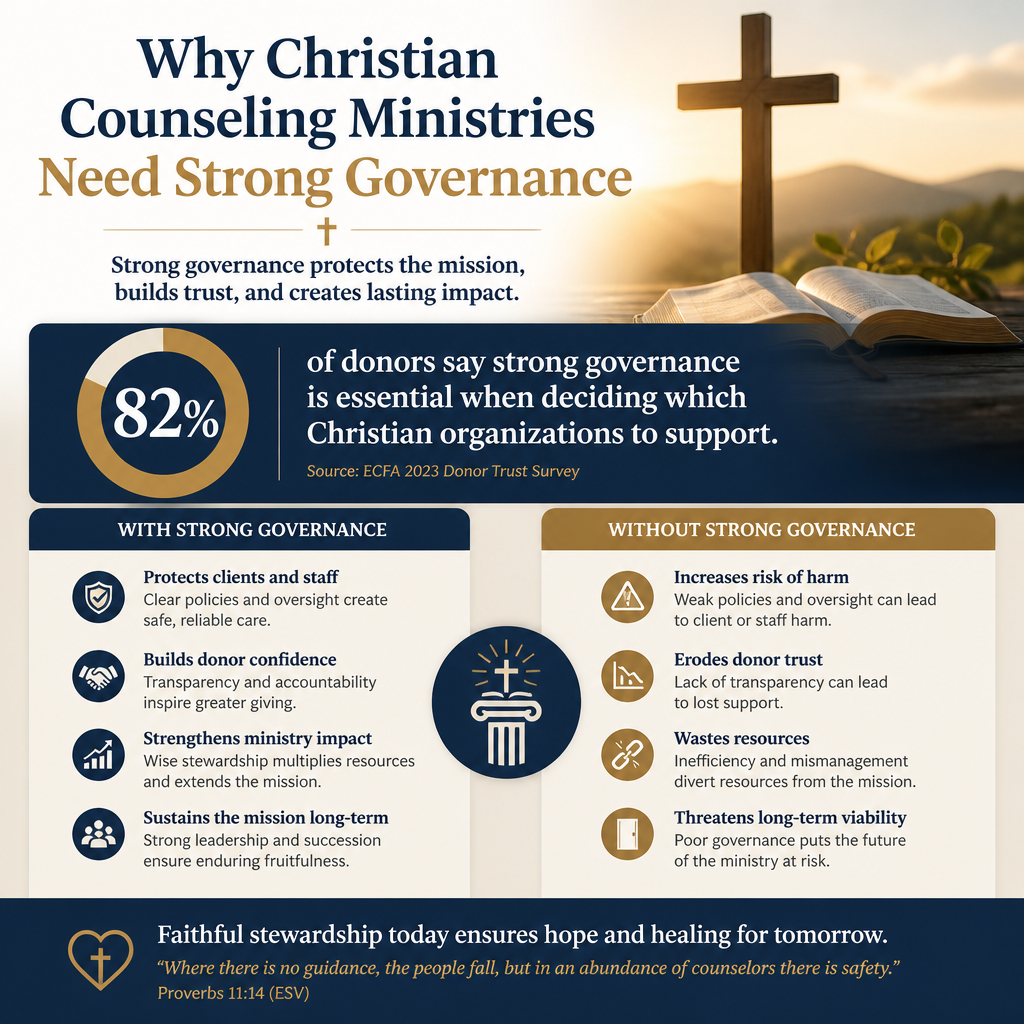
Why Christian counseling ministries need strong governance is not a secondary administrative question. It is a pastoral and moral question, because these ministries often receive people at their most vulnerable: after trauma, in crisis marriages, under addiction, or in the wake of spiritual abuse.
Donors who support counseling work are not merely funding programming; they are underwriting trust. Counseling requires confidentiality, clinical prudence, careful boundaries, and a clear theology of the human person. When governance is weak, those commitments can erode quietly, and the first people to pay the price are often the very people the ministry exists to serve.
Governance is a form of neighbor love when people are vulnerable
The counseling room magnifies the cost of leadership failure
Scripture treats leadership as a moral stewardship, not a platform. Elders are charged to shepherd “not domineering over those in your charge, but being examples to the flock” (1 Peter 5:3). That command is not confined to the local church’s formal structures; it applies to any Christian work that holds spiritual and relational authority. Counseling ministries occupy an especially sensitive space because they are entrusted with personal histories, family systems, and spiritual wounds that cannot be handled carelessly.
Strong governance creates conditions where humility is possible in practice: real oversight, a culture where concerns can be raised without retaliation, and a disciplined approach to risk. Weak governance tends to substitute personality for accountability. That can “work” for a time, especially when a founder is gifted and the mission is compelling, but it places an unhealthy weight on charisma rather than covenantal faithfulness.
Good intentions do not manage risk
Christian donors often give because they recognize a genuine need: the mental health crisis is real, and ministry leaders are trying to respond. The harder question is whether the ministry has the structures to respond without harm. In clinical contexts, harm is often unintentional. It can take the form of boundary violations, mishandled mandatory reporting, overpromising outcomes, or spiritual counsel that is not integrated with clinically appropriate care.
Governance is where good intentions become institutional responsibility. A board that understands its fiduciary and spiritual duty insists on policies, training, and external expertise where needed. That is not a concession to secular management. It is a practical application of the command to love our neighbor with truth and care.

Boards protect mission integrity and theological clarity
Christian counseling sits at a contested intersection
Christians genuinely disagree about what “Christian counseling” should mean. Some ministries are explicitly clinical, staffed by licensed counselors integrating faith and evidence-based treatment. Others emphasize pastoral counseling rooted in Scripture and discipleship, sometimes alongside referrals to clinicians. Still others operate as prayer ministries with a counseling dimension. These approaches can be faithful, but they are not interchangeable, and confusion here creates both ethical and theological problems.
A strong board presses for clarity: What exactly is being offered, by whom, under what licensure or supervision, and with what theological commitments? Donors should not have to infer whether a ministry is providing psychotherapy, pastoral counseling, coaching, or spiritual direction. Precision is part of honesty.
Mission drift is often a governance failure before it becomes a public one
In our verification work at Most Trusted, we observe that mission drift in counseling ministries often begins with small, understandable decisions: accepting funding with strings attached, expanding into services beyond staff competence, or adopting language that pleases everyone but commits to nothing. Boards that meet infrequently, lack independence, or defer excessively to a founder tend to notice drift late.
By contrast, ministries that meet The Most Trusted Standard typically document their theological commitments, define their model of care, and require leadership to report against that model consistently. Governance cannot guarantee faithfulness, but it can make unfaithfulness harder to institutionalize.
Strong governance is the most practical form of safeguarding
Safeguarding is broader than sexual misconduct prevention
When donors hear “safeguarding,” they often think first of sexual abuse prevention. That must be included, and a counseling ministry without clear boundaries and reporting pathways is not safe. Yet safeguarding in counseling work is broader: it includes confidentiality practices, data security, referral protocols for high-risk cases, informed consent, supervision standards, and clear limitations on what the ministry can responsibly treat.
These are governance-level questions because they determine what is required of staff and what is measured. A ministry can have caring counselors and still lack system-level protections that prevent foreseeable harm.
What donors should look for in governance practices
Donors rarely have direct visibility into counseling sessions, and they should not. Governance becomes the donor’s most reliable window into whether care is likely to be wise and safe. The following signals are not exhaustive, but they are meaningful.
- Independent board oversight with documented meetings, minutes, and conflict-of-interest policies.
- Clear safeguarding policies, including boundaries, supervision expectations, and reporting pathways.
- Competence alignment between services offered and staff qualifications, including licensure where required.
- Formal complaint and escalation channels that do not route concerns solely through the founder or executive director.
- Documented theology of care that explains how Scripture, pastoral wisdom, and clinical practice relate in that ministry.
Governance practices like these are not bureaucracy for its own sake. They are the ministry’s way of saying, in concrete terms, that people are more important than reputation, and that truth matters more than growth.
Financial integrity in counseling ministries is inseparable from leadership integrity
Conflicts of interest can be subtle in fee-based models
Many counseling ministries mix donations with fee-for-service counseling, training products, or reimbursed clinical work. These models can expand access and sustainability, but they also introduce incentives that deserve sober oversight: sliding scales handled inconsistently, scholarships allocated without clear criteria, or compensation structures tied too directly to volume.
Christian donors are right to ask whether a ministry’s financial model serves the mission or slowly reshapes it. Strong boards ask those questions early, set guardrails, and require reporting that can be audited. For donors trying to think carefully across the wider landscape of Christian Counseling Ministries, financial model clarity is often one of the quickest ways to distinguish mature operations from well-intended but fragile ones.
Transparency is not publicity
Some ministries equate transparency with an inspiring annual report and a few testimonials. That is not what donors most need. Donors need decision-useful information: audited or reviewed financials when appropriate, clear descriptions of program costs, and governance disclosures that demonstrate accountability.
One reason donors should not over-focus on simplistic overhead ratios is that the nonprofit field has long recognized how easily such metrics can mislead. Charity Navigator, Candid, and the BBB Wise Giving Alliance jointly warned against “the false conception that financial ratios are the sole indicator of nonprofit performance,” arguing that administrative and fundraising spending can be necessary for effectiveness and accountability (Charity Navigator). Strong governance helps donors interpret financials in context rather than rewarding ministries for underinvesting in controls that protect counselees.
Verification helps donors distinguish maturity from charisma
What The Most Trusted Standard is designed to test
Donors are often asked to make high-trust decisions with partial information. That is especially true in counseling work, where privacy concerns are legitimate and outcomes are difficult to quantify without reducing people to metrics. What this means in practice is that donors need a framework that tests integrity without demanding disclosures that would violate confidentiality.
Most Trusted exists to serve that need. We evaluate ministries against The Most Trusted Standard, a 15-criteria framework spanning faith foundation, financial integrity, governance and leadership, and transparency and effectiveness. In counseling ministries, governance and leadership criteria often carry disproportionate weight because they are upstream of both safety and mission clarity.
What governance maturity tends to look like over time
Across our verification work, we observe a consistent pattern: ministries with strong governance tend to face hard issues sooner and more truthfully. They acknowledge limits, make disciplined referrals, and treat policies as pastoral tools rather than legal cover. They also tend to invite external expertise—clinical, legal, and theological—when the work requires it.
By contrast, ministries with weak governance often become reactive. They respond to crises rather than preventing them, and they can confuse loyalty to a leader with loyalty to Christ. For donors seeking to discern how to approach giving across How to Give Wisely to Christian Counseling Ministries, governance is one of the most reliable predictors of whether a ministry can bear the weight of the trust it receives.
FAQs for Why Christian counseling ministries need strong governance
Is governance still necessary if a ministry has an orthodox statement of faith and a respected founder?
Yes. Orthodoxy and gifting are goods, but they are not governance. Scripture assumes that leaders require accountability, not because they are uniquely suspect, but because authority always creates temptation and blind spots. A respected founder can still make unilateral decisions that expose counselees to harm, drift the mission, or mishandle complaints. Strong governance honors the founder by surrounding leadership with structures that make faithful longevity more likely.
How can donors evaluate governance without prying into confidential counseling matters?
Donors should not seek private case information. Donors can, however, request public-facing indicators of maturity: board independence, conflict-of-interest policies, safeguarding and reporting protocols, financial statements and accountability practices, and a clear description of the ministry’s model of care and staff qualifications. Verification through an external standard can also help donors assess these fundamentals without requiring the ministry to compromise counselee confidentiality.
Governance is one of the clearest signals of love practiced at scale
Christian counseling ministries exist to bring truth and healing where suffering has narrowed a person’s world. That calling requires compassion, theological seriousness, and clinical prudence. It also requires governance strong enough to protect the vulnerable, restrain the powerful, and keep mission aligned with the gospel over time.
Donors cannot control every outcome, and no structure can eliminate every risk. But donors can choose to support ministries that treat accountability as discipleship and oversight as a form of neighbor love. Strong governance is one of the clearest ways a counseling ministry demonstrates that it is worthy of the trust it asks others to place in its care.



