

Red flags that signal weak Christian counseling ministry fundraising rarely show up first in a budget line. They show up in the ministry’s moral and theological posture toward money, truth, and people—especially vulnerable people seeking care. Donors who want to fund faithful, competent counseling work need a discernment framework that is serious enough for souls, not merely sufficient for revenue.
Christian counseling ministries often serve people in crisis: trauma, addiction, marriage collapse, self-harm, pastoral burnout. In that setting, fundraising is not neutral. How a ministry asks for money can either honor the dignity of those it serves or commodify their pain. Scripture’s warnings about dishonest gain and manipulative speech are not abstract. They are a direct test of whether a ministry’s public appeals align with the character of Christ (1 Thessalonians 2:3–5).
When fundraising language treats suffering as a product
Overwrought promises and spiritualized guarantees
A common red flag is the promise of outcomes that no responsible counselor can guarantee: “Your gift will save a marriage,” “Your support will prevent suicide,” “This week we will break generational curses.” Christian counseling can be profoundly effective, and prayer belongs within Christian care. But fundraising that implies certainty where wisdom requires humility is not faith; it is marketing. The New Testament condemns speech that is designed to persuade without regard for truthfulness or restraint (Colossians 3:9).
Healthy ministries describe their work with moral seriousness and professional care: they speak about improving access to counseling, subsidizing sessions, strengthening churches’ capacity to respond, and walking with people over time. They avoid turning the Spirit’s work into a donation-triggered transaction.
Testimonies that blur the line between witness and exploitation
Testimonies can be a gift to the church, and Scripture itself bears witness to God’s deliverance. But a ministry’s fundraising can misuse stories in ways that compromise dignity. Watch for appeals that rely on graphic details, identifiable information, or coercive narrative framing: “She shared because she wants you to give.” If the ministry serves minors, survivors of sexual abuse, or people in active mental health crises, the moral stakes rise further.
We recommend donors ask direct questions: How is informed consent obtained? Who reviews stories for confidentiality? Are clinicians involved in determining whether sharing a story is clinically appropriate? A ministry may not disclose every policy publicly, but it should be able to describe credible safeguards without defensiveness.

When finances are presented in ways that block real accountability
Vague budgets, missing documents, and selective transparency
Christian donors frequently hear the phrase “We are a faith-based ministry; we don’t want to focus on numbers.” That posture can sound spiritual, but it is often a way to avoid scrutiny. In Scripture, stewardship is not optional. The apostolic pattern includes taking pains to do what is right “not only in the eyes of the Lord but also in the eyes of man” (2 Corinthians 8:20–21). Ministries that handle donor funds should be able to show basic financial clarity: recent financial statements, an annual report, and a board that understands fiduciary responsibility.
For U.S. nonprofits, one practical baseline is whether the organization makes its IRS Form 990 readily available and consistent with its public claims. Donors can also use public databases such as the IRS Tax Exempt Organization Search to confirm basic standing and filings, especially for older organizations with steady revenue (IRS Tax Exempt Organization Search).
Overhead fixation or overhead concealment
Two opposite errors show up in weak fundraising. One is relentless messaging that “100% goes to counseling,” as though professional mental health care can be delivered without competent administration, supervision, compliance, or data security. The other is a refusal to discuss administrative costs at all, coupled with emotional pressure for donors not to ask. Both patterns typically indicate a ministry that has not made peace with honest cost accounting.
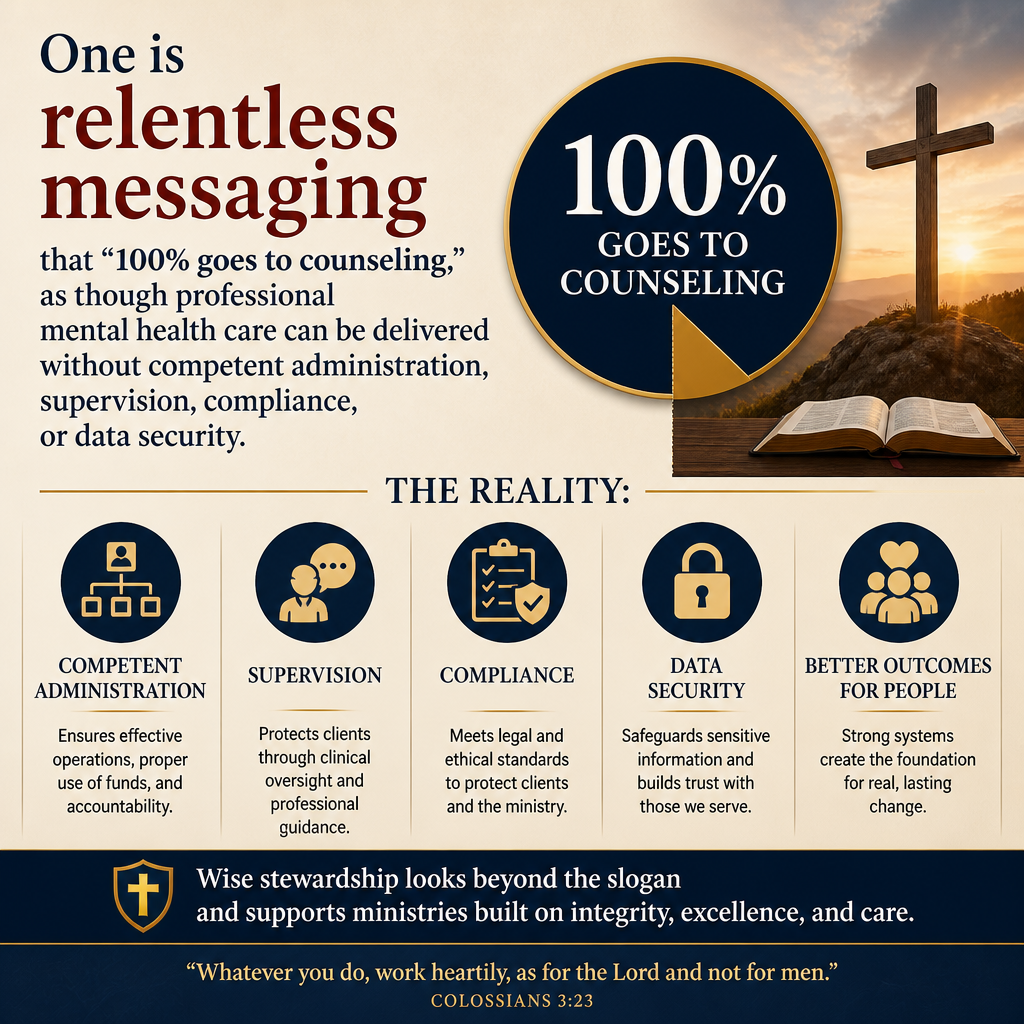
Serious evaluators across the sector have warned donors not to reduce effectiveness to a single overhead ratio. The Overhead Myth letter—signed by GuideStar (now Candid), BBB Wise Giving Alliance, and Charity Navigator—argued that overhead percentages can mislead and can incentivize unhealthy underinvestment in infrastructure (Candid on the Overhead Myth). Donors should expect a Christian counseling ministry to explain costs in plain terms: what it takes to keep clients safe, records secure, clinicians supervised, and counseling accessible.
When governance is too thin for the weight of the mission
A founder-centered structure that cannot absorb correction
Many counseling ministries begin with a faithful, competent leader responding to a real need. The danger comes when the ministry never develops governance strong enough to correct that leader—or to protect the leader from the temptations that accompany influence. Red flags include a board made up primarily of family, employees, or close friends; no clear conflict-of-interest policy; and a culture where questions are treated as disloyalty.
In counseling work, governance weakness is not merely a financial risk. It becomes a safeguarding risk. Without a functioning board and independent oversight, ethical failures can persist: boundary violations, financial self-dealing, mishandled disclosures, and pressure on staff to keep problems quiet for the sake of “the mission.”
Professional credibility without professional accountability
Some ministries highlight credentials in fundraising—“licensed,” “clinical,” “trauma-informed”—but avoid describing the accountability structures that make those words meaningful. Donors should listen for specifics: clinical supervision requirements, continuing education expectations, complaint pathways, and clear separation between pastoral authority and clinical authority when both exist in the organization.
The best ministries are transparent about the complexity. Christian counseling sits at the intersection of pastoral care, clinical practice, and spiritual formation. Christians genuinely disagree about where lines should be drawn in some cases. But a ministry that refuses to name the tensions is usually not mature enough to handle them.
When fundraising incentives distort the ministry model
The starvation cycle in counseling settings
Counseling ministries are especially vulnerable to the dynamic researchers have described as the “nonprofit starvation cycle,” where donor pressure to keep “overhead” low leads to underinvestment in staff, systems, and evaluation, ultimately reducing effectiveness and increasing risk. This pattern has been analyzed in the Stanford Social Innovation Review by Ann Goggins Gregory and Don Howard (Stanford Social Innovation Review). In counseling, underinvestment shows up as clinician overload, inadequate supervision, weak documentation, and inconsistent safeguarding practices.
Fundraising that celebrates chronic scarcity as a virtue—“We are always one month from shutting down”—can be a sign that the ministry has normalized fragility. Emergency appeals have a place in genuine crises, but perpetual crisis fundraising is often a business model.
Conflicted revenue streams and blurred client relationships
Another red flag is a funding approach that blurs who the “customer” is. If a ministry depends heavily on church or donor sponsorship, it may face subtle pressure to satisfy sponsors at the expense of client welfare: premature “success” stories, moralistic reporting, or indirect disclosure of private information to demonstrate impact. If the ministry sells high-priced intensives, conferences, or training as the main revenue engine, it may drift from serving those with the greatest need to serving those with the greatest ability to pay.
These are not automatic disqualifiers. Many ministries responsibly combine subsidized counseling, fee-for-service care, and training income. What matters is whether incentives are named and governed, and whether client dignity is protected when fundraising and care are in proximity.
When impact claims outpace evidence and spiritual maturity
Metrics without meaning and meaning without metrics
Weak fundraising often swings between two extremes: impressive metrics that cannot be interpreted, or spiritual language that refuses any measurement at all. “We served 10,000 people” can mean a social media impression, a one-hour webinar, or sustained therapy. “We are changing lives” may be true, but it can also become a shield against basic questions about effectiveness.
What this means in practice is that donors should ask for modest, credible indicators tied to the ministry’s actual work: number of counseling sessions provided, subsidy dollars distributed, clinician-to-supervisor ratios, client retention for multi-session care, and clear definitions for any reported outcomes. In counseling, outcomes are difficult to measure, and confidentiality limits what can be shared. Mature ministries acknowledge these constraints while still showing disciplined stewardship.
How we encourage donors to pressure-test fundraising integrity
Across our verification work at Most Trusted, the ministries that meet The Most Trusted Standard tend to welcome clear questions because they have already done the internal work of governance, documentation, and theological clarity about stewardship. Donors do not need to become auditors, but a few targeted questions often surface whether an appeal is built on substance or on pressure.
- Can you share your latest annual report and the most recent Form 990 or audited financials?
- How do you protect client confidentiality when you tell stories and report outcomes?
- What safeguards exist for counselor ethics, clinical supervision, and complaints?
- How is the board structured, and what conflicts of interest are disclosed and managed?
- What portion of giving is restricted, and how do you report back on restricted gifts?
Donors who want a wider view of this field can start with Christian Counseling Ministries, and then compare organizations through the lenses that matter most for wise giving. For a giving-focused set of decision criteria, How to Give Wisely to Christian Counseling Ministries names the questions that tend to separate durable ministries from fragile ones.
FAQs for What red flags signal weak Christian counseling ministry fundraising
Is it a red flag if a Christian counseling ministry does not accept insurance?
Not necessarily. Many counseling ministries avoid insurance because of administrative burden, reimbursement complexity, and concerns about clinical autonomy. It becomes a concern when the ministry presents “no insurance” as a spiritual badge while failing to provide transparent fee schedules, a credible scholarship policy, or clear reporting on how donor subsidies are used. Donors should look for fairness, clarity, and evidence that the pricing model does not exclude those the ministry claims to prioritize.
Should a Christian counseling ministry publish client outcomes publicly?
Not in a way that compromises confidentiality. Counseling outcomes are difficult to measure, and public reporting can create pressure to oversimplify complex cases. Still, donors can reasonably ask for aggregated, de-identified indicators and for honest explanation of what the ministry can and cannot measure. A refusal to provide any meaningful evidence of effectiveness, paired with aggressive fundraising claims, is a concern.
A faithful fundraising ministry should feel like truth-telling
Christian counseling ministry fundraising is not primarily a question of technique. It is a question of whether the ministry’s public speech reflects the God who does not lie, the Christ who does not manipulate, and the Spirit who does not coerce. Donors should expect appeals that honor sufferers, respect truth, and invite accountability without resentment. When those marks are present, giving becomes more than a transaction; it becomes shared stewardship for the healing work God is pleased to do through his people.



