

For many Christian donors, the best way to donate to Christian counseling ministries is to give in a manner that strengthens long-term, Christ-centered care rather than funding a moment of crisis alone. Counseling is deeply personal, often confidential, and frequently offered in the shadow of trauma, addiction, grief, and marital fracture. That combination makes discerning stewardship more demanding than it is in ministries where outcomes are easily counted.
Scripture’s call is not merely to feel compassion but to practice faithful love with integrity. “Bear one another’s burdens, and so fulfill the law of Christ” (Galatians 6:2) is not sentimental language; it describes a sustained, costly commitment to people whose burdens do not resolve quickly. The question for donors is how to support ministries that bear burdens wisely, protect the vulnerable, and remain accountable before God and neighbor.
Give toward the ministry model, not only the counseling session
The hardest stewardship decision in Christian counseling is that the work is both spiritual and clinical. Some ministries operate as church-based counseling centers; others are nonprofit clinics; others train pastors and lay leaders for pastoral care. Different models can be faithful, but they are not interchangeable, and donor support should match the ministry’s actual approach.
Clarify what kind of care is being offered
Before giving, identify whether the ministry provides licensed clinical services, biblical counseling, pastoral counseling, or a blended model. Mature ministries state this clearly and do not market ambiguity as breadth. Donors should expect clarity on licensure, supervision, referral protocols for higher levels of care, and how spiritual care is integrated without coercion.
Ask what the gift makes possible at the system level
A single subsidized session can be merciful. But the more strategic gift often funds the systems that make care sustainable: clinician supervision, trauma-informed training, safeguarding policies, and the administrative capacity required to handle intake, documentation, and referrals. The ministries that endure are typically the ones that treat “back office” functions as part of loving people well, not as distractions from ministry.

Prioritize access without creating dependency or distortion
Christian counseling ministries regularly face a moral tension: increasing access for those who cannot pay while avoiding financial structures that quietly break the ministry. Underpricing services can hollow out staff, shorten tenures, and unintentionally reduce quality. Overpricing can exclude the very people donors hope to serve.
Support a wise subsidy strategy
Many counseling ministries use sliding scales, scholarship funds, or church partnerships to reduce cost barriers. The best versions of these strategies are transparent: donors can see eligibility criteria, how subsidies are allocated, and how the ministry prevents fraud or favoritism. A designated fund for counseling scholarships can be powerful when the ministry has disciplined intake and clear boundaries.
Understand the scale of need and the limits of any one organization
Demand for mental health services is high across the United States, and waitlists are common. In 2023, about one-quarter of U.S. adults reported needing mental health counseling or therapy in the past year but not getting it, with cost cited among the barriers Centers for Disease Control and Prevention, National Health Interview Survey. A Christian counseling ministry cannot solve the whole landscape, but donors can look for ministries that respond honestly to limits: triage practices, referral networks, and partnerships with churches and clinicians.
Give in ways that strengthen accountability and protect the vulnerable
Counseling involves power, privacy, and spiritual influence. These are not reasons to distrust Christian counseling ministries; they are reasons to fund ministries that treat accountability as a form of discipleship. Donors should assume that strong governance and safeguarding practices are part of the ministry itself.
Look for verifiable safeguards
A credible counseling ministry can describe, in plain language, how it protects clients and counselees. That includes background checks where appropriate, mandatory reporting practices, policies for handling allegations, and ethical standards for confidentiality. Because counseling is often private, donors must look for proxies of trustworthiness: independent boards, documented policies, and external accountability.
Fund what transparency requires
Some donors hesitate to support administrative costs. In counseling, administration often is care: secure record systems, compliance, supervision structures, and trained intake staff. Donors can hold ministries to high standards while rejecting the simplistic belief that low overhead equals integrity. Leaders across the sector have argued that overhead ratios alone are a poor measure of effectiveness Charity Navigator.
Choose donation methods that match the ministry’s cash flow and ethics
The best way to donate is not merely a payment mechanism; it is a commitment structure. Counseling ministries often carry fixed costs—licensed staff, facilities, supervision, technology, insurance—that do not pause when giving dips. Matching the method of giving to the ministry’s financial reality is often the most practical kindness a donor can offer.
Consider recurring gifts for stability
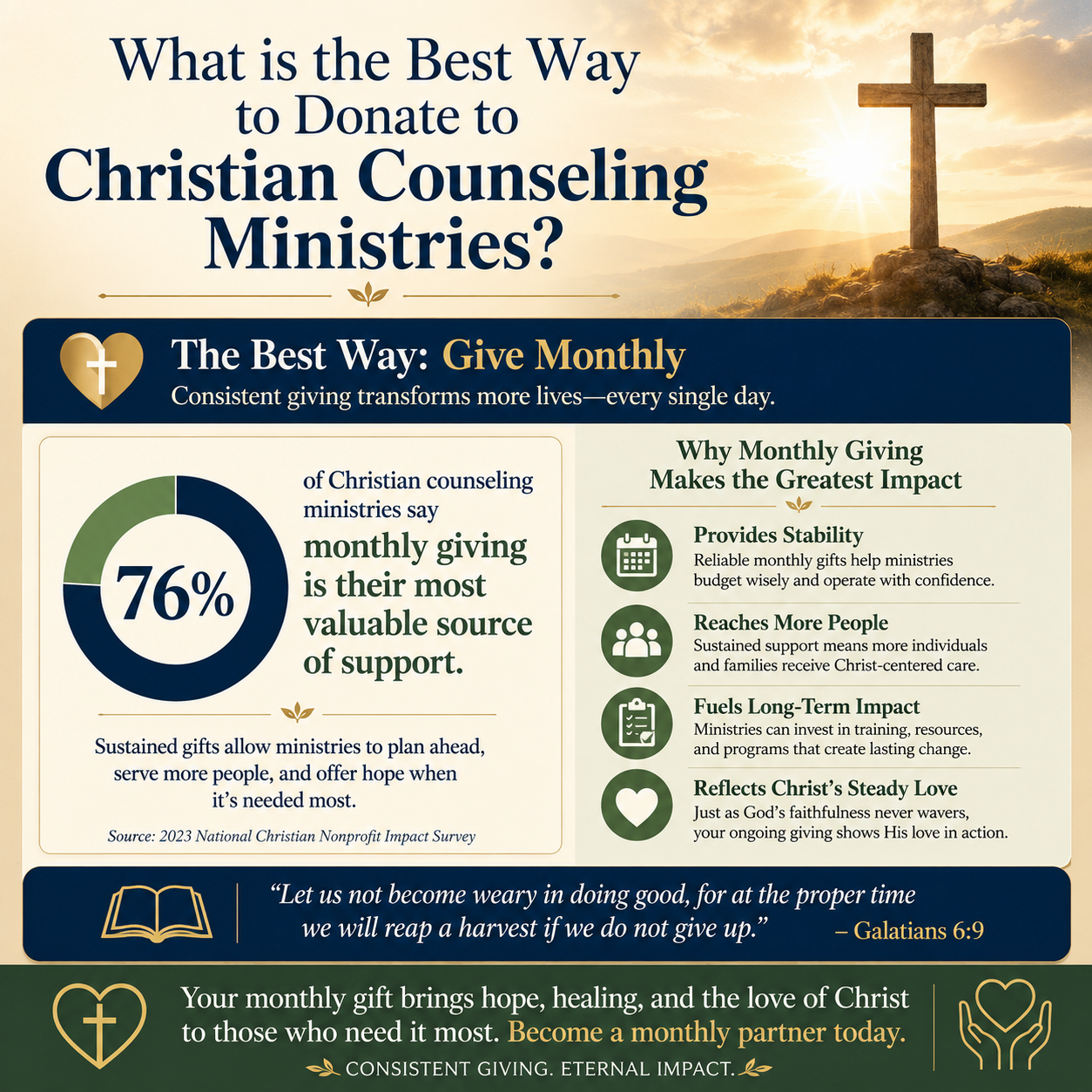
Monthly giving can underwrite scholarship funds, reduce pressure to overbook clinicians, and smooth the uneven rhythm of seasonal donations. If a ministry relies on client fees, recurring gifts can also help it keep fees from drifting upward in ways that exclude those of modest means.
Use restricted gifts with discipline
Designating a gift for counseling scholarships, clinician training, or pastoral care initiatives can be appropriate. But excessive restriction can unintentionally weaken the organization. Mature donors typically restrict funds only when they understand the budget and trust the ministry’s capacity to execute.
- Recurring gifts to sustain counseling scholarships and core operations
- One-time gifts for seasonal scholarship matching or crisis response
- Non-cash gifts such as appreciated securities when the ministry can receive them responsibly
- Employer matching when available to extend impact without distorting priorities
- Church partnerships that combine pastoral care pathways with clinical referrals
Some donors also explore donor-advised funds for planned giving. That can be prudent, but it should not become a way to delay generosity indefinitely. “Do not withhold good from those to whom it is due, when it is in your power to do it” (Proverbs 3:27) is a relevant stewardship warning for givers as well as for organizations.
Verify the ministry against a standard, not a story
Christian counseling ministries can tell moving stories, and some of those stories are true. But stories are not accountability. The deeper question is whether the ministry’s theology, finances, governance, and reported results can bear scrutiny. That is especially necessary in counseling, where confidentiality limits what can be shared publicly.
Use a framework that tests faithfulness and competence together
At Most Trusted, we evaluate Christian nonprofits against The Most Trusted Standard, a 15-criteria framework that examines faith foundation, financial integrity, governance and leadership, and transparency and effectiveness. The aim is not to reward marketing excellence but to identify ministries that can demonstrate integrity with evidence. In counseling ministries, that often includes clear doctrinal commitments, ethical counseling practices, responsible financial controls, and sober, non-exaggerated reporting about outcomes.
Read what the ministry publishes and notice what it avoids
Donors should expect accessible financial statements, clear leadership information, and forthright descriptions of programs. Vagueness is not always malice—small organizations often lack capacity—but it is still a risk indicator. For donors who want broader context on where counseling fits within Christian care, we maintain editorial coverage of Christian Counseling Ministries that treats the field with the seriousness it warrants.
Christians genuinely disagree about some aspects of counseling: the boundaries between sin and suffering, the appropriate integration of psychology, and the limits of pastoral authority. Those debates are not distractions from giving; they are part of discerning where a ministry stands and whether its posture is humble, teachable, and anchored in historic Christian conviction.
FAQs for What is the best way to donate to Christian counseling ministries
Should we give to counseling scholarships or to general operating support?
Both can be faithful, but they serve different purposes. Scholarships directly expand access for clients who cannot pay, which is often the urgent need. General operating support strengthens the staffing, supervision, systems, and accountability that make scholarship care safe and sustainable. When donors trust a ministry’s governance and transparency, unrestricted or lightly restricted support is often the most stabilizing gift.
How can we evaluate impact when counseling outcomes are private?
Counseling confidentiality limits public reporting, and donors should not pressure ministries to disclose identifying stories. Still, credible ministries can provide non-identifying indicators: numbers served, waitlist data, completion rates where appropriate, clinical supervision practices, safeguarding policies, and external accountability. For donors focused on discernment across the broader giving category, How to Give to Christian Counseling Ministries is a useful reference point for evaluating common models and risks.
A faithful way to give is one that makes care more truthful, more durable, and more accountable
The best way to donate to Christian counseling ministries is to fund what sustains wise, Christ-centered care over time: access for the poor, ethical practice, competent leadership, and transparency that withstands scrutiny. Donors are not merely purchasing services; we are participating in a work of mercy that must be as truthful as it is compassionate. When giving strengthens both love and integrity, the church’s care for the suffering becomes not only present, but trustworthy.



