

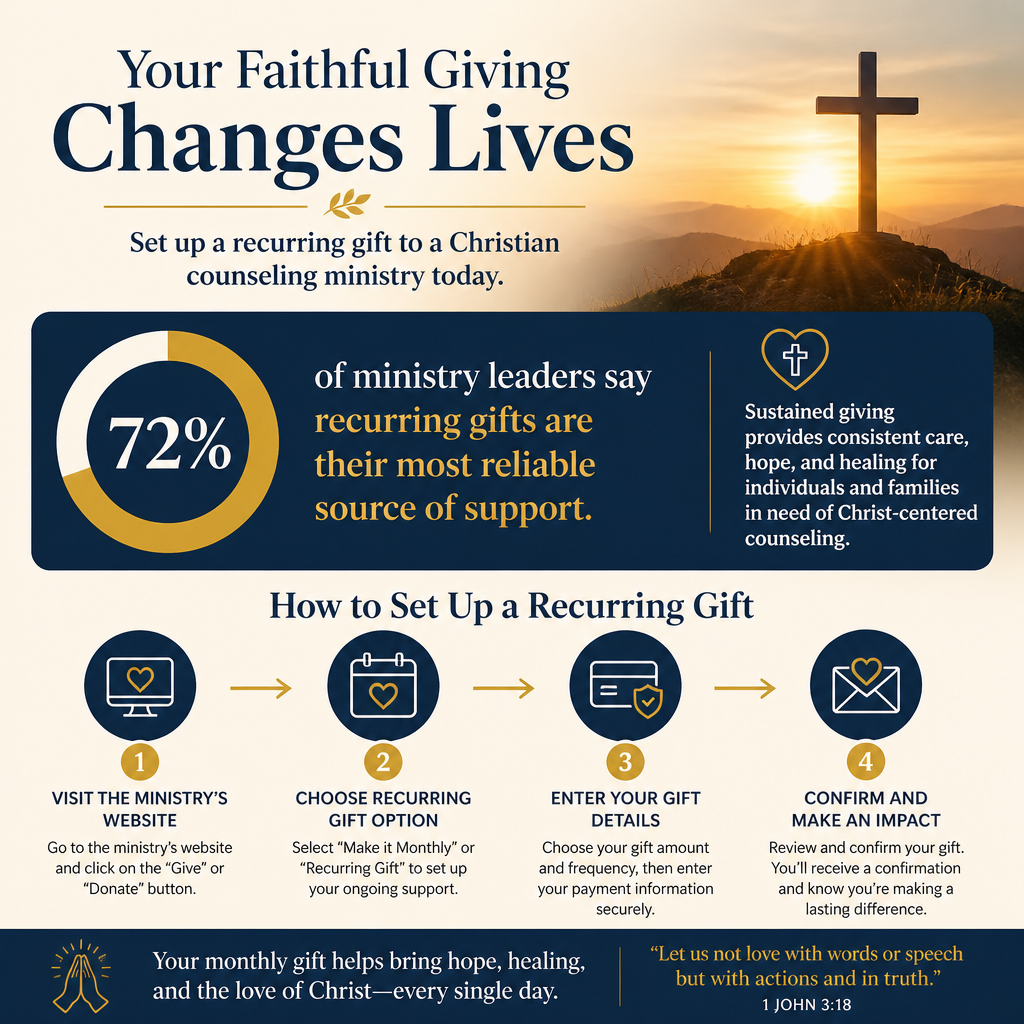
Setting up recurring gifts to Christian counseling ministries is one of the most practical ways to sustain long-term, gospel-shaped care for people whose suffering rarely resolves on a predictable timeline. Trauma recovery, marriage repair, addiction support, and grief counseling often require steady presence, not episodic attention. Recurring giving matches the pastoral reality of counseling: slow work, faithful accompaniment, and the patient rebuilding of trust.
For many donors, the harder question is not whether Christian counseling matters, but how to fund it responsibly. Counseling ministries operate at the intersection of spiritual care, clinical prudence, and financial constraint. Fees can be a barrier, subsidized sessions require dependable funding, and confidentiality limits the kind of story-based fundraising many donors have come to expect. A recurring gift becomes a disciplined form of stewardship precisely because it is less dependent on emotional immediacy and more anchored in sustained obligation to love our neighbor.
Why recurring support matters for Christian counseling ministries
Counseling is intensive work with long arcs
Christian counseling ministries rarely function like event-driven programs. A meaningful course of counseling can span months, and complex cases can extend longer. Even when a ministry uses group modalities or short-term models, the work depends on trained staff, supervision, safe facilities, and careful intake processes.
Most ministries also carry financial tension: they want to keep care accessible, but they cannot build healthy systems on unstable cash flow. A recurring donor base can stabilize subsidized counseling funds, reduce disruptive staffing swings, and make it possible to plan responsibly for caseloads and clinician capacity. What this means in practice is that recurring gifts are not simply a convenience feature; they are often a key part of whether a ministry can offer care without compromising standards.
Christian generosity is formation, not only transaction
Scripture ties giving to discipleship. Jesus treats money as a reliable indicator of allegiance, not because God needs funds, but because we need conversion. Paul commends the Macedonians for giving beyond their means as an act of worship, and he frames generosity as participation in God’s provision for others (2 Corinthians 8–9). Recurring giving can be a modest but meaningful rule of life: a pattern that makes room for mercy in a budget that otherwise fills itself.
Christians genuinely disagree about the best way to fund counseling ministries: fully donor-supported models, fee-for-service models with scholarships, church-subsidized care, or hybrid approaches. But most agree on this: faithful care requires durable structures. Recurring gifts are one of the cleanest ways donors can help build them.

Choose a ministry with verifiable credibility and fit
Start with theological clarity and clinical responsibility
Not every ministry that uses Christian language is prepared to carry the weight of counseling work. Mature donors should look for a clear statement of faith, a coherent view of the person, and transparent boundaries about what the ministry does and does not provide. A ministry should be able to describe how it integrates Scripture with appropriate clinical practice, including referral pathways for cases that require specialized psychiatric care or emergency intervention.
Across our verification work at Most Trusted, we observe that the ministries that meet The Most Trusted Standard tend to explain their counseling model with both conviction and restraint. They know what they are called to do, and they resist overstating outcomes that cannot be promised on the ministry’s timeline.
Use objective signals, not only compelling stories
Counseling ministries often cannot share detailed client narratives because confidentiality is ethically and legally serious. That constraint can frustrate donors who want vivid proof. A wiser approach is to prioritize verifiable signals: governance strength, financial integrity, leadership accountability, and transparent reporting. Donors can also ask whether the ministry has policies for counselor supervision, background checks, and crisis protocols.
When evaluating options, it can be helpful to browse the broader landscape of Christian Counseling Ministries and notice which organizations publish clear documentation of their mission, leadership, and safeguards. The point is not to demand perfection; it is to choose ministries that are committed to truthfulness under scrutiny.
Set up the recurring gift with discipline and clarity
Make the amount sustainable and the purpose specific
Recurring giving works when it is sustainable. If a donor’s recurring commitment forces recurring anxiety, it will eventually collapse, and the ministry will feel that disruption. A sound approach is to select an amount that can endure through ordinary financial volatility.
Many counseling ministries offer restricted options such as scholarship funds, subsidized sessions, pastoral care training, or a general fund. Restrictions can be appropriate, but they can also unintentionally constrain a ministry if donors over-restrict. Donors can ask how the ministry uses general funds versus designated funds, and whether a designated gift can be reallocated if the need changes.
Choose frequency, payment method, and review rhythm
Most ministries allow monthly giving, and some offer quarterly or annual schedules. Monthly tends to fit how ministries pay salaries and ongoing costs. Bank transfer can reduce processing fees; credit cards are often simpler for donors but generally cost more to process. Some donors choose to cover the transaction fee if the giving form allows it, though donors should not assume that a low-fee approach is always the only wise approach. Ministries also need systems that donors will actually use.
A disciplined rhythm includes periodic review. A recurring gift should not be immune to evaluation. Setting a calendar reminder to review the ministry annually encourages both stability and accountability.
- Confirm the ministry’s legal name and tax status before initiating recurring gifts.
- Keep the purpose of the gift clear: general support, counseling scholarships, or another stated fund.
- Prefer a schedule the ministry can plan around, usually monthly.
- Keep a written record of the recurring authorization and any restrictions.
- Set an annual review date for financial health, leadership changes, and reporting quality.
Guardrails that protect both donor and ministry
Watch for common fragilities in counseling-focused organizations
Counseling ministries can face distinctive pressures. Demand can outstrip capacity, leading to waitlists and staff burnout. Some ministries overextend by subsidizing more sessions than funding can sustain. Others become personality-driven, especially when a founder is also the primary public face. These are not accusations; they are predictable risks in a field that combines intimate care with limited resources.
Financially, donors sometimes misread overhead. Counseling work necessarily includes supervision, training, case management, and administrative safeguards. A ministry that spends responsibly on these functions may appear less efficient by simplistic ratios, even when it is more faithful to ethical care. The broader nonprofit sector has publicly warned against treating overhead ratios as a primary measure of effectiveness in the “Overhead Myth” letter signed by GuideStar, BBB Wise Giving Alliance, and Charity Navigator (GuideStar).
Ask questions that a serious board would welcome
A mature ministry does not treat donor questions as hostility. It receives them as part of shared stewardship. Donors setting up recurring gifts can ask for the most recent annual report, audited financial statements if available, and a clear description of governance and leadership accountability. For counseling ministries, it is also reasonable to ask about counselor qualifications, supervision structures, and mandatory reporting policies.
We recommend using a consistent evaluation lens rather than improvising every time a compelling need is presented. The Most Trusted Standard is designed for that purpose: it emphasizes faith foundation, financial integrity, governance and leadership, and transparency and effectiveness without reducing trustworthiness to a single metric.
Make recurring giving part of a broader stewardship strategy
Align recurring gifts with local church responsibility
Many donors want to strengthen counseling access in the church without displacing the church’s own pastoral obligations. A recurring gift can be framed as reinforcement rather than replacement. Some donors prioritize ministries that equip pastors, train lay leaders, or provide referral networks that serve local congregations. Others focus on direct care subsidies. Both can be faithful, but the decision should be conscious.
Donors can also coordinate with their church benevolence or care ministry to avoid duplicative efforts and to ensure that giving supports a coherent ecosystem of care. In practice, recurring giving works best when it is integrated into a donor’s wider pattern of tithing, benevolence, and targeted mission support.
Reassess as the ministry grows and conditions change
Counseling ministries can change rapidly: new leadership, new clinical partnerships, changing fee structures, or shifts in theological positioning. A recurring gift should be stable, but it should not be unthinking. The appropriate posture is faithful consistency with periodic scrutiny.
For donors comparing giving options across organizations, it is often helpful to focus specifically on How to Give to Christian Counseling Ministries and to make decisions based on clarity of mission, verifiable governance, and the ministry’s demonstrated ability to steward restricted and unrestricted funds appropriately.
FAQs for How to set up recurring gifts to Christian counseling ministries
Should recurring gifts be restricted to counseling scholarships or given as general support?
Both can be appropriate. Scholarships directly expand access to care, which many donors rightly prioritize. General support often strengthens the infrastructure that makes subsidized counseling possible over time, including supervision, intake, training, and program stability. We recommend asking the ministry how it would use each type of gift and whether a restriction could become burdensome if needs shift.
What reporting should donors expect from a counseling ministry given confidentiality limits?
Donors should not expect identifiable client stories, but they should expect transparent organizational reporting: financial statements, governance disclosures, leadership accountability, and clear program descriptions. Aggregate metrics can be appropriate when presented carefully, such as number of subsidized sessions provided or number of churches served, as long as the ministry avoids inflated claims about outcomes it cannot responsibly verify.
Faithful recurring giving strengthens long-term care
Christian counseling is often quiet ministry: slow, costly, and difficult to summarize in a testimonial. Recurring giving is a fitting response because it funds steadiness rather than spectacle. When donors choose credible ministries, set sustainable commitments, and insist on verifiable integrity, recurring gifts become one more way the church bears one another’s burdens with patience and truth.



