

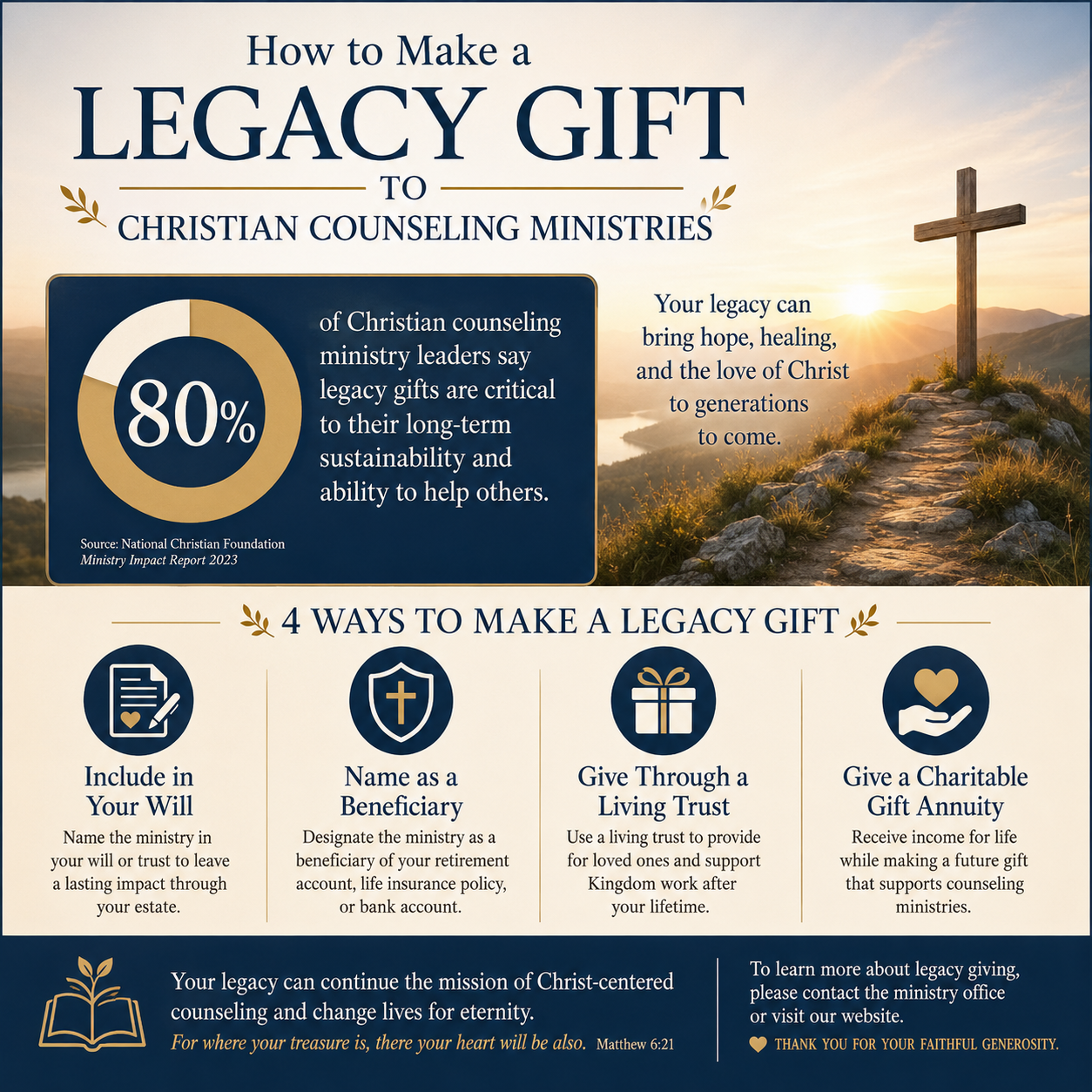
How to make a legacy gift to Christian counseling ministries is ultimately a question of stewardship over time: how our resources can continue bearing fruit for Christ’s people after our deaths. Because counseling work often happens quietly and over years, legacy giving can be one of the most fitting ways to sustain it.
Yet mature donors also recognize that planned gifts can be mishandled. Restrictions can become unworkable, leadership transitions can shift priorities, and under-governed ministries can treat an estate distribution as a blank check. A legacy gift is not merely a financial instrument; it is a moral act that joins donor intent, organizational integrity, and a ministry’s long-term faithfulness.
Why legacy giving fits Christian counseling ministries
Counseling is long obedience in the same direction
Christian counseling ministries work in the slow spaces of discipleship: relapse and repentance, estrangement and reconciliation, trauma and patient rebuilding. Donors who care about spiritual formation and emotional health often discover that annual gifts are important but not sufficient for the long horizons this work requires. A legacy gift can fund stability where instability is common—staff retention, clinical supervision, training, subsidized care for those who cannot pay, and facilities that enable privacy and safety.
Scripture’s stewardship frame is not limited to the present moment. The righteous person “leaves an inheritance to his children’s children” (Proverbs 13:22), and the Church has long understood bequests as one way to extend care beyond one’s lifetime. A legacy gift is not a substitute for daily generosity; it is a disciplined way to align accumulated assets with the Kingdom of God.
The financial reality of counseling ministries creates specific vulnerabilities
Many counseling ministries sit in an uneasy position between pastoral care and clinical service. Sliding-scale fees may be essential to access, but they can also produce chronic underfunding. Some ministries rely on a mix of donated support, program fees, and insurance reimbursement, each with administrative burdens and cash-flow volatility. For donors, this means sustainability matters: reserves, internal controls, and realistic budgeting are not distractions from ministry; they are part of loving care.
When donors have questions about where counseling ministries fit within the wider landscape of Christian service, the broader context matters. Our research across Christian Counseling Ministries reflects a consistent pattern: the healthiest organizations treat financial discipline as a spiritual responsibility, not as a concession to “business.”

Choose the right legacy gift vehicle for your situation
Start with the simplest tool that accomplishes the goal
Planned giving can become complicated quickly. Mature stewardship begins by choosing the simplest structure that clearly expresses intent and is easy for both heirs and the ministry to administer. For many donors, a basic bequest in a will or living trust is sufficient: a stated amount, a percentage of the estate, or a contingent gift if certain heirs predecease the donor.
More complex instruments—beneficiary designations, charitable remainder trusts, donor-advised funds, or gifts of appreciated assets—can be appropriate in particular tax or family circumstances. But complexity should be justified by purpose. When a legacy plan becomes difficult for executors to interpret, the risk of delay, dispute, or unintended outcomes increases.
Understand what you are actually giving
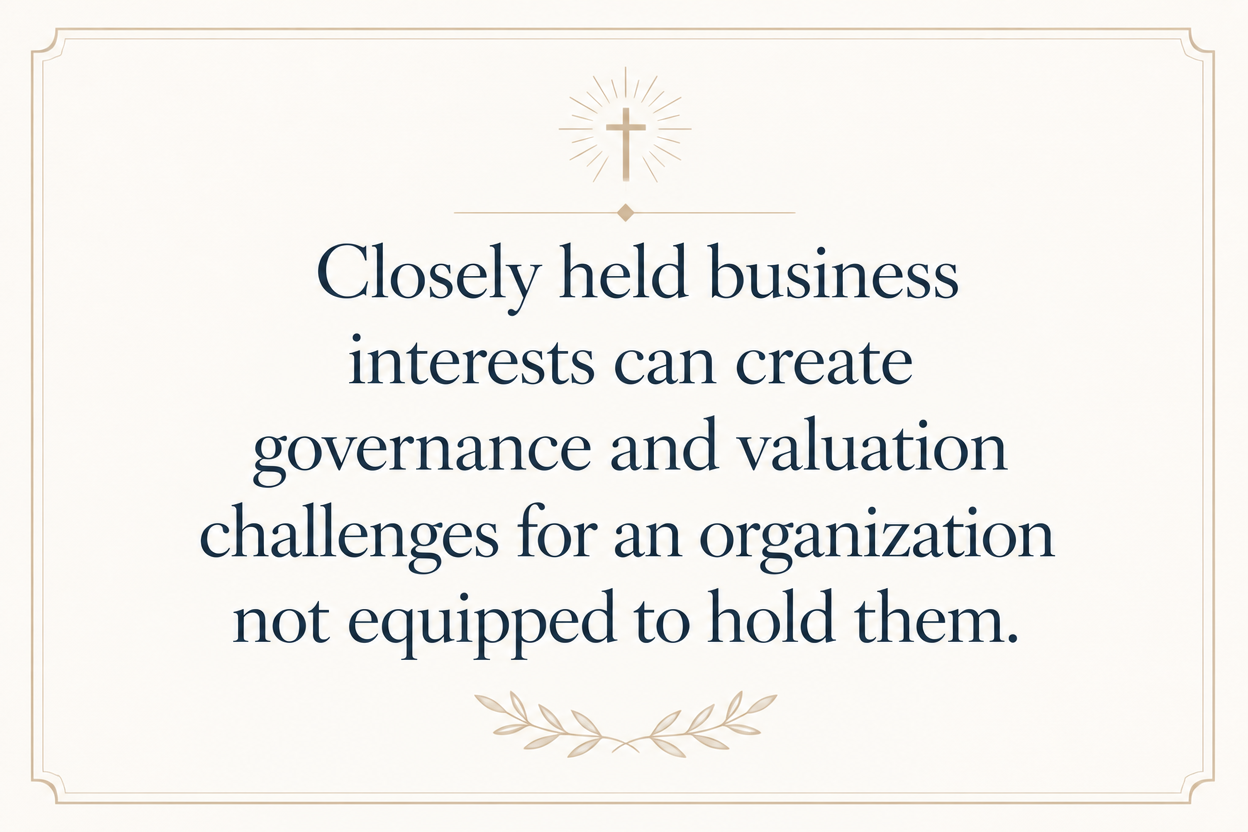
Legacy gifts often come from assets that do not feel like “cash.” Retirement accounts, life insurance policies, and brokerage accounts can pass by beneficiary designation outside the will. Real estate can be valuable but illiquid. Closely held business interests can create governance and valuation challenges for an organization not equipped to hold them.
Our team often encourages donors to ask one clarifying question early: “Will this gift be a blessing to administer, or a burden?” A ministry with modest administrative capacity may need a planned gift structured so it can be received, acknowledged, and deployed without legal risk.
- Bequest in a will or trust for clarity and simplicity
- Beneficiary designation on retirement accounts or life insurance for efficient transfer
- Gifts of appreciated securities to reduce capital gains exposure in some cases
- Real estate gifts only when the ministry has a clear policy and capacity
- Endowment-style funds when long-term stability is the explicit goal
Clarify donor intent without over-restricting the ministry
Write restrictions that can survive leadership and cultural change
Donor intent is a moral good. It is also fragile. The more narrowly a restriction is written, the more likely it becomes obsolete or infeasible—especially in counseling, where clinical standards, licensure requirements, and community needs change over time. A bequest restricted to a specific therapeutic modality, a single staff role, or a particular facility may not age well.
A wiser approach is often to restrict by mission-aligned purpose rather than by operational detail. “Subsidizing counseling for those with demonstrated financial need” is more durable than “funding ten counseling sessions for 50 clients per year.” The former preserves flexibility while guarding the spiritual aim.
Plan for accountability without turning the gift into a contested contract
Some donors hesitate to give legacy gifts because they fear loss of control after death. That fear is not irrational. It is one reason the Church has historically valued clear governance, reputable trustees, and transparent reporting.
What this means in practice is that donors should ask for the organization’s current financial statements, independent audit status, conflict-of-interest policy, and a written gift acceptance policy. Many ministries provide these readily; hesitation or improvisation is a signal to slow down. Donors can also request that the ministry acknowledge, in writing, the intended purpose and any reporting expectations (for example, annual reporting on the fund’s use).
Verify the ministry before naming it in your estate plan
Legacy giving magnifies both faithfulness and dysfunction
An estate gift can be one of the largest donations a ministry ever receives. That scale has consequences. In healthy organizations, it can accelerate mission in a measured way. In unhealthy ones, it can finance drift, entrench poor leadership, or create internal conflict over control of funds. This is why due diligence is not a lack of trust; it is a form of love for the people served and for the integrity of Christian witness.
At Most Trusted, we evaluate ministries against The Most Trusted Standard, a 15-criteria framework that examines faith foundation, financial integrity, governance and leadership, and transparency and effectiveness. The aim is not to reward polish, but to identify ministries structured for long-term faithfulness, especially when major gifts increase responsibility.
Use evidence-based questions that reveal organizational maturity
Some questions are simple but revealing. Does the ministry have an independent board with meaningful oversight? Are executive compensation and related-party transactions disclosed and governed? Is there a credible policy for safeguarding counselees, particularly minors and vulnerable adults? Does the ministry articulate how Scripture informs its counseling model, and how it relates that model to clinical standards and licensure where relevant?
Donors also benefit from resisting common misconceptions about nonprofit health. The “Overhead Myth” letter—signed by GuideStar (now Candid), Charity Navigator, and BBB Wise Giving Alliance—warned donors not to use overhead ratios as a proxy for effectiveness, urging instead a fuller view of outcomes and capacity.GuideStar on the Overhead Myth Counseling ministries, in particular, may require “overhead” that is actually direct protection: supervision, continuing education, background checks, secure records systems, and appropriate facilities.
When donors want to understand practical giving choices in this field—what to ask, what documents matter, and how to assess different models—many find it useful to reference How to Give to Christian Counseling Ministries as a directory of giving considerations and ministry types.
Work with professionals and the ministry to execute the gift well
Coordinate legal language, beneficiary forms, and ministry details
A legacy gift fails most often through mundane breakdowns: outdated beneficiary forms, inconsistent legal names, missing tax identification numbers, or unclear restrictions that an executor cannot interpret. Donors should confirm the ministry’s legal name and address, and the correct way to designate the gift in a will, trust, or beneficiary designation. Ministries accustomed to planned gifts typically provide a standard bequest language document.
Because this is an editorial publication rather than a law firm, we do not provide legal advice. But we can name the underlying principle: stewardship includes competence. A qualified estate attorney and, where relevant, a tax professional can ensure that the gift is legally effective and aligned with family responsibilities.
Consider family dynamics and discipleship, not only tax efficiency
Christians genuinely disagree about how to balance provision for heirs with significant charitable bequests, especially when family relationships are strained. Wisdom here is rarely abstract. It often involves pastoral counsel, patient conversation with adult children, and a sober assessment of whether money will bless or wound the next generation.
Research on inheritance expectations suggests the emotional stakes are high. In a 2023 survey, Pew Research Center reported that a majority of U.S. adults say leaving an inheritance is important, while views vary significantly by income and parental status.Pew Research Center Donors do not need to submit to cultural assumptions about entitlement, but they should recognize that estate decisions are interpreted through relational history. A legacy gift to counseling ministry can be an expression of love for the Church’s wounded, but it should not be made as a weapon in family conflict.
FAQs for How to make a legacy gift to Christian counseling ministries
Should we restrict a legacy gift to scholarships for counseling sessions?
Sometimes, yes—especially when the ministry serves people who would otherwise be excluded by cost. The more durable approach is to define the purpose broadly enough to remain viable: subsidized care for those with financial need, training counselors who serve underserved communities, or strengthening clinical supervision and safeguarding. Highly specific restrictions can become obsolete as staffing models, licensure rules, or community needs change.
How can we know whether a counseling ministry is spiritually faithful and clinically responsible?
Donors should examine both doctrine and practice. On the faith side, look for a clear statement of faith and an explicit account of how Scripture shapes the ministry’s counseling approach. On the practice side, review governance, safeguarding protocols, clinical supervision, and transparency in reporting. Independent verification can help, particularly when evaluating a planned gift that will outlast current leadership; at Most Trusted, The Most Trusted Standard is designed to surface these long-term indicators of integrity.
A legacy gift should strengthen the Church’s care for the suffering
Christian counseling ministries stand at a demanding intersection: the care of souls, the complexities of trauma and mental illness, and the public credibility of Christian witness. A legacy gift, made carefully, can sustain this work with humility and strength. When donors clarify intent, verify integrity, and structure the gift so it can be administered faithfully, they are not merely transferring assets—they are investing in the long mercy of God toward his people.



