

Learning how to give stock to Christian counseling ministries is often less about mechanics than about stewardship. Appreciated securities can become a disciplined way to fund faithful care for the wounded without creating unnecessary tax friction for a family trying to give wisely before the Lord.
Christian counseling is not a peripheral concern. Scripture is candid about the inner life—fear, despair, anger, shame, and the disordered desires that fracture families and churches. The Psalms give language for distress without sentimentality; the New Testament calls the church to restore the caught with gentleness (Galatians 6:1) and to bear one another’s burdens (Galatians 6:2). Many counseling ministries stand in that intersection of spiritual care and clinical competence, and donors are right to ask how to support them with rigor.
Why stock gifts often serve Christian donors well
Giving appreciated assets can reduce tax drag
For U.S. donors who itemize and who hold appreciated publicly traded stock for more than one year, giving shares directly to a qualified 501(c)(3) can allow the donor to avoid capital gains tax and generally claim a charitable deduction for fair market value, subject to IRS limits. The underlying principle is not loophole-hunting; it is stewardship—directing more of what God has entrusted to ministry rather than to avoidable taxation. The IRS outlines the treatment of charitable contributions, including gifts of property, in Publication 526.
Many Christian donors default to writing checks because it feels straightforward. Yet checks can be the least efficient way to give when a portfolio contains long-held positions with significant unrealized gains. A stock gift can convert “paper appreciation” into immediate ministry capacity.
Stock gifts can strengthen long-term generosity
Stock giving also tends to impose healthy discipline. It encourages planning, reduces impulsive fundraising reactions, and can anchor giving to a deliberate set of ministry priorities—care for marriages under strain, trauma recovery, addiction counseling, pastoral consultation, and youth mental health support. For donors who are building a sustained pattern of generosity, the habit of giving appreciated assets can be as formative as it is financially prudent.

Determining whether a counseling ministry is ready to receive stock
Not every ministry has the infrastructure
Some Christian counseling ministries are small clinics or networks with limited administrative capacity. They may not have a brokerage account, a relationship with a custodian, or internal controls that reduce risk. A stock gift requires operational readiness: clear receiving instructions, timely liquidation policy if appropriate, and reconciled gift accounting.
Across our verification work at Most Trusted, ministries that meet The Most Trusted Standard tend to treat non-cash gifts as part of their overall integrity system, not as a fundraising novelty. That includes board oversight, clear financial policies, and transparent communication with donors about how gifts are received, recorded, and used.
Verification matters because counseling carries unique sensitivities
Christian counseling ministries frequently handle confidential information, work with vulnerable populations, and operate under licensure and clinical standards. Donors are right to look for governance maturity and transparent reporting, not only compassionate messaging. The harder question is not whether counseling is needed. It is whether a specific organization can be trusted to deliver care that is both faithful and competent, while using resources responsibly.
Many donors evaluate program fruit primarily through stories. Stories have a place, but they are not a control system. In counseling especially, selective testimony can obscure inconsistent clinical quality or weak oversight. Verification is one way to honor both compassion and prudence.

The practical steps for giving stock well
Confirm the ministry’s gift acceptance pathway
Start by asking the ministry whether it can receive publicly traded securities directly. Larger ministries may provide broker-to-broker transfer instructions (often through a donor relations office). Others may use a donor-advised fund or a third-party platform. If a ministry cannot receive stock, a donor-advised fund can be a bridge: you contribute stock to the DAF and then recommend grants to the counseling ministry over time.
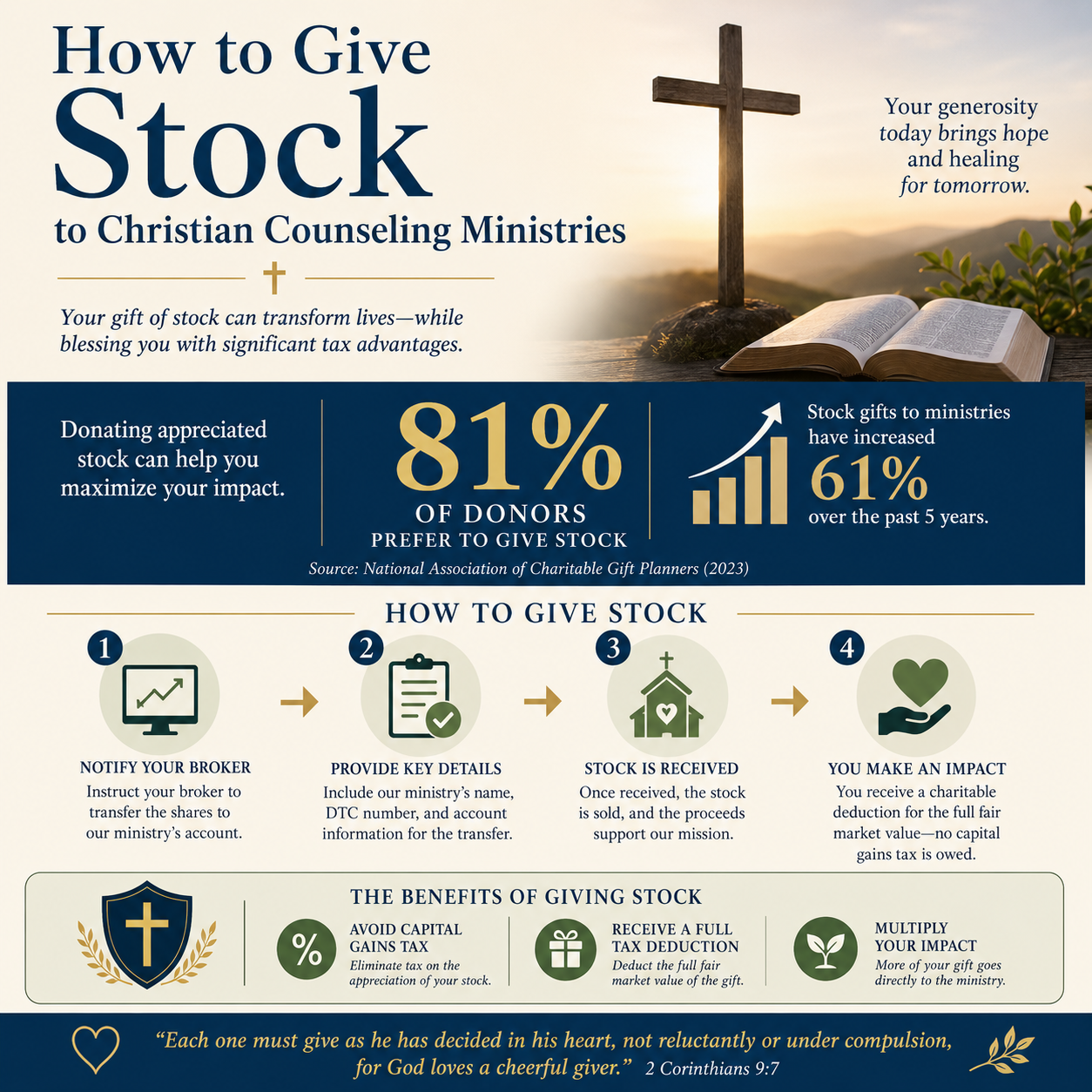
For donors comparing organizations within Christian Counseling Ministries, this first operational question is revealing. A ministry’s response often demonstrates whether financial administration is treated as ministry stewardship or as an afterthought.
Coordinate your broker, the ministry, and your tax professional
A basic stock gift has three moving parts: your brokerage firm, the receiving organization’s brokerage account, and proper documentation for your records. Many complications arise from timing and communication, not from the concept itself. We recommend coordinating in advance so the gift is transferred before year-end deadlines, and so the ministry can identify the donor and issue a contemporaneous written acknowledgment.
The IRS requires a contemporaneous written acknowledgment for any single contribution of $250 or more. The IRS explains this requirement in its guidance on charitable contributions; donors can reference the IRS charitable contribution resources at IRS Charitable Contributions.
Document the gift carefully and avoid common errors
With publicly traded securities, donors typically document the gift date based on the transfer date and value the gift using the fair market value on that date under IRS rules. For certain non-cash contributions, additional forms may apply. The IRS addresses substantiation and reporting for noncash gifts, including Form 8283 considerations, in Publication 561.
Before you initiate the transfer, confirm these basics:
- The ministry’s legal name matches its brokerage account and IRS records.
- You have written transfer instructions, including DTC number if applicable.
- The ministry knows who the gift is from and how you want it designated, if designation is allowed.
- You understand whether the ministry generally liquidates shares promptly or holds them, and why.
- You will receive a written acknowledgment that describes the property received without stating a value.
Choosing a counseling ministry worthy of appreciated assets
Faithful care requires both doctrine and competence
Christian donors often face a false dichotomy: either “biblical counseling” that rejects clinical insight, or “clinical therapy” that treats faith as optional ornamentation. The field is more complex. Some ministries are explicitly confessional and grounded in historic Christian doctrine while also employing licensed clinicians and evidence-based modalities. Others operate as referral networks, training institutes, pastoral support lines, or subsidized clinics for the under-resourced.
Christians genuinely disagree about certain counseling models and about how to integrate psychological research with theological anthropology. That disagreement does not eliminate the donor’s responsibility to ask hard questions. It clarifies it. A ministry should be able to articulate its theological commitments, its view of the human person, and its clinical accountability without resorting to slogans.
Financial integrity and governance protect vulnerable people
Appreciated stock is often a larger gift than a routine monthly contribution. Larger gifts intensify the donor’s responsibility to ensure the organization is governed well. In our work, the most trustworthy ministries tend to exhibit several observable traits: independent and engaged boards, meaningful conflict-of-interest practices, audited or review-level financials when size warrants, and transparent reporting on program scope and constraints.
Donors should also resist simplistic proxies for effectiveness. The “Overhead Myth” letter—signed by leaders at GuideStar (now Candid), Charity Navigator, and BBB Wise Giving Alliance—argues that overhead ratios alone are a poor measure of nonprofit performance. The statement is available through BBB Wise Giving Alliance at BBB Wise Giving Alliance. Counseling ministries require qualified staff, supervision, and data privacy systems; under-investing in those areas can create harm.
For donors making decisions within How to Give to Christian Counseling Ministries, we recommend treating stock gifts as an opportunity to deepen discernment. Appreciated assets are well-suited to ministries that have earned the right to receive them through transparent governance and credible evidence of faithful service.
Designations, restrictions, and the ethics of donor influence
Restricted giving can be faithful and still unwise
Many donors want to designate a stock gift for a counseling subsidy fund, a marriage intensives program, or clinician training. Designations can be appropriate when they align with the ministry’s strategy and when the ministry can track and honor the restriction without distorting its work. Yet restrictions can also unintentionally pressure leadership into sustaining programs that are popular with donors rather than those most needed by the community served.
The ethical question is not whether donors may express preferences. It is whether the preference strengthens or weakens the ministry’s ability to pursue its calling. Mature ministries will sometimes decline restricted gifts that would create long-term obligations without sustainable funding. That is often a sign of integrity, not ingratitude.
Privacy, dignity, and the limits of reporting
Donors sometimes ask for counseling “outcome stories” or detailed case data to validate impact. Christian counseling ministries must protect counselee confidentiality and dignity. Transparent reporting in this field often looks different: aggregate measures, clearly described program models, training standards, supervision ratios, and financial reporting that shows how subsidized care is funded. A ministry can be meaningfully transparent without turning people’s pain into donor content.
FAQs for How to give stock to Christian counseling ministries
Should a ministry sell the stock immediately or hold it?
Many ministries liquidate gifted securities promptly to reduce market risk and to fund ministry work predictably. Others may hold certain positions if their board has an investment policy and sufficient reserves to tolerate volatility. Donors may ask what policy governs the decision and whether it is consistently applied. A coherent policy, board oversight, and clear donor communication generally matter more than the specific choice in any one instance.
Can we give stock through a donor-advised fund if the ministry cannot receive shares?
Yes. A donor-advised fund can accept appreciated securities and then distribute grants to qualified 501(c)(3) counseling ministries. This approach can be particularly helpful when a ministry lacks brokerage capacity or when a donor wants to separate the timing of the tax deduction from the timing of grantmaking. Donors should still evaluate the receiving ministry carefully; administrative convenience does not replace discernment.
Stewardship that strengthens the church’s care
Giving stock to Christian counseling ministries can direct a larger share of God’s provision toward compassionate, competent care—especially when the gift is paired with careful evaluation of governance, financial integrity, and theological clarity. The aim is not merely efficient giving. It is faithful stewardship ordered toward restoration, so that those burdened by grief, trauma, addiction, or marital fracture encounter help that honors both truth and love.



