

How Christian counseling ministries spend donations is not an abstract accounting question for Christian donors. It is a stewardship question with spiritual and pastoral stakes: whether giving supports wise care for people made in God’s image, offered in Christ’s name, without shortcuts that wound the vulnerable or compromise the Church’s witness.
Christian counseling sits at an intersection of disciplines that do not always agree. Pastoral theology, clinical ethics, trauma science, and nonprofit finance each bring real constraints. Donors should expect complexity, but not opacity. The ministries most worthy of trust can explain, in plain language, what donations fund, what they do not fund, and how they safeguard counselees and honor the gospel.
Christian counseling is ministry and clinical care at once
Why funding counseling costs more than many donors expect
Christian counseling is often compared to church-based pastoral care, but professional counseling carries additional obligations. If a ministry employs licensed clinicians, it must budget for clinical supervision, continuing education, professional liability coverage, record systems, and compliance practices that protect confidentiality. Those expenses are not decorative. They are part of loving a neighbor well when the neighbor is disoriented by grief, trauma, addiction, or severe anxiety.
Donors sometimes feel tension here: the desire for “more ministry, less administration” can collide with the realities of ethical care. The field of psychotherapy treats confidentiality, informed consent, and competent practice as non-negotiables, and Christian ministries should not treat them as secular add-ons. Where a ministry integrates Scripture, prayer, and discipleship with clinical practice, it must also set clear boundaries so spiritual authority is never used to override a client’s agency or safety.
Free care, subsidized care, and the economics of access
Many counseling ministries exist because access is uneven. When households face mental health strain, cost is a real barrier. National survey data regularly shows that affordability is among the leading reasons people do not receive mental health treatment; for example, KFF has documented cost-related barriers and unmet need in its mental health coverage analyses (KFF). When a Christian counseling ministry uses donations to subsidize sessions, donors are often funding access for people who otherwise would not receive help.
What this means in practice is that donors should ask whether the ministry is clear about its care model. Is it primarily a scholarship fund for counseling sessions? A clinic that bills insurance? A training institute that equips churches? A hybrid model can be faithful, but donors should understand what donations actually do in that hybrid.

Where donations commonly go in healthy counseling ministries
Direct care and clinical infrastructure
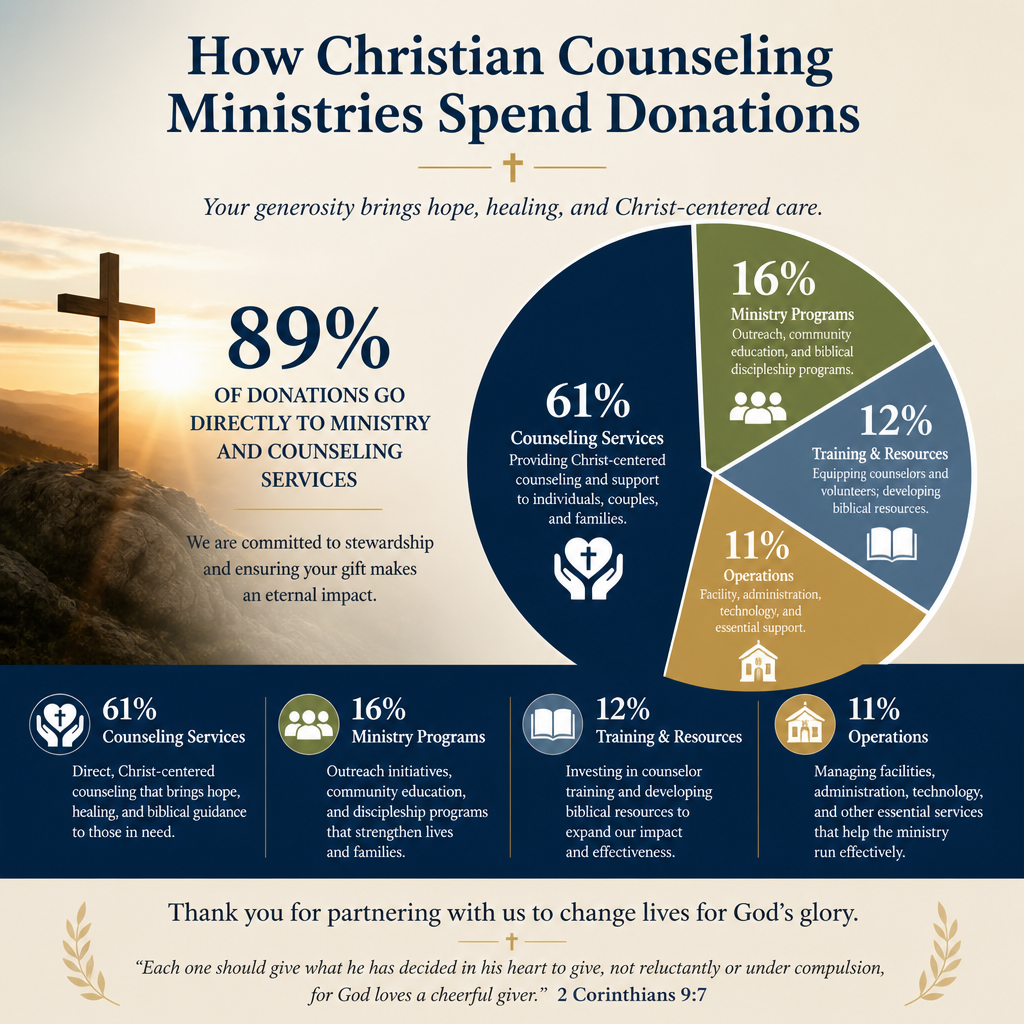
Christian counseling ministries that handle donations responsibly tend to spend them in a small number of predictable categories. The categories are not identical across ministries, but the logic is similar: fund competent people, protect clients, and sustain access. “Counseling ministry” is not simply time in a room; it is the full set of systems that make that time safe and effective.
- Client care subsidies for reduced-fee sessions, crisis scholarships, or short-term care for those in acute need
- Clinician compensation that reflects credentialing, supervision requirements, and local labor markets
- Training and supervision for interns, residents, and staff development, including clinical oversight
- Confidential record and scheduling systems designed for clinical privacy and continuity of care
- Care coordination including referral networks for psychiatry, inpatient care, domestic violence resources, or legal support
Donors sometimes ask whether these items count as “ministry” or “overhead.” The question is understandable but can be misframed. The nonprofit sector has repeatedly cautioned donors against treating overhead ratios as a proxy for trustworthiness. In 2013, Charity Navigator, GuideStar, and the BBB Wise Giving Alliance jointly warned that pressuring nonprofits to minimize overhead can undermine effectiveness (Charity Navigator).
Spiritual integration with appropriate guardrails
Some donations support explicitly Christian elements: pastoral partnerships, biblically grounded resources, and training that helps counselors work with spiritual trauma, repentance and forgiveness, and the complexities of suffering. Funding spiritual integration can be faithful when it is done with humility and boundaries. It becomes problematic when a ministry substitutes spiritual language for clinical care, or when counseling becomes a vehicle for coercive discipleship rather than a setting for truth, compassion, and responsible help.
Across our verification work at Most Trusted, we find that the strongest ministries can articulate their integration model without marketing gloss. They can explain what happens in a typical session, what a counselee can expect, and what the ministry will not do. That clarity is part of honoring the dignity of the person seeking help.
Financial transparency is necessary but not sufficient
What donors can and cannot learn from a Form 990
For ministries that file a Form 990, donors can often see broad spending categories, key compensation, related-party transactions, and governance disclosures. Those documents matter, but they do not answer every question a careful donor will have. For example, the line between “program” and “support” expenses can be interpreted differently across organizations. A counseling ministry might classify clinical record systems as program expense because they directly enable care. Another might classify them as administration. Donors should read categories, but not treat them as self-interpreting.
Many explicitly religious organizations are not required to file a Form 990, depending on their structure. That does not make them untrustworthy, but it does increase the responsibility to provide voluntary transparency. Ministries that welcome scrutiny generally provide audited financial statements or at least independently reviewed statements, clear annual reports, and plain explanations of what donations fund.
What meaningful transparency looks like in counseling work
Counseling adds a particular challenge: client confidentiality limits what can be disclosed about outcomes, stories, and case mix. Sophisticated donors should expect fewer dramatic narratives and more careful reporting. A credible ministry will report what it can without exploiting counselees: number of clients served, scholarship dollars granted, counselor credentials, wait times, referral partnerships, and safeguards for high-risk situations.
Transparency also includes naming constraints. If a ministry has a waitlist because it cannot recruit enough licensed clinicians, it should say so. If it relies heavily on interns for low-cost care, it should explain supervision. Candor signals maturity.
Governance and ethics shape how donations are experienced by counselees
Safeguarding, confidentiality, and power dynamics
Donations are not only spent; they are embodied in structures that can protect or expose the vulnerable. Counseling is a setting of asymmetrical power, and Christian language can intensify that asymmetry when misused. Healthy ministries establish policies for mandatory reporting, crisis response, record retention, conflicts of interest, and spiritual boundaries. They train staff to recognize domestic violence dynamics, suicidal risk, and coercive control, and they maintain referral pathways for care beyond their competence.
Donors should not assume that a warm mission statement implies strong safeguards. They should ask about written policies, training cadence, and accountability mechanisms. When a ministry is truly committed to holiness and justice, it will welcome structures that restrain the misuse of authority.
Board oversight and leadership accountability
Governance is where trust becomes durable. A board that is independent, engaged, and financially literate reduces the risk of moral and financial drift. In counseling ministries, board competence should include at least some familiarity with clinical ethics, data privacy, and risk management. It should also include an ability to ask hard questions about fundraising claims, outcomes reporting, and the use of restricted gifts.
For donors evaluating the broader landscape, the parent topic Christian Counseling Ministries can be a useful reference point for the kinds of standards and safeguards that distinguish mature work from aspirational branding.
How we assess counseling ministries at Most Trusted
Verification that respects both faith and evidence
Most Trusted exists because Christian donors rightly want more than assurances. We evaluate ministries against The Most Trusted Standard, a 15-criteria framework that examines faith commitments, financial integrity, governance practices, and public transparency about results and limitations. For counseling ministries, we pay particular attention to how clinical care is governed, how safety is handled, and whether the ministry’s claims match what documentation can sustain.
Verification is not cynicism. It is a form of neighbor love applied to stewardship. When donors give into settings where people are psychologically fragile, due diligence becomes part of moral responsibility.
Questions that reveal whether donations are being spent well
Christian donors do not need to become clinical administrators, but a few questions can quickly clarify whether a ministry is prepared for the work it claims to do:
Ask about care access: How are subsidies allocated, and who qualifies? Are scholarships used for short-term stabilization or longer-term care? What happens when funds run out mid-care plan?
Ask about staffing: Who is licensed? Who is supervised? How does the ministry prevent burnout, given the emotional load of counseling work?
Ask about confidentiality: What systems store records, and who has access? What is the policy for church leaders requesting information?
Ask about referral boundaries: What cases are outside the ministry’s competence, and where are those counselees referred?
Ask about reporting: What does the ministry report publicly that is specific, measurable, and honest about limitations?
Donors who want to evaluate ministries through the lens of spending categories and accountability practices can also consult How Christian Counseling Ministries Use Donations for further context on what responsible allocation and reporting tend to include.
FAQs for How Christian counseling ministries spend donations
Do donations mainly pay for counseling sessions, or for administration?
In many ministries, donations directly subsidize counseling sessions for clients who cannot afford full fees. They also often fund the clinical infrastructure that makes care ethical and sustainable: supervision, training, secure record systems, and compliance practices. Treating these costs as merely “administration” can be misleading, because they are part of what protects counselees and maintains competent care. The more important question is whether the ministry can explain its spending clearly and document that spending with credible reporting.
Should Christian donors avoid counseling ministries with higher overhead?
Not automatically. The sector has warned for years that overhead ratios are a poor proxy for effectiveness, and that pressuring nonprofits to minimize overhead can create underinvestment in systems that protect beneficiaries and improve outcomes (Charity Navigator). In counseling ministries, certain “overhead” categories—privacy safeguards, supervision, and risk management—can be directly tied to client safety. Donors should focus on transparency, governance, ethical practice, and whether reported outcomes and access claims match what the ministry can support with evidence.
A stewardship question with pastoral consequences
Christian counseling ministries handle sacred trust: human suffering brought into the light, often with fragile hope. Donations that underwrite competent care, careful boundaries, and honest reporting can become instruments of mercy. Donations given without discernment can unintentionally fund confusion, harm, or institutional self-protection. Christian donors honor Christ when they give with compassion and with clear-eyed accountability, seeking ministries that can show—without defensiveness—how their spending serves people and advances faithful care.



