

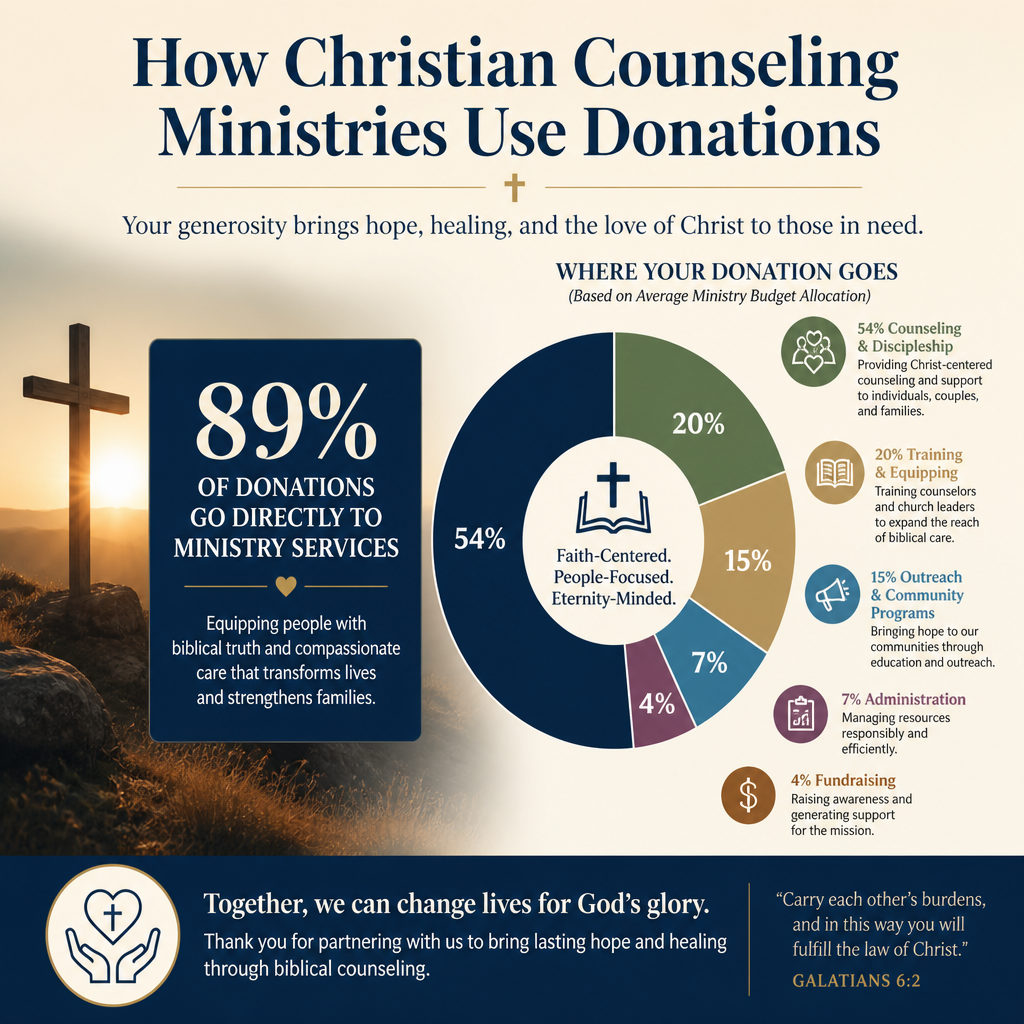
How Christian counseling ministries use donations is not a peripheral question for Christian donors. It sits at the intersection of pastoral care, clinical responsibility, and Christian stewardship, where good intentions are not enough and financial habits can either protect or compromise the ministry’s witness.
The central tension is simple to name and difficult to execute: counseling is labor-intensive, confidentiality constrains storytelling, and many of the people who need care most cannot pay market rates. Donors are often asked to fund what cannot be easily photographed, toured, or measured without violating the trust that makes counseling possible.
Donations underwrite access to care that fee revenue cannot cover
Most Christian counseling ministries operate with a mixed-income model. Fees from clients cover a portion of costs, but donations often cover the gap between what responsible care requires and what clients can afford, especially when a ministry serves those facing trauma, marital crisis, addiction, abuse, or severe anxiety and depression.
In practice, donor funding typically supports access in three ways: reducing the per-session price through a sliding scale, subsidizing longer treatment for complex cases, and covering care for clients who cannot pay at all. This is not merely a financial choice; it is a theological one. Scripture assumes that the community of faith bears one another’s burdens, including burdens that have a financial dimension (Galatians 6:2).
Sliding scale care and scholarship funds
Many ministries establish a counseling assistance fund to subsidize sessions for clients who are underinsured, uninsured, or facing acute hardship. The ethical question for donors is not whether financial assistance exists, but whether the ministry administers it with clear criteria and appropriate documentation, rather than ad hoc decisions that drift into favoritism or quiet coercion.
In a healthcare environment where counseling is commonly paid out-of-pocket, donor-funded subsidies materially change who can receive help. Out-of-pocket spending remains a meaningful share of mental health costs in the United States, particularly where coverage is limited or providers are out of network; the KFF regularly documents these affordability pressures and insurance constraints.
Care that takes time rather than quick fixes
Christian donors often prefer to fund a “breakthrough” moment. Responsible counseling ministries, however, are built around steady, competent care that may require months rather than weeks. Donations allow a ministry to resist the temptation to promise quick outcomes in order to raise funds. This matters because the clinical literature is clear that therapeutic work often depends on continuity and the strength of the therapeutic alliance over time; the American Psychological Association summarizes this evidence and its implications for practice.
Serving the church without turning pastors into case managers
Many counseling ministries function as an extension of local churches, receiving referrals from pastors and lay leaders. Donations frequently cover consultation time with pastors, referral triage, and coordination with other services. When done well, this protects pastors from being pressured into clinical roles they are not trained to hold, and it protects counselees from being handled primarily as “discipleship problems” when professional mental health care is appropriate.

Donations pay for professional capacity, not only counseling hours
Christian donors sometimes focus on the counseling session itself as the unit of ministry. But the true cost of competent counseling includes what donors do not see: supervision, compliance, recordkeeping, continuing education, policies that protect the vulnerable, and leadership that can sustain a ministry through crisis without cutting ethical corners.
What this means in practice is that an effective Christian counseling ministry will spend donor dollars on infrastructure that is not glamorous but is morally weighty. In counseling, “overhead” is often where safeguarding lives.
Clinical supervision and quality control
Where counselors are in training, or where the ministry employs clinicians across multiple specialties, supervision is not optional. Donations may fund senior clinicians who review cases, ensure ethical practice, and provide structured oversight. Donors should not be suspicious of this line item; they should ask whether the ministry can explain how it protects clients from incompetent or unsupervised care.
Training in trauma care and ethical boundaries
Many ministries invest in staff development: trauma-informed care, suicide risk assessment protocols, mandated reporting requirements, and appropriate integration of spiritual practices. Donors should look for evidence that the ministry is not improvising its ethical framework. The question is not whether the ministry is “biblical” in aspiration, but whether its clinicians are competent to serve complex needs without spiritualizing mental illness or ignoring the limits of their training.
Technology, security, and privacy obligations
Counseling ministries handle highly sensitive information. Donations often fund HIPAA-aware systems, secure telehealth tools, and staff training in confidentiality. Christian donors may understandably prioritize direct service, but ministries that treat privacy lightly eventually harm people and discredit the gospel they claim to honor. A ministry should be able to describe, in plain language, how it secures records and restricts access.
Unrestricted donations often determine whether a ministry can act responsibly
Christians genuinely disagree about unrestricted giving. Some donors fear that flexible dollars reduce accountability; others recognize that restrictions can force ministries into distorted budgeting. In counseling ministries, unrestricted support is often what allows leaders to make the least dramatic but most faithful decisions: keeping caseloads at sustainable levels, funding supervision, and maintaining emergency reserves.
The harder question is whether a ministry has the governance maturity to handle unrestricted funds with discipline. That maturity shows up in budgeting practices, internal controls, board oversight, and candor about what donor dollars can and cannot accomplish.
The real cost of retaining competent counselors
Counselor retention is not merely an HR issue. High turnover can destabilize care and harm clients who have already learned that relationships are unreliable. Donations may support competitive compensation, benefits, and manageable caseloads so counselors are not pushed into burnout. The broader mental health workforce has documented staffing pressures, including shortages in key segments; the HRSA Behavioral Health Workforce resources summarize the scope and drivers of these constraints.
Reserves and the moral problem of crisis-driven finance
Some Christian ministries drift into what nonprofit researchers have described as a “starvation cycle,” where organizations underinvest in the capacities that produce long-term effectiveness because donors reward low overhead. This dynamic has been analyzed in Stanford Social Innovation Review by Ann Goggins Gregory and Don Howard in “The Nonprofit Starvation Cycle” (Stanford Social Innovation Review). Counseling ministries are especially vulnerable because their most important outputs cannot be marketed without violating confidentiality.
Unrestricted donations can help a counseling ministry maintain reserves, absorb seasonal fluctuations, and respond to community crises without compromising standards. Donors should ask whether leadership has a board-approved reserve policy and whether the ministry can explain its rationale in terms of stewardship rather than fear.
When restricted gifts unintentionally distort ministry priorities
Restricted giving can be a gift when it aligns with a clear plan. But restrictions can also push a counseling ministry toward donor-preferred programs that are easier to describe than to execute well. For example, a donor may want funds for “marriage counseling scholarships” while the ministry’s greatest need is clinical supervision, a receptionist who can handle crisis calls safely, or subsidized care for individuals with acute trauma histories.
Wise donors often ask a more disciplined question: “What would responsible care require if no one were watching?” That question tends to surface needs that are less inspiring to fund but more consequential for clients.
Transparent reporting should honor both stewardship and confidentiality
Christian donors rightly expect clarity about how funds are used. Counseling ministries face a distinct constraint: they cannot demonstrate impact by publishing client stories or detailed case outcomes the way other ministries might. A mature ministry does not hide behind confidentiality as an excuse for vagueness, and it does not violate confidentiality to satisfy donor curiosity.
Healthy reporting typically includes audited or reviewed financials where feasible, clear functional expense reporting, program descriptions tied to budgets, and outcome indicators that do not expose client identities. Donors should look for honesty about limits: counseling outcomes are difficult to measure, and simplistic metrics can incentivize rushed care.
What credible financial transparency looks like
At a minimum, donors should be able to find current governing documents, a recent Form 990 for U.S. nonprofits, a clear description of how the board oversees finances, and a plain explanation of how counseling assistance is administered. Where audited financial statements are available, they should be accessible without friction.
The question is not whether the ministry has perfect numbers. It is whether the ministry demonstrates habits of truthfulness: reporting that is consistent over time, explanations that match the financial statements, and leadership that is willing to answer hard questions without defensiveness.
Effectiveness without marketing theater
Counseling ministries can report outcomes in ways that respect privacy: aggregated client-reported symptom measures, attendance and completion rates, wait times, referral sources, and follow-up engagement with church communities. The research is mixed on which measures best capture long-term spiritual and emotional health, and ministries should acknowledge that complexity rather than claiming more certainty than the data allows.
Donors should also beware of ministries that promise transformation in ways that imply guaranteed results. Scripture is clear that God changes hearts, and yet human care remains partial and often slow. Responsible ministries speak with humility about outcomes while maintaining rigorous stewardship in how they pursue them.
How Most Trusted evaluates counseling ministries
Across our verification work at Most Trusted, we find that the counseling ministries that meet The Most Trusted Standard tend to combine clinical seriousness with theological clarity. They can explain how faith shapes their anthropology, ethics, and pastoral commitments, while also demonstrating financial integrity, governance strength, and public transparency appropriate to the work.
Donors who want broader context on this sector can consult Christian Counseling Ministries for the patterns we see across organizations and the questions that consistently separate admirable intent from verifiable trustworthiness.
Giving that strengthens both care and witness
How Christian counseling ministries use donations ultimately reveals what a ministry believes counseling is for: reputational uplift, organizational growth, or faithful service to wounded neighbors in the name of Christ. Donors serve the church well when they fund access for those who cannot pay, the professional capacities that keep counseling safe, and the uncelebrated disciplines of governance and reporting.
The most credible ministries do not treat donor trust as a fundraising asset. They treat it as a moral responsibility, because the people seeking help are not projects. They are image-bearers. And financial stewardship, in Scripture’s frame, is one of the ordinary places where faithfulness becomes visible.



