

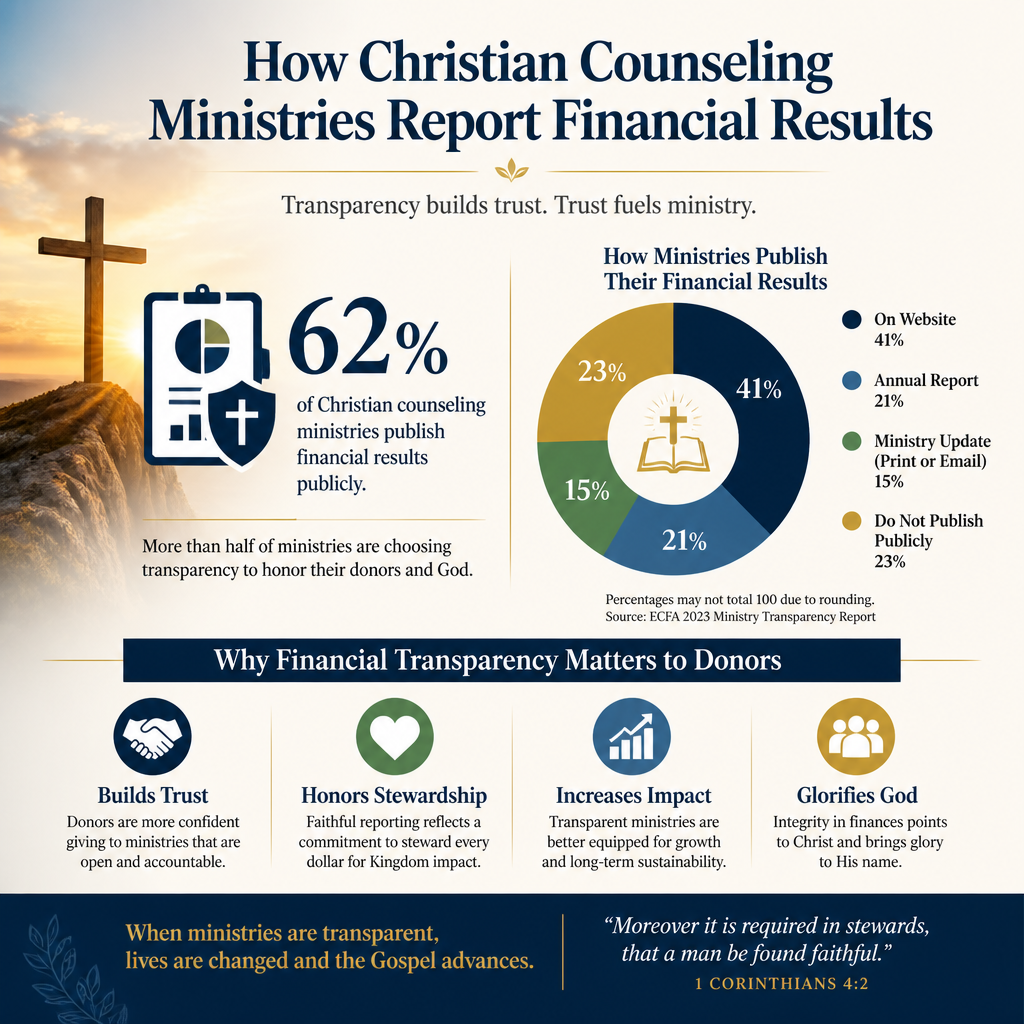
How Christian counseling ministries report financial results is not a technical afterthought; it is a spiritual and fiduciary question. Donors are not merely purchasing services. We are entrusting resources to ministries that bear Christ’s name, serve vulnerable people, and must therefore walk in the light with unusual care.
Financial reporting will never capture the full moral reality of a counseling ministry. A set of audited statements cannot tell the story of repentance, reconciliation, sobriety, or restored marriages. But reporting can show whether a ministry treats money as a sacred trust, whether leadership welcomes scrutiny, and whether donors can trace gifts to the work they intended to support.
Financial reporting as Christian witness
Stewardship is not optional
Scripture treats stewardship as a matter of discipleship, not merely competence. Jesus’ parable of the talents assumes that servants will give an account, and that faithful management is part of faithfulness itself. Christian counseling ministries operate in a field where the harms of mismanagement fall on people already carrying heavy burdens. When a ministry handles funds carelessly, it is not only donors who are disappointed; counselees and staff can be destabilized, and public trust in Christian ministry is damaged.
What this means in practice is that ministries should report results in ways that invite accountability rather than deflect it. “Trust us” is not a reporting standard. A ministry can be doctrinally sound and missionally earnest while still being financially opaque, and mature donors should not treat opacity as a minor flaw.
Confidentiality does not excuse opacity
Counseling ministries rightly guard personal information. HIPAA obligations for covered entities, professional ethics, and pastoral wisdom all press toward discretion. But protecting counselee privacy is not the same thing as withholding basic financial clarity. A ministry can preserve confidentiality while still disclosing what it costs to operate programs, how leaders are compensated, how reserves are managed, and what outcomes are being measured.

Which financial documents donors should expect
The baseline is public accountability where it is required
For US nonprofits, the Form 990 is often the starting point. It is not perfect, but it is standardized, comparable, and legally consequential. It discloses revenue sources, major expenses, governance practices, and key compensation. Donors should also know that the IRS requires most tax-exempt organizations to make their Form 990 available for public inspection. That expectation is not a burden imposed by hostile outsiders; it is a reasonable protection for the public and for faithful givers. The requirement is described by the IRS in its guidance on public disclosure for exempt organizations: IRS.
Some counseling ministries operate within churches or denominational structures that are not required to file a Form 990. That legal reality changes what can be accessed, but it does not change what donors should prudently request. When a ministry is exempt from a disclosure rule, it is often wise for leadership to voluntarily provide equivalent clarity.
Audit, review, or compilation matters
Not every ministry needs a full audit every year. But donors should understand the difference between levels of assurance. An independent audit provides the highest level of assurance and includes internal control testing. A review offers limited assurance. A compilation provides essentially none. When ministries say “financials available upon request,” mature donors can ask a precise follow-up: “Are these audited financial statements, reviewed statements, or internal reports?”
As donors, we should also resist simplistic moralizing about administrative costs. The widely endorsed “Overhead Myth” letter—signed by Charity Navigator, GuideStar, and the BBB Wise Giving Alliance—warns against evaluating nonprofits primarily by overhead ratios. The signatories make a direct case that overhead can reflect necessary investment in infrastructure and accountability: Charity Navigator.
How strong ministries present results without hiding trade-offs
Program reporting that connects spending to ministry activity
Counseling ministries have legitimate complexity: subsidized counseling, sliding-scale fees, scholarship funds, church partnerships, staff supervision, and continuing education. Transparent reporting does not flatten that complexity; it names it. The stronger reports typically clarify:
- How much counseling is subsidized by donations versus covered by fees
- How scholarships are awarded and what restrictions apply to restricted gifts
- What share of counseling is delivered by licensed clinicians, supervised interns, or trained lay counselors
- How the ministry accounts for group counseling, workshops, and training events
- What costs are allocated to care delivery versus fundraising and administration, and why
Donors sometimes assume a counseling ministry should look like a local church budget: mostly people and direct care. Yet counseling requires clinical supervision, record-keeping systems, legal compliance, and ethical safeguards. These are not distractions from ministry; they are often part of loving our neighbor with prudence.
Outcome language that avoids both hype and cynicism
The hardest question is how a counseling ministry should report “results” in a way that is honest and theologically literate. Scripture does not reduce spiritual formation to metrics. At the same time, refusing any measurement can become a way to avoid accountability.
More credible ministries tend to report a mix of outputs and outcomes, with clear definitions and appropriate humility. Outputs might include sessions delivered, waitlist times, and scholarships funded. Outcomes might include standardized client-reported measures when clinically appropriate, retention rates in multi-session programs, or follow-up surveys that assess perceived spiritual and relational growth. The field has had to reckon with the fact that mental health improvement is often nonlinear, and relapse is a reality in trauma recovery and addiction work. Reporting should reflect that moral seriousness rather than presenting ministry as a simple transaction.
What donors should look for in revenue, reserves, and restrictions
Revenue concentration and the risk of instability
Christian counseling ministries are often financially fragile. Many depend on a limited number of large donors, a small set of church sponsors, or seasonal fundraising cycles. That is not inherently unfaithful, but it does create risk. When revenue is concentrated, a single loss can force staff layoffs, program closures, or abrupt fee increases that harm counselees.
Prudent reporting makes concentration visible. It may disclose whether a ministry has diversified giving, whether fees cover a stable portion of costs, and whether the organization has a plan for downturns. Ministries that publish these realities are not signaling weakness; they are demonstrating seriousness about continuity of care.
Restricted gifts and the moral obligation to honor donor intent
In counseling ministry, restricted gifts are common: donors fund counseling scholarships, a specific campus, a training initiative, or a particular people group. Accounting standards require restricted net assets to be tracked and released when the purpose is fulfilled, and strong ministries explain this clearly in their statements and annual reporting.
Donors should be alert to vague language about “designated” gifts that are not truly restricted, or to perpetual fundraising for a restricted purpose without transparent reporting on how those funds were used. Honoring donor intent is not merely a legal concern; it is a matter of truth-telling.
How Most Trusted evaluates reporting under The Most Trusted Standard
Verification focuses on evidence, not reassurance
Most Trusted exists to help Christian donors give with confidence. Across our verification work, we find that donors are often asked to carry emotional weight without being offered verifiable evidence. Under The Most Trusted Standard, we examine whether a ministry’s reporting and governance practices are consistent with Christian integrity and with basic nonprofit accountability. We do not assume that visibility equals virtue, but we do treat voluntary transparency as a meaningful indicator of organizational maturity.
Donors evaluating counseling ministries will often benefit from keeping the full field in view. For a broader view of what distinguishes trustworthy organizations in this space, see Christian Counseling Ministries.
Transparency is not merely disclosure but intelligibility
Many ministries publish documents that are technically “available” yet practically unusable: scanned PDFs without context, financial statements without narrative explanation, or annual reports that are more promotional than informative. The ministries that meet The Most Trusted Standard tend to make reporting intelligible. They explain how decisions are made, what trade-offs were faced, and what changed from the prior year.
This is particularly important in counseling ministries because donors often care about both compassion and competence. Donors want to know that the ministry serves people gently, and that it can sustain the work without recurring emergencies. For donors who want to understand giving categories and common expense patterns in this sector, How Christian Counseling Ministries Use Donations provides additional context.
FAQs for How Christian counseling ministries report financial results
Should a Christian counseling ministry publish audited financial statements?
Not every ministry has the budget or complexity that warrants a full audit annually, but donors are right to ask what level of independent assurance exists. If a ministry is large, multi-site, or handling substantial restricted funds and scholarships, audited financial statements are often a prudent expectation. At minimum, clear internally prepared financials, a board-approved budget, and timely Form 990 access where applicable are basic signals of accountability.
Is a low overhead ratio a sign of faithfulness for counseling ministries?
Not necessarily. Counseling requires qualified staffing, clinical supervision, compliance systems, and careful record-keeping. Underinvesting in these areas can create ethical and legal risk that harms counselees. The signers of the “Overhead Myth” letter argue that overhead ratios alone are a poor measure of nonprofit performance and can incentivize damaging underinvestment: Charity Navigator.
Giving with clarity and peace
Christian counseling ministries serve people at the edge of endurance. Donors are right to seek compassion in the work, and just as right to seek candor in reporting. When ministries report financial results with precision, context, and humility, they honor the trust of donors and the dignity of those they serve, and they strengthen the credibility of Christian witness in a skeptical public square.



