

Evaluating Christian counseling ministry success stories is not a matter of deciding whether a testimony sounds sincere. It is the harder work of discerning whether a story reflects faithful care, truthful claims, and outcomes consistent with both Scripture and responsible practice.
Christian donors often give because they believe the gospel speaks to the whole person. Yet counseling ministries sit at an ethical edge: real people, real trauma, real privacy concerns, and real spiritual language that can be used carefully or carelessly. The question is not whether God can redeem; it is whether a ministry is representing its work in a way that honors the counselee, tells the truth, and deserves the church’s trust.
Start by clarifying what a success story is allowed to claim
Testimony is not the same as evidence
A success story in a counseling context is usually a narrative of change: a marriage stabilized, a panic cycle interrupted, a compulsive pattern weakened, a survivor re-engaging life, a family learning new ways of relating. These stories can be true and still be incomplete. They can also be presented in ways that imply more than they can responsibly prove.
Scripture treats speech as a moral act. “Therefore, having put away falsehood, let each one of you speak the truth with his neighbor” (Ephesians 4:25). For donors, this raises a straightforward evaluative question: does the ministry’s story communicate what happened without implying guarantees, universal outcomes, or simplistic causation?
We recommend donors listen for the difference between “this person experienced meaningful change through counseling” and “this program fixes people.” The former can be honest. The latter often becomes spiritualized marketing. Christian counseling is discipleship-adjacent work, but it is not sanctification on demand.
Know what the story leaves unsaid
The most persuasive stories often omit the difficult parts: relapse, long timelines, medication decisions, additional referrals, marital separation, or a counselee choosing to stop. None of those are moral failures; they are common realities in care. But a ministry that never acknowledges the ordinary complexity of counseling is likely managing impressions rather than reporting truth.
What this means in practice is asking: Does the ministry ever describe partial improvement, ongoing maintenance, or the limits of what their model can address? Mature organizations do not fear honest boundaries. They view boundaries as an expression of love.

Examine ethical integrity in how stories are gathered and published
Consent and privacy are not optional in Christian care
Christian counseling involves power imbalances, heightened vulnerability, and often spiritual authority dynamics. That makes the ethics of storytelling particularly weighty. Donors should expect a ministry to handle stories with restraint: informed consent, anonymity where appropriate, and an explicit avoidance of details that could re-identify a person in a church or community.
Even when a counselee volunteers a story, good practice considers whether the person is in a position to assess long-term consequences. A ministry that treats testimonial content as fundraising assets may still be “effective” in raising support, but it has likely drifted from shepherding toward extraction.
Across our verification work at Most Trusted, ministries that meet The Most Trusted Standard tend to document policies that govern confidentiality, communications, and the public use of client stories. These are not bureaucratic hurdles; they are safeguards for image-bearers.
Watch for spiritual coercion in narrative framing
Christians genuinely disagree about the language of “deliverance,” the role of clinical diagnoses, and how to integrate prayer, Scripture, and evidence-based practice. Those disagreements do not automatically disqualify a ministry. What does matter is whether the story frames counselees in ways that pressure them to perform a particular kind of “victory” to be considered faithful.
Donors can ask a simple diagnostic question: does the story honor the person’s agency and complexity, or does it reduce them to a cautionary tale and a tidy turnaround? Where ministries treat suffering as a branding opportunity, they frequently also mishandle the people who suffer.
Look for outcome indicators that match counseling realities
Responsible measures are modest and specific
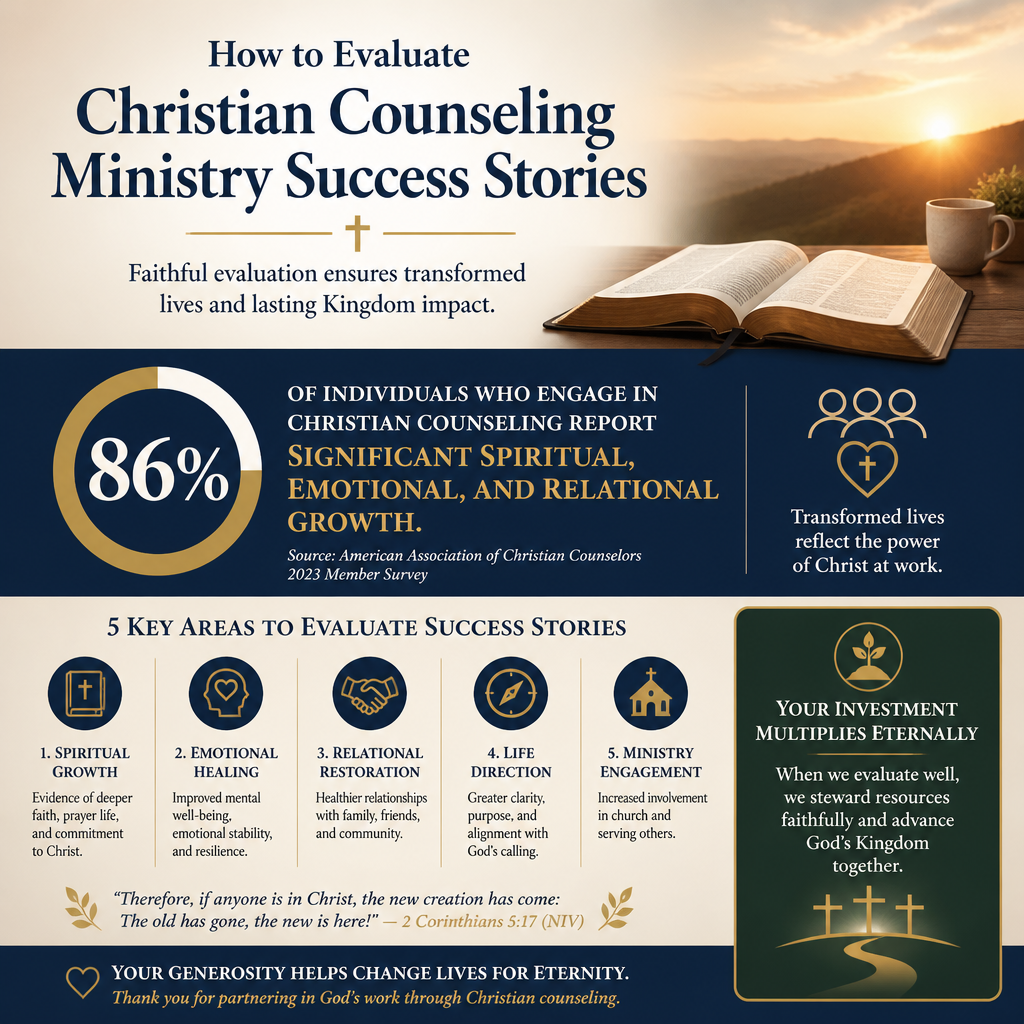
Many counseling outcomes are not best captured by dramatic before-and-after language. Healthier indicators are often concrete and incremental: improved functioning at work, fewer panic attacks, reduced conflict intensity, increased safety planning, consistent church participation without coercion, or stabilized family routines. When ministries talk about outcomes this way, donors are often hearing the voice of practice rather than promotion.
The American Psychological Association describes psychotherapy outcome research as showing that “the average person who receives psychotherapy is better off than 75% of persons who do not” (American Psychological Association). That kind of broad finding does not validate any particular ministry’s claims, but it does reinforce a key donor principle: the most credible organizations do not need extravagant promises; they need clear, bounded claims tied to how counseling typically works.
We also recommend attention to time horizons. A counseling relationship can produce early relief, but durable change often requires sustained practice and support. Ministries that imply quick transformation for every participant are misrepresenting the nature of care.
Evidence should fit the ministry model and population
A trauma-informed counseling ministry should not evaluate itself the same way a pastoral care hotline does. A marriage intensives program should not report success the same way a long-term counseling clinic does. The harder question is whether the ministry’s reporting matches its model, and whether it distinguishes between outputs and outcomes.
Outputs include sessions provided, scholarships awarded, churches trained, or referrals made. Outcomes include changes in symptoms, functioning, safety, and relational health. Both matter, but they are not interchangeable.
When donors want a deeper view of how ministries think about evidence, it can be helpful to read across the wider field of How Christian Counseling Ministries Measure Impact and compare how different organizations define and substantiate success.
Test stories for theological clarity and pastoral wisdom
Success should not be defined as the absence of suffering
Some Christian counseling stories subtly redefine success as a pain-free life: anxiety gone, marriage effortless, grief resolved, temptation eliminated. That is not the Bible’s definition of faithfulness. Scripture is candid about ongoing weakness, slow growth, and the endurance of hardship. Paul’s language about weakness and sufficiency of grace is not a fundraising problem; it is Christian realism.
Donors should listen for whether a ministry can speak about sanctification without triumphalism. Does it describe growth in obedience, humility, reconciliation, and truth-telling? Does it acknowledge that certain scars remain, and that healing can include learning to live faithfully with ongoing limitations?
Integrating clinical care and spiritual care requires competence
The field has had to reckon with failures on both extremes: ministries that use only clinical language and treat faith as ornamental, and ministries that treat complex mental health conditions as merely spiritual deficiencies. Wise integration requires trained supervision, appropriate referral relationships, and theological clarity about what counseling can and cannot do.
When donors evaluate a success story, they should ask what the ministry did with risk. Did it have protocols for suicidality, domestic violence, or abuse disclosure? Did it refer out when a case exceeded competence? A “successful” story that omits the ministry’s approach to safety is a partial picture at best.
Assess organizational credibility and accountability behind the stories
Patterns matter more than a single compelling narrative
One moving story can be true and still be unrepresentative. Donors are stewards, not merely listeners. We recommend looking for patterns: repeated examples across different contexts, consistent definitions of success, and a willingness to report challenges. A ministry that only publishes peak outcomes may be selecting for persuasion rather than transparency.
A practical way to evaluate patterns is to ask for aggregate reporting that does not compromise privacy. For example: retention rates, completion rates for a program, client satisfaction summaries, referral follow-through, or pre-post change on an appropriate measure. None of these is perfect. Together, they can signal whether stories reflect a broader reality.
Use verification frameworks to reduce blind spots
Donors often carry a quiet burden: the fear of giving to a ministry with sincere people and unsound practices. Independent verification can reduce that burden by examining not only stories, but also finances, governance, doctrinal commitments, and transparency about results. At Most Trusted, our evaluations are structured around The Most Trusted Standard, a 15-criteria framework that examines Faith Foundation, Financial Integrity, Governance and Leadership, and Transparency and Effectiveness.
The ministries that merit long-term donor confidence are rarely the ones with the most dramatic testimonials. They are usually the ones with steady leadership, clear policies, responsible claims, and the humility to say what they know and what they do not. In counseling work, that humility is often a mark of competence.
For donors comparing organizations in this space, the broader landscape of Christian Counseling Ministries helps clarify what different models exist and what credible reporting can look like across approaches.
FAQs for How to evaluate Christian counseling ministry success stories
Should we distrust success stories because they are subjective?
No. In Christian ministry, testimony is a legitimate form of witness, and counseling outcomes often include qualitative change that cannot be reduced to a single number. The question is whether a ministry presents stories with ethical care and makes claims proportionate to what the story can support. Donors can honor testimony while still asking for aggregate indicators and clear boundaries around what is being claimed.
What is a reasonable way to ask a counseling ministry for evidence without violating confidentiality?
We recommend asking for de-identified, aggregated reporting: program completion rates, client satisfaction summaries, referral patterns, and any appropriate pre-post measures reported at the group level. It is also appropriate to ask whether the ministry has written policies for consent and the use of stories, and whether it has clinical supervision and safety protocols for high-risk situations. Those requests respect privacy while still treating donors as stewards.
Stewardship that honors both truth and persons
Christian counseling ministry success stories can be a gift to the church when they are truthful, restrained, and grounded in a theology that makes room for both redemption and remaining weakness. Donors serve counselees best when they refuse to be governed by sentiment alone and instead insist on ethical storytelling, credible outcomes, and accountable leadership. This is not skepticism; it is love ordered by truth.



