

How often Christian counseling ministries should publish impact updates is not a marketing preference; it is a stewardship question. Donors are not merely buying a service outcome. They are entrusting resources to a ministry that claims, in Christ’s name, to bear one another’s burdens without violating the vulnerable.
Counseling work also carries real constraints: confidentiality, clinical nuance, and outcomes that rarely fit clean quarterly scorecards. Wise frequency protects counselees, serves donors, and disciplines ministries toward truth-telling rather than performance. That is the standard mature supporters increasingly expect.
Why update frequency is a stewardship issue, not a communications tactic
Christian counseling sits at the intersection of pastoral care and professional practice. The people served are often enduring trauma, shame, addiction, marital rupture, or profound grief. Reporting that turns suffering into donor-facing content can become spiritually corrosive, even when unintentional. Scripture warns against speaking “words without knowledge” (Job 38:2) and calls God’s people to “speak the truth in love” (Ephesians 4:15). Impact communication must hold both together.
Donors, for their part, have a legitimate stewardship mandate. Jesus commends faithful management and sober accountability in the parable of the talents (Matthew 25:14–30). The question is not whether a counseling ministry should communicate results, but how often it can do so with accuracy, humility, and proper care for the counselee.
Confidentiality changes what “transparency” can mean
Some forms of ministry transparency are straightforward: audited financials, governance disclosures, and clear policies. Counseling outcomes are different. HIPAA applies to covered entities, and state privacy laws and ethical codes apply broadly; even when a ministry is not legally bound in every detail, Christian ethics should exceed the legal minimum. Overly frequent reporting can pressure staff to package stories, shorten assessment windows, or publish “wins” that later unravel.
Outcomes mature over time
Many counseling outcomes are lagging indicators. Relapse prevention, marital repair, and trauma recovery require time and stability to assess. Frequent updates can drift toward counting what is easiest (sessions delivered) rather than what is most meaningful (sustained change). The field of program evaluation has long distinguished outputs from outcomes for this reason.

What “good” looks like across ministries that take effectiveness seriously
Across our verification work at Most Trusted, the ministries that meet The Most Trusted Standard tend to communicate in a rhythm: frequent enough to sustain accountability, slow enough to preserve integrity. They avoid both extremes—silence that leaves donors guessing, and constant messaging that can feel like a fundraising drumbeat detached from clinical reality.
What this means in practice is that many counseling ministries should plan for three layers of updates, each serving a distinct purpose and audience.
Layer one: brief operational updates on a predictable cadence
These are short, factual notes that do not require heavy interpretation: program milestones, capacity changes, new counselor onboarding, policy updates, and high-level service volume trends. Monthly or every other month is often appropriate because it does not force premature claims about change in a person’s life.
Layer two: outcome learning on a slower, evidence-aware cadence
Outcomes require measurement windows, tools, and interpretation. For many ministries, quarterly is the fastest reasonable cycle for outcome learning, and semiannual can be more faithful depending on case length. The aim is not to prove the ministry is impressive; it is to show the ministry is attentive, teachable, and willing to name what is not yet working.
Layer three: annual accountability that integrates faith, finance, and results
An annual impact report remains the most coherent place to integrate mission theology, leadership accountability, financial integrity, and effectiveness. The better reports do not read like celebration brochures. They resemble a sober ministry account: what was attempted, what was learned, and how leadership is responding.
A practical publishing rhythm we recommend for most counseling ministries
Christian donors often ask for a single number—monthly, quarterly, or annually. A single number can mislead, because counseling ministries do more than one kind of reporting. Still, donors deserve a clear expectation.
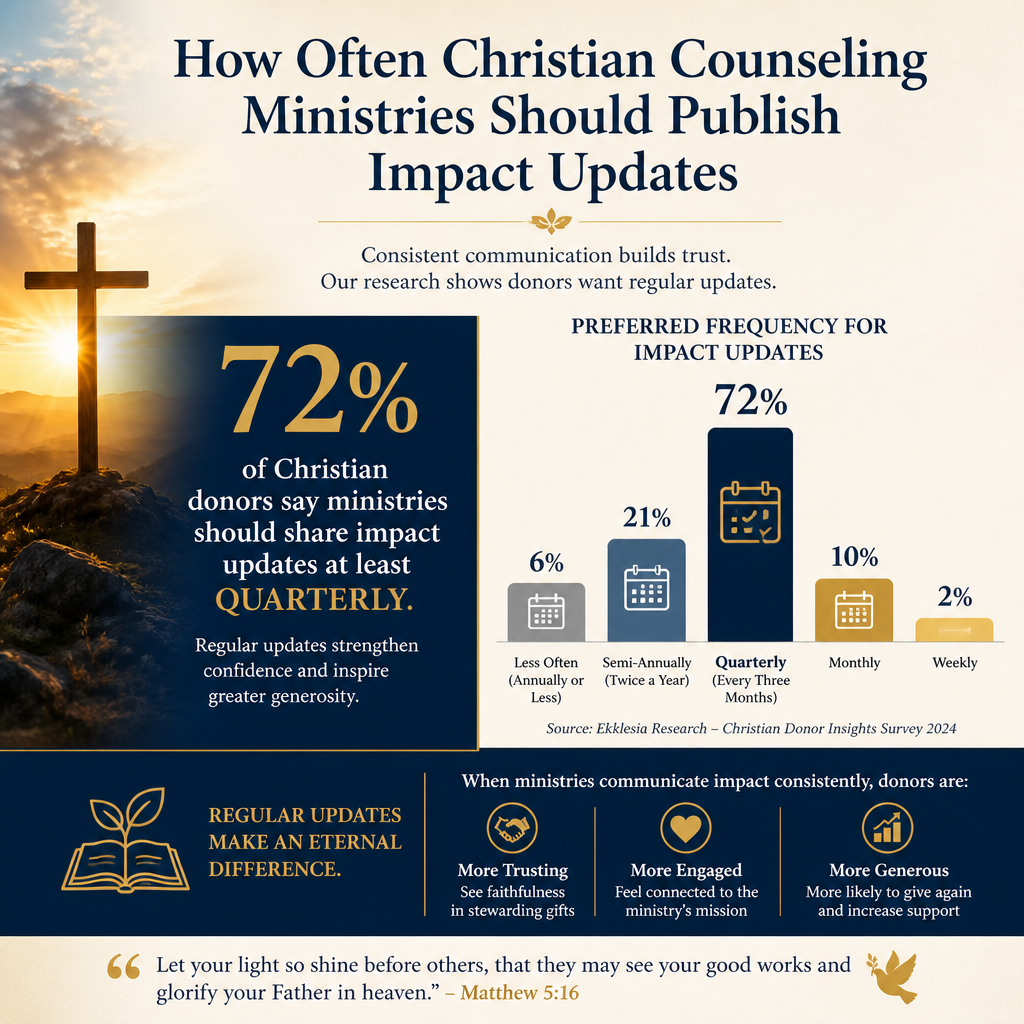
For a typical Christian counseling ministry with ongoing services and year-round fundraising, we recommend a baseline rhythm built around quarterly impact updates, supplemented by lighter-touch communications between them and a more comprehensive annual report.
Recommended baseline cadence
- Quarterly impact update: outcomes where defensible, learning where outcomes are still maturing, and clear discussion of constraints and limitations.
- 1–2 brief communications between quarters: operational notes, prayer priorities, capacity changes, and governance or policy updates that affect trust.
- Annual impact report: integrated narrative, audited or reviewed financials where available, leadership and governance disclosures, and longitudinal outcome trends.
- Immediate updates when risk changes: major leadership transitions, credible allegations, program closures, or significant shifts in service model.
When monthly impact reporting is appropriate
Monthly “impact” can be responsible when the ministry is reporting stable, non-sensitive operational measures and does not imply clinical effectiveness prematurely. Examples include average wait time, number of counseling hours delivered, number of volunteer mentors trained, or hotline call volume—provided those figures are contextualized and not used as a proxy for healing.
When semiannual may be more faithful than quarterly
Some ministries serve complex populations where treatment plans are long and measurement tools require careful administration. If the ministry’s best outcome indicators only meaningfully shift over six to twelve months, a semiannual update may protect against noise and misinterpretation. Donors can accept slower reporting when it is candid about why speed would reduce truthfulness.
What credible impact updates include for counseling work
Frequency is only half the question. The content of an impact update determines whether it builds trust or erodes it. Mature donors have learned to be wary of ministries that present only testimonies and superlatives. Testimonies are biblically significant—Christ’s deliverance deserves witness—but testimony is not a measurement system, and it cannot carry the full weight of accountability.
Use measures that fit the ministry’s model of care
Some counseling ministries operate as pastoral counseling centers; others are clinically licensed practices with explicit therapeutic modalities. The measures should match. A ministry may report on retention, completion, symptom reduction using validated tools where appropriate, referrals to higher levels of care, or restoration milestones defined with clinical and pastoral sobriety. If a ministry lacks the expertise to design measurement well, it should say so and describe what it is doing to improve.
Name the limits of what can be claimed
Christians genuinely disagree about how to speak of healing without implying a prosperity logic or treating sanctification as a measurable product. Responsible reporting avoids the false choice between spiritual language and careful evidence. It can state, plainly, what was observed, what was self-reported, what was assessed, and what remains unknown.
Prefer aggregated learning over individualized storytelling
Counseling stories can be powerful, but they carry risk: selective editing, subtle coercion, and exposure of people who later regret the public narrative. Aggregated reporting—patterns, ranges, and anonymized composites with ethical review—often serves both counselees and donors better. When stories are used, ministries should describe consent practices in plain terms.
For donors wanting to compare ministries within a broader field context, we address the distinctive demands of counseling accountability under Christian Counseling Ministries, including how theological commitments shape what “success” can responsibly mean.
How donors should interpret update frequency and what it signals about trustworthiness
Some donors assume that more frequent updates automatically mean greater transparency. In practice, the opposite can be true. A ministry that publishes constant celebratory metrics may be less transparent than one that reports less often but with rigorous definitions, stable denominators, and hard conversations about what did not go well.
High-frequency reporting can hide fragility
In nonprofit performance discussions, the pressure to show quick wins is well documented. The “Starvation Cycle,” described by Gregory and Howard, explains how unrealistic expectations can push organizations toward underinvestment and distorted reporting rather than genuine effectiveness (Stanford Social Innovation Review). Counseling ministries can face a parallel temptation: oversimplify outcomes to keep donor confidence high.
Low-frequency reporting can also be a warning sign
Silence is not automatically virtue. If a ministry cannot provide any regular account of service delivery, financial integrity, leadership oversight, and learning, donors should ask why. Mature governance expects a ministry to know its own operations well enough to communicate them without endangering counselees.
What we examine in verification
Most Trusted exists because many donors want something more than self-reported claims. Under The Most Trusted Standard, we look for evidence of consistent governance, financial integrity, faithfulness to stated Christian commitments, and transparency about both results and limitations. In counseling work, that includes whether impact updates are tied to a plausible measurement approach, whether leadership can explain the cadence, and whether privacy and consent practices are treated as non-negotiable duties.
Donors evaluating the credibility of reporting practices in this space often benefit from the broader context in How Christian Counseling Ministries Measure Impact, where we distinguish between outputs, outcomes, and spiritual formation claims that must be handled with care.
FAQs for How often Christian counseling ministries should publish impact updates
Is a quarterly impact update enough for a Christian counseling ministry?
Quarterly is often enough for outcome-oriented learning when counseling episodes last weeks or months and when measures need time to stabilize. The stronger practice is quarterly impact updates paired with lighter operational communications between quarters and an annual report that integrates theology, finances, governance, and longitudinal trends.
What should donors do if a ministry only publishes an annual impact report?
An annual report can be responsible if it is substantive, candid, and supported by accessible financial and governance disclosures throughout the year. If the annual report is glossy but thin, or if there is no clear way to ask questions and receive timely answers, donors should request clarification about how leadership monitors effectiveness and risk between reporting cycles.
Publishing impact updates as an act of Christian truthfulness
The most credible counseling ministries treat impact updates as part of discipleship in truth: resisting exaggeration, resisting silence, and speaking with appropriate restraint for the sake of those they serve. Donors should expect a clear cadence—often quarterly for impact, annual for integrated accountability—and a posture that honors both the sacredness of the counselee and the stewardship responsibility of the giver.



