

What impact reports Christian counseling ministries should provide is not a branding question. It is a stewardship question—how faithfully a ministry can account for what God has entrusted to it, and how honestly it can describe what it can and cannot measure in the care of souls. Donors are not asking for certainty where only God can see the heart, but we are asking for credible evidence that counseling is delivered with integrity, competence, and spiritual seriousness.
Christian counseling carries a particular weight. Ministries often work at the intersection of trauma, marriage breakdown, addiction, depression, and spiritual confusion. The donor is not merely funding sessions; the donor is supporting a form of neighbor-love that can either strengthen a person’s agency and church ties or unintentionally replace them. Impact reporting should be shaped by that moral reality, not by marketing needs.
1. Begin with a theologically coherent theory of care
Clarify what the ministry is trying to heal and what it cannot promise
The first mark of a credible impact report is a plain statement of what the ministry believes counseling is for. Christian counseling ministries should be explicit about how they understand sanctification, suffering, the role of the local church, and the appropriate use of clinical tools. Scripture does not treat the inner life as irrelevant; it also refuses the illusion that spiritual maturity is a quick outcome. A ministry that reports impact as if discipleship were a controllable production line is already signaling risk.
We recommend that an impact report name the boundaries of counseling. Not every counselee will reconcile a marriage. Not every depressive episode resolves on a donor-friendly timetable. Not every trauma narrative yields to short-term intervention. Mature reporting states what the ministry is responsible to provide—competent, ethically delivered care—and what belongs to God’s providence and the counselee’s ongoing community and choices.
Explain how counseling relates to the local church
Christian donors often give to counseling ministries because they have seen church communities overwhelmed by mental health complexity or uncertain about clinical categories. That concern is legitimate. Yet the church cannot be outsourced without consequence. Impact reports should describe how the ministry partners with pastors, small groups, and trusted lay care when appropriate; how confidentiality is protected; and how the ministry avoids becoming a parallel church.
This is also where donors can read the ministry’s ecclesiology between the lines. A ministry that treats the church as an obstacle may still deliver competent services, but it should be candid about how that posture shapes referrals, aftercare, and spiritual formation. Across our verification work at Most Trusted, the ministries that meet The Most Trusted Standard tend to articulate these relationships with clarity rather than sentiment.

2. Report reach and access without turning people into metrics
Service volume, timeliness, and equitable access
Impact reporting must include basic operational facts: how many individuals were served, how many sessions were delivered, and what the average wait time was. These are not shallow numbers. They are a window into whether the ministry is accessible to people in real distress. When a ministry says it is meeting a need but cannot show whether people are waiting weeks or months for care, donors are left guessing about urgency and capacity.
When ministries report wait times, they should also report how triage works. Do they prioritize suicidality, domestic violence risk, or severe addiction? Do they have referral pathways for cases beyond their competency? A credible report describes this plainly, because ethical counseling is not only about helping; it is about not harming.
Affordability and financial burden on counselees
Donors often support counseling ministries to reduce cost barriers. A responsible impact report will show how fees are structured, what portion of clients receive subsidies, and what the typical out-of-pocket cost is. It should also address financial sustainability: a ministry that subsidizes care but does not track the true cost per session may be one economic downturn away from abrupt program cuts that destabilize clients.
National context matters here. The share of U.S. adults who received mental health treatment in the past year has been reported at roughly one in five in recent federal surveys, underscoring both demand and the importance of access to competent care (CDC). A Christian counseling ministry does not need to mirror national systems, but it should show how it is responding to a real public need with transparent, humane practice.
- Clients served and sessions delivered over the reporting period
- Average time to first appointment and a description of triage
- Referral outcomes for cases beyond scope
- Scholarship and sliding-scale participation, with definitions
- Cost per session and how it is calculated
Donors who want a broader view of the field and its distinct models will also benefit from the landscape framing we maintain under Christian Counseling Ministries.
3. Measure outcomes with clinical humility and spiritual seriousness
Use validated tools where they fit, and explain why
Outcomes matter, but the field must reckon with what outcomes can honestly claim. Christian counseling ministries should not be allergic to validated measures; when chosen carefully, they protect clients and donors from vague promises. At minimum, a report should state whether the ministry uses standardized screening or progress tools (for example, depression and anxiety symptom measures), how often they are administered, and how data is stored and protected.
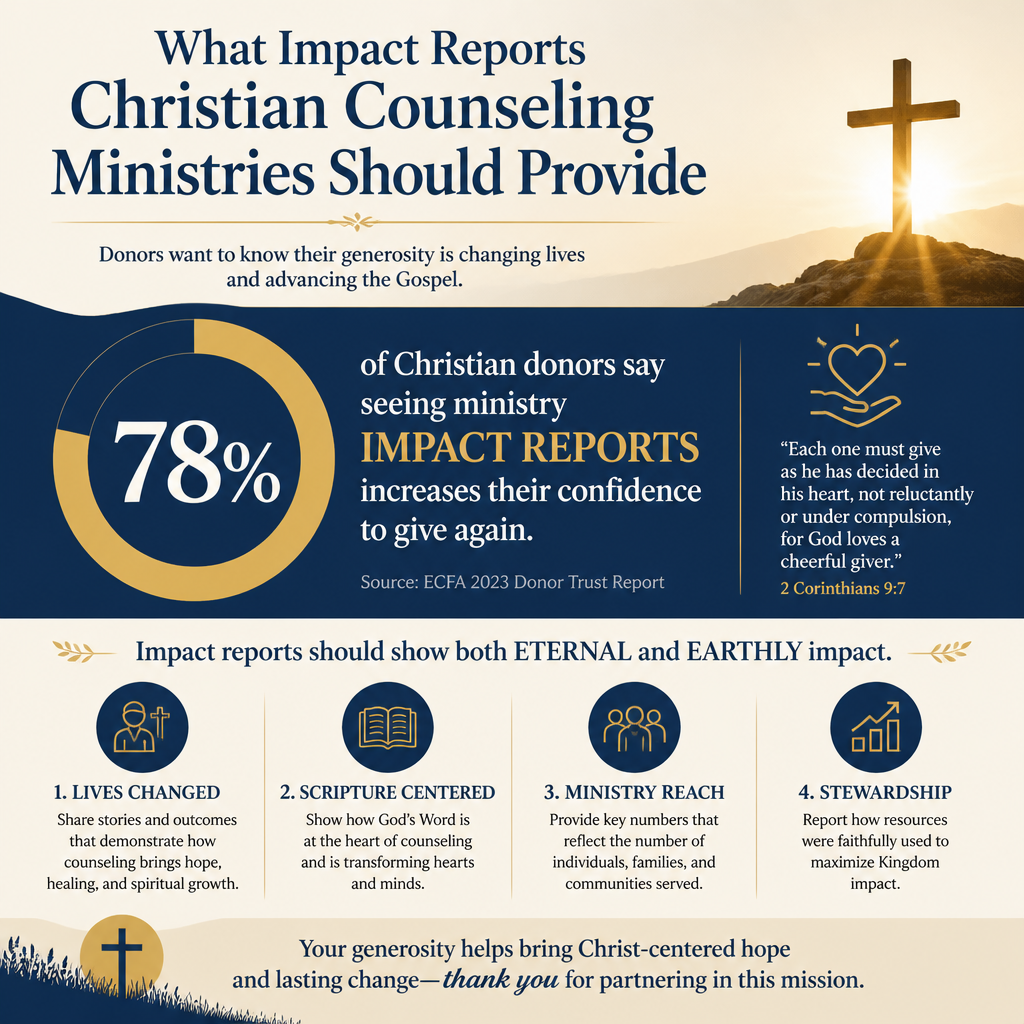
The harder question is not whether measurement is good, but whether it is appropriate to the ministry’s model and population. Ministries serving complex trauma or severe comorbidity will often see nonlinear progress. Their reports should say so, and they should avoid cherry-picking easy wins. A mature report includes outcome distributions, not only averages, and it interprets them with restraint.
Define spiritual outcomes carefully and resist manipulation
Christian donors understandably want to know whether counseling is spiritually faithful. Yet spiritual outcomes are easily mishandled. A simplistic “salvation count” tied to counseling sessions can pressure clients, reduce consent, and confuse counseling with evangelistic events. Impact reports should instead describe spiritual integration practices: how counselors invite prayer when appropriate, how Scripture is used with pastoral discretion, and how the ministry respects clients who are exploring faith.
Where a ministry does report faith-related indicators, it should define them precisely and acknowledge limitations. For example, a ministry may track whether clients reconnect with a local church, engage in pastoral care, or report improved spiritual disciplines. These may be meaningful, but they are not a substitute for the church’s long-term work of discipleship. The report should state this clearly.
For donors who are thinking carefully about what constitutes credible evidence in this space, we address common measurement challenges and reporting norms in How Christian Counseling Ministries Measure Impact.
4. Prove quality and safety, not only activity
Credentials, supervision, and scope of practice
Christian counseling ministries are sometimes tempted to report impact as if compassion were the primary credential. Compassion is essential; it is not sufficient. An impact report should disclose who is providing care: licensed clinicians, supervised interns, trained lay counselors, pastoral counselors, or some mixture. It should also disclose the supervision model, continuing education expectations, and how the ministry defines scope of practice.
We recommend explicit statements on what issues the ministry does not treat, and what triggers a referral to emergency services or specialized care. Donors should not have to infer these boundaries from vague language. Serious ministries also report policies on dual relationships, mandatory reporting, and conflicts of interest, because counseling is a setting where power can be abused.
Safeguarding, confidentiality, and incident response
Because counseling involves sensitive disclosures, safeguarding is part of impact. Reports should summarize confidentiality policies, data security practices, and how the ministry handles complaints. A donor who funds counseling is funding an environment where trust must be protected with more than goodwill.
When adverse events occur—breaches of confidentiality, boundary violations, or credible allegations of misconduct—an honest report will not sensationalize. It will state the existence of an incident response process, the governance oversight involved, and any corrective action taken in a way that preserves privacy. This is one of the places where transparency costs something, and it is also where trust is earned.
5. Connect impact to financial integrity and governance
Show how resources translate into care
Donors are not only funding counseling; they are funding the institutional machinery that makes counseling safe: supervision, training, record systems, facilities, and scholarship support. An impact report should connect dollars to service delivery without reducing stewardship to a low “overhead” ratio. The sector has learned that obsessing over overhead can be misleading; the joint statement often called the “Overhead Myth” urged donors to evaluate governance, transparency, and outcomes rather than treating administrative spending as inherently suspect (Charity Navigator).
What this means in practice is that ministries should report program expense categories in a way donors can understand: direct counseling labor, supervision, clinical software, training, scholarships, and crisis referral partnerships. When donors can see the chain from giving to care, the ministry is less dependent on narrative persuasion.
Governance signals that protect donors and clients
Impact reporting is not only a program function. It is a governance function. Reports should state who reviews outcome data and safety indicators, how often leadership reports to the board, and what external accountability exists. If a ministry is structurally dependent on a single charismatic founder with minimal board oversight, donors deserve to know, because the risks are predictable.
At Most Trusted, we evaluate ministries against The Most Trusted Standard because donors need a comprehensive picture: faith commitments, financial integrity, governance and leadership, and transparency and effectiveness. The counseling space particularly benefits from this integrated approach, since program claims cannot be separated from safety practices, fiduciary stewardship, and truthful reporting.
FAQs for What impact reports Christian counseling ministries should provide
Should Christian counseling ministries report spiritual outcomes such as conversions?
They may, but we recommend extreme care. Counseling creates vulnerability and an inherent power dynamic, and clients must never feel that spiritual responses are expected in exchange for care. If a ministry reports faith-related indicators, it should define them precisely, explain how consent is protected, and avoid presenting spiritual decisions as program outputs. Many ministries serve best by reporting spiritual integration practices and church-connection pathways rather than headline counts.
What is a reasonable set of outcome measures for a counseling ministry without overclaiming?
A reasonable approach combines (1) service access indicators such as wait time and retention, (2) client-reported experience measures such as satisfaction and perceived safety, (3) limited use of validated symptom or functioning tools where appropriate to the client population, and (4) quality and safety indicators such as supervision compliance and referral follow-through. The report should interpret results with humility, acknowledge missing data and limitations, and explain how findings inform improvements.
Stewardship requires truthfulness about what changed
Christian counseling ministries should provide impact reports that are concrete about reach, disciplined about outcomes, and uncompromising about safety. The aim is not to prove spiritual fruit with laboratory certainty, but to offer donors and churches an honest account of faithful care—delivered competently, governed prudently, and reported transparently. That kind of reporting honors the counselee, serves the donor, and resists the temptation to make sacred work answer to shallow metrics.



