
How churches can host Christian counseling ministry events is not primarily a logistics question. It is a pastoral and stewardship question: whether a congregation will treat emotional suffering with the same seriousness Scripture gives to human frailty, and whether the church will do so with integrity worthy of donor trust.
Christian donors often fund counseling ministries because they have seen what unaddressed trauma, addiction, marital rupture, and anxiety do to families and congregations over decades. Yet the field has also had to reckon with real risks: spiritualizing what requires clinical care, importing secular therapeutic frameworks without discernment, mishandling confidentiality, or platforming leaders whose governance would not withstand scrutiny. A well-hosted event can strengthen a church’s care system. A poorly governed one can injure the vulnerable and compromise a church’s witness.
Begin with a theological and pastoral purpose that the whole church can name
Mercy ministry includes the interior life
The Psalms refuse denial: “The LORD is near to the brokenhearted and saves the crushed in spirit” (Psalm 34:18). The New Testament calls the church to “bear one another’s burdens” (Galatians 6:2). These are not sentimental texts; they describe a covenant community that takes suffering seriously and responds with truthful compassion.
What this means in practice is that Christian counseling ministry events should be framed as part of ordinary Christian care, not as a niche program for “other people.” When a church communicates that counseling is merely for crises, shame tends to govern participation. When a church communicates that seeking help can be an act of wisdom, humility, and faithfulness, more people will step into the light before problems become catastrophic.
Define the event by outcomes, not by crowds
Attendance is measurable, but it is not the right measure of faithfulness. A donor-minded church should name outcomes that serve the vulnerable: early identification of risk, clearer referral pathways, trained lay care that knows its limits, and strengthened marriages and families over time. The harder question is whether the event will actually connect people to competent care, or simply stir emotion and then leave them alone.

Select counseling partners with verification-level diligence
Discernment requires more than doctrinal alignment
Churches rightly care about theological fidelity. But donors also understand that ministries can affirm an orthodox statement of faith and still fail in financial stewardship, governance, or safeguarding. Across our verification work at Most Trusted, we observe that the strongest counseling ministries treat accountability as part of discipleship: they document policies, welcome oversight, and can explain how decisions are made and funds are handled.
This is where a framework like The Most Trusted Standard is useful. It asks whether a ministry’s faith commitments are clear and practiced, whether financial reporting is reliable, whether governance has appropriate independence, and whether the organization communicates outcomes and limitations honestly. Those are not bureaucratic concerns. They are the practical guardrails that protect people made in God’s image.
Ask the questions vulnerable people cannot reasonably ask
A congregant walking into a counseling event may be exhausted, ashamed, or in crisis. They are not positioned to evaluate clinical boundaries, safeguarding, or whether a ministry’s leadership is accountable. A church, by contrast, can do pre-work that honors the vulnerable and honors donors who fund the work.
- Is there a written statement of faith and a clear model for integrating theology with clinical practice?
- Are counselors properly credentialed where licensure is relevant, and are roles accurately described?
- Are there written policies for confidentiality, mandatory reporting, and safeguarding of minors?
- Is governance accountable, with clear leadership oversight and conflict-of-interest practices?
- Are fees, scholarships, and financial arrangements disclosed without pressure or ambiguity?
Christians genuinely disagree about some integration questions: how to weigh common grace insights from psychology, where to draw boundaries around certain therapeutic schools, and how to relate pastoral counseling to licensed therapy. But churches do not need unanimity to act wisely. They need clarity, honesty, and a refusal to promise what they cannot deliver.
Design events that protect confidentiality and reduce harm
Build the event around referral and triage, not public disclosure
Many churches default to a testimony-driven approach because stories move hearts. Yet counseling ministry events can unintentionally invite public disclosures that should remain private, especially when dynamics of spiritual authority are present. A safer model uses teaching, guided pathways, and private next steps. The goal is not to extract vulnerability from people. The goal is to give them dignified access to care.
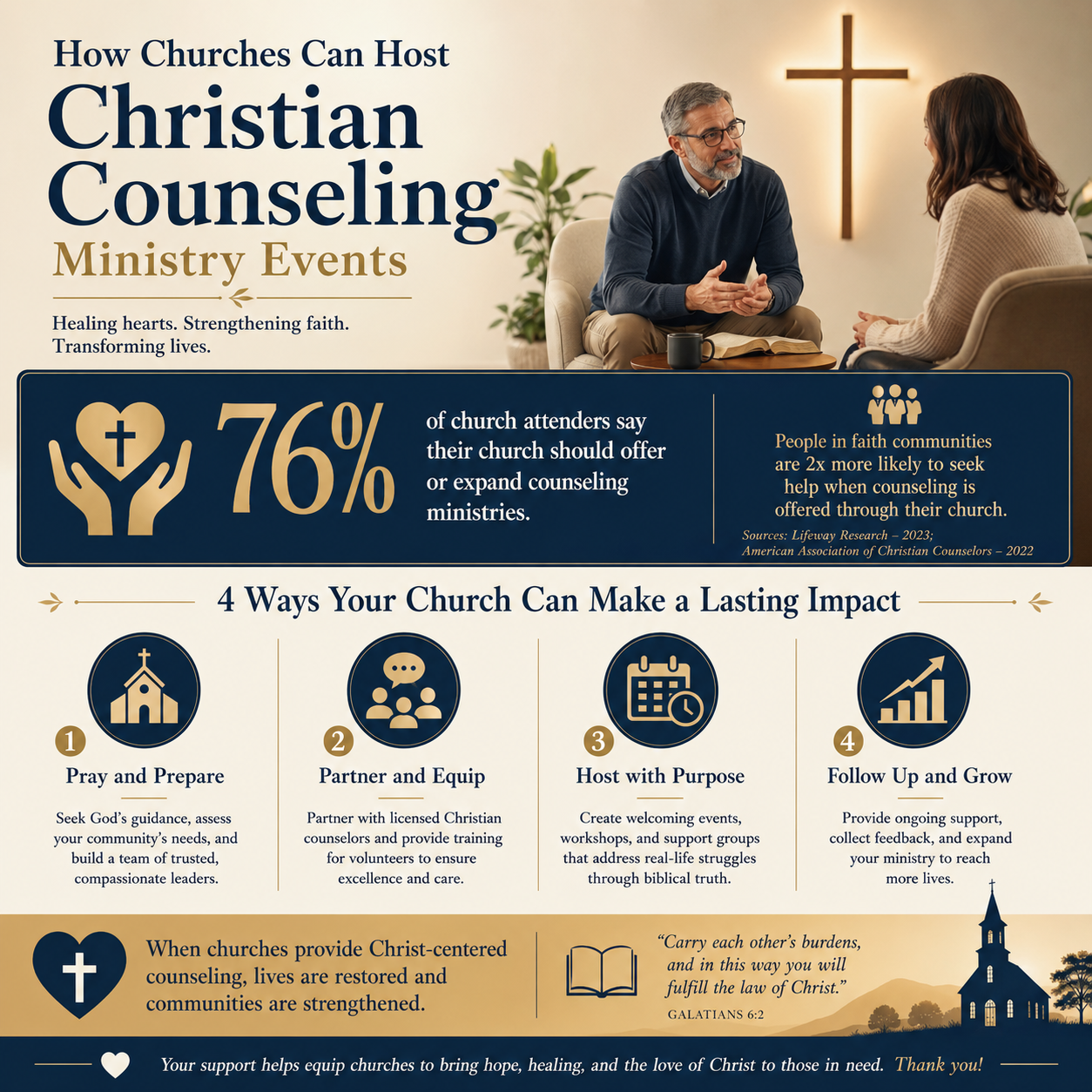
Concrete design choices matter. Registration should not require disclosure of sensitive information. Prayer teams should be trained on confidentiality and limits. Clear written instructions should explain when leaders must report harm or risk. If minors are present, child protection practices should be explicit and staffed. These details are not distractions from ministry; they are expressions of love of neighbor.
Attend to the mental health realities in the room
Even a well-framed event will include people with acute depression, suicidal ideation, domestic violence, or active addiction. Churches should not pretend those realities are rare. A credible event plan includes crisis pathways: who to call, where to refer, and how to ensure a person is not left alone if risk is identified.
For context, national data underscores the prevalence of mental distress. In 2023, about one in five U.S. adults experienced mental illness in the past year, according to the Substance Abuse and Mental Health Services Administration. Churches do not need to become clinics to take that seriously. They need to host events that assume complexity and are designed for it.
Make donor stewardship visible without turning care into marketing
Transparency strengthens ministry when it serves people
Donors tend to support counseling ministries for years, not months, because healing is often slow and non-linear. That patience is a form of stewardship. But donors also know that counseling work can be difficult to evaluate, and that “impact” language is easily inflated. Churches hosting events should model a better standard: speak plainly about what the ministry does, what it does not do, what it costs, and how financial assistance works.
Healthy transparency avoids two extremes. One is secrecy that hides practices donors would rightly question. The other is oversharing that violates privacy or turns suffering into proof of success. An event can communicate stewardship through budgets, policies, and governance practices rather than through dramatic stories.
Resist simplistic financial signals and explain costs honestly
Counseling ministries carry real costs: qualified staff, supervision, safeguarding practices, continuing education, secure records, and often subsidized care. Donors sometimes inherit a secular nonprofit instinct to judge quality by low overhead. The field has had to correct that misconception. Major evaluators have warned against equating overhead ratios with effectiveness, including Charity Navigator, Candid, and BBB Wise Giving Alliance in their joint statement on the “overhead myth” hosted by Candid.
What this means for a church event is straightforward. If a partner ministry can only offer “free counseling” by overworking staff, skipping supervision, or failing to protect client data, the price is being paid somewhere—usually by those least able to bear it. Donor stewardship is not merely about minimizing cost. It is about funding faithfulness.
Strengthen the church as a care ecosystem after the event ends
Equip pastors and lay leaders to know their roles and limits
A counseling ministry event should not imply that pastors are peripheral to care, nor that licensed clinicians can replace the ordinary means of grace. Mature churches resist false choices. Pastors shepherd through Word, sacrament, prayer, and wise counsel. Clinicians offer specialized care within defined competencies. Lay leaders provide presence, practical help, and accountability. The church’s responsibility is to clarify roles so people are supported rather than bounced between systems.
When churches host events with external counseling partners, they should also evaluate their internal pathways: Do small group leaders know how to respond when someone discloses abuse? Do elders have a process for high-conflict marital situations? Is there a benevolence policy that can assist with counseling costs without favoritism? These questions are part of governance, not merely caregiving.
Anchor partnerships in accountability and shared language
Partnerships work best when churches and counseling ministries share vocabulary about confidentiality, safeguarding, referrals, and follow-up. Donors often assume those systems exist. Many churches discover they do not until a crisis exposes the gap. A thoughtfully hosted event can become the impetus for formal memoranda of understanding, documented referral processes, and periodic review.
For churches assessing the wider landscape of Christian Counseling Ministries, clarity about these practices is also how donors give with confidence. At Most Trusted, we encourage churches and donors alike to prefer partners who can demonstrate integrity through documents and governance, not only through compelling vision.
And for those building broader relationships across Church Partnerships with Christian Counseling Ministries, the strongest pattern we see is consistent: churches treat accountability as a ministry asset, and counseling partners welcome scrutiny as part of Christian stewardship.
FAQs for How churches can host Christian counseling ministry events
Should a church only partner with licensed counselors for an event?
Licensure is not the only marker of faithfulness, but it is often a relevant marker of competence and accountability when clinical claims are made. Churches can host events with a range of providers—pastoral counselors, biblical counselors, licensed clinicians, and integrated models—so long as roles are accurately described, safeguarding and confidentiality are clear, and referral pathways exist for higher-acuity cases. The ethical failure is not choosing one model; it is obscuring limits or implying a level of clinical care that is not actually available.
How can donors support these events without funding a one-time moment?
Donors can prioritize funding that strengthens durable care systems: scholarships for ongoing counseling, training for lay care teams, supervision and safeguarding capacity for counseling ministries, and documented partnerships that improve referral and follow-up. A one-time event can be helpful, but lasting fruit usually comes from repeatable processes, accountable leadership, and transparent reporting about what care was provided and what outcomes were realistically achieved.
A church-hosted counseling event should deepen trust, not merely raise awareness
Churches host Christian counseling ministry events well when they refuse two temptations at once: treating suffering as a private matter that should remain hidden, and treating counseling as a spectacle that can be packaged for quick results. The more faithful path is slower and more accountable. It honors Scripture’s call to bear burdens, protects confidentiality, and invites donors into visible stewardship that makes care credible over time.



