

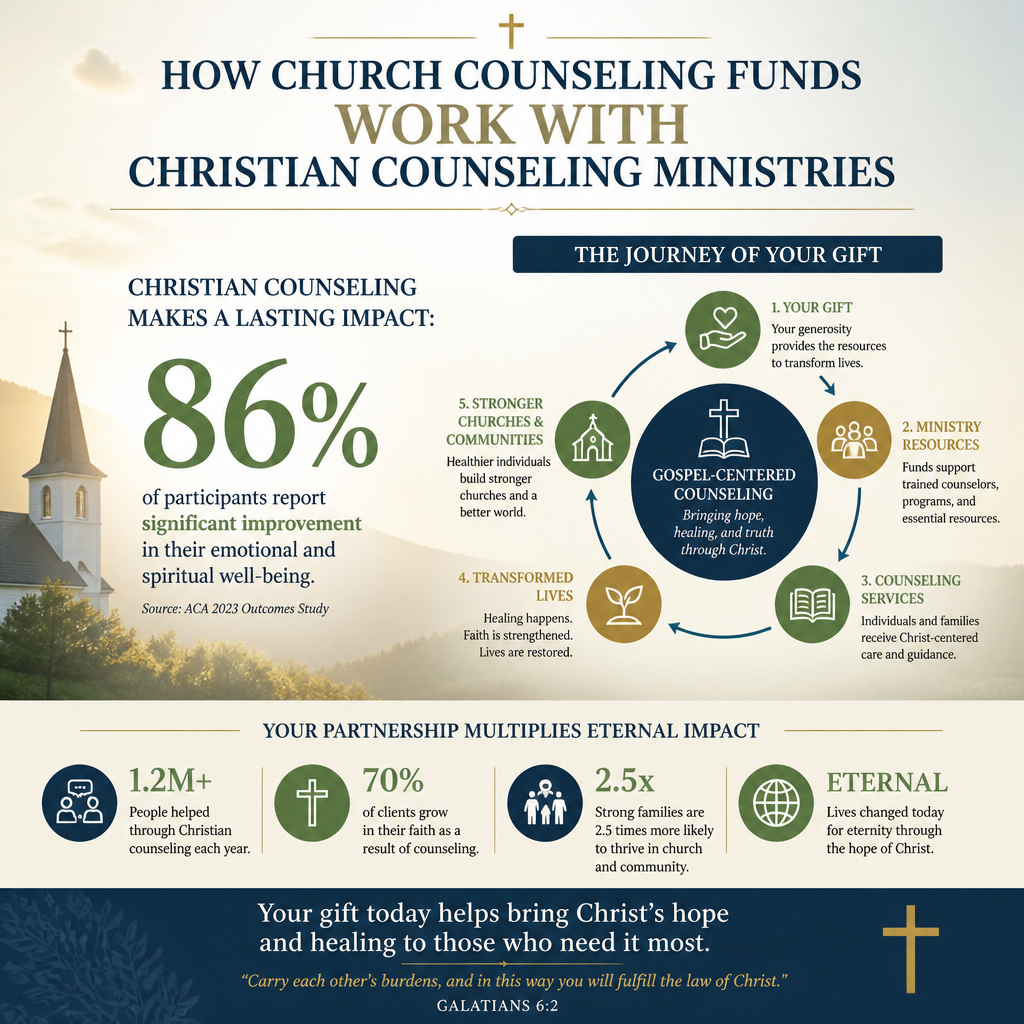
Church counseling funds work with Christian counseling ministries when a church treats care as a shared stewardship: the church remains responsible for shepherding its people, and the counseling ministry brings clinical competence under a Christian moral and pastoral horizon. Donors often support these funds because the need is immediate, private, and spiritually weighty—and because therapy costs can quietly exclude lower-income families from help that may be decisive.
The harder question is not whether counseling is needed, but how money flows without distorting the care. Financial assistance can unintentionally pressure counselees, compromise confidentiality, or subsidize ministries that lack theological clarity or basic financial controls. Wise church counseling funds are designed to protect the counselee, honor the local church, and preserve the integrity of the counseling ministry.
Why churches create counseling funds and what they are and are not
A mercy fund with a clinical edge
Most churches already carry some form of benevolence or mercy assistance. Counseling funds are a specialized form of that mercy, aimed at mental health care delivered through a Christian counseling ministry or Christian-formed clinicians. The goal is not to “buy outcomes,” but to remove financial barriers so that people can receive competent help while remaining under pastoral care.
Because counseling work touches trauma, marriages, addiction, grief, and psychiatric realities, churches often find that a general benevolence process is not specific enough. Effective counseling funds clarify who qualifies, what expenses can be covered, and what accountability is appropriate without turning care into a transaction.
What a counseling fund should never become
A counseling fund should not become a parallel pastoral authority that bypasses a church’s shepherding. Nor should it become a de facto endorsement of any counselor who self-identifies as Christian. Donors generally assume theological and ethical safeguards; churches serve donors and counselees best by making those safeguards explicit.
What this means in practice is that a church can honor both biblical wisdom and clinical reality: “Where there is no guidance, a people falls, but in an abundance of counselors there is safety” (Proverbs 11:14). The verse does not erase the need for discernment about who the counselors are and what counsel they provide.

The basic financial mechanics donors should understand
Common models of support
Churches typically use one of several financial arrangements when working with Christian counseling ministries. Each model carries trade-offs in privacy, control, and administrative burden. The best model is often the one that most clearly protects the counselee while maintaining clear documentation for the church’s fiduciary obligations.
- Direct-to-provider payments: the church pays the counseling ministry directly for approved sessions.
- Reimbursement: the counselee pays and submits receipts for partial reimbursement.
- Vouchers or session authorizations: the church authorizes a set number of sessions with a partner ministry.
- Matching assistance: the church covers part of the fee while the counselee contributes a portion, when feasible.
- Designated giving: donors give to a restricted counseling assistance fund, governed by a written policy.
Restricted gifts, donor intent, and church accountability
Donors often prefer designated giving because counseling needs are concrete and urgent. Churches should be careful here: restricted gifts require discipline. If a donor gives to “counseling assistance,” those funds should not be reallocated casually. Policies should define how long restricted funds remain restricted, how excess balances are handled, and what happens if a partner counseling ministry changes.
Across our verification work at Most Trusted, ministries and churches that handle restricted funds well tend to share two habits: they document decisions contemporaneously, and they separate pastoral concern from financial authorization. Compassion remains central, but it is expressed through orderly stewardship rather than ad hoc exceptions.
How partnerships with Christian counseling ministries are structured
Referral relationships and formal partnerships
Some churches maintain a referral list with several local providers. Others choose a formal partnership with one Christian counseling ministry that agrees to shared expectations—fee structures, scheduling priority for urgent cases, communication boundaries, and a clear statement of faith or moral framework.
Formal partnerships can reduce confusion for counselees and pastors, but they also concentrate risk. If the partner ministry’s doctrine, clinical practices, or governance are weak, the church’s reputation and pastoral credibility can be drawn into the damage. This is why Church Partnerships with Christian Counseling Ministries deserves the same due diligence donors would expect for any other high-trust ministry relationship.
Sliding scales, scholarships, and how they interact with church funds
Many counseling ministries offer sliding-scale fees or internal scholarship support. A church counseling fund can complement that support rather than replace it. A common arrangement is for the counseling ministry to apply its own sliding scale first, then the church covers a portion of the remaining balance. This approach reduces moral hazard and allows the ministry’s financial assistance policies to carry their weight.
The field has had to reckon with a tension: counseling ministries need stable revenue to retain qualified clinicians, maintain supervision, and carry appropriate insurance. Churches rightly want affordability. When these pressures are not named, expectations can quietly become unrealistic, and the result is either counselor burnout or a drift toward lighter-touch services that do not meet complex needs.
Clinical ethics, confidentiality, and the church’s pastoral role
Protecting the counselee from financial entanglement
Donors often want assurance that funds are used wisely, but counseling is not a program with easily reportable metrics. The church’s responsibility is to steward money without turning the counselee’s story into documentation for others’ peace of mind. The counseling ministry’s responsibility is to protect confidentiality according to professional ethics and applicable law.
A healthy arrangement usually means the church receives minimal necessary information: confirmation that sessions occurred and the amount due, without clinical notes. Pastors may stay involved through pastoral care, but the line between pastoral shepherding and clinical recordkeeping should remain clear.
When safety issues require disclosure
Christians genuinely disagree about how much information should flow between counselor and pastor. Yet most agree on a basic moral obligation: when there is credible risk of harm, the church and the counseling ministry must act. Licensed clinicians are typically mandatory reporters for child abuse and may have duties related to imminent threats. Churches should not assume; they should ask the counseling ministry to state its reporting obligations plainly.
Donors should also understand that counseling assistance cannot replace the church’s broader care for the vulnerable. Where abuse is involved, financial help for counseling may be necessary, but it is not sufficient. The church must prioritize protection, truth-telling, and lawful reporting as required.
Due diligence donors should expect and how Most Trusted evaluates ministries
What can be verified and what cannot
Counseling outcomes are real, but they are not always measurable in the way donors might prefer. Even secular health systems struggle to define success across the breadth of mental health conditions. What can be verified is whether a counseling ministry is structured to pursue faithful, competent care: governance, financial integrity, a coherent theological framework, appropriate licensing and supervision standards, and transparent policies.
For donors, the practical question becomes: is this ministry trustworthy enough to receive funds that will touch lives in their most fragile moments? That is the kind of question our team was built to answer through The Most Trusted Standard, evaluating ministries for faith commitments, financial stewardship, governance, and transparency that donors can examine.
Signals of credibility and warning signs
Across our verification work, the ministries that meet The Most Trusted Standard tend to show clarity in three areas that are often muddled in the counseling world: doctrinal commitments that are not merely generic, financial reporting that makes sense to non-specialists, and governance that includes independent oversight rather than founder control.
Donors considering support for a church counseling fund—or a counseling ministry directly—should ask for concrete evidence in areas that are too often assumed. The following signals are particularly meaningful:
- Clear statement of faith and ethical commitments, including how sexuality, marriage, and sanctification are understood in counsel.
- Qualified clinical leadership, including licensed supervision where required and formal policies for crisis cases.
- Financial transparency, such as recent audited financials or reviewed statements appropriate to size, and a credible budget narrative.
- Governance with real oversight, including a functioning board and documented conflict-of-interest policy.
- Boundaries on confidentiality and communication that protect counselees while addressing safety obligations.
The nonprofit sector has also learned to resist simplistic heuristics about “overhead.” The public conversation was shaped by the Overhead Myth statement endorsed by organizations including GuideStar and BBB Wise Giving Alliance, cautioning donors against treating administrative ratios as a proxy for impact (Candid GuideStar). Counseling ministries often require higher professional expenses—clinical supervision, records systems, and insurance—precisely because they are handling serious human risk.
For a broader view of how counseling ministries fit within the Christian nonprofit landscape donors support, see Christian Counseling Ministries.
FAQs for How church counseling funds work with Christian counseling ministries
Should a church pay the counseling ministry directly or reimburse the counselee?
Direct payment to the counseling ministry is often simpler for accountability and can reduce the burden on a counselee already under stress. Reimbursement can preserve privacy in certain settings but requires the counselee to front costs and submit documentation. Churches usually choose based on their administrative capacity and their commitment to minimize what personal information must be shared beyond what is necessary for stewardship.
Is it appropriate for donors to restrict gifts specifically to counseling scholarships?
Restricted gifts can be appropriate when the restriction is clear and the church has a written policy to honor donor intent. The church should also define how decisions are made, how confidentiality is protected, and what happens if counseling needs change or a partner relationship ends. The aim is to unite generosity with order, so that mercy does not become opaque or discretionary in ways that erode trust.
Stewardship that honors both mercy and truth
Church counseling funds are most faithful when they do not treat counseling as a commodity and do not treat money as morally neutral. They express the church’s calling to bear burdens (Galatians 6:2) while insisting that care be delivered with competence, ethical clarity, and accountable stewardship. Donors serve the church best when they ask the questions that protect counselees and strengthen trustworthy ministries for the long term.



