

How Christian counseling ministries measure impact is not a secondary question for serious Christian donors. Counseling work touches the most intimate areas of human life—sin and suffering, trauma and responsibility, despair and hope—and the claims ministries make about healing deserve disciplined scrutiny.
Christian donors also carry a distinct burden of judgment here. We want to honor the reality that the Spirit’s work is not reducible to a spreadsheet, while refusing the false comfort of stories that cannot be tested. Scripture holds both together: the fruit of repentance is visible over time, and yet “the wind blows where it wishes” (John 3:8). The work of verification is not to domesticate grace, but to bring clarity, humility, and accountability to the parts of ministry that can be measured.
Impact in Christian counseling begins with theological and clinical clarity
Many disappointments in counseling ministry reporting are not moral failures; they are definition failures. Impact cannot be measured until a ministry states what it is trying to change, for whom, through what means, and within what time horizon. Theologically serious ministries avoid vague outcomes like “people were encouraged” and instead describe durable change: restored functioning, reduced symptoms, repaired relationships, strengthened participation in the local church, and growth in spiritual practices consistent with historic Christian discipleship.
Across our verification work at Most Trusted, we observe that ministries best positioned to report meaningful outcomes tend to hold two disciplines together: a coherent Christian anthropology and appropriate clinical competence. When those disciplines are separated, reporting becomes either spiritualized (claims of transformation without evidence) or clinicalized (mental health metrics detached from the ministry’s stated Christian ends).
Define the ministry’s theory of change in plain language
In counseling, a credible theory of change names the presenting problems a ministry addresses (for example, marital conflict, anxiety, sexual trauma, grief, addiction recovery support) and the interventions it actually provides (licensed counseling, pastoral counseling, group programs, lay coaching under supervision, referral networks, training churches). Donors should be wary when a ministry’s public materials imply comprehensive treatment for complex conditions without describing the qualifications, supervision, and referral practices that make such work responsible.
Clarity also includes boundaries. A mature ministry can say, without defensiveness, what it does not do. That is not a lack of faith; it is an expression of wisdom and love for counselees.
Use measures that respect both soul care and safety
“Impact” in counseling is not only improvement. It also includes avoiding harm: appropriate screening for risk, mandated reporting when required, protocols for suicide risk, and referral pathways for higher levels of care. A ministry that cannot describe its safety practices is not prepared to invite donors into trust.
For donors, this is where doctrinal commitments matter. A ministry’s view of sin, agency, suffering, and the body will shape its counsel. Yet donors should not confuse doctrinal fidelity with clinical negligence, or clinical rigor with theological compromise. Christians genuinely disagree about models of integration, but most agree that love of neighbor requires competence, truthfulness, and a refusal to make suffering people into ideological proofs.

What credible outcomes look like in counseling ministry reporting
Some outcomes in counseling are measurable with established instruments, and donors should expect ministries to use them appropriately. Others require careful qualitative evidence, gathered consistently and reported with restraint. The aim is not to prove that every counselee flourishes, but to show that the ministry knows what is happening in its programs and tells the truth about results.
Quantitative outcomes for mental health and functioning
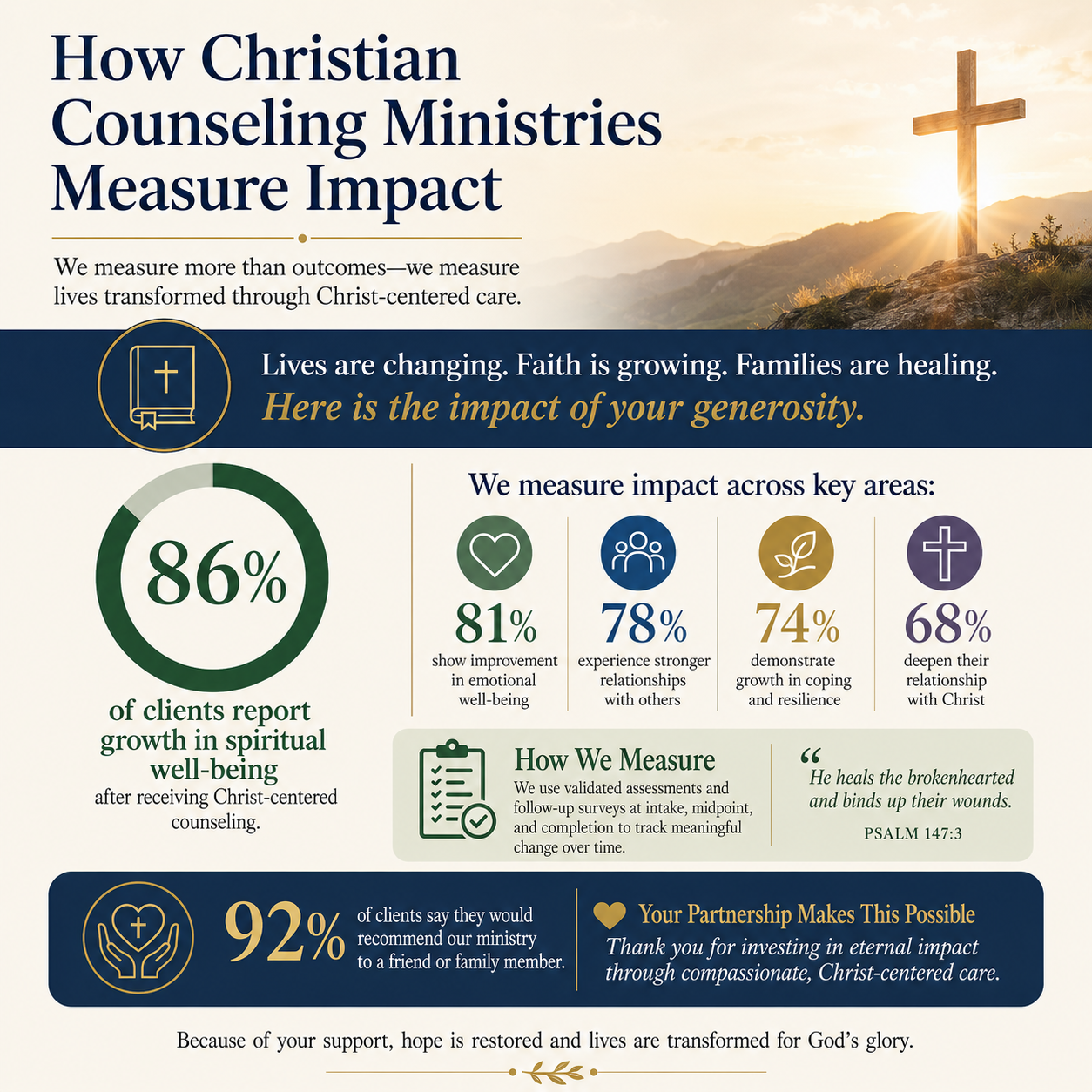
When counseling is provided by licensed clinicians or under clinical supervision, ministries can often report changes on validated measures (for example, PHQ-9 for depression symptoms, GAD-7 for anxiety symptoms, or other domain-specific tools). These tools are not the gospel, but they can provide honest signals of change over time when used responsibly and interpreted with care. Donors should look for reporting that explains:
- Who is assessed (which clients, which programs, what exclusion criteria)
- When assessments are taken (intake, periodic reassessment, discharge, follow-up)
- How missing data is handled (dropout, non-response)
- How the ministry defines improvement (clinically meaningful change, not merely any change)
Counseling outcomes also interact with access and need. The scale of mental health burden in the United States is substantial, and it shapes what “success” can realistically mean in a given year. The National Institute of Mental Health reports that a significant share of U.S. adults experience mental illness annually, which provides context for why prevention, early intervention, and referral partnerships matter alongside direct counseling services (National Institute of Mental Health).
Qualitative outcomes that do not collapse into marketing
Counseling ministries often rely on testimonies. Testimony is a Christian practice, but donor-facing storytelling can become manipulative when it substitutes for evidence. Mature reporting treats stories as illustrative rather than dispositive. It also protects counselees from spiritual and reputational harm, including harms created by pressure to perform a “victory narrative.”
Strong qualitative reporting tends to include consistent methods: structured exit interviews, coded themes from anonymized feedback, and representative examples rather than only the most dramatic cases. Donors should be cautious when every story reads the same, when suffering is simplified, or when the counselee’s privacy is treated as a secondary concern.
Spiritual growth outcomes without coercion or confusion
Some ministries attempt to track spiritual growth: church re-engagement, Scripture reading habits, prayer practices, reconciliation efforts, reduced substance misuse, or progress in forgiveness. The harder question is whether these outcomes are measured with integrity. Because spiritual growth is deeply personal and often nonlinear, ministries should avoid turning formation into a scorecard.
Credible reporting will specify what is observed (for example, self-reported practices, participation in discipleship structures, pastoral confirmation where appropriate) and will acknowledge limitations. It will also distinguish between counseling goals (stabilization, coping skills, trauma processing) and discipleship goals (long-term formation in Christ). Conflating the two can produce spiritually pressurized counseling, which tends to harm the very people the ministry aims to serve.
What impact reports should include for donor-grade transparency
Donors who fund counseling ministries are not only paying for sessions. They are underwriting systems: intake processes, supervision, safeguarding, data practices, and spiritual care structures that protect the vulnerable. An impact report should therefore be more than a year-end scrapbook. It should function as a truthful account of stewardship.
This is one reason we encourage donors to compare ministries against a coherent verification framework. At Most Trusted, our evaluations are anchored in The Most Trusted Standard, which examines ministries across Faith Foundation, Financial Integrity, Governance and Leadership, and Transparency and Effectiveness. When counseling ministries report impact well, their reporting typically aligns with the same disciplines: doctrinal clarity, accountable leadership, responsible finances, and verifiable evidence of outcomes.
Service volume with context, not as a substitute for outcomes
Counts matter: number of counselees served, sessions delivered, group participants, training attendees, scholarships provided, and average wait time. But donors should insist on context. Volume without outcomes can reward throughput rather than care. Outcomes without volume can hide a ministry’s narrow reach. The better reports show both, and explain trade-offs honestly—for example, why a ministry chose longer treatment courses for high-need clients, or why it expanded group programming to address capacity constraints.
Retention, completion, and follow-up
Dropout is a major interpretive issue in counseling. People discontinue for many reasons: cost, transportation, ambivalence, symptom improvement, dissatisfaction, crisis escalation, or referral to higher care. Donors should look for ministries that track retention and completion and that can speak to patterns without blaming clients. Follow-up, even at modest intervals, can add credibility: what percentage of clients can be reached at 3 or 6 months, and what outcomes persist.
Safeguarding, confidentiality, and data integrity
Counseling ministries hold sensitive information. An impact report need not disclose private details, but it should disclose the ministry’s posture toward confidentiality and safeguarding. Responsible ministries describe data handling practices, consent processes for testimony, and training for staff and volunteers.
When counseling includes minors, survivors of abuse, or high-risk populations, donors should expect clear safeguarding protocols and appropriate partnerships. This is not only a best practice; it is a moral obligation rooted in Jesus’ warnings about harming the vulnerable (Matthew 18:6).
How donors can evaluate results claims with disciplined charity
Christian donors often feel pressure to choose between suspicion and naïveté. Neither serves the Church well. Disciplined charity treats ministries as neighbors—worthy of respect, and worthy of accountability. It asks honest questions, receives honest answers, and honors the reality that some of the most faithful counseling work will never produce easily publishable numbers.
What this means in practice is a posture: assume complexity, require clarity, and reward truthfulness over polish. The ministries most likely to be trustworthy are usually not the ones promising the fastest transformation. They are the ones willing to describe slow work: sustained care, appropriate referral, and long-term formation supported by the local church.
Questions donors should ask about counseling outcomes
- What outcomes do you track, and why those? How do they relate to your theology of change?
- What instruments or methods do you use, and who oversees their use?
- What is your completion rate, and what do you know about why clients discontinue?
- How do you ensure safety for high-risk clients and appropriate referral for complex needs?
- How do you handle testimonies and protect privacy, consent, and dignity?
- How do you learn from negative feedback or cases where outcomes are poor?
How often ministries should publish impact updates
Annual impact reporting is the minimum that serious donors should accept, and more frequent updates can be appropriate for larger ministries or those scaling rapidly. The goal is not constant content production; it is regular accountability. A quarterly dashboard can be valuable if it is stable, comparable over time, and candid about what is not yet known. Annual reporting should include year-over-year comparisons and narrative interpretation, not merely a fresh set of numbers each year.
Donors should also distinguish between operational updates (capacity, staffing, waitlists) and outcome reporting (client change, program effectiveness). Both matter, but they answer different stewardship questions.
How Most Trusted fits into donor due diligence
Some donors have the time and expertise to perform deep evaluation on each counseling ministry they fund. Many do not, especially when counseling ministries vary widely in model, theology, and clinical structure. Most Trusted exists to support that diligence with independent verification against The Most Trusted Standard, so that donors can give with clearer confidence and more precise questions.
For donors considering this category, it is often helpful to begin with the broader landscape of Christian Counseling Ministries, then move into outcome measurement, reporting practices, spiritual growth claims, success story evaluation, and the cadence of impact updates. The responsible donor does not require perfection, but does require honesty that can be tested.
Impact measurement should serve truth, love, and long obedience
Christian counseling is not an assembly line, and impact measurement cannot make it one. Yet counseling ministries that refuse measurement altogether place donors and counselees in an untenable position: they ask for trust without offering accountability. The better path is rigorous humility—measuring what can be measured, telling the truth about limitations, and treating each person as more than an outcome.
Donors should fund counseling ministries that can name their aims clearly, demonstrate responsible practice, and report results with restraint and integrity. That combination—truthfulness, competence, and theological seriousness—tends to produce the kind of impact that endures, even when it is slow and costly.



