
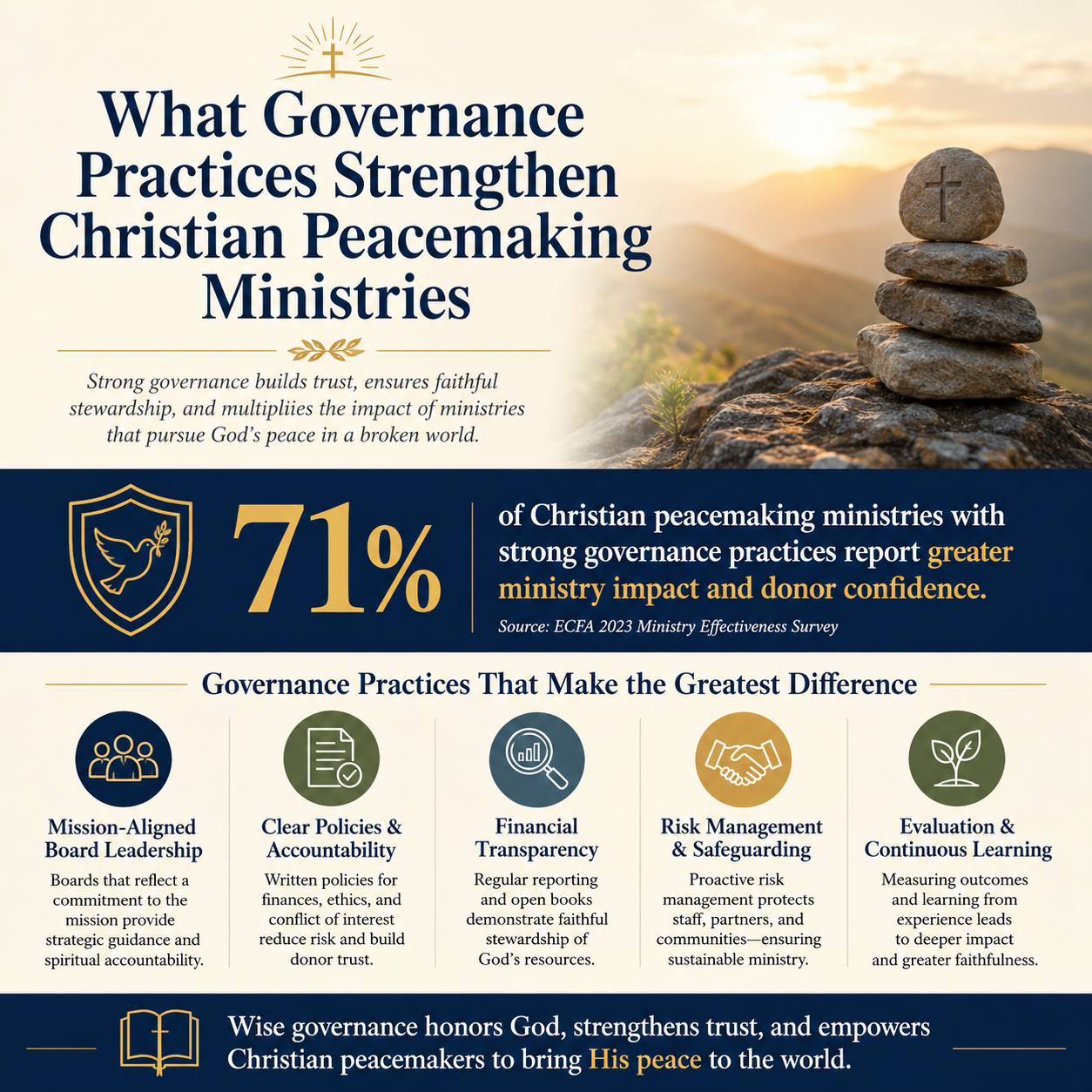
Governance practices that strengthen Christian peacemaking ministries are the ones that keep reconciliation ministry accountable to truth, protected from personality, and resilient under pressure. Donors fund more than programs; we fund authority structures, decision rights, and moral safeguards that either support faithful mediation or quietly undermine it.
Christian conflict resolution work carries unique temptations. Confidentiality can become a shield against scrutiny. A charismatic reconciler can eclipse the church’s shared discernment. And when a case involves abuse, the ministry’s commitment to “restoration” can be misapplied to minimize harm. Strong governance does not remove these tensions, but it forces them into the light and builds disciplined ways to respond.
Governance begins with a biblical theology of authority
Christian peacemaking is not simply a technique for de-escalation. It is ministry shaped by Scripture’s claims about truth, justice, repentance, and the church’s responsibility to judge rightly. Governance matters because it defines who has the authority to make hard calls when values collide: confidentiality versus disclosure, restoration versus consequences, forgiveness versus safety.
Clarify what the ministry can and cannot promise
Across our verification work at Most Trusted, the healthiest ministries are explicit about the limits of their role. They will not function as private courts. They will not promise outcomes they cannot control. And they will not imply that reconciliation requires ongoing contact in situations where safety is at stake.
A governing board should require written policies that distinguish pastoral reconciliation efforts from legal investigation, clinical care, and law-enforcement responsibilities. The ministry may walk alongside those processes, but it must not replace them.
Anchor peacemaking in justice as well as mercy
Christians genuinely disagree about how to apply Matthew 18, Galatians 6, and 2 Corinthians 5 in complex disputes. Yet Scripture does not permit governance by sentiment. “What does the LORD require of you but to do justice, and to love kindness, and to walk humbly with your God?” (Micah 6:8). Boards strengthen peacemaking when they insist that a ministry’s model includes justice for the vulnerable, not merely relational repair for the powerful.

A competent, independent board protects both parties and the mission
Peacemaking ministries often arise around founders with unusual credibility: a seasoned pastor, an experienced mediator, a well-known author. Donors may appreciate strong leadership, but founder centrality is also a governance risk. A ministry that adjudicates conflict must be structured so that no single individual can suppress dissent, silence whistleblowers, or redefine “peace” as personal loyalty.
Independence is not hostility to leadership
We recommend that boards be meaningfully independent of staff leadership. The point is not suspicion; it is accountability. In practice, independence means a majority of voting directors are neither employees nor close relatives of employees, and the board has clear authority to evaluate and, if necessary, correct executive leadership.
Where ministries work closely with churches, independence also means resisting capture by a single congregation, network, or donor bloc. The ministry’s credibility depends on its ability to render principled judgment without fear of relational fallout.
Board composition should match the ministry’s risk profile
Conflict resolution is inherently interdisciplinary. A board dominated by one vocational lane, even a wise pastoral lane, can miss critical blind spots. Strong governance tends to include directors with complementary competence: legal literacy, financial oversight, trauma-informed care, and ecclesial discernment. This is especially important where the ministry engages cases involving domestic violence, child abuse, or institutional misconduct.
Policies and controls matter because peacemaking work is high-trust and high-risk
Christian donors often assume that relational ministries need less structure. The opposite is frequently true. High-trust work requires high-quality controls precisely because the mission trades in credibility, confidentiality, and moral authority.
Conflict of interest rules must be stringent and enforced
Peacemaking ministries can be tempted to assign mediators based on relationships rather than impartiality. Governance should require an annual conflict-of-interest disclosure for directors and key staff, and it should include a recusal process that is documented in minutes.
For donors evaluating a ministry within Christian Conflict Resolution Ministries, it is reasonable to ask whether the organization can say “no” to a case when impartiality is compromised. Ministries that cannot decline conflicted cases will eventually harm the very people they intend to serve.
Case management governance must protect confidentiality without enabling secrecy
Confidentiality is ethically necessary in mediation, but secrecy is not. Boards strengthen ministries when they require clear protocols for data handling, record retention, and limited access to sensitive files. They also require exceptions: mandatory reporting obligations, credible threats of harm, and patterns of predation that cannot be treated as isolated “misunderstandings.”
Donors should not expect public disclosure of case details. They should expect transparent governance about how confidentiality is governed and who can override it.
- Written scope-of-services and referral policies for legal, clinical, and pastoral needs
- Mandatory reporting compliance protocols and staff training
- Documented mediator selection standards and conflict checks
- Secure case record practices with defined access controls
- A grievance pathway that bypasses the case team
Accountability requires measurable outcomes and honest reporting
Peacemaking outcomes are difficult to quantify without distorting the work. A “reconciliation rate” can become a vanity metric that pressures victims to comply or pressures mediators to declare success prematurely. Still, governance that avoids measurement entirely invites another distortion: ministries can drift into activity without efficacy.
Use outcomes that reflect integrity, not public relations
The best practice is not simplistic scorekeeping, but accountable learning. Boards can require the ministry to track process measures that protect participants: timeliness, completion of informed-consent steps, referral follow-through, and participant feedback gathered in a way that does not coerce positive responses.
For donors, transparency is often more meaningful than triumph. A ministry that reports hard lessons—cases declined, safeguards strengthened, boundaries clarified—may be demonstrating deeper faithfulness than one that only publishes celebratory stories.
Respect the field’s contested questions
Christians disagree about the proper relationship between church discipline, civil courts, and mediation processes. They also disagree about when separation is a legitimate expression of peace rather than a failure to reconcile. Governance strengthens ministries when it requires leaders to name these tensions in policy and training rather than improvising in crisis.
What this means in practice is that a board should review teaching materials and ensure they do not imply that forgiveness eliminates the need for consequences, or that “unity” requires silence. The New Testament’s call to peace is never a call to deny the truth.
External accountability builds credibility with churches and donors
Internal governance is necessary but not sufficient. Peacemaking ministries operate in a trust economy: churches refer cases, participants disclose painful details, and donors fund work they cannot directly observe. External accountability signals that the ministry is not self-credentialing.
Financial transparency should be disciplined, not performative
Donors should not equate low overhead with integrity; credible evaluators have warned for years that overhead ratios are a poor proxy for effectiveness. Charity Navigator, Candid, and the BBB Wise Giving Alliance jointly argued that “overhead is a misleading measure of a charity’s performance” and urged donors to look at governance, results, and transparency instead (Charity Navigator).
Strong governance includes a board-approved budget, timely financial statements reviewed by directors who can read them, and an independent audit or appropriate external financial review when scale and complexity warrant it. Ministries that handle restricted gifts, international transfers, or fee-for-service mediation should have controls proportionate to those risks.
Verification can serve the church when it is principled and consistent
Most Trusted exists because donors are often asked to make high-trust decisions with limited visibility. We evaluate ministries against The Most Trusted Standard, a 15-criteria framework covering Faith Foundation, Financial Integrity, Governance and Leadership, and Transparency and Effectiveness. In this category, the ministries that meet The Most Trusted Standard tend to show evidence of board independence, credible safeguarding, and transparent decision-making—without surrendering the pastoral discretion that sensitive cases require.
Donors discerning within How to Give Wisely to Christian Conflict Resolution Ministries should treat governance not as administrative overhead but as moral infrastructure. When reconciliation is the mission, accountability is not a distraction from ministry. It is one of the primary ways a ministry loves its neighbor in truth.
FAQs for What governance practices strengthen Christian peacemaking ministries
What should donors ask about a peacemaking ministry’s handling of abuse allegations?
Donors should ask whether the ministry has written policies for mandatory reporting, referral to qualified investigators and clinicians, and boundaries on mediation when power imbalances are severe. A strong answer will distinguish pastoral care from investigative authority, clarify who makes escalation decisions, and describe a grievance pathway that does not route complaints back through the same leaders responsible for the case.
Is a founder-led peacemaking ministry automatically a governance concern?
Not automatically. Many effective ministries begin with a founder who has unusual credibility. The governance concern arises when the board lacks independence, when decision rights are unclear, or when staff and directors cannot challenge leadership without retaliation. Donors should look for evidence that the board evaluates the executive, documents key decisions, enforces conflict-of-interest rules, and can correct course when the ministry’s influence expands.
Why governance is a spiritual issue for peacemaking work
Christian peacemaking ministries ask people to risk truth-telling, repentance, and costly forgiveness. That moral weight requires structures worthy of it. Governance practices—independent oversight, safeguarding, transparent policies, and accountable reporting—do not replace the Spirit’s work, but they can prevent the misuse of spiritual language to justify harm. For donors, funding strong governance is often one of the most practical ways to support reconciliation that is both merciful and just.



