
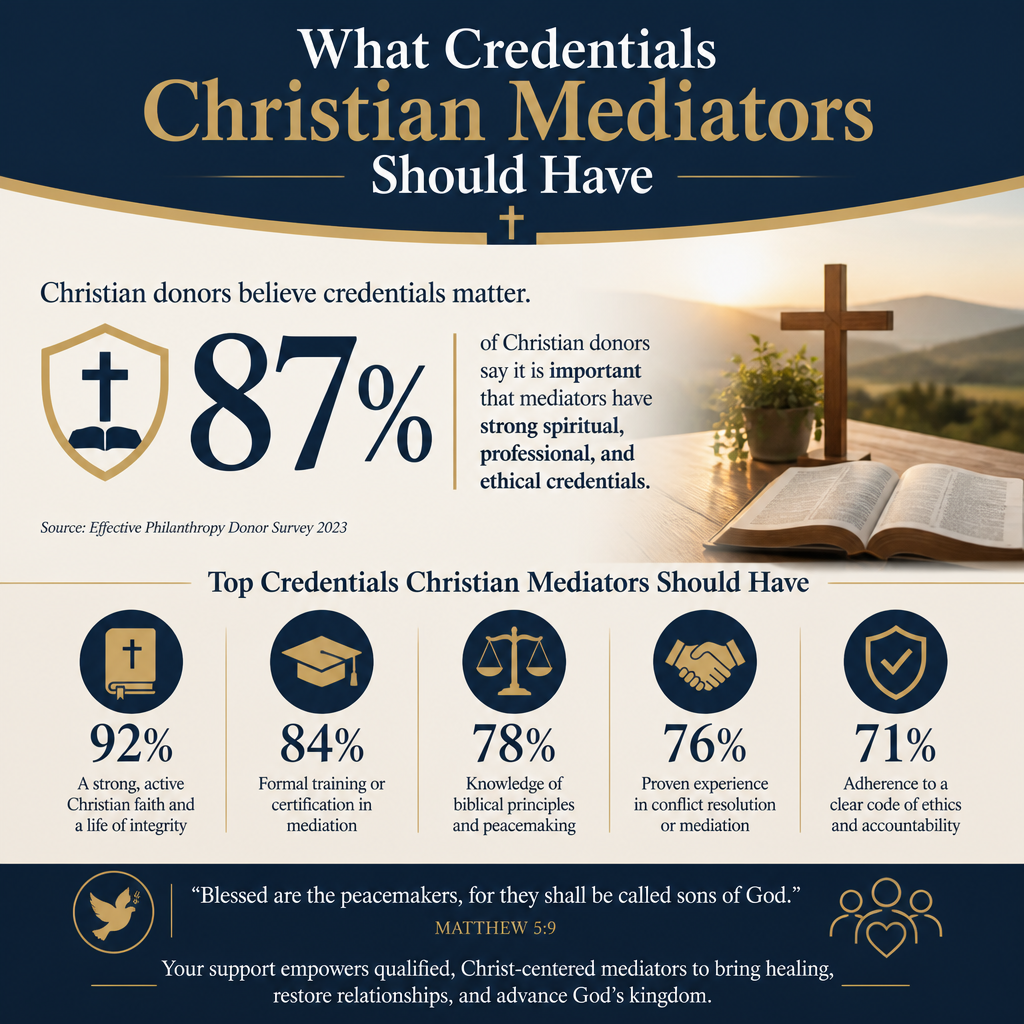
What credentials Christian mediators should have is not a merely professional question; it is a question of spiritual authority, moral credibility, and institutional accountability. Donors fund these ministries because they hope for reconciled marriages, restored churches, and peaceable communities—not simply a well-managed process.
Christian mediation sits at an unusual intersection. It draws from established dispute resolution practice, yet it also claims theological substance: that truth matters, repentance is possible, and reconciliation is a Christian mandate (2 Corinthians 5:18–19). Credentials, therefore, should signal more than competence. They should signal formation, safeguards, and a ministry’s willingness to be evaluated in ways that protect the vulnerable.
Credentialing begins with a theological anthropology
Peacemaking is not value neutral
Christian mediators do not merely broker compromise. They operate within a moral universe where God’s justice is real, where partiality is condemned, and where speech can either heal or destroy. Scripture’s counsel is direct: “If possible, so far as it depends on you, live peaceably with all” (Romans 12:18), and “Blessed are the peacemakers” (Matthew 5:9). Yet Scripture also refuses false peace. The prophetic tradition repeatedly indicts leaders who “heal the wound… lightly” (Jeremiah 6:14). A mature credentialing conversation holds both together: a commitment to reconciliation and a refusal to call coercion, concealment, or sentimental closure “peace.”
What this means in practice is that donors should look for ministries that articulate a clear theology of conflict: sin and self-interest are real, power differentials matter, and forgiveness does not erase consequences. A mediator’s training can be impressive, but if the ministry lacks theological clarity about truth-telling, repentance, and protection of the weak, credentials will not carry the weight donors assume they do.
“Christian” should describe the process, not only the parties
Christians genuinely disagree about how explicitly faith should shape mediation sessions. Some mediators will open in prayer and use Scripture as an interpretive guide; others keep Scripture in the background to maintain accessibility for mixed-faith parties. The credential question, then, is not whether every session looks the same. It is whether the ministry’s approach is coherent and accountable: the mediator knows when spiritual counsel is appropriate, when it becomes spiritual pressure, and when the matter requires pastoral discipline, legal reporting, or clinical referral.
Donors can probe this by reading a ministry’s published statement of faith, reconciliation philosophy, and safeguarding policies. Many ministries serve churches; few are willing to be evaluated as if church conflict can include misconduct, financial impropriety, or abuse. The ministries worthy of support do not treat those possibilities as unthinkable.

Professional mediation training is necessary but not sufficient
Baseline mediation formation should be verifiable
At minimum, a Christian mediator should have formal training in mediation skills: structured intake, issue identification, negotiation facilitation, caucusing, agreement drafting, confidentiality boundaries, and ethical standards. In the United States, some mediators earn court rosters or complete state-approved trainings; others pursue private mediation credentials through recognized professional associations. Donors are not responsible to master the industry, but they can ask for verifiable details: who trained the mediator, how many hours, what continuing education is required, and whether the mediator is accountable to an enforceable code of ethics.
The harder question is what kinds of cases the mediator is being asked to handle. A mediator trained primarily for neighbor disputes or small claims is not automatically equipped for complex church conflict involving allegations, employment law exposure, or reputational pressure. Competence must match the risk profile of the ministry’s caseload.
A clear ethical code should shape the ministry’s boundaries
Mediators regularly navigate conflicts of interest: a church board hires the mediator, but staff members may be the ones at risk; a ministry depends on donor goodwill, but a public report may be needed for truth-telling. Ethical training should produce written practices on neutrality, informed consent, confidentiality limits, and mandatory reporting when abuse is suspected. Those are not bureaucratic accessories. They are part of loving one’s neighbor in conditions where harm is possible.
Donors should ask whether the ministry uses written engagement agreements, how it handles allegations that arise mid-process, and whether it ever declines cases. The willingness to say “no” is often a mark of integrity, not a lack of compassion.
Case complexity requires adjacent competencies
Trauma awareness is often decisive
Many conflicts presented as “communication issues” include trauma histories, coercive dynamics, or spiritual intimidation. A mediator does not need to be a therapist to recognize when a process is becoming unsafe or when a party is dissociating, panicking, or capitulating under pressure. Donors should look for credible trauma-informed training and clear referral pathways to licensed clinicians when needed.
That concern is not speculative. The U.S. Department of Justice’s National Intimate Partner and Sexual Violence Survey reports that roughly 1 in 4 women and about 1 in 10 men have experienced contact sexual violence, physical violence, and or stalking by an intimate partner during their lifetime, a prevalence that underscores how frequently mediators may encounter abuse dynamics even when parties initially frame the dispute differently. Centers for Disease Control and Prevention
A Christian ministry that mediates marital conflict without the ability to recognize domestic abuse warning signs is not merely under-credentialed; it is operating without the protections the vulnerable require.
Church governance and employment realities cannot be ignored
Church conflicts routinely touch governance documents, bylaws, denominational procedures, and employment considerations. A mediator should not act as legal counsel unless qualified and retained as such, but effective mediation often depends on knowing the difference between a spiritual disagreement and a matter that triggers fiduciary duties, HR practice, or legal exposure. Donors can ask whether the ministry has access to qualified counsel for consultation, whether it distinguishes mediation from investigation, and whether it has written escalation protocols.
Across our verification work at Most Trusted, we see that ministries that handle complex disputes well tend to have interdisciplinary capacity: trained mediators, pastoral wisdom, trauma awareness, and governance literacy. A single charismatic “peacemaker” without a team, policies, and accountability usually cannot sustain excellence under pressure.
Credentials must be matched by character and accountability
Christian mediators should be spiritually formed and supervised
Because Christian mediators often work with confession, forgiveness, and repentance, they occupy a quasi-pastoral role even when they are not ordained. That role requires spiritual maturity. Donors should look for evidence of formation: active membership in a local church, endorsement from recognized ecclesial leadership, ongoing supervision or mentoring, and disciplined boundaries around spiritual authority.
Scripture’s qualifications for spiritual leadership emphasize character over performance—self-control, gentleness, integrity, and a proven reputation (1 Timothy 3:1–7). Mediation credentials cannot replace those qualities; they can only support them.
Safeguarding and grievance processes reveal seriousness
Any ministry working with conflict should assume that complaints will occur: parties will feel misheard, power imbalances will surface, and allegations may emerge. A credible ministry publishes a grievance process, explains how complaints are investigated, and maintains independent oversight when accusations concern staff leadership. This is not cynicism; it is a recognition that sinners mediate among sinners, and accountability is one of God’s mercies.
Donors should also expect basic protections: background checks where appropriate, documented safeguarding training, and clarity about mandatory reporting obligations. Where a ministry serves minors, victims of abuse, or vulnerable adults, these safeguards are not optional extras.
- Verifiable training: documented mediation education and continuing education.
- Ethical standards: a written, enforceable code and clear conflict-of-interest rules.
- Case-fit clarity: stated scope of practice and referral criteria for high-risk cases.
- Trauma competence: training and protocols for coercion, abuse, and unsafe dynamics.
- Accountability: supervision, grievance processes, and independent board oversight.
For donors, the question is not credentials alone but institutional trustworthiness
What donor diligence should reasonably include
Donors are not called to become professional evaluators, but Christian stewardship does require sobriety. When a ministry claims to reconcile families and churches, the impact can be holy and life-giving—or it can compound harm by pressuring victims toward premature “forgiveness,” shielding misconduct, or confusing confidentiality with concealment. The call to reconciliation never negates the call to justice.
Prudent donor diligence asks for more than resumes. It asks for governance, financial integrity, and evidence that a ministry can handle uncomfortable truths. That is one reason Most Trusted evaluates nonprofits against The Most Trusted Standard, a 15-criteria framework that examines theological commitments, financial integrity, governance and leadership, and transparency and effectiveness. The point is not to replace the church’s discernment, but to strengthen it with verifiable evidence.
Where to look when ministries present impressive credentials
Credentials can signal seriousness, but they can also be used as a proxy for trust. Donors should therefore look at the ministry’s track record and disclosures: What outcomes does it report? What does it measure? Does it publish policies? Does it acknowledge limitations? Ministries that speak as if every conflict can be mediated to mutual agreement may be underestimating the reality of hardened hearts, systemic injustice, or criminal wrongdoing.
It is also wise to understand the broader ecosystem of Christian Conflict Resolution Ministries—not to reduce discernment to categories, but to see how different models handle authority, ecclesiology, and safeguarding under real-world pressure.
Donors who want to place that discernment within practical giving decisions can also consult How to Give Wisely to Christian Conflict Resolution Ministries, where the donor’s questions about credibility, safeguards, and evidence of effectiveness can be asked without embarrassment.
FAQs for What credentials Christian mediators should have
Should Christian mediators be licensed counselors or therapists?
Not always. Mediation and therapy are distinct practices with different aims and regulatory structures. For cases involving trauma, abuse dynamics, or severe mental health concerns, a mediation ministry should have trauma-informed training and clear referral pathways to licensed clinicians. Donors should be cautious of ministries that attempt to handle complex clinical realities without appropriate qualifications or partnerships.
Is ordination required for a Christian mediator to be credible?
Ordination is not required for competency in mediation, but spiritual authority should be accountable. A credible Christian mediation ministry can demonstrate ecclesial endorsement, spiritual maturity, and clear boundaries about what is pastoral counsel versus what is structured dispute resolution. Donors should place more weight on verifiable accountability, safeguarding, and ethical practice than on titles alone.
Credentials should serve reconciliation without sacrificing truth
The credentials Christian mediators should have are the ones that protect the vulnerable, clarify the mediator’s authority, and support durable outcomes under scrutiny. Donors can honor the biblical call to peacemaking while refusing false peace. The ministries most worthy of support treat reconciliation as a holy work that requires both skill and accountability, because the people caught in conflict are never abstractions; they are image-bearers, and Christ’s name is at stake.



