
Why Christian reconciliation ministries require accountability boards is not a bureaucratic question. It is a spiritual and fiduciary question about whether a ministry’s pursuit of peace is itself governed by the fear of the Lord, the protection of the vulnerable, and the kind of shared authority that Scripture assumes when it speaks about leadership in the church.
Reconciliation work regularly touches trauma, power, disputed narratives, and high-stakes decisions. Donors often support these ministries because they long to see families restored, churches healed, and public witness strengthened. But the same dynamics that make reconciliation holy work also make it uniquely susceptible to drift, coercion, and quiet conflicts of interest. An accountability board is one of the primary instruments God has given institutions to resist those failures.
Reconciliation is a sacred ministry with predictable governance risks
Christian reconciliation ministries do not merely offer information or services. They enter contested relationships where one party may have more power, better social standing, or greater rhetorical skill. The ministry’s counsel can influence whether a victim feels safe to speak, whether a perpetrator faces consequences, whether a church reports abuse, and whether leaders are confronted or protected.
Scripture assumes that judgment and counsel must be administered with integrity. “Better is a poor man who walks in his integrity than a rich man who is crooked in his ways” (Prov. 28:6). Integrity does not emerge from sincerity alone. It is cultivated through structures that expose decisions to scrutiny and correct leaders when their interests and God’s justice diverge.
Why the same virtues can become liabilities
Reconciliation ministries emphasize forgiveness, humility, patience, and forbearance. Those virtues are biblical. Yet they can be weaponized if a ministry lacks clear standards and oversight. Calls for “quick reconciliation” can become pressure on victims to resume unsafe proximity. Appeals to “covering” leaders can become a rationale for secrecy. A healthy board does not diminish grace; it helps ensure grace is not used to excuse harm.
Complex cases demand more than a founder’s discernment
Many reconciliation organizations begin with a gifted peacemaker whose wisdom is real and hard-won. But gift-based leadership, left unchecked, can become personality-based authority. Boards provide a counterweight: not to stifle founders, but to keep the ministry anchored when complexity exceeds one person’s judgment or when the leader’s blind spots become systemic.

Accountability boards are a practical expression of biblical leadership
The New Testament’s pattern of shared leadership is not an incidental detail. Paul and Barnabas were “appointed elders” (plural) in the churches (Acts 14:23). The early church navigated a doctrinal crisis through a council-like process that included debate, testimony, and judgment (Acts 15:1–29). Even when apostolic authority was present, the church practiced deliberation, corroboration, and communal responsibility.
An accountability board is not identical to a body of elders, and Christians genuinely disagree about how closely nonprofit governance should mirror ecclesial governance. Still, donors can reasonably expect a reconciliation ministry to embody the moral logic of the church: leaders should be accountable, decisions should be reviewable, and authority should be distributed enough to prevent quiet domination.
Authority is legitimate when it is answerable
Scripture warns that leaders “will have to give an account” (Heb. 13:17). That verse is often cited to encourage trust in leaders. Its sharper edge is responsibility: leaders are accountable before God, and institutions should reflect that accountability in tangible ways. A board creates a mechanism for asking hard questions when outcomes are disputed and when parties claim they were harmed by the ministry’s intervention.
Boards help safeguard truth-telling
Reconciliation depends on truth. “Speak the truth with his neighbor” is not optional because we are members of one body (Eph. 4:25). But truth-telling is difficult in emotionally charged conflict. Boards can require consistent documentation, formal grievance pathways, and external review when serious allegations arise. Without those tools, ministries drift toward narrative control rather than truth.
Donors underwrite not only outcomes, but moral credibility
Donors rarely fund reconciliation ministries because they want an impressive brand. They fund them because the credibility of Christian witness is at stake. When reconciliation is pursued without justice, the watching world notices. When ministries protect the powerful, churches fracture, victims leave, and confidence in Christian leadership corrodes.
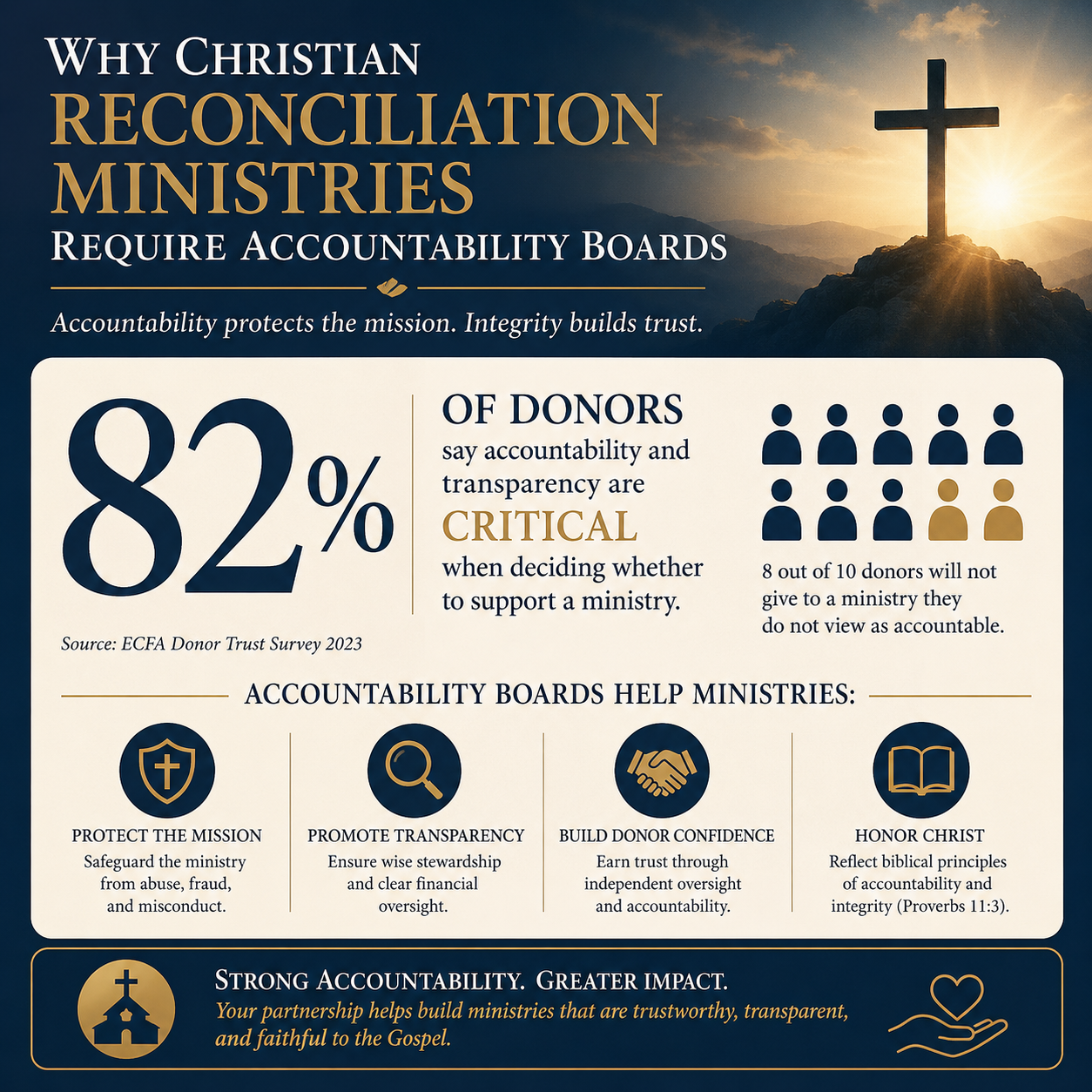
Philanthropic trust is also fragile. The broader nonprofit sector has learned that donor confidence is closely tied to governance and transparency, not simply program claims. In its summary of public trust in charities, the Charity Commission for England and Wales reports that maintaining public confidence is a central concern of charity regulation, reflecting the direct link between trust and charitable effectiveness (Charity Commission).
Reconciliation work amplifies the cost of mistakes
In many program areas, a governance failure wastes money. In reconciliation work, it can also re-traumatize people, distort church discipline, or discourage reporting of abuse. That is why donors should treat board accountability as a mission-critical safeguard rather than administrative overhead.
The credibility test is often internal, not public
Some ministries appear credible publicly while experiencing deep internal dysfunction. A mature board asks questions that press past public messaging: How are staff treated? How are complaints handled? Are ministry interventions evaluated for harm as well as benefit? A donor’s stewardship is better served when these questions are answered before a crisis forces them into the open.
What a credible accountability board looks like in practice
Not every board is a safeguard. Some boards are ceremonial, loyal to a founder, or populated by close friends who cannot exercise independent judgment. Donors should look for governance practices that create real accountability, not symbolic oversight.
Across Most Trusted’s verification work, the ministries that meet The Most Trusted Standard tend to treat governance as a spiritual responsibility and a practical discipline. That includes documented policies, transparent reporting lines, and credible checks on executive authority.
Key markers donors can ask to see
- Board independence, including a meaningful majority of directors who are not employees, contractors, or close relatives of senior leaders
- Regular executive evaluation, with documented goals, performance review, and a defined process for corrective action
- Conflict-of-interest policy that is signed annually and enforced in board minutes when recusals occur
- Clear complaint and whistleblower pathways, including an option that bypasses executive leadership
- Financial oversight that includes budget approval, review of restricted funds, and independent accounting review when scale warrants it
Why independence matters more than prestige
Donors sometimes assume that prominent names create credibility. Prominence can help, but independence is more protective. A board member who cannot challenge a founder is a liability, not an asset. A reconciliation ministry should be able to articulate how its board makes decisions, how it handles disagreement, and how it corrects leaders when needed.
How accountability boards fit into wise Christian giving
Christian donors often experience a tension here. We want to fund peacemaking without funding bureaucracy. We also want to honor leaders who have spent decades serving the church. Yet Scripture does not pit spiritual fruit against prudent oversight. Proverbs repeatedly commends counsel and warns against unaccountable certainty (Prov. 11:14; 15:22).
What this means in practice is that board accountability should be part of a donor’s discernment, alongside theology, outcomes, and integrity. Donors seeking broader context on the field can begin with Christian Conflict Resolution Ministries, where the underlying ministry models and common risk areas become clearer.
Verification can reduce the burden on donors
Most donors are not positioned to audit governance documents or assess whether policies are lived rather than merely written. Most Trusted exists to serve donors in precisely this gap by evaluating ministries against The Most Trusted Standard, a 15-criteria framework spanning Faith Foundation, Financial Integrity, Governance and Leadership, and Transparency and Effectiveness. A donor can still ask direct questions, but independent verification helps confirm whether the answers are supported by evidence.
Accountability is not suspicion; it is stewardship
Some leaders hear donor questions about boards as mistrust. Mature ministries understand it differently. Because reconciliation work handles fragile lives and contested stories, it requires unusually strong safeguards. Donors who ask for accountable governance are not demanding perfection; they are seeking evidence that a ministry is structured to repent, repair, and learn when it falls short.
For donors thinking through giving decisions and due diligence expectations across this category, How to Give Wisely to Christian Conflict Resolution Ministries provides a more complete set of questions to ask before supporting a peacemaking organization with complex caseloads.
FAQs for Why Christian reconciliation ministries require accountability boards
Is an accountability board necessary if the ministry is led by respected pastors and counselors?
Yes. Respected leaders still face conflicts of interest, fatigue, and blind spots, and reconciliation cases can pressure even mature pastors toward partiality. A board provides structured, documented oversight that does not depend on one leader’s self-awareness. The goal is not to undermine pastoral authority, but to ensure that authority is exercised with safeguards appropriate to the stakes.
What should donors do if a reconciliation ministry refuses to share basic governance information?
Donors should slow down and treat the refusal as a material risk. A ministry does not need to disclose sensitive case details, but it should be able to explain board composition, independence, complaint pathways, financial oversight, and how leaders are evaluated. If those basics are not available, donors can redirect support toward ministries that demonstrate accountable governance and transparent practices consistent with Christian stewardship.
The kind of peace Scripture commends requires accountable institutions
Christian reconciliation is not conflict avoidance. It is the pursuit of truth, justice, repentance, and restored communion where restoration is possible. Accountability boards help ensure that a ministry’s call to peace is governed by integrity, not personality; by shared judgment, not private control; and by structures that protect the vulnerable as a matter of Christian obedience.



