
Signs a Christian conflict resolution ministry is trustworthy are rarely found in marketing claims; they are found in verifiable patterns of doctrine, practice, and accountability over time. Donors who care about reconciliation in Christ often feel a particular tension: conflict work is deeply spiritual, but it is also procedural, legal-adjacent, and vulnerable to misuse when power is involved.
The New Testament refuses to treat peacemaking as optional. Jesus blesses the peacemakers as children of God (Matthew 5:9), and Paul commands the church to pursue the unity purchased by Christ’s blood (Ephesians 4:1–3). Yet Scripture is equally clear that false peace is not biblical peace. Some ministries promise “unity” in ways that silence victims, minimize serious sin, or bypass appropriate authorities. Trustworthiness, then, is not a vague impression. It is evidence that a ministry tells the truth, protects the vulnerable, and handles money and power with fear of God.
1) Trustworthy ministries name what reconciliation is and what it is not
They teach a doctrine of reconciliation shaped by Scripture
Christian conflict resolution sits under a larger biblical theology: God reconciles sinners to himself through Christ, and reconciled people are called to pursue peace with one another (2 Corinthians 5:18–19). A trustworthy ministry can articulate this clearly and apply it carefully. It will distinguish between forgiveness and reconciliation, between personal offense and criminal harm, and between ordinary church conflict and patterns of abuse.
Across our verification work at Most Trusted, ministries that meet The Most Trusted Standard tend to state their theological commitments in writing, and those commitments show up consistently in their materials, not only in donor-facing messaging. When a ministry’s “statement of faith” is generic but its practice consistently pressures quick closure, donors should ask whether the ministry’s functional theology is closer to conflict avoidance than biblical peacemaking.
They reject coercive peace and spiritualized shortcuts
Christians genuinely disagree about how quickly reconciliation can be pursued in complex cases, but there is broad agreement that reconciliation cannot be coerced. A trustworthy ministry avoids using Scripture as a tool of control—proof-texting submission, demanding silence “for unity,” or treating a refusal to reconcile as automatic disobedience. It will teach that repentance includes truth-telling, repair where possible, and submission to appropriate discipline (Luke 3:8; Matthew 18:15–17).
The harder question is how the ministry handles scenarios where “peacemaking” intersects with safety and justice: domestic violence, sexual abuse, stalking, credible threats, or misuse of ecclesial authority. Trustworthy ministries do not treat police involvement, medical care, or protective orders as faithlessness. They treat them as part of living in God’s common grace structures while the church fulfills its spiritual responsibilities.

2) Trustworthiness shows up in safeguards, not charisma
They have clear boundaries, qualifications, and a referral posture
Conflict resolution ministries often attract gifted communicators—people who can sit in the heat of anger and speak calmly about peace. That gift is valuable, but it is not a safeguard. Donors should look for ministries that describe their scope of practice with precision: what kinds of cases they take, what they will not take, and when they refer out to licensed clinicians, attorneys, law enforcement, or specialized abuse experts.
A ministry can be both spiritually serious and professionally responsible. Many of the most credible organizations train through established peacemaking frameworks (for example, the principles popularized in Ken Sande’s The Peacemaker) while maintaining boundaries about trauma, mental illness, and criminal conduct. When a ministry claims it can handle every situation “biblically” without external expertise, donors should treat that as a warning, not a mark of faith.
They protect confidentiality without hiding wrongdoing
Confidentiality is central to mediation and conciliation, but secrecy is not. Trustworthy ministries explain confidentiality in plain language, including what cannot be kept confidential: threats of harm, abuse of a minor, or other situations governed by mandatory reporting laws. They have written policies, train staff and volunteers, and document that training.
The field has had to reckon with how confidentiality can be misused as a shield for institutions. Donors should ask whether the ministry’s practices help illuminate truth or bury it. If the ministry’s model makes it easy for powerful parties to control the narrative, that is not reconciliation; it is managed risk.
- Written case intake standards, including exclusions for high-risk situations
- Mandatory reporting policy consistent with state law
- Clear confidentiality statement with defined exceptions
- Safeguards against conflicts of interest, especially when a pastor is a party
- Referral network for trauma-informed clinical care and legal counsel
3) Financial integrity is a theological issue, not an administrative detail
They treat donors as stewards, not revenue sources
Jesus’s warnings about money are warnings about worship. A ministry can speak often about peace while quietly shaping its internal culture around fundraising pressure. Trustworthy ministries fund their work in ways that do not create perverse incentives—especially incentives to keep cases going unnecessarily, to promise outcomes they cannot ensure, or to accept engagements that compromise safety.
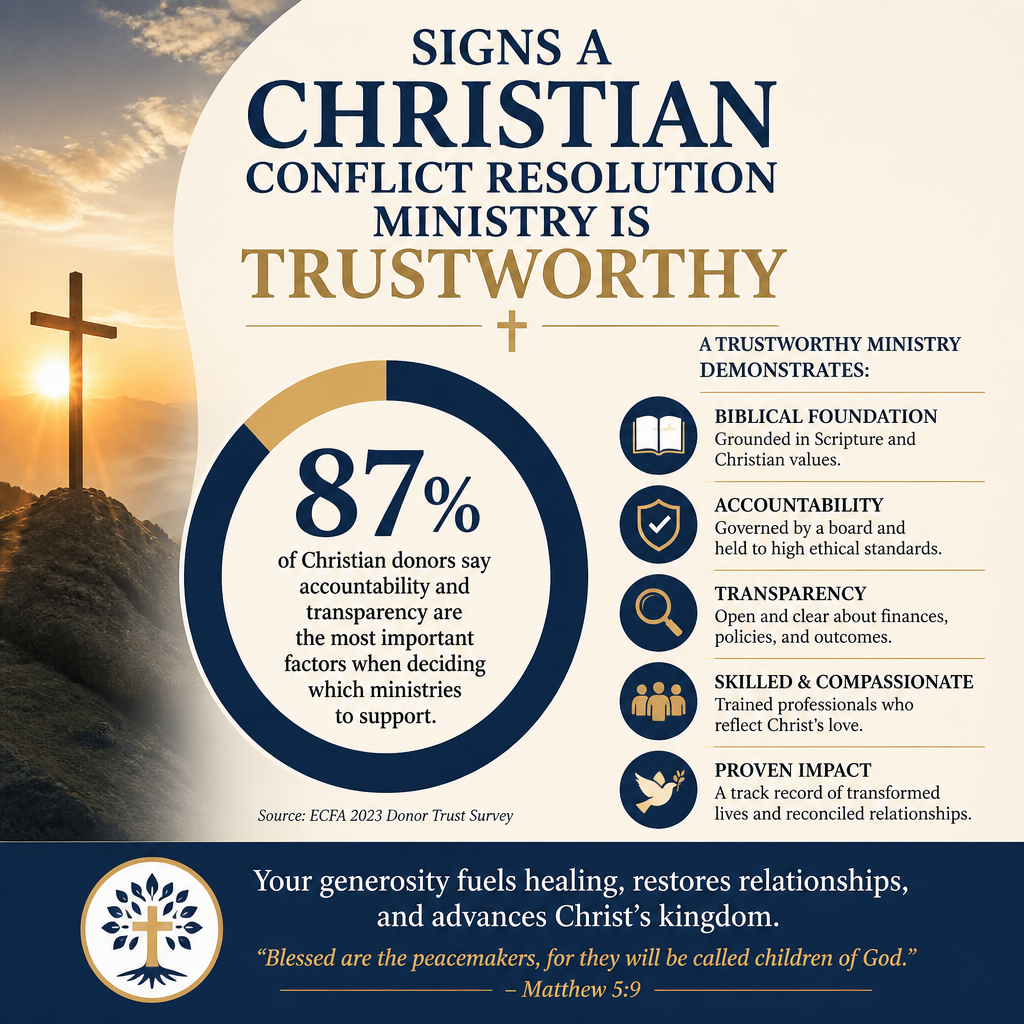
Donors should expect clean, legible financial reporting. For U.S. nonprofits, the IRS requires an annual Form 990 for most tax-exempt organizations, and it is a meaningful baseline for financial transparency and governance disclosures; the IRS describes public availability requirements and provides guidance on exempt organizations and returns at IRS Charities and Nonprofits. A trustworthy ministry will make its Form 990 easy to find, will answer questions without defensiveness, and will explain major revenue sources and significant expense categories in a way that fits what it claims to do.
They do not weaponize overhead ratios
Some donors still evaluate ministries primarily by administrative overhead. That impulse is understandable, but it can distort decision-making. The most credible guidance in the sector has repeatedly cautioned against simplistic overhead metrics. The joint “Overhead Myth” letter, signed by GuideStar (now Candid), BBB Wise Giving Alliance, and Charity Navigator, argues that overhead ratios are a poor proxy for impact and can incentivize underinvestment in accountability and infrastructure; see Candid on the Overhead Myth.
What this means in practice is that a trustworthy conflict resolution ministry will invest appropriately in case documentation, training, supervision, and safeguarding. Those investments cost money. The question is not whether the ministry has expenses; it is whether those expenses are governed transparently and ordered toward faithful mission.
4) Governance and leadership reveal whether power is ordered toward service
Boards that actually govern
Conflict resolution work places ministries near the fault lines of church life: pastoral authority, reputational risk, and the temptation to protect institutions over people. A ministry that cannot hold itself accountable should not be mediating accountability for others. Donors should examine whether the board is independent enough to govern the CEO, set policy, manage conflicts of interest, and respond to complaints.
Across our evaluation process at Most Trusted, governance tends to be one of the clearest separators between ministries that are merely impressive and ministries that are dependable under pressure. Trustworthy organizations document board membership, terms, meeting cadence, and conflict-of-interest disclosures. They do not treat governance as a ceremonial requirement.
Leaders who submit to scrutiny and correction
Because conflict work can be reputation-sensitive, leaders may be tempted to keep processes opaque. A trustworthy ministry’s leadership communicates with clarity about decision-making authority: who determines case acceptance, who assigns mediators, who reviews complaints, and who can remove a mediator or terminate an engagement. Donors should expect pathways for escalation when clients believe the ministry has mishandled a case.
Christian donors should also ask how leaders handle public repentance when needed. Scripture’s vision of leadership is not perfectionism; it is humility under Christ’s lordship (1 Peter 5:2–3). Ministries that cannot say, in substance, “we were wrong and have changed our practice,” often lack the moral formation required to handle other people’s crises.
For donors assessing organizations in this space, it can be helpful to view the broader landscape of Christian Conflict Resolution Ministries and compare how different groups describe their authority, safeguards, and accountability.
5) Transparency and effectiveness must fit the nature of the work
They are transparent about methods, limits, and outcomes
Effectiveness in conflict resolution is harder to measure than meals served or Bibles distributed. Some results are private by necessity, and some cases end without reconciliation despite faithful effort. Donors should not demand simplistic metrics. Yet it is reasonable to expect ministries to describe what they do in operational terms: mediation, conciliation, coaching, training, policy consulting, or abuse-response support—each with distinct goals and risks.
Trustworthy ministries can report activity without violating confidentiality: number of trainings delivered, leaders trained, cases opened and closed, average time to resolution, and client satisfaction data gathered ethically. When a ministry reports outcomes, donors should listen for theological honesty: reconciliation cannot be manufactured, and justice can require consequences that feel costly to an institution.
They can show a credible approach to learning and quality control
In a field shaped by human sin, a ministry’s learning posture matters. Donors should look for routine debriefing, supervision, and continuing education for mediators. If volunteers do the bulk of casework, the ministry should be explicit about screening, training hours, supervision structure, and removal procedures. If staff lead cases, donors should still expect professional development and outside input.
The Most Trusted Standard is designed to translate these concerns into verifiable criteria across faith commitments, finances, governance, and public accountability. For donors who want a disciplined way to evaluate ministries without reducing discernment to a gut feeling, Most Trusted’s verification work exists to help you give with confidence while honoring the complexity of the work.
FAQs for Signs a Christian conflict resolution ministry is trustworthy
Should a conflict resolution ministry ever tell someone to avoid reporting a crime?
No. A trustworthy Christian conflict resolution ministry will never counsel a victim or witness to evade lawful reporting obligations or to conceal credible criminal conduct. Christian ethics recognizes the legitimacy of civil authority in restraining evil (Romans 13:1–4). Ministries can and should provide pastoral and practical support, but they should not position “church handling” as a substitute for lawful action in situations involving abuse, violence, or credible threats.
What documents should donors reasonably expect a trustworthy ministry to provide?
Donors should expect, at minimum, a clear statement of faith, a description of services and limits, written safeguarding and confidentiality policies with defined exceptions, board and leadership information, and accessible financial disclosures such as an IRS Form 990 for U.S. nonprofits. When donors want to go deeper, it is reasonable to ask for conflict-of-interest policies, complaint and escalation procedures, and evidence of training and supervision for those doing casework.
A trustworthy ministry makes reconciliation credible
Christian donors support conflict resolution ministries because we believe the gospel creates a different kind of community—one where truth is told, sin is confronted, and peace is pursued without sacrificing the vulnerable. The signs of trustworthiness are therefore not cosmetic. They are the steady marks of ministries that submit their theology, money, power, and practices to accountability.
For donors making decisions in this space, the disciplines gathered under How to Give Wisely to Christian Conflict Resolution Ministries can help keep compassion aligned with prudence. The church’s pursuit of peace is too important to fund carelessly, and too holy to entrust to institutions that cannot bear scrutiny.



