

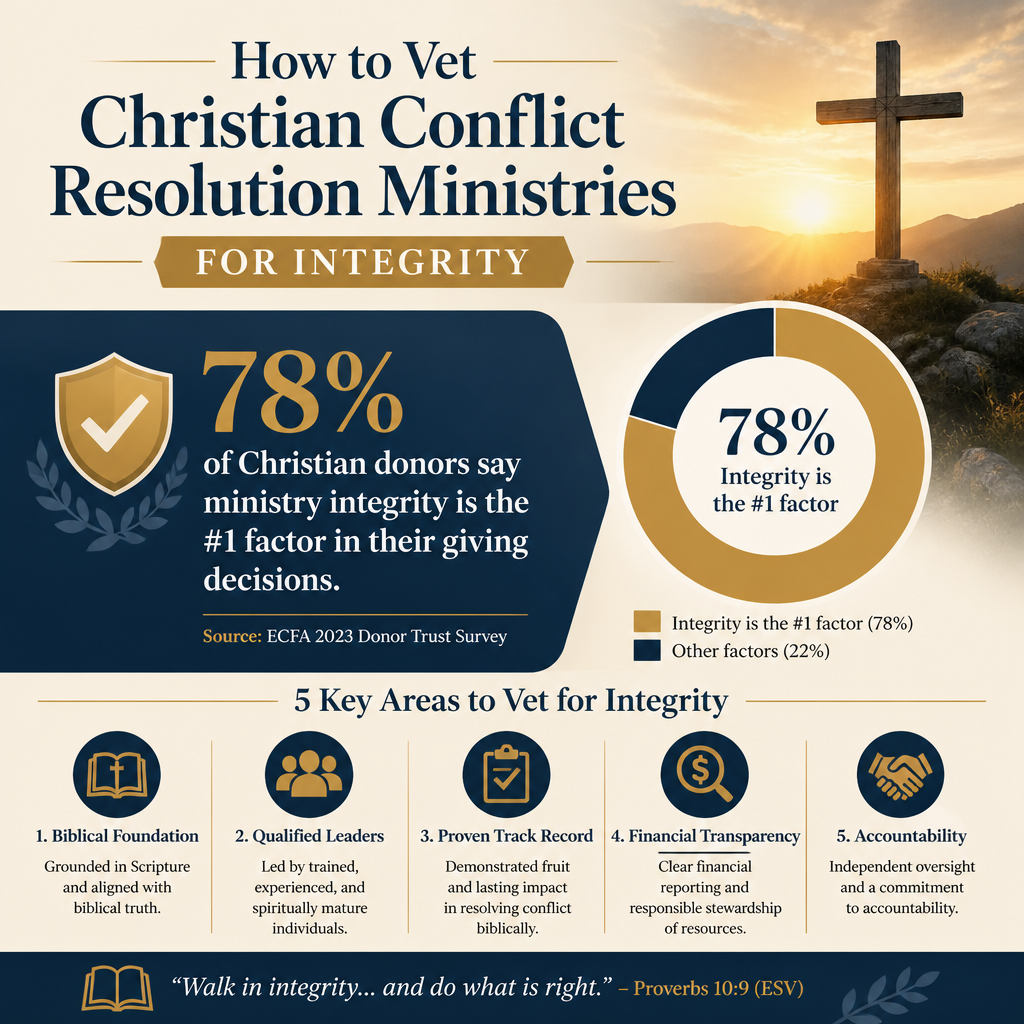
Vetting Christian conflict resolution ministries for integrity is not a secondary exercise in donor caution; it is a matter of moral stewardship. These ministries often step into moments of deep relational fracture—marriages at the edge, churches split by accusation, leaders under investigation, victims seeking protection, offenders seeking restoration. In that terrain, a ministry’s methods can heal or deepen harm, and its theology can either uphold truth with mercy or weaponize “peace” against the vulnerable.
Scripture is clear that reconciliation is a Christian obligation. God “gave us the ministry of reconciliation” (2 Corinthians 5:18). Yet Scripture is equally clear that false peace is a judgment, not a virtue: “They have healed the wound of my people lightly, saying, ‘Peace, peace,’ when there is no peace” (Jeremiah 6:14). Integrity in conflict resolution is the disciplined refusal to trade truth for speed, silence for unity, or institutional preservation for justice.
Start with the ministry’s theology of reconciliation and justice
Many ministries speak the language of peace, forgiveness, and unity. The harder question is what they mean by those words when power is unequal and harm is real. Christian donors should listen for a theology that can name sin plainly, protect the vulnerable decisively, and still hold out gospel hope for repentance and restoration.
Look for reconciliation that does not bypass truth
In the New Testament, reconciliation is never separated from repentance, confession, and reparative action. A ministry operating with integrity will not treat reconciliation as a technique for quickly reducing tension. It will treat reconciliation as a moral process that begins with truth-telling and ends, when possible, in restored relationships that are safe and honest.
Verifiable markers include written principles on confession, repentance, restitution, and accountability; training materials that address coercion and manipulation; and policies that acknowledge that some relationships require boundaries rather than proximity. Donors should be cautious of ministries that describe conflict primarily as “misunderstanding” or “two sides” without the category of wrongdoing, especially where abuse is alleged.
Test their doctrine of the church and of authority
Conflict resolution ministries routinely interact with church governance, discipline, and leadership power. Christians genuinely disagree about how authority should be exercised across traditions, but integrity requires clarity. A ministry should explain how it relates to local elders, denominational structures, and civil authorities, and it should be explicit about when it will recommend outside reporting or independent investigation.
When a ministry speaks as if protecting the church’s “witness” is the supreme value, donors should ask whether the ministry can name the biblical priority of protecting the oppressed and pursuing justice. Scripture condemns partiality and corruption with unusual directness (Isaiah 1:17; James 2:1–9). A reconciliation ministry that cannot confront partiality is not equipped for the conflicts that most need its help.

Verify safeguarding practices for abuse and power imbalance
Conflict resolution is often requested in cases that include intimidation, spiritual abuse, financial coercion, or sexual misconduct. Treating those as ordinary “relational conflict” is a predictable category error. Integrity means knowing when mediation is inappropriate and when specialized safeguarding and independent oversight are required.
Require written protocols for abuse disclosures
Donors should ask for written policies on mandatory reporting, referrals to professional counselors, and processes for handling allegations against leaders. Where the ministry serves churches, it should be clear about how it prevents leaders from using reconciliation language to pressure victims into silence, premature forgiveness, or unsafe proximity.
As a practical matter, donors should also expect ministries to be conversant with mainstream safeguarding standards. For example, many churches use third-party background screening as a baseline risk-reduction practice. The National Center for Missing & Exploited Children estimates that “1 in 10 children will be sexually abused before their 18th birthday,” a sobering figure that underscores why ministries working near family systems and church leadership must treat safeguarding as essential, not optional National Center for Missing & Exploited Children.
Ask how they handle confidentiality, records, and conflicts of interest
Confidentiality can protect the vulnerable, but it can also shield wrongdoing. Ministries with integrity explain, in writing, what confidentiality means, what exceptions exist, who owns case records, and how records are secured and retained. They also disclose how they manage conflicts of interest, especially when a church or ministry leadership is paying for services while also being the subject of allegations.
Donors should be wary of any ministry that cannot describe an escalation pathway when leadership is implicated: independent investigators, external advisors, or board-level oversight that is not controlled by the accused party. A conflict resolution ministry that depends on continued access to influential leaders may face subtle incentives to preserve relationships rather than tell the truth.
Evaluate governance and accountability beyond charisma
Many conflict resolution ministries are built around a founder, a methodology, or a compelling personal narrative. Mature donors should appreciate expertise while still insisting on accountable structures. A ministry can be theologically sound and methodologically capable and still fail under weak governance.
Inspect board independence and decision rights
Good intentions do not replace oversight. A board should have real authority, not merely advisory symbolism. Donors should look for a board that is meaningfully independent of staff, meets regularly, keeps minutes, and has clear policies on executive compensation, related-party transactions, and conflicts of interest.
For ministries receiving public charitable gifts, transparency is not merely courtesy; it is part of faithful stewardship. One practical starting point is whether the ministry files an annual Form 990, which provides donors a standardized view into governance, leadership compensation, and financial priorities Internal Revenue Service.
Look for ethical boundaries in services and pricing
Conflict resolution ministries often provide training, consulting, mediation, and investigations. Those services can be legitimately priced, but donors should still ask about ethical boundaries: Do they sell certification that implies competence without meaningful assessment? Do they accept cases where they are both “mediator” and “advocate” for one side? Do they offer packaged services that blur pastoral care, legal strategy, and public relations?
Integrity in this field includes refusing work that would predictably compromise impartiality, even when the budget pressure is real. This is where governance matters: a board must be willing to forego revenue that would purchase influence at the cost of truth.
Follow the money with discipline, not suspicion
Financial integrity is not reducible to low overhead or a lean staff. The Overhead Myth statement—signed by Charity Navigator, GuideStar, and the BBB Wise Giving Alliance—argues that simplistic overhead ratios can mislead donors and harm nonprofits by discouraging investment in capacity and accountability Charity Navigator. The question is not whether a ministry spends on staff, training, or legal counsel; the question is whether those expenditures are aligned with mission and handled with documented controls.
Check for audited statements and internal controls
Not every small ministry can afford a full audit each year, but donors can still look for graduated accountability: reviewed financial statements, an independent treasurer, segregation of duties, and clear approval thresholds for spending. Ministries that handle sensitive cases also tend to carry elevated legal and reputational risks, making prudent financial practices more than administrative hygiene.
Donors should ask whether restricted gifts are tracked and honored, whether there is a whistleblower policy, and whether the ministry has processes for handling refunds or disputes. In a field that may involve contested narratives, financial controls protect both the ministry and the people it serves.
Assess fundraising truthfulness and outcomes reporting
Conflict resolution results can be difficult to quantify. Not every case ends in visible reconciliation, and some faithful outcomes involve separation, discipline, or legal reporting. Still, integrity requires that ministries do not market outcomes they cannot substantiate or tell stories that obscure ongoing risk.
A responsible ministry will communicate results with appropriate restraint: what services were provided, what practices guide them, what limitations exist, and what third-party feedback they seek. Donors should be cautious about “guaranteed” reconciliation, exaggerated claims of transformation, or testimonies presented without disclosure of selection bias and follow-up limitations.
Use a rigorous, repeatable verification lens
Discernment is not the same as cynicism, but it does require more than intuition. Mature donors often support multiple ministries across different sectors, and the only sustainable approach is a repeatable framework that can be applied with discipline. At Most Trusted, we evaluate ministries against The Most Trusted Standard, a 15-criteria framework across Faith Foundation, Financial Integrity, Governance and Leadership, and Transparency and Effectiveness.
Ask for evidence, not assurances
When ministries invite trust, donors can honor that invitation by asking for documentation rather than settling for verbal reassurance. The ministries that meet The Most Trusted Standard tend to welcome careful questions, because they understand that accountability is part of Christian witness. They can produce policies, board lists, financial statements, and clear descriptions of how they handle risk.
What this means in practice is that donors should request a small set of concrete items and evaluate their quality, not merely their existence. A “policy” that is a paragraph long and never reviewed is not the same as a policy embedded in staff training and board oversight.
A short integrity checklist for donor due diligence
- Written safeguarding policies that address abuse, reporting, and when mediation is inappropriate
- Clear theological commitments that hold justice and mercy together without coercion
- Board independence with conflict-of-interest and whistleblower protections
- Transparent financial reporting, including Form 990 availability and credible financial controls
- Honest communications about outcomes, limitations, and follow-up practices
For donors building a fuller giving strategy in this area, our coverage of Christian Conflict Resolution Ministries provides additional context on the field, common risks, and what mature practice tends to look like over time.
Many donors also benefit from placing this specific question within broader discipline around discernment and accountability. Our work on How to Give Wisely to Christian Conflict Resolution Ministries reflects the reality that the same virtues that sustain reconciliation—truthfulness, patience, courage, and humility—also sustain responsible generosity.
FAQs for How to vet Christian conflict resolution ministries for integrity
Should a Christian conflict resolution ministry ever recommend involving civil authorities?
Yes. Integrity requires clarity about jurisdiction and the limits of internal processes. Where there are credible allegations of criminal conduct or ongoing risk to children or other vulnerable persons, ministries should not treat reporting as a spiritual failure. Romans 13 frames civil authority as a minister of justice in the public order, and many church safeguarding frameworks explicitly distinguish pastoral care from legal obligation. Donors should expect a ministry to have written guidance and referral pathways rather than improvising under pressure.
How can donors evaluate outcomes when reconciliation is not always measurable?
Donors can look for evidence of responsible practice rather than simplistic success metrics. A ministry can report the number and type of cases served, training delivered, post-engagement surveys, and adherence to safeguarding protocols. It can also disclose limitations candidly, including when the safest outcome is separation or formal discipline rather than restored relationship. Integrity is not proven by a high “reconciliation rate,” but by faithful processes that protect the vulnerable, pursue truth, and resist the temptation to manufacture peace.
Integrity is the precondition for credible peacemaking
Christian donors support conflict resolution ministries because the gospel creates a people who do not accept estrangement as inevitable. Yet the church’s calling to reconciliation does not cancel the demands of truth, justice, and protection for the vulnerable. The ministries most worthy of trust are not those that promise easy unity, but those that practice accountable peacemaking under the light—willing to tell the truth, document their work, submit to oversight, and accept the costs of integrity.



