
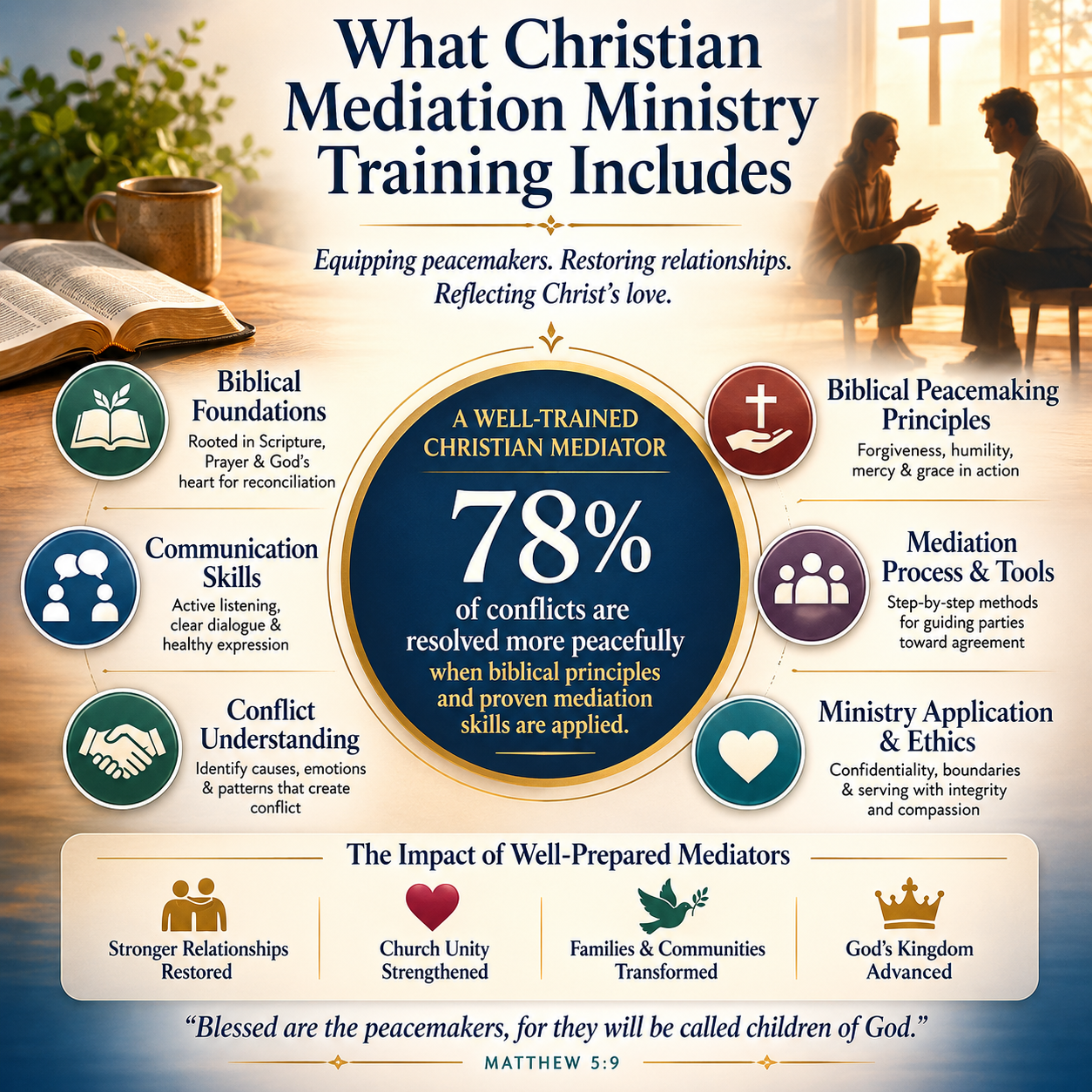
What Christian mediation ministry training includes is not primarily a set of negotiation techniques, but a formation process that holds together truth, love, justice, and mercy. Donors who fund peacemaking work should expect training that is biblically anchored, psychologically informed, and accountable to the church’s calling to pursue reconciliation without sacrificing the protection of the vulnerable.
Christian conflict work attracts sincere optimism: if we just teach people to talk better, peace will follow. The more mature ministries have learned that conflict is rarely only about words. It is often about power, fear, entrenched patterns of sin, and the slow work of repentance and repair. Training that ignores those realities can unintentionally pressure victims to reconcile prematurely or treat complex disputes as simple misunderstandings.
1) The theological and ecclesial foundation is explicit
Reconciliation is framed as discipleship, not a product
Training normally begins with a doctrine of the human person and of sin that is serious enough to explain why conflicts persist even among sincere Christians. Mediators are taught to resist both cynicism and naiveté: people are image-bearers capable of real change, and people are also capable of self-justification that survives many conversations.
Scripture typically shapes the mediator’s aims and limits. Matthew 18 is often studied not as a mechanical procedure but as a pastoral wisdom text: private confrontation, widening involvement when necessary, and sober recognition that some conflicts reveal deeper ruptures in fellowship. Donors should note what is emphasized: training that treats Matthew 18 as a universal template for every case, including abuse, is a warning sign.
The role of the local church is defined with clarity
Faithful Christian mediation training distinguishes among pastoral care, conciliation between believers, counseling, and formal adjudication. It clarifies when a matter belongs under church discipline and when it belongs to civil authorities. This distinction is not merely legal caution; it reflects a theological commitment to justice as part of love. Romans 13 is not invoked to outsource the church’s responsibilities, but to name the legitimacy of civil authority where crimes and safety are at stake.
Within Christian Conflict Resolution Ministries, we see the most credible training programs describe their ecclesial posture plainly: how they relate to church leadership, whether they serve only church members or the wider community, and what authority they do and do not claim over parties in conflict.

2) Core mediation competencies are taught and assessed
Process discipline and ethical neutrality are practiced
Competent training covers the practical craft: intake, informed consent, confidentiality limits, session design, caucusing policies, and documentation. Christian mediators are taught to be honest about the limits of confidentiality, particularly in relation to mandated reporting and threats of harm. The point is not to sound professional; it is to protect people from false expectations that can later feel like betrayal.
Training also addresses the distinctive ethical question Christian mediators face: how to be spiritually serious without coercion. Parties may share a faith vocabulary while holding radically different understandings of repentance, forgiveness, and justice. Good training prepares mediators to keep Scripture from becoming a tool of pressure, especially when one party is more articulate, more socially powerful, or more familiar with Christian language.
Communication skills serve truth-telling, not mere harmony
Active listening, reframing, and interest-based negotiation are usually included, but faithful programs teach these as servants of truth rather than as techniques to produce superficial agreement. Mediators learn to slow the conversation down, surface what is actually being claimed, and distinguish positions from underlying concerns. They are also trained to recognize when “peace” is being defined as silence.
We recommend donors ask whether training includes observed practice with feedback. Classroom content alone does not reliably change mediator behavior under pressure. Programs that require supervised role-plays, case simulations, and reflective evaluation are more likely to produce mediators who can hold steady in real conflict.
3) Training addresses trauma, abuse, and power without euphemism
Screening and safety protocols are part of the curriculum
The field has had to reckon with the harm caused when mediation is used where it should never be used. Domestic violence advocates have long warned that standard mediation can be dangerous in contexts of coercive control because the process can amplify power imbalances and expose victims to retaliation. The National Domestic Violence Hotline is explicit that abuse is about power and control, not anger management, and safety planning must govern any intervention.
Accordingly, credible Christian training includes screening protocols, referral pathways, and clear “no mediation” criteria. It also teaches mediators to recognize spiritual manipulation, including the misuse of forgiveness language to demand continued access to a victim or to minimize accountability. In church contexts, this is not theoretical; it is a recurring pastoral failure that training must directly confront.
Power analysis is treated as a moral requirement
Some Christians worry that talking about power imports secular categories into biblical peacemaking. Yet Scripture repeatedly condemns partiality and the oppression of the weak. Training that ignores power dynamics will tend to protect the socially strong by default. Training that obsesses over power can also become cynical and flatten moral agency. Mature curricula do neither; they insist that mediators learn to identify power imbalances concretely and respond with safeguards, not slogans.
Donors should look for training that teaches mediators to ask: Who bears the costs of “reconciliation” in this case? Who has more to lose by speaking candidly? What forms of authority are in play—formal, relational, financial, ecclesial—and how do they shape what each party can safely say?
4) Formation and accountability are built into the training model
Character qualifications are named, not assumed
Christian mediators routinely hear confession, grief, accusation, and moral injury. Training that focuses only on skills can produce mediators who sound competent but lack the maturity to carry the weight of what people disclose. Strong programs therefore treat the mediator’s character as integral: humility, patience, courage, and a disciplined resistance to favoritism.
This is one place where donors can be appropriately demanding. If a ministry claims to train “Christian mediators” but cannot describe how it evaluates readiness, ongoing spiritual health, or boundaries, it is likely relying on goodwill rather than governance. In our verification work at Most Trusted, ministries that meet The Most Trusted Standard tend to name formation practices plainly—supervision, continuing education, complaint processes, and guardrails for conflicts of interest.
Supervision, continuing education, and complaints are normal
Mediation is an applied discipline. The more a mediator works, the more likely they are to encounter cases that do not fit the textbook. Training therefore typically includes a pathway for mentoring and supervision after the initial course, along with a continuing education expectation. Donors should not confuse a certificate with competence; a certificate can represent anything from a weekend seminar to a rigorous apprenticeship.
When donors assess a conflict-resolution ministry, several training elements are especially informative:
- Clear ethics standards with defined confidentiality limits and mandatory reporting guidance
- Screening protocols for abuse, coercion, and severe power imbalance
- Observed practice with feedback before mediators take live cases
- Supervision structures for difficult cases and mediator care
- Complaint and escalation pathways that protect both parties and the ministry’s integrity
5) Donor due diligence focuses on outcomes and integrity, not sentiment
Metrics are used carefully because reconciliation is not easily counted
Christians genuinely disagree about what “success” means in mediation. Is it a signed agreement? Restored relationship? Clarified boundaries? Safe separation? In some cases, the most faithful outcome is not relational restoration but truthful exposure of wrongdoing and the protection of those harmed. Training that prepares mediators to accept those outcomes is more biblically realistic than training that promises relational harmony as the default.
At the same time, donors deserve more than inspiring stories. Programs can track measurable indicators without reducing reconciliation to numbers: completion rates, participant satisfaction with procedural fairness, compliance with follow-up plans, referral appropriateness, and time-to-resolution for eligible cases. Where ministries publish meaningful performance data, we look for transparency about what is measured, what is not measured, and why.
Verification questions donors can ask with confidence
Because mediation often happens behind closed doors, governance and financial integrity matter. Donors should ask how cases are selected, how mediators are supervised, and what the ministry does when allegations arise against a mediator or a referring leader. A credible ministry will not hide behind confidentiality to avoid accountability; it will explain its processes while protecting personal details.
Many donors supporting Christian Conflict Resolution Programs Donors Can Support are also trying to avoid a common error: assuming that low overhead signals high integrity. The nonprofit sector has repeatedly corrected this assumption. The “Overhead Myth” letter signed by GuideStar (now Candid), Charity Navigator, and the BBB Wise Giving Alliance argues that overhead ratios are not a reliable indicator of nonprofit performance and can pressure organizations to underinvest in systems and accountability.Candid
What this means in practice is that strong training often costs real money: skilled instructors, supervised practice, trauma-informed safeguards, and proper documentation systems. Donors can fund that without embarrassment, provided the ministry is transparent and governed well.
FAQs for What Christian mediation ministry training includes
Does Christian mediation training require legal credentials or licensure?
Not necessarily. Many mediation ministries use trained volunteer or staff mediators who are not attorneys. The more important question is whether the training is rigorous, includes supervised practice, and clearly defines boundaries with legal matters. Credible programs also teach when to refer to licensed professionals, law enforcement, or the courts, especially in cases involving alleged crimes or safety risks.
How can donors tell whether a mediation training program is safe in abuse-related cases?
Donors should look for explicit screening protocols, clear “no mediation” criteria, and formal referral relationships with trauma-informed resources. A program should articulate confidentiality limits, mandatory reporting obligations where applicable, and safeguards against spiritual coercion. The absence of these elements is not a minor gap; it is a structural risk.
Funding training that honors both peace and protection
Christian mediation is a ministry of peace only when it refuses to purchase peace at the expense of truth and the vulnerable. Training worthy of donor support forms mediators who can listen patiently, tell the truth without cruelty, and set boundaries without abandoning the call to reconciliation. For donors, the prudent path is to fund ministries that can describe their training and accountability with clarity, because hidden processes are rarely where trust grows.



