
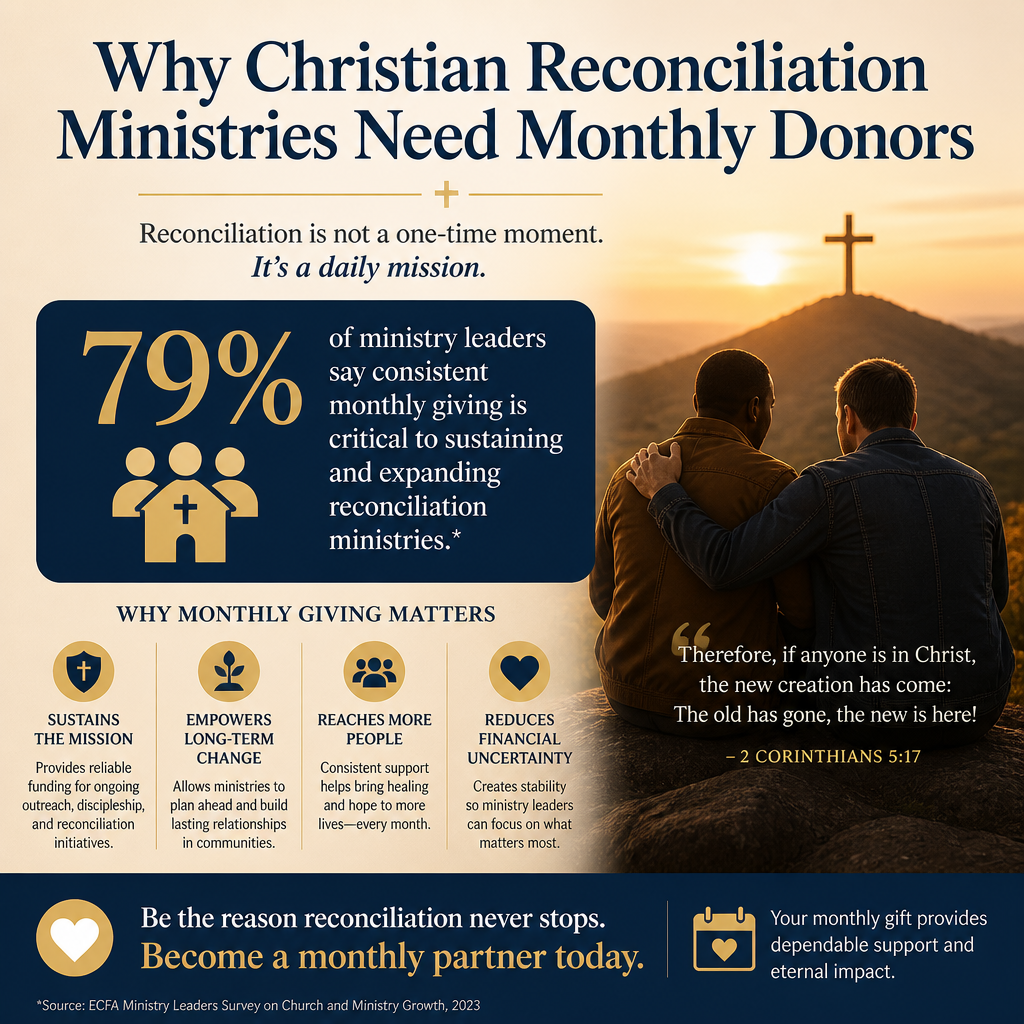
Why Christian reconciliation ministries need monthly donors is not a marketing question. It is a question of whether peacemaking work can be sustained with integrity when the work itself is slow, relational, and often invisible until a conflict has already caused damage. Donors who care about the credibility of Christian witness have strong reasons to prefer steady, disciplined giving over episodic generosity.
Reconciliation ministry is rarely linear. A marriage may stabilize and then destabilize. A church may move from public crisis to quiet repair and then face a second wave of grievance. A restorative process may require careful documentation, trained facilitation, and long follow-up. What this means in practice is that the ministries doing the most careful work are often the ministries least able to promise quick stories, dramatic before-and-after photos, or program metrics that fit cleanly into a quarterly appeal.
The work is spiritual, relational, and time-intensive
Peacemaking is not an event
Scripture treats reconciliation as an outworking of the gospel itself. Paul’s appeal in 2 Corinthians 5 is not simply that reconciliation is useful; it is that God reconciled us to himself in Christ and then entrusted to the church “the ministry of reconciliation.” Reconciliation ministries operate in that theological stream. They do not merely offer conflict management techniques. They seek to help people tell the truth, repent where necessary, forgive where possible, and rebuild trust in ways that do not trivialize harm.
That kind of work is labor-intensive. It requires trained staff and carefully supervised volunteers. It also requires time: intake, assessment, safety planning when abuse is alleged, facilitated conversations, agreements, and follow-up. Monthly donors underwrite the ordinary, unglamorous hours where most of the work actually happens.
Crises create pressure, but pressure is not clarity
Conflict escalations create urgency for churches and families, but urgency can distort decision-making. In the early stages of a high-conflict case, ministries may need to slow the process to gather facts, consult outside expertise, or establish boundaries that protect vulnerable parties. That is rarely the moment when a ministry can pause to raise emergency funds.
Stable monthly support allows a reconciliation ministry to respond without immediately reshaping its approach to whatever fundraising message performs best. Mature donors should recognize this as a form of ethical insulation: it reduces the temptation to promise outcomes that cannot be promised, or to oversimplify complex situations to make them “donor-friendly.”

Funding volatility shapes ministry behavior, sometimes for the worse
The temptation toward visibility over faithfulness
Reconciliation work can be difficult to narrate responsibly. Confidentiality matters. Legal risk matters. The well-being of participants matters. When funding is volatile, ministries can be pushed toward public storytelling that is premature, selective, or unwise. In some cases, ministries may feel pressured to broaden their claims, highlight only the cleanest wins, or treat a fragile peace as a finished victory.
This is not cynicism about ministries; it is realism about incentives. Donors who have supported Christian organizations over time have seen the pattern: unpredictable funding can produce unpredictable communication. Monthly giving changes the incentive structure. It encourages ministries to report carefully and to resist the subtle pressure to monetize pain.
Donors should expect overhead because reconciliation has real costs
Some Christian donors have been discipled by a simplistic suspicion of “overhead.” That suspicion has been widely challenged in the broader nonprofit field. The “Overhead Myth” statement signed by GuideStar, BBB Wise Giving Alliance, and Charity Navigator argued that overhead ratios are a poor proxy for impact and can create harmful incentives, especially when donors treat low overhead as the primary mark of virtue BBB Wise Giving Alliance.
Reconciliation ministries need competent staffing, training, case management systems, and governance safeguards. Those are not distractions from mission; they are part of what keeps the mission faithful. Monthly donors make it easier for ministries to budget for that competence rather than treating it as an optional add-on.
Monthly donors strengthen transparency and accountability
Steady support creates space for verifiable reporting
Accountability is not merely a matter of publishing an annual report. It is a discipline of accurate financial reporting, clear program claims, independent oversight, and honest communication when outcomes are mixed. The ministries that take reconciliation seriously tend to be cautious with claims. They will often describe processes and safeguards more than headline numbers, because reconciliation is not a commodity and because outcomes are shaped by the agency of every participant.
In our work at Most Trusted, we evaluate Christian nonprofits against The Most Trusted Standard, a 15-criteria framework spanning faith commitments, financial integrity, governance practices, and transparency with effectiveness. Monthly giving supports the kind of internal maturity that verification tends to reveal: timely audits or reviews when appropriate, documented policies, stable leadership development, and measured reporting that does not collapse complexity into slogans.
Transparency is also about what a ministry refuses to do
Some of the strongest signals of integrity are negative commitments: refusing to promise quick reconciliation, refusing to pressure victims into “forgiveness” as a substitute for protection, refusing to bypass due process in church discipline, refusing to treat mediation as a tool to silence legitimate complaint. Those refusals can cost money in the short term because they sometimes reduce the supply of easy stories.
Donors who care about the church’s public witness should prefer ministries that can afford those refusals. Sustained monthly support is one of the clearest ways to make that possible. For readers considering the broader landscape of reconciliation work, we maintain coverage of Christian Conflict Resolution Ministries with attention to how ministries describe their approach, safeguards, and governance.
Monthly giving underwrites prevention, not only crisis response
The highest-leverage work is often upstream
When reconciliation ministries are funded primarily in response to public crises, their work can become reactive. Yet much of the most valuable work is preventive: training pastors and elders in biblical peacemaking, equipping churches with clear grievance processes, teaching congregations how to distinguish repentance from mere regret, and helping leaders understand when professional counseling or legal reporting is required.
Prevention rarely generates dramatic fundraising spikes, even when it prevents real harm. Monthly donors allow ministries to invest in training cohorts, curriculum development, and long-term partnerships with denominations and networks. They make it possible for a ministry to serve smaller churches that could never fund the work at market rates.
What consistent support makes possible
Across reconciliation-focused nonprofits, monthly giving most directly funds work that donors often say they want but episodic funding rarely sustains:
- Training and supervision for mediators, facilitators, and pastoral care teams
- Case management, documentation, and follow-up processes that protect participants
- Scholarships and sliding-scale services for churches with limited budgets
- Independent oversight mechanisms and governance safeguards
- Measured communications that honor confidentiality and avoid sensationalism
These are not peripheral. They are the operational contours of faithfulness in a field where mistakes can compound trauma and discredit Christian testimony.
Donors can give monthly without giving uncritically
Steady support must be paired with discerning questions
Christians genuinely disagree about models of reconciliation, especially where serious wrongdoing is alleged. Some approaches emphasize mediation and mutual confession; others emphasize investigation, protection, and formal processes before any mediated engagement. A wise donor will not demand a single script, but a wise donor should demand clarity: What does the ministry do when abuse is alleged? How does it guard against spiritual coercion? Who has authority to stop a process when safety concerns emerge?
Monthly donors should also be realistic about mixed outcomes. Reconciliation is not always possible, and “peace” is not always righteous. The goal is not a superficial ceasefire, but truth and justice ordered toward restored communion where restoration is actually warranted. Donors should expect a ministry to say so plainly.
How verification helps donors give with confidence
Discernment is difficult when ministries are sincere, stories are partial, and outcomes are private. Independent verification can help donors move from intuition to evidence. At Most Trusted, The Most Trusted Standard emphasizes governance, financial integrity, and transparency precisely because good theology does not substitute for good controls. Donors who want to support reconciliation work monthly can still insist on clear documentation: financial statements that can be reviewed, conflict-of-interest policies, board independence, complaint-handling mechanisms, and public communication that does not overpromise.
For donors who want a deeper lens on what credible disclosure looks like in this space, we track Accountability and Transparency in Christian Conflict Resolution Ministries with attention to the practices that protect both participants and donors.
FAQs for Why Christian reconciliation ministries need monthly donors
Is monthly giving only helpful for large, well-known reconciliation ministries?
Monthly giving is often more strategic for smaller and mid-sized reconciliation ministries because it reduces cash-flow uncertainty. Smaller teams can be forced into short-term decisions when giving is episodic: delaying training, postponing technology improvements, or narrowing service to only those who can pay. A stable base of monthly donors allows these ministries to keep commitments, retain skilled staff, and serve churches that lack resources, without compromising safeguards.
What should Christian donors look for before committing to monthly support?
Donors should look for a clear theological account of reconciliation that does not minimize justice, truthful reporting that avoids sensational stories, and governance practices that include real oversight. Financially, donors should expect accessible reporting and, when appropriate for the ministry’s size and complexity, independent review or audit practices. Programmatically, donors should look for articulated safeguards: how the ministry handles allegations of abuse, confidentiality boundaries, referral practices, and accountability when processes fail. Monthly giving is most powerful when it is paired with these forms of due diligence.
A credible ministry of reconciliation requires credible funding
Monthly donors do not merely “keep the lights on.” They underwrite the slow faithfulness that reconciliation requires: patient listening, careful truth-telling, protections for the vulnerable, competent training, and honest reporting that refuses to purchase momentum with exaggeration. For Christian donors who care about the church’s witness, this is a fitting place for steady stewardship—giving that reflects the long obedience of peacemaking in a world where conflict rarely resolves on a fundraising calendar.



