
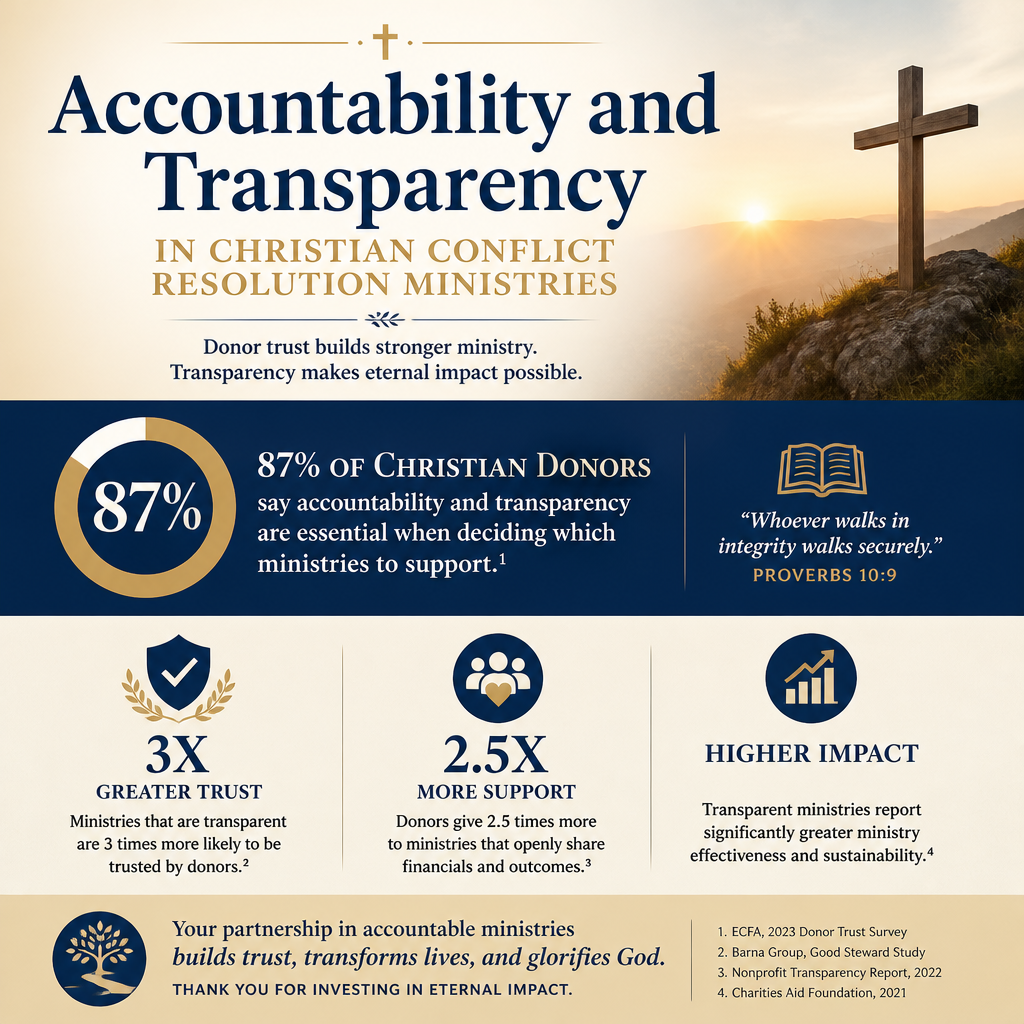
Accountability and transparency in Christian conflict resolution ministries are not optional virtues; they are part of the moral substance of peacemaking itself. When a ministry asks donors to fund mediation, reconciliation, and discipleship under stress, it is also asking them to trust processes that are often private, emotionally charged, and difficult to measure without violating confidentiality.
The donor’s question is therefore not merely, “Is the ministry orthodox?” but also, “Is it honest about what it can and cannot show, and is it governed and financed in ways that deserve confidence?” Scripture treats hiddenness and light differently: some matters require discretion, but nothing that depends on deception can bear the name of peace. “The wisdom from above is first pure, then peaceable… full of mercy and good fruits, impartial and sincere” (James 3:17). Sincere peacemaking has administrative consequences.
Why accountability is unusually difficult in conflict resolution work
Christian conflict resolution ministries operate in a domain where good practice often limits what can be publicly disclosed. Parties may be dealing with marital breakdown, church discipline, employment disputes, or allegations of spiritual abuse. The ministry may have legal exposure and pastoral obligations at the same time. Donors should expect confidentiality, but they should not accept opacity.
Confidentiality is not secrecy
Confidentiality protects people; secrecy protects institutions. A mature ministry can explain this distinction in writing. It should be able to publish (1) its case-intake standards, (2) its conflict-of-interest policies, (3) its safeguarding and mandated-reporting posture, and (4) its approach to recordkeeping and data retention—without naming cases or parties.
Donors should watch for a common failure mode: “We cannot share anything because of confidentiality.” That answer is too broad. A ministry can and should share governance facts, financial statements, staffing structure, program model, and how it evaluates outcomes while protecting identities. When a ministry cannot describe its work at a meaningful level, donors are being asked to fund a black box.
Outcomes are real, but they are not always countable
Reconciliation is not a simple throughput metric. A “settled” dispute may not represent justice, repentance, or safety. Conversely, a faithful mediation may end with separation because repentance is absent or protection is necessary. This is one reason donors should resist simplistic scorecards and instead look for ministries that are candid about what success looks like in different categories of cases.
That said, donors are not wrong to ask for evidence. The question is what kind of evidence is appropriate. Ministries can track participation, completion rates for training programs, satisfaction measures, post-process follow-up, and referrals to counseling or legal help when necessary. They can also report aggregate patterns, such as the proportion of cases involving church leadership disputes versus marital mediation, while avoiding details that would identify individuals.
Power dynamics raise the stakes
Many conflicts involve unequal power: pastor and congregant, employer and employee, ministry leader and volunteer, husband and wife. This is where accountability becomes more than a financial matter. A ministry that rushes to “reconcile” without attending to coercion can unintentionally reinforce harm. Donors should look for visible commitments to safeguarding, trauma-informed care, and clear boundaries around when mediation is inappropriate.
The contemporary church has had to reckon with how easily spiritual language can be used to silence the vulnerable. Transparency, in this setting, includes transparency about limits: when the ministry will pause a case, require outside investigation, or refer to specialized abuse professionals rather than conducting a mediation process that would be unsafe.

What financial transparency should look like for peacemaking ministries
Financial accountability is not a substitute for spiritual integrity, but it is one of its public tests. The New Testament’s concern for honorable handling of funds is explicit: “We take this course so that no one should blame us about this generous gift… for we aim at what is honorable not only in the Lord’s sight but also in the sight of man” (2 Corinthians 8:20–21). Donors should expect the same posture from ministries working in high-trust, high-risk situations.
The basic documents that should be easy to find
At a minimum, a US-based ministry should make its IRS Form 990 available, along with recent audited financials if the organization is large enough to justify an audit. Many smaller organizations will not have audited statements, but they can still provide reviewed statements or internal financial reports upon request. A ministry’s refusal to share basic financial documents is a substantive signal, not a minor inconvenience.
Form 990s are broadly accessible through established repositories, including the IRS Tax Exempt Organization Search (IRS). Donors should not treat the 990 as a holiness test, but it is a disciplined starting point: revenue sources, major contractors, compensation disclosures, and governance attestations all matter.
Program spending is not the whole story
Christian donors often want a clean answer to the question, “What percentage goes to programs?” That instinct is understandable, but it can be misdirected. The nonprofit sector has repeatedly warned against treating overhead ratios as a proxy for effectiveness. In a widely cited joint letter, Charity Navigator, GuideStar (now Candid), and the BBB Wise Giving Alliance argued that “overhead” is a poor measure of performance and can drive harmful underinvestment in systems and staff (Candid).
For conflict resolution ministries, this matters in particular. Skilled mediation requires training, supervision, documentation systems, and careful intake. Underfunding these “indirect” costs can lead to sloppy processes, poor safeguarding, and preventable harm. Donors should read spending breakdowns with a mature question: are administrative costs supporting competence and accountability, or protecting inefficiency?
Restricted gifts and designated funds require clarity
Some peacemaking ministries fund scholarships for mediation training, subsidize services for low-income churches, or underwrite casework for missionaries abroad. Donors should expect a written gift acceptance policy and clear descriptions of how restricted gifts are tracked, honored, and reported. A ministry that casually reassigns donor-restricted funds, or refuses to clarify how designations work, is asking donors to accept fiduciary risk.
At the same time, donors should be cautious about imposing restrictions that create perverse incentives. The best ministries can explain how they budget for staff time across casework, training, church consulting, and follow-up care, and why flexible funding is often essential for faithful peacemaking over time.
Governance and spiritual integrity in ministries that arbitrate disputes
Conflict resolution ministries often serve as third parties. That role amplifies the importance of governance: board independence, conflict-of-interest discipline, and clear lines of authority. When a ministry’s leaders are themselves embedded in the conflicts they mediate, or when the board functions as a circle of friends rather than a governing body, the ministry’s neutrality is compromised before the first meeting begins.
Independence and conflict-of-interest practices
Donors should look for governance features that are mundane but morally significant: a written conflict-of-interest policy, regular disclosures, documented recusal practices, and independent oversight of executive compensation. In some Christian ecosystems, it is normal for boards to include founders, family members, and close ministry partners. This is not automatically disqualifying, but it increases the need for transparent safeguards.
Across our verification work at Most Trusted, the ministries that meet The Most Trusted Standard tend to publish basic governance facts without defensiveness: board composition, terms, committee structure, and how the board evaluates the chief executive. This kind of clarity does not guarantee virtue, but its absence makes virtue harder to verify.
Doctrinal commitments and the ethics of peacemaking
Many donors prioritize doctrinal fidelity, and rightly so. Yet in conflict work, doctrinal statements can be used as either anchors or weapons. A ministry should articulate not only what it believes, but how those beliefs constrain its methods. For example, does the ministry affirm the dignity of every person made in God’s image, including the accused and the accuser? Does it distinguish forgiveness from reconciliation? Does it acknowledge that repentance is not a rhetorical performance but a moral reality with fruits?
Christians genuinely disagree about how Matthew 18 applies in complex cases, especially when allegations involve abuse, criminal conduct, or systemic leadership failure. A responsible ministry does not pretend the tensions are easy; it shows donors its decision rules, its referral pathways, and the guardrails that keep “peace” from becoming a cover for coercion.
Competence, training, and supervision
Donors should ask what qualifies someone to mediate under the ministry’s name. Is there formal training in mediation and conciliation? Are practitioners supervised? Are there continuing education expectations? In a field where spiritual authority can be persuasive, technical competence and accountability structures are not secular intrusions; they are expressions of love of neighbor.
Ministries sometimes rely heavily on volunteer mediators. That can be honorable stewardship, but it raises questions about screening, safeguarding, and consistency. A transparent ministry can explain how it trains volunteers, how it handles complaints, and how it prevents lone-ranger dynamics in emotionally volatile situations.
How donors can evaluate transparency without demanding the wrong things
Donors are sometimes forced into an unhelpful dilemma: either accept minimal disclosure in the name of confidentiality, or demand case-specific details that would violate trust. There is a better path. The objective is not voyeuristic visibility into people’s pain; it is verifiable evidence that the ministry’s systems are truthful, lawful, and spiritually responsible.
Ask for process transparency
A ministry can publish its model: intake criteria, assessment steps, how it handles conflicts of interest, and the circumstances that trigger referral to legal authorities or specialized care. It can also explain fee structures when services are paid, how it subsidizes work for churches with limited resources, and what donors are actually funding—casework, training, curriculum development, travel, or pastoral consulting.
Donors should be wary of ministries that present their work as spiritually powerful but operationally vague. A faithful ministry can describe the shape of its work without disclosing confidential particulars, just as a hospital can describe its clinical standards without naming patients.
Ask for outcome transparency at the right level
Outcome reporting should be aggregated, defensible, and cautious about overclaiming. Donors should look for ministries that report both strengths and limitations: the kinds of cases they can serve well, the kinds they decline, and what follow-up looks like. When the only public narrative is a string of reconciliation stories, donors should wonder whether the ministry has made honest room for hard cases that do not end neatly.
Quality indicators can include: written participant feedback, documented training completion, repeat engagement by churches that have used the ministry over time, and independent references from partners who are not financially dependent on the organization. The best ministries make it easy to see how learning from failures is built into their culture.
Use independent verification when trust is most expensive
Many donors give to conflict resolution work because they care about the witness of the church and the integrity of Christian relationships. That is a worthy motive, and it is also why verification matters. When a ministry handles disputes, it is often handling reputation, authority, and deep emotional injury. The costs of failure are borne by real people in local congregations.
Most Trusted exists to help donors give with confidence by evaluating Christian nonprofits against The Most Trusted Standard, a 15-criteria framework spanning faith commitments, financial integrity, governance, and transparency and effectiveness. When donors want to support this field responsibly, it helps to start with the wider context of Christian Conflict Resolution Ministries and then apply a disciplined set of questions to each organization’s public claims.
Transparency that serves peace
Accountability and transparency in Christian conflict resolution ministries are ultimately about whether peacemaking is conducted in the light. Donors should expect confidentiality for those seeking help, but they should also expect ministries to be forthright about governance, finances, safeguarding, and standards of practice. When those elements are clear, donors are not merely funding a set of services; they are strengthening institutions that can pursue peace without sacrificing truth.



