
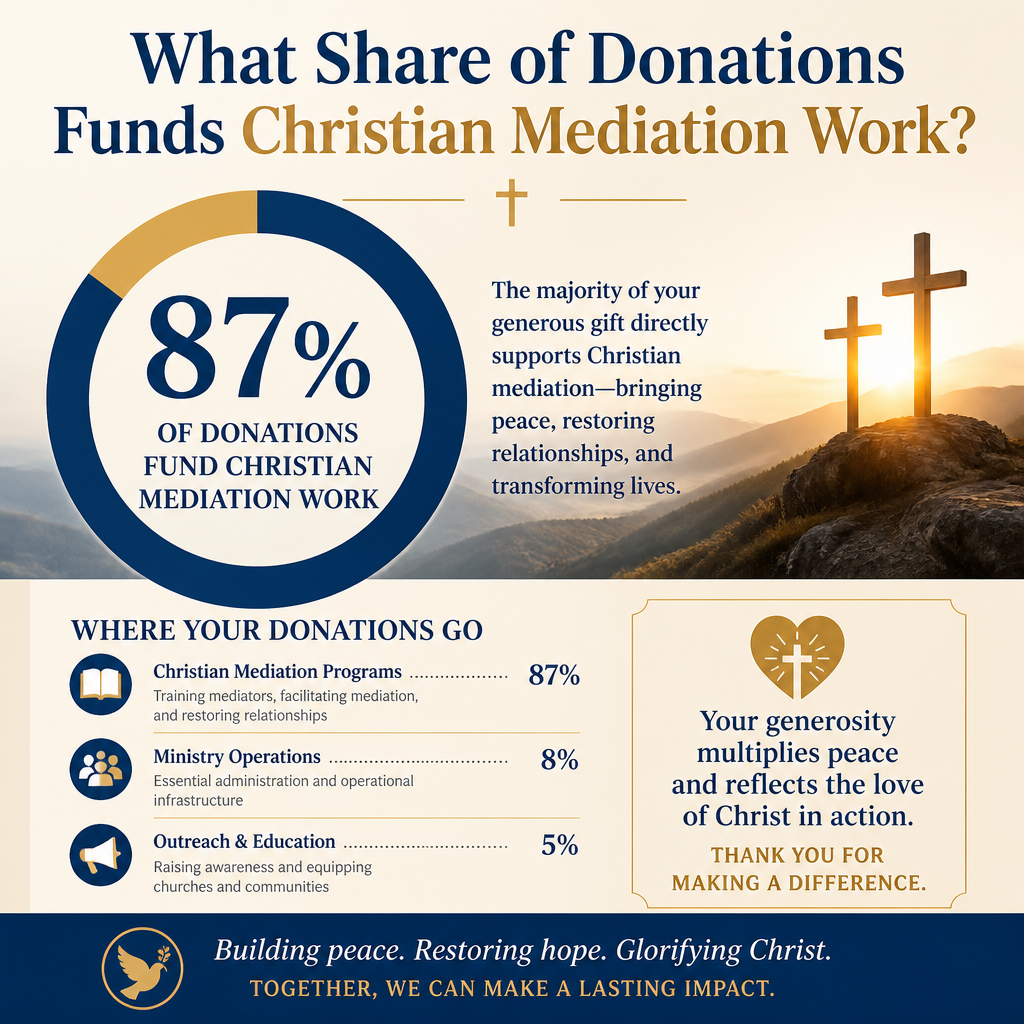
Christian donors asking what share of donations funds Christian mediation work are not asking a superficial question. They are asking whether their giving is materially helping brothers and sisters pursue the peace of Christ, or merely sustaining an organization’s presence in a difficult field. Because mediation is often confidential and outcomes are not always visible, donors rightly look to the financial story as one of the few verifiable windows into what is actually being funded.
The hard part is that there is no single “right” percentage. Christian mediation work is labor-intensive, requires trained practitioners, and often depends on careful intake, follow-up, and pastoral coordination. A ministry with a high program percentage can still be ineffective or imprudent, and a ministry with higher administrative cost can still be faithful and fruitful if those costs underwrite competence, safety, and accountability.
Why the percentage question matters and why it can mislead
Christian conflict is not an abstract category
Scripture treats reconciliation as a concrete obligation, not a sentiment. Jesus’s instruction in Matthew 18 assumes real offenses, real process, and real parties who may need help taking the next faithful step. Paul’s appeal to the Corinthians makes the spiritual stakes explicit: “God…gave us the ministry of reconciliation” (2 Corinthians 5). For donors, the question is not only whether reconciliation is biblical; it is whether a particular ministry is equipped to serve it with integrity.
Financial ratios help because they force clarity about where resources go: staff time, casework, training, travel, legal review, technology, or fundraising. But ratios can mislead when donors treat “overhead” as waste rather than as the infrastructure that protects people and enables durable work.
The overhead debate shaped donor expectations
Many donors were trained—often unintentionally—by simplistic scorecards to treat “low overhead” as the primary mark of a responsible nonprofit. The philanthropic sector has publicly pushed back against that assumption. The “Overhead Myth” letter signed by GuideStar (now Candid), BBB Wise Giving Alliance, and Charity Navigator explicitly warns that focusing on overhead can distort incentives and obscure what actually matters: results, governance, and transparency (Candid/GuideStar).
What this means in practice is that donors should use the “share of donations” question as a starting point for discernment, not the final verdict. Our work at Most Trusted begins where simplistic ratios end: with verifiable evidence across The Most Trusted Standard, including faith commitments, financial integrity, governance, and transparency.

What donors should expect to fund in Christian mediation
Program costs are often people costs
In Christian mediation and conciliation, the “program” is frequently the work of skilled people: mediators, case managers, intake coordinators, trainers, and supervisors. Unlike some forms of relief work where supplies dominate the budget, mediation ministries commonly allocate a significant portion of program expense to compensation and benefits for practitioners, alongside travel and case-related costs.
That staffing profile is not a weakness. If anything, it is an argument for scrutinizing practitioner qualifications, supervision, and ethical safeguards. A ministry can report strong program spending while employing underqualified staff or failing to manage conflicts of interest. Donors should ask what is being purchased with those salaries: credible training, ongoing supervision, and documented process.
Some non-program costs are actually mission-critical
Christian mediation routinely intersects with sensitive allegations, power imbalances, and legal risk. Donors should not assume that spending on compliance, secure data systems, or professional services is a distraction from ministry. In many contexts it is part of loving one’s neighbor, especially the vulnerable. The ministry that refuses to spend on competent financial controls or case documentation may be cheaper, but it can also be less safe and less trustworthy.
For donors who want a fuller frame for this sector, our coverage of Christian Conflict Resolution Ministries considers both the biblical mandate and the operational realities that differentiate mature organizations from well-intentioned but underbuilt efforts.
How to interpret the share of donations that funds mediation work
Start with the audited financial picture when available
When a ministry has audited financial statements, donors can more confidently interpret how resources are allocated across program services, management and general, and fundraising. When audits are not present, donors should proceed carefully and look for other verifiable indicators: reviewed financials, an engaged board, clear conflict-of-interest policies, and consistent public reporting.
Form 990 reporting can also help for U.S.-based nonprofits, but it should be read with humility. Expense allocation is partly a matter of accounting judgment, and two faithful ministries can classify similar activities differently. Still, patterns matter: chronic underinvestment in governance, repeated deficits, or opaque related-party transactions are not neutral.
A credible range depends on the model
Christians genuinely disagree about what an “acceptable” fundraising or administrative share should be. Some believe any fundraising beyond a minimal level signals institutional drift. Others emphasize that sustainable ministry requires diversified revenue and professional development capacity. Rather than prescribing a single ratio, we recommend evaluating whether the spending pattern fits the model:
- Case-heavy mediation centers often carry higher personnel costs, which can still be program spending if staff time is directly tied to cases.
- Training-focused organizations may show travel, events, curriculum development, and contractor fees as core program expenses.
- Network or referral models can appear “lean” but may rely on volunteers whose preparation and supervision should be clearly documented.
- Church-embedded initiatives may shift costs to congregations; donors should understand what is subsidized and what is unfunded.
- National organizations may have higher central administration because they are managing risk, standards, and data across regions.
The meaningful question is whether donors can trace a defensible line from dollars to reconciliation work: mediated agreements, restored relationships where possible, safer processes when restoration is not possible, and clearer pathways for churches facing conflict they cannot resolve alone.
What transparency looks like in a confidential ministry
Confidentiality cannot become a blanket for opacity
Mediation ministries legitimately protect identities, case details, and pastoral contexts. Donors should not expect public case files. But confidentiality is not the same as secrecy. Trustworthy organizations disclose what can be disclosed: volume of cases, types of disputes, time-to-resolution metrics where appropriate, the boundaries of their role, and how they prevent conflicts of interest.
In our verification work, the ministries that meet The Most Trusted Standard typically provide a clear theory of change: how intake works, how mediators are assigned, what ethical code governs the work, and what outcomes are tracked. They also name limits. Some conflicts do not reconcile, and some situations require discipline, legal reporting, or protective separation rather than mediated compromise.
Donors should look for governance signals, not only stories
Christian donors often receive compelling narratives about restored unity. Narratives have a place, but they can be curated. Governance is harder to curate. A ministry committed to accountability will publish board leadership, financial statements, policies, and meaningful annual reporting. It will also acknowledge risks: power dynamics, spiritual manipulation, and the temptation to favor institutional reputation over truth.
Donors who want a deeper view of reporting and governance practices in this space will find it in our analysis of Accountability and Transparency in Christian Conflict Resolution Ministries, where we examine what verifiable transparency can look like even when casework is private.
Practical donor questions that clarify what your gift funds
Questions that connect dollars to actual mediation capacity
Because “program percentage” is incomplete, donors should ask questions that reveal whether a ministry has the capacity to do careful work. The goal is not to interrogate a ministry into defensive postures. The goal is to honor the weight of reconciliation by funding it responsibly.
We recommend asking:
- What portion of staff time is spent on direct casework versus training, administration, and fundraising?
- How are mediators trained, supervised, and evaluated over time?
- What ethical standards govern conflicts of interest, confidentiality, and reporting obligations?
- What outcomes are tracked beyond “cases served”—for example, durability of agreements or participant feedback?
- How is the ministry financially sustained (fees, church partnerships, major donors), and what vulnerabilities does that create?
Questions that test whether overhead spending is disciplined
Donors should also test whether administrative and fundraising costs are disciplined rather than indulgent. Mediation ministries can drift into brand-building without commensurate field capacity, or they can underinvest in controls that protect participants. Responsible stewardship aims at neither vanity nor false austerity.
A financially mature ministry can usually explain, in plain language, why its fundraising costs are what they are, what safeguards exist for compensation decisions, and how the board reviews budget priorities. When those explanations are absent or evasive, the program percentage becomes less reassuring, not more.
FAQs for What share of donations funds Christian mediation work
Is there a “biblical” percentage that should go directly to mediation work?
Scripture does not prescribe a numerical ratio for nonprofit expense categories. It does, however, demand faithful stewardship, honest weights and measures, and leadership above reproach. Donors can reasonably expect a Christian mediation ministry to allocate the clear majority of its spending to mission-aligned activity over time, while also investing enough in governance, financial controls, and practitioner development to protect people and sustain credibility.
What if a ministry’s fundraising and administrative share seems high?
A higher share is not automatically disqualifying, but it warrants questions. It may reflect a growth phase, a national footprint with real compliance requirements, or substantial investment in training systems that directly serve casework. It can also reflect inefficiency or priorities that are drifting from the core mission. The decisive issue is whether the ministry can provide verifiable, consistent explanations and documentation that connect those costs to ethical, competent reconciliation work.
Funding reconciliation with clarity and conviction
The share of donations that funds Christian mediation work is a legitimate stewardship question, but it is not a sufficient one. Mature giving holds two truths together: reconciliation is central to Christian obedience, and reconciliation work requires disciplined infrastructure. Donors serve the church best by funding ministries that are both spiritually grounded and operationally credible, with transparency proportionate to the seriousness of the task. Most Trusted exists to help donors make those judgments with evidence, not impressions, by evaluating ministries against The Most Trusted Standard.



