
How Christian camp endowments work is ultimately a question of whether a ministry can serve campers faithfully over decades, not only over the next budget cycle. For donors who care about the formation of children and teenagers, endowments can be one of the few funding tools designed to protect long-term gospel ministry from short-term volatility.
Endowments, however, are not morally self-justifying. A camp can build an endowment and still drift theologically, govern poorly, or hide financial risks. The Christian donor’s task is stewardship: to understand what an endowment is meant to do, what it can and cannot do, and what verifiable signals indicate that the camp is using it as a servant of mission rather than a substitute for spiritual and organizational health.
What a Christian camp endowment is and what it is not
The basic mechanism
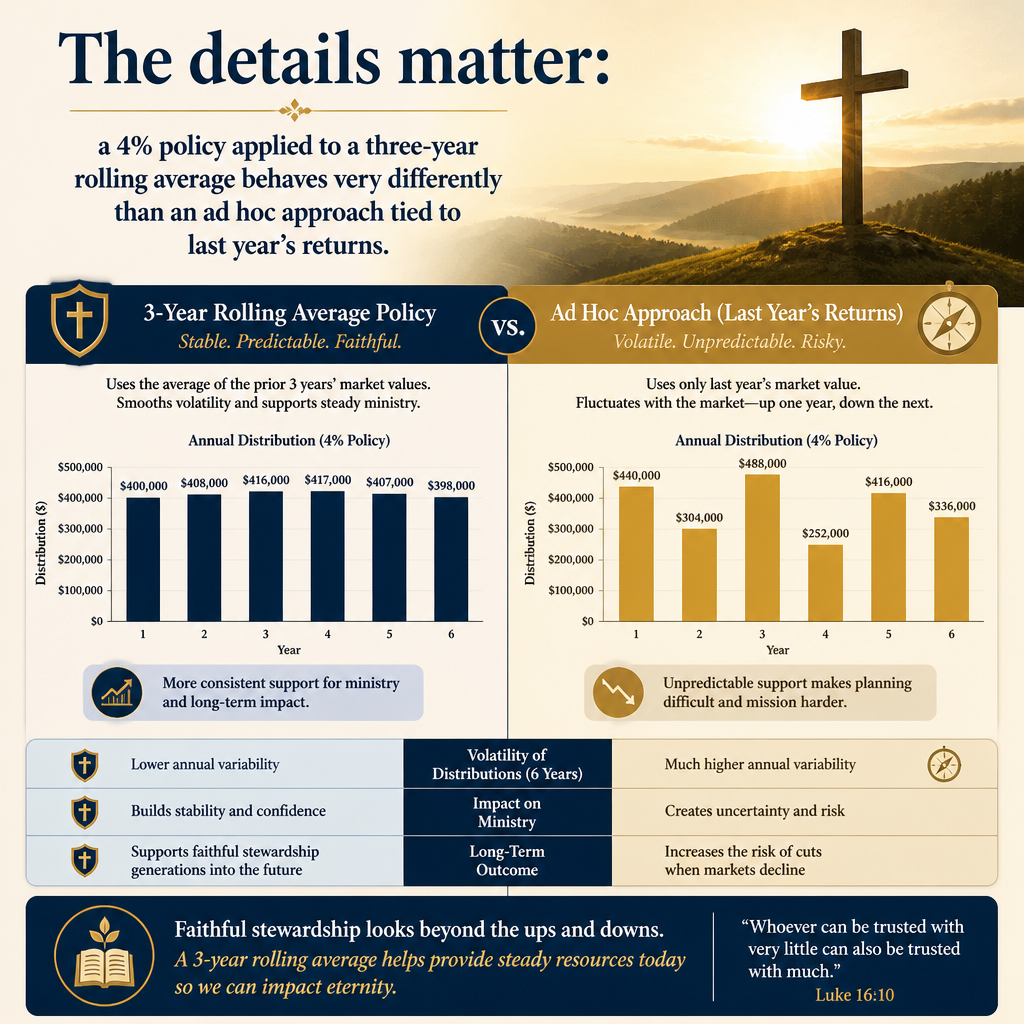
An endowment is a pool of assets invested for the long term, typically with the intent to distribute a portion each year to support a ministry’s work while preserving the principal in real terms. Many camps follow a spending policy that targets a percentage of an endowment’s average value over a multi-year period, which helps stabilize distributions when markets rise and fall. The details matter: a 4% policy applied to a three-year rolling average behaves very differently than an ad hoc approach tied to last year’s returns.
In practice, camp endowment revenue often underwrites scholarships, facility renewal, staff development, and spiritual formation programming that is difficult to fund through tuition alone. Done well, it can prevent pricing pressure from pushing camps away from families of modest means or from churches that cannot subsidize camp participation.
Common forms of endowment arrangements
Camps use several structures, and donors should ask which is in place:
- True endowment: donor-restricted principal held in perpetuity, with only earnings or a defined spend rate available for use.
- Quasi-endowment: board-designated funds treated like an endowment, but the board can release principal if needed.
- Restricted fund: assets earmarked for a purpose, sometimes invested long-term, but not necessarily governed by an endowment spending policy.
- Agency endowment: funds held at a community foundation or denominational foundation, with distributions sent to the camp under a fund agreement.
Each structure has trade-offs. A true endowment can honor donor intent with clarity, but it also reduces flexibility during crises. A quasi-endowment can be prudently flexible, but it depends heavily on the integrity and stability of governance. Donors who understand these distinctions are less likely to be surprised when a camp asks to “borrow from the endowment,” which may or may not be permissible.

Why camps pursue endowments and why some donors resist them
The ministry case for permanence
Christian camps occupy a particular place in the discipleship ecosystem. Many campers have their first sustained exposure to Scripture, prayer, and Christian community away from the distractions of ordinary life. A camp that serves faithfully for fifty years will outlast staff generations, facility cycles, and economic seasons. Endowment funding is one practical expression of a biblical intuition: the work is larger than the present moment, and stewardship includes planning for those who will come after us.
Christian donors also understand that formation is often expensive in ways that are not easily monetized. The most spiritually formative moments at camp may require lower counselor-to-camper ratios, well-trained staff, safe facilities, and meaningful pastoral leadership. An endowment can underwrite quality without turning camp into a luxury good.
The legitimate critiques
Some Christians genuinely worry that endowments can become spiritual insulation: a temptation to trust financial reserves more than the Lord’s provision, or to accumulate assets while immediate needs remain unmet. Those concerns are not frivolous. They should drive scrutiny of whether endowment policy is tethered to mission and whether annual budgets still require active faith, fundraising, and accountable leadership.
There is also a fairness question in the broader nonprofit field: locked-up capital can reduce responsiveness to urgent needs. Philanthropy researchers have noted increasing debate about perpetuity versus time-limited giving, especially when needs are immediate and compounding. The correct answer varies by ministry type, but donors should not treat “endowment” as an automatic virtue.
What this means in practice is that donors should ask a camp to articulate why an endowment is the right tool for its context: what problem it solves, what outcomes it protects, and what safeguards keep it from becoming an idol of institutional permanence.
How endowment money is invested and distributed
Investment oversight and fiduciary duty
Endowments are typically invested in a diversified portfolio (public equities, fixed income, and sometimes alternatives), with oversight by an investment committee, a board, and often an external investment advisor. For ministries, this is not merely technical. It is a governance and discipleship question about prudence, conflicts of interest, and transparency.
For donor-advised and foundation-held endowments, the camp may not control the underlying investments at all; a community foundation or denominational foundation may set the investment pools and spending rules. The camp should be able to explain these arrangements clearly, including fees, distribution formulas, and what happens if the relationship ends.
Spending policy and the discipline of restraint
A disciplined spending policy is one of the clearest markers of whether an endowment is being treated as a long-term tool rather than an emergency fund. Many institutions choose spending rates in the range of roughly 4% to 5% of the endowment’s value. Market returns are not guaranteed, inflation erodes purchasing power, and distributions that are too aggressive quietly consume principal over time. The tension is structural: camps want steady income for ministry today while preserving resources for campers ten and twenty years from now.
Donors should ask to see the policy in writing and look for these signs of seriousness: use of multi-year averaging, explicit inflation awareness, board accountability, and clear documentation of how endowment distributions are applied to mission outcomes (scholarships funded, cabins repaired, staff trained, seasonal ministry capacity strengthened).
For donors comparing endowment growth to immediate-impact giving, it is helpful to remember that charitable giving in the United States is cyclical and sensitive to economic stress. Total charitable giving fell by 10.5% in inflation-adjusted terms in 2022, according to Giving USA. Camps that are entirely dependent on annual gifts can be forced into reactive decisions precisely when families and churches are under strain. Endowment income can provide a stabilizing counterweight, though it is not immune to market downturns.
What donors should verify before funding an endowment
Endowments amplify governance
An endowment does not correct weak leadership; it can subsidize it. Across our verification work at Most Trusted, we observe that financial strength without strong governance increases the risk of mission drift, avoidable conflicts of interest, and opaque decision-making. Camps that manage endowments well tend to have boards that ask hard questions, document decisions, and maintain clear boundaries between staff authority and board oversight.
Because Most Trusted evaluates ministries against The Most Trusted Standard, we encourage donors to think of endowment due diligence as broader than investment returns. The deeper question is whether the camp’s faith commitments, governance practices, financial controls, and public transparency make it worthy of long-term capital.
A practical donor checklist
Before funding a Christian camp endowment, we recommend verifying several items with documentation rather than assurances:
- Written gift acceptance and endowment policies, including how restrictions are drafted and honored.
- Audited financial statements and a clear accounting of endowment assets, restrictions, and withdrawals.
- Board-approved investment and spending policies, including who has authority to change them.
- Conflict-of-interest disclosures for board and key leaders, especially where investment advisors or vendors are involved.
- Transparent reporting on what endowment distributions actually fund in the camp’s ministry.
Two field-wide cautions are worth naming. First, donors sometimes fixate on overhead ratios as a proxy for trustworthiness, even though major charity evaluators have warned against that simplification in the “Overhead Myth” letter signed by GuideStar, Charity Navigator, and the BBB Wise Giving Alliance: Candid GuideStar. Second, endowment restrictions that are too narrow can hamstring leaders and lead to the kind of financial contortions that erode honesty. Restrictions should be precise enough to protect intent and broad enough to remain workable over decades.
Donors who want to situate endowment questions within the wider landscape of camp ministry can review Christian Camps and Conferences as a broader context for how camps are funded, governed, and evaluated.
How donors can structure endowment gifts with wisdom
Deciding between restricted and unrestricted
Christian donors often prefer restricted gifts because restrictions feel like faithful guardianship. That instinct can be wise, particularly when a camp is early in its organizational maturity or when a donor is funding a specific burden such as camper scholarships for underserved families. Yet unrestricted endowment support can be a profound act of trust when a camp has demonstrated durable integrity. It allows leaders to respond to changing needs, regulatory requirements, and facility realities without bending language or inventing workarounds.
In either case, clarity is charity. The gift agreement should state the purpose, the spending rule, what constitutes “income” for distribution, whether principal can ever be invaded, how the fund will be described publicly, and what happens if the camp can no longer carry out the purpose.
Planned giving as an endowment builder
Many camp endowments are built through planned gifts: bequests, beneficiary designations, charitable remainder trusts, and other arrangements that allow a donor to provide for family while leaving a durable legacy for gospel ministry. Donors considering these tools should insist on a ministry’s ability to administer them faithfully, including documentation, proper receipting, and a sober understanding of long-term obligations.
A bequest to an endowment is also a theological statement. Scripture commends forethought and generational stewardship without promising that wealth itself will preserve faith. The point is not permanence for its own sake; it is durable capacity for ministry that proclaims Christ, serves churches, and forms young people in holiness.
For donors evaluating these options in the wider context of major and legacy giving, Planned Giving and Major Gifts for Christian Camps is a helpful reference point for the common instruments and the questions that protect donor intent.
FAQs for How Christian camp endowments work
Does giving to a camp endowment reduce the need for annual giving?
Usually it reduces volatility more than it removes need. A well-managed endowment can provide predictable annual distributions, but most camps still depend on annual giving for program expansion, capital projects, and scholarship demand that exceeds endowment payout. Donors should ask what percentage of the operating budget is supported by endowment distributions and how that figure changes in market downturns.
Is an endowment always better than funding scholarships or programs directly?
Not always. Direct scholarship and program gifts can serve immediate needs, especially when a camp has a clear, measurable backlog of campers who cannot attend without assistance. Endowment gifts can serve the same goal over time, but they require confidence in governance, spending discipline, and theological stability. Many mature donors choose a both-and approach: immediate scholarships for today’s campers alongside endowment gifts that protect access for future generations.
Endowments as stewardship, not security
Christian camp endowments work best when they are treated as disciplined instruments of stewardship: governed with integrity, invested prudently, and distributed according to clear policy in service of visible ministry outcomes. They can help camps remain accessible, resilient, and focused on formation rather than financial survival.
For donors, the central task is to fund permanence without financing complacency. The camps most worthy of endowment capital are those that can demonstrate, in verifiable ways, that long-term money will be held under accountable leadership for long-term gospel fruit.



