
Why Christian conferences matter for church leaders is not a sentimental question about encouragement. It is a stewardship question about formation: whether leaders are being equipped to teach sound doctrine, shepherd people under pressure, and govern institutions with integrity.
For Christian donors, conferences can seem secondary to “direct ministry.” Yet Scripture treats the preparation of leaders as a primary means of protecting and building the church. Paul’s charge to Timothy is not merely to be sincere, but to “guard the good deposit” entrusted to him (2 Timothy 1:14). The quality of leadership formation shapes the health of congregations, the credibility of Christian witness, and the long-term fruit of funded ministry.
Leadership formation is a biblically mandated work, not a professional perk
The New Testament assumes trained, tested leaders
The pastoral epistles presume that the church will identify, train, and evaluate leaders who can teach, refute error, and model character (1 Timothy 3; Titus 1). Conferences are one modern mechanism for that work. At their best, they offer concentrated theological instruction, practical skill development, and peer accountability that many leaders do not receive in weekly rhythms.
What this means in practice is that a conference is not simply a “refresh.” It is a setting where leaders are exposed to doctrinal clarity, pastoral wisdom, and governance practices that can either strengthen or weaken the local church. Paul’s warning to the Ephesian elders—“from among your own selves will arise men speaking twisted things” (Acts 20:30)—is not addressed by charisma. It is addressed by mature formation and vigilant oversight.
Conferences can serve the church, or subtly substitute for it
Christians genuinely disagree about the conference ecosystem. Some see it as a healthy complement to the local church’s teaching ministry; others see it as a parallel authority structure that can erode pastoral responsibility. Both concerns can be valid, depending on what a conference is teaching, how it relates to local churches, and how leaders apply what they learn.
Donors should not romanticize the category. A conference that treats novelty as virtue, elevates celebrity over character, or sells “ministry success” formulas can distort the pastoral calling. The test is not energy in the room. The test is whether leaders are being formed in the humility, endurance, and doctrinal steadiness Scripture requires.

Conferences strengthen leaders where ministry pressure is most acute
Pastors operate under measurable strain
Many church leaders carry sustained emotional and organizational burden with limited feedback mechanisms. A national survey of pastors found that a substantial share report stress and discouragement as recurring realities of ministry life (Barna). The point is not to produce alarm; it is to recognize that leaders are embodied people. Fatigue and isolation are not merely personal problems. They can become institutional risks—especially in small and mid-sized churches where governance is informal.
Well-constructed conferences can provide structured pastoral care: the reminder that suffering is not failure, that holiness is not optional, and that perseverance is a normal Christian pattern. Elijah’s collapse in 1 Kings 19 is not solved by a strategy memo. God meets him with presence, reorientation, and renewed calling.
Peer learning can correct blind spots that internal teams cannot see
Local ministry teams often share the same assumptions, the same habits, and the same unspoken anxieties. Conferences create cross-pollination: leaders compare notes on staffing, volunteer systems, crisis response, financial controls, and discipleship models. Healthy peer learning is not outsourcing discernment; it is submitting our work to the wider wisdom of Christ’s body.
Across our verification work at Most Trusted, we observe that ministries with durable leadership cultures tend to normalize outside input. They invite critique, learn from failure without self-protection, and connect leaders to mentors who are not dependent on them for employment or platform.
For donors, conferences matter because leadership quality shapes ministry impact
Impact is not only program output
Christian donors often ask for measurable results: people served, leaders trained, Bibles distributed, missionaries sent. Those are legitimate questions. But Christian stewardship also includes the less quantifiable formation that precedes and safeguards visible results—doctrinal fidelity, ethical reflexes, and healthy governance.
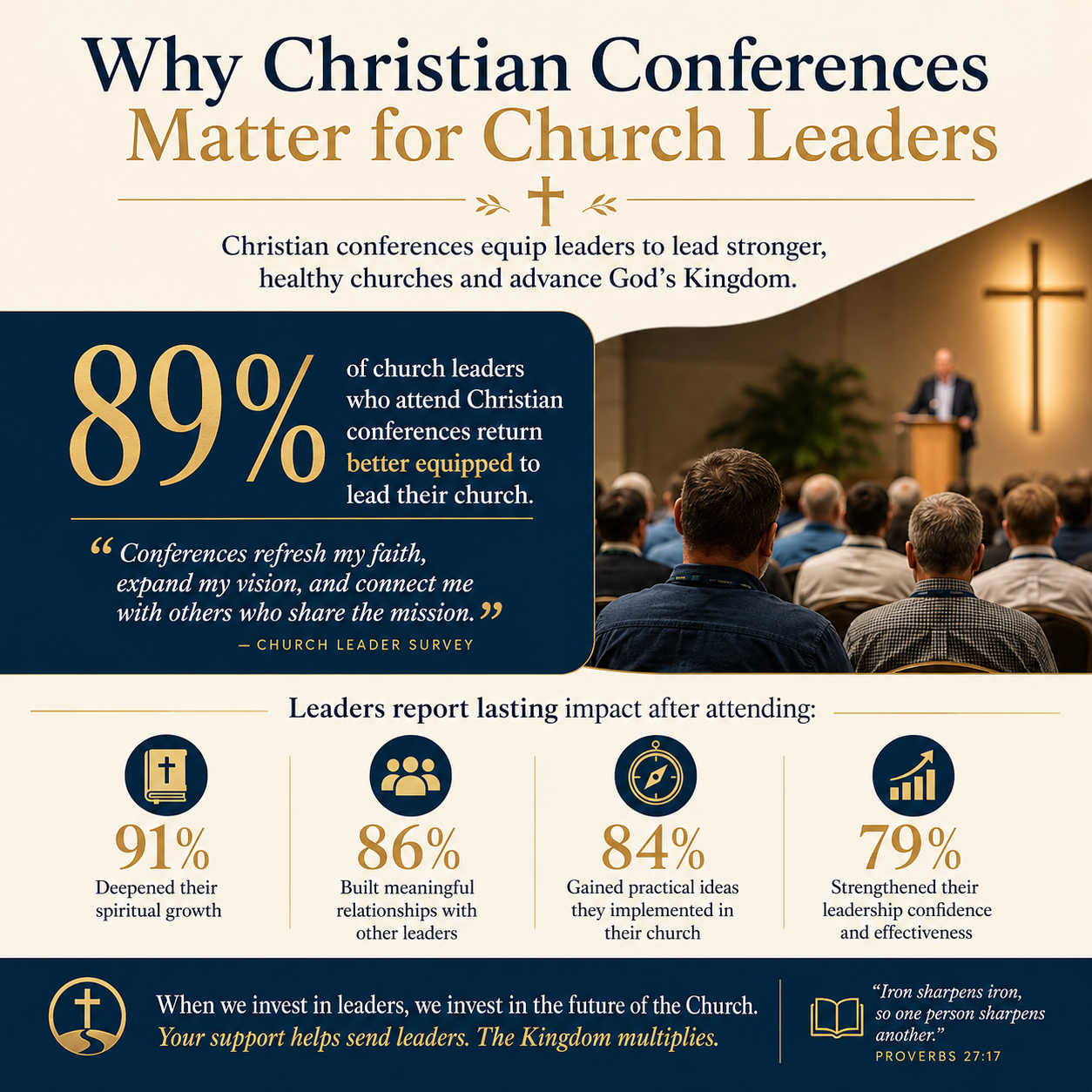
The modern impact conversation has learned to question simplistic indicators. The “Overhead Myth” critique, advanced by leading evaluators, argued that low administrative spending is not a reliable proxy for effectiveness, and that starving infrastructure can undermine mission delivery (Candid). Conferences can be part of that infrastructure when they directly strengthen leaders who bear responsibility for people and budgets.
Conferences can function as risk mitigation when they teach governance and accountability
Donors do not fund abstractions; we fund institutions led by human beings. When leaders lack training in governance, conflicts of interest, financial controls, and safeguarding practices, the ministry’s mission is exposed. Conferences that address these areas soberly—without cynicism—serve donors and beneficiaries alike.
In this context, The Most Trusted Standard exists because good intentions are not enough. When a conference ministry is evaluated across Faith Foundation, Financial Integrity, Governance and Leadership, and Transparency and Effectiveness, donors can better discern whether the organization’s formation work is likely to produce long-term fruit or short-term enthusiasm.
- Does the conference teach Scripture in context, with accountable theological oversight?
- Does it train leaders in governance basics, not merely communication skills?
- Does it demonstrate financial clarity about how registrations and donations are used?
- Does it maintain appropriate safeguarding and reporting practices?
- Does it track meaningful outcomes beyond attendance and social reach?
Donors often support leadership conferences because they want to strengthen the “upstream” conditions for healthy churches. That instinct is sound. It simply needs verification and discernment rather than assumption.
Christian conferences can either reinforce or erode ecclesial faithfulness
The opportunity is theological renewal and pastoral seriousness
At their best, conferences help leaders recover the weight of their calling. They remind pastors that the church is not a content enterprise but Christ’s bride, purchased with blood. They remind elders that governance is spiritual work. They remind ministry teams that prayer is not a prelude to real work; it is dependence.
This is one reason donors pay attention to the broader world of Christian Camps and Conferences. These gatherings can be moments of renewal that carry back into ordinary congregational life—preaching that is more faithful, pastoral care that is more patient, and leadership that is more accountable.
The danger is platform dynamics and doctrinal drift
The conference environment has its own incentives: attendance growth, sponsor appeal, social visibility, and the gravitational pull of celebrity. Those incentives can quietly shape messaging. A conference can become a marketplace of techniques where the cross is assumed but not preached, where repentance is therapeutic rather than moral, and where ecclesiology is reduced to branding.
Christians genuinely disagree about how much weight to place on conference influence. Some leaders are strengthened; others are distracted from their local responsibilities. Donors should ask not only, “Was it helpful?” but “Did it produce greater faithfulness to Christ and deeper love for the church?” That is a more demanding question, and it is closer to Scripture’s concern.
How donors can evaluate conference ministries with confidence
Ask for evidence that matches the claim
A conference ministry typically claims to equip leaders, strengthen churches, and advance the gospel. Those claims can be true. But claims require corroboration. Attendance counts are not the same as formation. Social engagement is not the same as pastoral competence. A serious organization will be able to describe what it teaches, why it teaches it, and what changes it expects to see in leaders over time.
Within How Christian Conferences Measure Impact, the central issue is not whether a conference is exciting. The question is whether it can show credible indicators of outcomes: improved preaching practices, stronger governance habits, healthier staff cultures, better safeguarding, and clearer doctrinal commitments.
Use verification as a complement to trust, not a replacement for it
Donors should not approach Christian ministries as adversaries. Charity is a Christian virtue. But Scripture also assumes discernment. Jesus warns against wolves in shepherd’s clothing (Matthew 7:15). Paul instructs believers to test and hold fast to what is good (1 Thessalonians 5:21). Verification is a practical expression of that posture.
Most Trusted exists to help donors give with confidence by evaluating ministries against The Most Trusted Standard. For conference ministries, that means examining theological accountability, financial practices, board governance, and transparency about outcomes. When a ministry is clear in these areas, donors can fund leadership formation as a strategic investment in the church’s long-term health.
FAQs for Why Christian conferences matter for church leaders
Do conferences distract church leaders from their primary local responsibilities?
They can. The test is whether the conference strengthens the leader’s faithfulness to Christ and service to the local church, or whether it cultivates restlessness, platform aspiration, or dependence on outside voices. Wise leaders attend selectively, submit what they learn to Scripture, and remain accountable to local elders and congregational realities.
What should donors ask before funding a conference or conference scholarship program?
Donors should ask what is taught, who provides theological oversight, how leaders are selected and safeguarded, what financial controls exist, and what outcomes are tracked beyond attendance. It is also reasonable to ask whether the organization has been independently evaluated, and whether its governance and transparency practices match the seriousness of its claims.
Why this remains a stewardship question
Christian conferences matter for church leaders because leadership formation shapes everything downstream: doctrine taught, people protected, money stewarded, and the credibility of Christian witness in public. Donors who fund conferences are not funding an event; they are funding the strengthening or weakening of institutions that will outlast the room’s applause. The responsible path is neither reflexive skepticism nor uncritical enthusiasm, but discerning generosity grounded in Scripture and confirmed by verifiable practices.



