
How donor-advised funds support Christian camps is fundamentally a question of stewardship: how a donor can plan generously over time while helping camps remain faithful, financially stable, and mission-effective. For many Christian households, the desire is clear—help more children and teens encounter Christ, strengthen families, and form durable discipleship—but the mechanics of giving can feel needlessly complex.
Donor-advised funds, commonly called DAFs, have become one of the most significant tools in contemporary American philanthropy. DAFs can serve Christian camps well when they are used with clarity about purpose, integrity in administration, and accountability in outcomes. They can also create new pressures—particularly when camp leaders feel compelled to chase restricted dollars, or when donors unintentionally replace relational giving with transactional giving.
Donor-advised funds fit a biblical stewardship horizon
Why DAFs resonate with long-range Christian giving
Scripture treats money as moral and spiritual territory, not as a neutral instrument. Jesus’ parables assume that resources are entrusted, not owned, and that faithful stewardship is measured over time. A DAF, at its best, can serve that stewardship horizon by letting a donor set aside capital for generosity, then distribute it thoughtfully as needs and opportunities become clear.
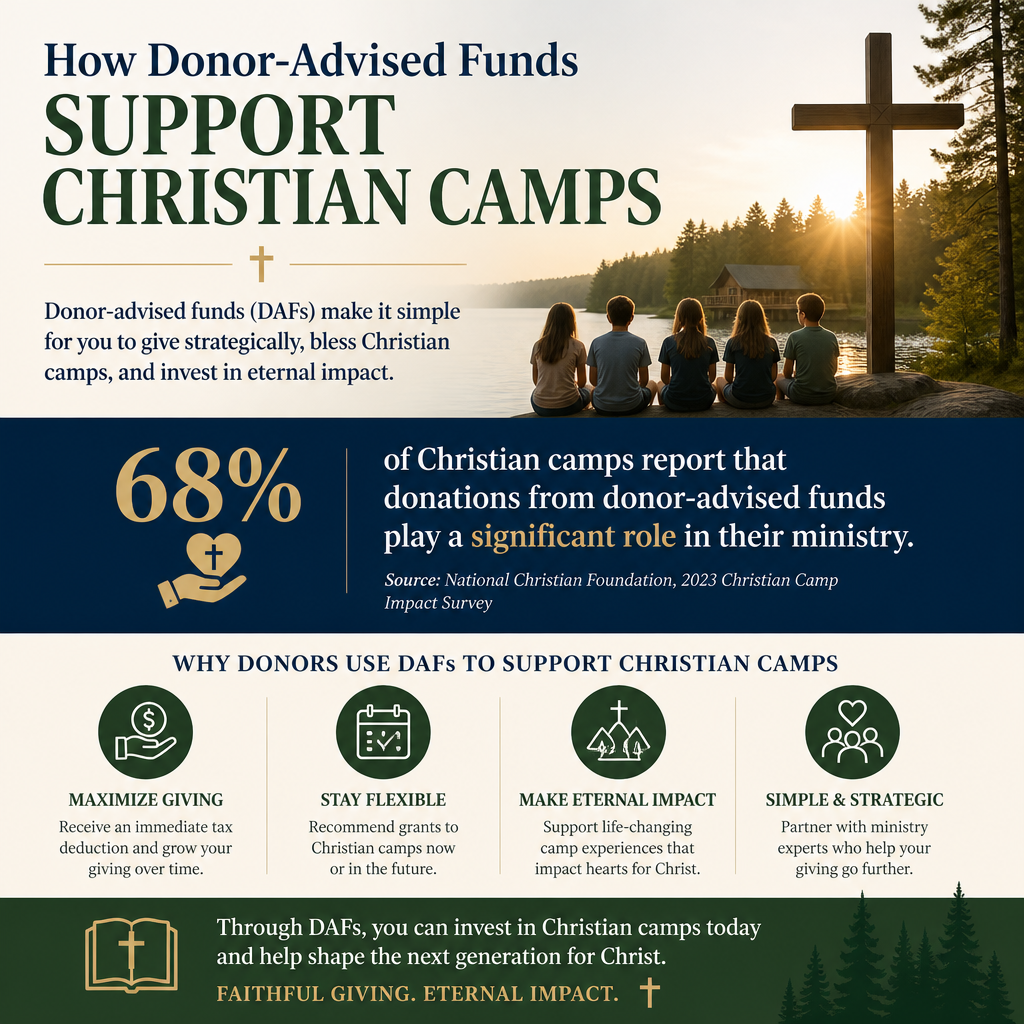
A practical feature of DAFs is timing: donors can make a charitable contribution in a high-income year, then recommend grants over subsequent years. For donors whose income fluctuates—business owners, executives with equity events, or families navigating an estate transition—this can prevent reactive giving driven by tax deadlines rather than discernment.
How common DAFs have become
DAFs are not a niche vehicle. National Philanthropic Trust reports that DAF charitable assets have grown substantially over the past decade and now represent a major share of donor-directed giving in the United States (National Philanthropic Trust). The prevalence matters for camps because many donors now default to giving from a DAF, and ministries that cannot receive DAF grants cleanly may experience avoidable friction.
What this means in practice is that camps should be prepared to receive DAF grants with clear gift acceptance policies, documented charitable purpose, and sound receipting practices. Donors should likewise treat a DAF as a tool, not as a substitute for wisdom, prayer, and due diligence.

DAFs can strengthen camp ministry without distorting it
Supporting scholarships and access with clearer funding
Many Christian camps carry an ongoing tension: they want to keep tuition within reach for ordinary families, yet they face real costs—staffing, insurance, program compliance, facility maintenance, and year-round ministry overhead. Donor funding can fill the gap, but the most helpful funding is often predictable and aligned with mission rather than narrowly restricted to a donor’s preferred line item.
DAFs can support scholarship funds in a way that keeps the camp’s compassion tethered to financial reality. A donor can recommend an annual grant for camper scholarships, sustaining access without forcing leadership into late-season fundraising emergencies. When scholarships are administered with clear criteria and documented outcomes, they also become a measurable expression of mercy and formation rather than a vague appeal.
Building capacity for year-round discipleship work
Christian camps are rarely “summer-only” in any meaningful sense. Many operate retreat programs, outdoor education partnerships, staff training, and spiritual formation initiatives throughout the year. DAF grants can be particularly suited to capacity-building gifts that strengthen the camp’s long-term health: staff development, program evaluation, or infrastructure that improves safety and ministry effectiveness.
The caution is that not every “project” is the highest need. Mature donors ask whether a proposed project fits the ministry’s strategy, whether leadership has the competence to deliver it, and whether the camp has the governance discipline to sustain it after the initial gift. These are not cynical questions. They are questions of faithful stewardship.
DAFs raise real accountability questions for donors and camps
DAFs do not remove the need for verification
DAF sponsors typically perform basic due diligence—confirming that a recipient is a legitimate 501(c)(3), for example—but that is not the same as evaluating a ministry’s faithfulness, integrity, and effectiveness. A camp can be legally qualified and still be poorly governed, financially fragile, or unclear about its doctrinal commitments.
Across our verification work at Most Trusted, we observe that donors often assume an intermediary has done deeper review than it actually has. That assumption can lead to preventable risk: gifts made with good intentions to organizations that lack adequate controls, transparency, or leadership accountability. Our purpose as an independent verification service is to help donors give with confidence by evaluating ministries against The Most Trusted Standard, a 15-criteria framework addressing Faith Foundation, Financial Integrity, Governance and Leadership, and Transparency and Effectiveness.
The harder question of donor intent and ministry independence
DAFs also sharpen an older tension in Christian philanthropy: when does donor influence become mission drift? Camps are especially susceptible because facilities and capital projects are tangible, emotionally resonant, and expensive. A camp can quietly reshape its priorities around what donors prefer to fund, even when those preferences are not the most strategic or faithful use of resources.
Wise donors do not confuse restriction with impact. Sometimes restrictions protect a specific ministry aim. Other times they displace leadership discernment, suppress honest budgeting, and leave core operations underfunded. The most durable pattern is partnership: donors and leaders aligning on mission, then funding that mission with clarity and mutual accountability.
What discerning DAF support looks like for Christian camps
Signals of health donors can reasonably ask for
DAFs make giving easier; they do not make discernment unnecessary. Donors should expect camps to answer serious questions without defensiveness, and camp leaders should welcome those questions as part of being above reproach.
For donors considering a DAF grant to a camp, the following practices are reasonable to request:
- Clear articulation of the camp’s doctrinal commitments and discipleship aims
- Current financial statements and evidence of responsible reserves and cash management
- Board oversight that is active, independent, and documented
- Transparent scholarship policies and reporting that protects camper privacy
- Gift acceptance policies that address restrictions, refunds, and designated giving
When donors want a broader view of how camps and conference centers approach ministry, safety, governance, and long-term sustainability, we publish ongoing coverage within Christian Camps and Conferences.
Grant structure that helps rather than complicates
DAF grants work best when they are administratively clean and aligned with how nonprofit accounting actually functions. The DAF sponsor will generally require that the grant be made to the organization—not to an individual camper, staff member, or family. Donors who want to help a specific child attend camp should coordinate with the camp’s scholarship process rather than attempting a pass-through arrangement, which can create compliance issues for both the camp and the sponsor.
Multi-year commitments are often more helpful than one-time gifts, even when the annual amount is modest relative to the donor’s total capacity. Predictability enables staffing stability, program continuity, and more honest planning. Camps can take fewer desperate swings at revenue and more deliberate steps toward sustainable ministry.
DAFs belong inside a broader planned giving posture
DAFs and legacy generosity are complementary
Many Christian donors are thinking about the stewardship of a lifetime: how current giving, long-term plans, and family discipleship fit together. A DAF can sit alongside other tools—bequests, beneficiary designations, charitable trusts—without replacing them. In some families, a DAF also becomes a context for teaching children and grandchildren how to give: researching ministries, discussing theological priorities, and practicing generosity as a household discipline.
At the same time, Christians genuinely disagree about the broader cultural dynamics DAFs can create, including the concern that charitable dollars may sit too long without being granted. That debate is not merely political; it is a question about whether philanthropic tools are serving the church’s call to generosity or quietly domesticating it.
Planned giving requires clarity and accountability
Donors who want to place DAF giving within a wider planned giving strategy often benefit from working with qualified advisors and from verifying recipient ministries with rigor. Planned giving is where good intentions can meet complicated legal and financial realities, and where unclear documentation can create future conflict for heirs, boards, and beneficiaries.
For donors evaluating larger commitments to camps—whether through a DAF, estate plans, or major gifts—we address these dynamics more broadly within Planned Giving and Major Gifts for Christian Camps.
FAQs for How donor-advised funds support Christian camps
Can we use a donor-advised fund to pay for a specific camper to attend a Christian camp?
In general, a DAF grant must be made to a qualified charity for charitable purposes, not to provide a benefit to a specific individual. If the camp has a scholarship fund and an objective process for awarding aid, donors can recommend grants to support that fund, allowing the camp to award scholarships according to its established criteria. Donors should confirm the details with both the camp and the DAF sponsor, since sponsor policies vary.
What should we ask a Christian camp before recommending a large DAF grant?
Donors can reasonably ask for the camp’s doctrinal commitments, audited or reviewed financials if available, a current budget, board governance practices, gift acceptance policies, and how the camp measures ministry outcomes beyond attendance counts. For donors who want consistent, third-party evaluation, Most Trusted verifies Christian nonprofits against The Most Trusted Standard so that giving decisions rest on evidence, not only on reputation or personal affinity.
A faithful tool, not a substitute for faithful judgment
DAFs can serve Christian camps by making generosity more deliberate, more consistent, and more aligned with long-term ministry health. They can also tempt both donors and camps toward convenience: donors drifting into hands-off giving, and camps drifting into donor-driven priorities. The most credible outcome is not merely funded programming, but strengthened discipleship—stewardship that is accountable, mission-aligned, and worthy of trust.



