

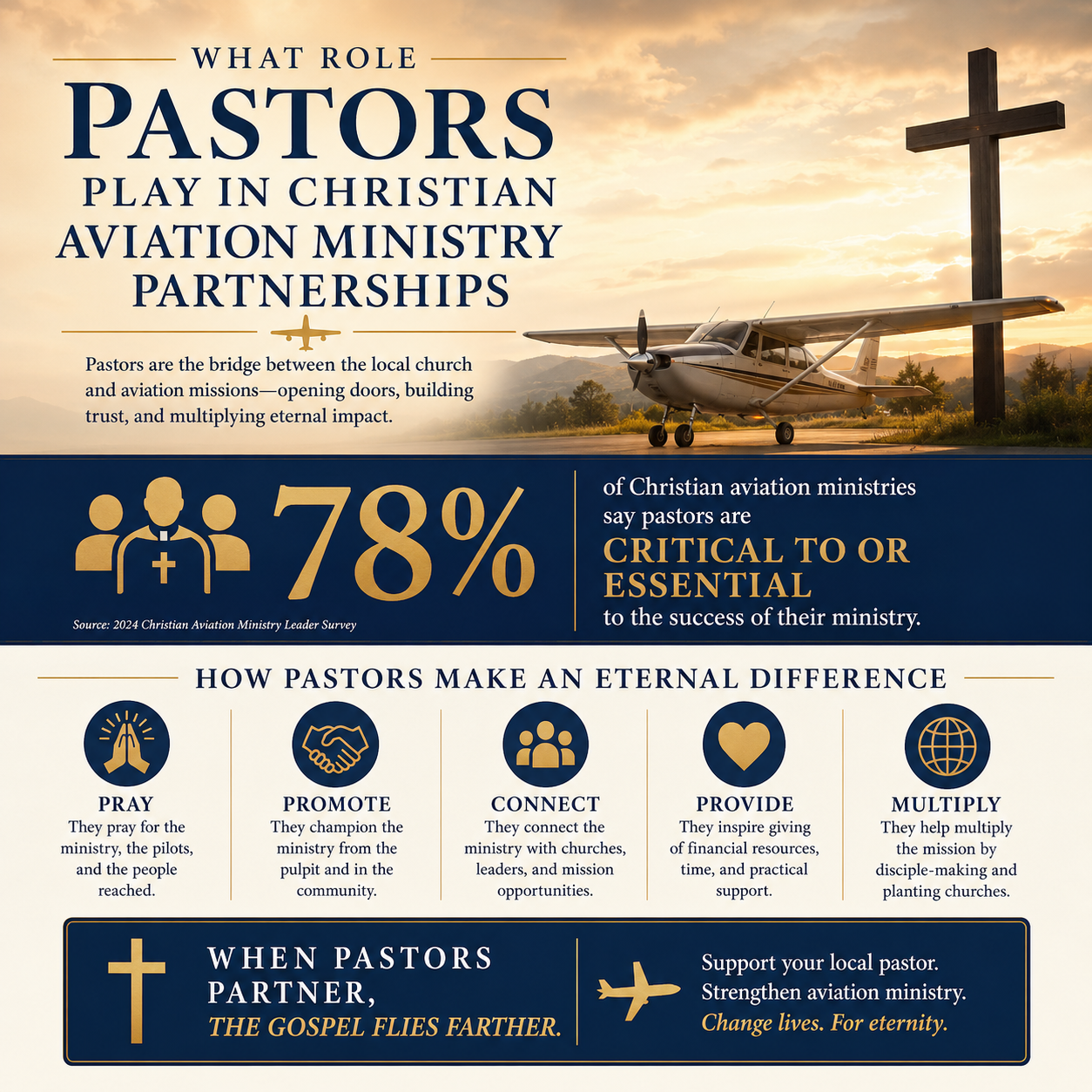
Pastors play a decisive role in Christian aviation ministry partnerships because they sit at the intersection of theology, trust, and accountability. When a church funds aircraft, underwrites fuel, or sends teams into remote regions, the pastor often becomes the primary steward who interprets that decision spiritually and governs it practically.
For Christian donors, that pastoral role matters for more than inspiration. Aviation is expensive, high-risk, and operationally complex. Wise partnerships require clarity about gospel purpose, disciplined oversight, and a sober understanding of what aviation can and cannot accomplish in mission work.
Pastors provide theological and missional clarity for why aviation serves the Church
Aviation is a means, not a message
Christian aviation can be an extraordinary servant to the Great Commission, but it is not the Great Commission itself. Pastors help a congregation keep first things first: proclaiming Christ, forming disciples, and strengthening local churches. In practice, aviation often supports that work by moving Scripture translators, church planters, medical teams, and local leaders safely and efficiently where roads do not exist or are dangerous.
Scripture provides categories for this kind of support role. Paul commended the Philippian church for their partnership in the gospel (Philippians 1:5), and he described co-laborers who strengthened the mission through tangible help. Pastoral leadership keeps aviation from becoming a fascination with tools rather than a commitment to faithfulness.
Pastors help churches name what partnership requires
Partnership is a word Christians use easily, but true partnership carries mutuality and accountability. Pastors can press a ministry to articulate how aviation integrates with local church priorities: local leadership development, language and cultural humility, and long-term presence rather than episodic access. In aviation work, those questions are not theoretical. Flights can either reinforce local ownership or inadvertently create dependency if access is treated as a substitute for local capacity.
What this means for donors is that the pastor is often the one who insists on a coherent theology of mission before the church funds a sophisticated operational platform. That insistence protects both the congregation and the ministry.

Pastors serve as trust-bearers who translate technical aviation work into accountable stewardship
Donors give when they believe stewardship is real
Most church members cannot assess aircraft maintenance programs, aviation safety management systems, pilot currency, or the regulatory environment in which flights occur. Pastors cannot replace aviation professionals, but they can require intelligible reporting and a governance posture that treats donor funds as sacred trust. This is one reason mature donors watch pastoral leadership closely: it signals whether a church is prepared to ask hard questions without cynicism.
Trust also has a measurable civic dimension. Public confidence in churches has weakened over time, and donors know it. For example, Gallup has reported a long-term decline in Americans’ confidence in the church or organized religion, reaching historically low levels in recent years (Gallup). That reality does not change the Church’s calling, but it does raise the stakes for visible integrity when churches endorse and fund external ministries.
Pastors create the conditions for verification to matter
Most Trusted exists because donors deserve verifiable evidence, not only compelling narratives. Across our verification work, we observe that ministries that meet The Most Trusted Standard tend to welcome scrutiny, communicate constraints clearly, and treat financial and governance questions as part of discipleship rather than as distractions from mission.
Pastors are often the ones who make that posture possible. They can normalize due diligence as an expression of love of neighbor and care for the vulnerable, rather than as suspicion. When a pastor publicly affirms that a church will examine a ministry’s governance, financial practices, and reporting integrity, the congregation learns that stewardship is worshipful, not merely administrative.
Pastors shape partnership governance so aviation strengthens rather than bypasses local church leadership
The hardest question is who holds authority on the ground
Christian aviation ministries often serve multiple stakeholders: sending churches, field teams, local congregations, and partner NGOs. Pastors can help ensure that a partnership does not unintentionally marginalize the authority and wisdom of local church leaders. Flights scheduled for “efficiency” can unintentionally re-order local priorities if they are not coordinated with those responsible for long-term shepherding.
This tension is familiar in broader missions practice. The When Helping Hurts framework, articulated by Steve Corbett and Brian Fikkert, has reshaped how many Christians think about paternalism, dependency, and the spiritual dangers of one-directional “help” (When Helping Hurts). Aviation can magnify those dynamics because it concentrates capability in a small number of trained professionals and expensive assets. Pastoral leadership can insist that partnership structures honor local agency and do not confuse access with discipleship.
Church-to-ministry agreements benefit from pastoral realism
Strong partnerships tend to be documented plainly. Pastors can require clarity on decision rights, expectations, and reporting cadence. They can also ask whether the aviation ministry’s board and leadership have sufficient independence to address conflicts of interest, and whether field operations have clear safety accountability.
In the category of How Christian Aviation Ministries Support Other Mission Work, the pattern is consistent: when aviation is governed as a service to the Church rather than as an autonomous brand, it more reliably strengthens the work it claims to support.
Pastors influence how churches evaluate risk, safety, and ethics without romanticizing hardship
Risk is not righteousness, and safety is not faithlessness
Aviation inherently carries risk. Some donors subtly equate danger with spiritual authenticity, especially when stories highlight remote airstrips and hazardous terrain. Pastors can correct that instinct. Christian courage is not the pursuit of avoidable harm; it is obedience to Christ with sober judgment. Aviation safety culture—training, incident reporting, maintenance discipline, weather minimums—can be framed as love of neighbor and protection of life, not as fear.
Ethically, pastors can also insist that ministries tell the truth about limitations. Not every flight is a “miracle,” and not every canceled flight is a lack of faith. Responsible aviation ministries will explain delays due to safety standards, regulatory constraints, or local political realities.
What donors should ask pastors to require
Because aviation work blends ministry and technical operations, pastoral oversight is strongest when it results in concrete expectations. A short list can help a church align its giving with integrity:
- Clear statement of gospel purpose and how flights serve local church priorities
- Evidence of safety governance, including maintenance standards and pilot training expectations
- Transparent financial reporting that distinguishes restricted and unrestricted funds
- Documented partnership expectations, including who makes scheduling and field decisions
- Outcome reporting that avoids exaggeration and explains constraints honestly
These questions do not replace the aviation ministry’s technical competence. They clarify whether the partnership is being governed as a moral responsibility before God.
Pastors protect congregational unity when donor expectations collide with field realities
Churches often underestimate how emotionally charged aviation giving can become
Aviation giving tends to attract designated gifts, strong donor preferences, and powerful stories. That combination can produce tension inside a church: pressure to fund a particular aircraft, frustration when a flight plan changes, or disappointment when visible outputs do not match expectations. Pastors can protect unity by teaching that the Church’s mission is not a consumer transaction, and that faithful ministry reporting includes complexity, not only successes.
Research on charitable giving consistently shows that trust and relationship shape generosity. For example, the Lilly Family School of Philanthropy has documented the importance of trust and confidence in nonprofit giving decisions (Indiana University Lilly Family School of Philanthropy). Pastors are central trust-bearers in a congregation; their public posture toward integrity and patience influences how donors interpret inevitable friction in complex work.
Pastors can preserve both urgency and patience
Mission aviation can make urgent needs visible: a medical evacuation, a crisis response, a pastor traveling to strengthen scattered believers. Pastors can honor that urgency without turning it into a permanent emergency that overrides governance. They can also remind donors that hidden faithfulness—routine maintenance, careful training, unremarkable flights completed safely—is often the backbone of sustainable ministry.
For donors seeking depth, it is often helpful to examine aviation work within the wider landscape of Christian Aviation Ministries, where the differences between models, accountability structures, and reporting practices become clearer.
FAQs for What role pastors play in Christian aviation ministry partnerships
Should pastors be involved in evaluating an aviation ministry, or is that a technical decision?
Pastors should be involved because the decision is moral and theological as well as technical. Aviation professionals must assess safety and operational competence, but pastors can require integrity in governance, clarity of gospel purpose, and truthful reporting. The strongest churches pair pastoral oversight with qualified technical counsel, then treat the final decision as stewardship before God.
What should donors do if their church supports an aviation ministry that resists transparency?
Donors should ask pastors to pursue clarity in a measured way: requesting basic financial reporting, governance information, and a plain explanation of how flights serve local church priorities. If a ministry repeatedly refuses reasonable accountability, that is a substantive signal. Donors may then encourage their church to direct giving toward ministries that welcome verification and can demonstrate alignment with The Most Trusted Standard.
Pastoral leadership is the hinge between generosity and integrity
Christian aviation ministry partnerships can honor Christ when they are governed as service to the Church, accountable in stewardship, and truthful about risk and limits. Pastors are rarely the ones flying the aircraft, but they are often the ones ensuring that the church’s giving remains theologically sound, relationally respectful, and financially responsible. For donors who want confidence rather than mere confidence language, that pastoral role is not incidental; it is foundational to trustworthy partnership.



