

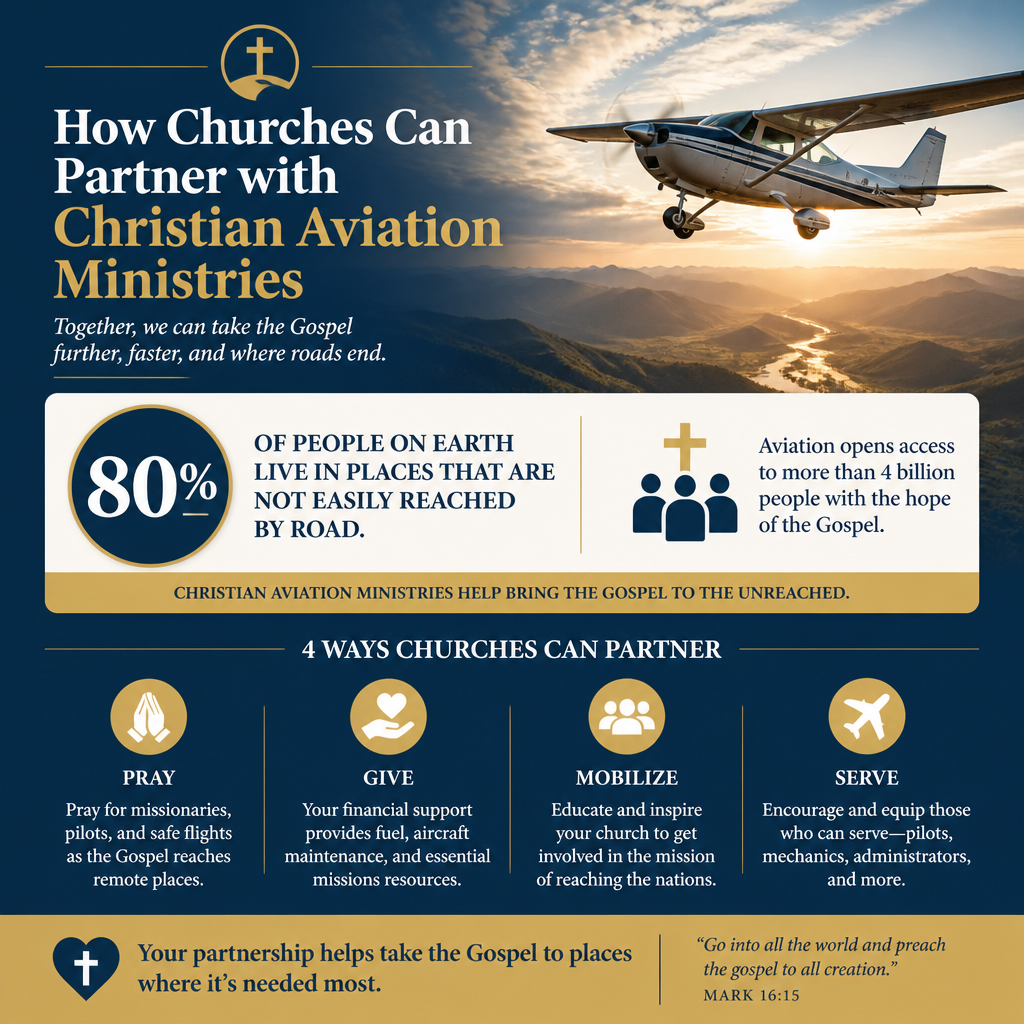
Churches partner with Christian aviation ministries when they treat aviation not as a specialty interest, but as a shared instrument of mission: moving people, medicine, Scripture, and practical help across barriers that roads, politics, and geography keep in place. The question is not whether aircraft are impressive; it is whether the partnership is faithful, accountable, and aligned with what the local church is actually called to do.
For mature donors, aviation raises immediate stewardship questions. Flights are expensive, safety is non-negotiable, and the work often happens far from a Sunday congregation’s line of sight. Those realities do not disqualify aviation; they require clarity about outcomes, governance, and the moral discipline of serving the church’s mission rather than building an organization’s brand.
Begin with a theology of presence and the limits of access
Why aviation is a mission question, not merely a logistics question
Christian mission has always had an embodied character. The incarnation dignifies proximity, and the Great Commission assumes going, not merely sending ideas. Yet Christian mission also recognizes real constraints: geography, borders, insecurity, disaster, and the fragility of supply chains. Aviation can be one of the few ethical ways to cross those constraints without coercion or corruption.
Paul’s missionary journeys were shaped by the transportation infrastructure of his day: Roman roads, shipping routes, and the costs and risks they imposed. Modern aircraft are not a new gospel, but they are a new road system. They can enable pastoral care, medical referral, Bible translation teams, and emergency response in places where the alternative is weeks of travel or none at all.
The harder question is who benefits and who decides
Christians genuinely disagree about what “presence” should look like in global ministry. Some emphasize long-term embeddedness and local leadership; others emphasize catalytic support that strengthens existing churches. Aviation can serve either approach, and it can also distort both—especially when the aircraft becomes the center of attention rather than the church and community it is meant to serve.
What this means in practice is that churches should ask early: Does this ministry’s flight program exist to strengthen local churches and accountable partners, or does it function as a self-referential ecosystem? The difference is often visible in governance, in how decisions are made about flight priorities, and in how the ministry reports its work.

Choose partnership models that fit a church’s calling
Three common ways churches partner well
Not every church is positioned to fund an aircraft, sponsor a pilot, and organize mission travel. Many faithful partnerships are smaller, clearer, and more sustainable. The most effective arrangements usually start with a narrow commitment, tested over time, rather than a dramatic first step.
Across our verification work at Most Trusted, we observe that durable partnerships are built around defined responsibilities: who requests flights, who approves them, how costs are shared, and how the church will evaluate whether the aviation support is advancing ministry outcomes rather than simply increasing activity.
- Operational support: predictable giving that underwrites flight hours for vetted church and medical partners
- Project-based support: time-bound funding for a specific corridor of work, such as disaster relief or medical referral
- Member care support: funding for pastoral and counseling travel to isolated workers and their families
- Local church strengthening: underwriting transport for local pastors, training cohorts, or theological education intensives
- In-kind expertise: legal, accounting, HR, or safety expertise from qualified congregants who understand fiduciary duty
Aviation should reduce dependency, not increase it
Partnership should not quietly teach local leaders that ministry only happens when outside resources arrive by air. The healthiest aviation ministries plan for sustainability: training local staff where feasible, coordinating with local health systems and churches, and resisting the temptation to fly every request simply because it is urgent. Scarcity forces moral triage, and transparent triage is part of integrity.
The When Helping Hurts framework, articulated by Corbett and Fikkert, has shaped the broader missions conversation by warning how outsiders can unintentionally displace local initiative and dignity. Churches should expect aviation partners to speak that language fluently and to show how their flight strategy strengthens local agency rather than supplanting it.
Do the stewardship work donors assume you have done
Cost, safety, and accountability must be stated, not implied
Aircraft operations concentrate risk. A single incident can harm people, devastate trust, and compromise the witness of the church. Churches should insist on clear safety standards, training requirements, and incident reporting protocols. If a ministry is vague about safety governance, that is not humility; it is a warning sign.
Financial stewardship is similarly concrete. Donors do not need perfection, but they do need evidence: audited financials when scale warrants it, coherent budgeting, meaningful board oversight, and transparent reporting on restricted gifts. The contemporary nonprofit sector has also had to reckon with the “overhead ratio” obsession. The joint “Overhead Myth” letter from GuideStar, Charity Navigator, and the BBB Wise Giving Alliance cautioned donors against using overhead percentages as the primary measure of effectiveness because it can punish necessary investments in systems and accountability. See the statement on GuideStar.
What to verify before the church makes a commitment
Aviation ministry can be unusually compelling for donors: a plane looks like direct action. That visibility can disguise weak governance or unclear results. The stewardship discipline is to verify what is not visible—controls, oversight, and whether the ministry can explain its impact without resorting to sentiment.
Most Trusted exists to help donors give with confidence by evaluating ministries against The Most Trusted Standard, a 15-criteria framework that examines Faith Foundation, Financial Integrity, Governance and Leadership, and Transparency and Effectiveness. Churches do not need to outsource discernment, but third-party verification can strengthen a missions committee’s decision-making and protect unity when questions arise later.
Align aviation support with measurable ministry outcomes
Good reporting distinguishes activity from fruit
Flights are activity; the gospel-shaped outcomes are what the flights enable. A mature aviation ministry can explain, with appropriate restraint, what changed because transport existed: patients reached care, pastors received training, translators completed work, relief arrived in time to prevent avoidable loss. They can also describe what did not work, and what they changed, without spin.
Where outcomes are difficult to quantify, the ministry should at least demonstrate disciplined learning: consistent definitions, documented partner feedback, and evaluation that is not designed only for fundraising. Sophisticated donors typically accept that some impact is long-term and indirect; they are less patient with reporting that never matures beyond anecdotes.
Coordinate with credible partners, not parallel structures
One of the best signals of effectiveness is whether aviation ministries strengthen existing systems rather than duplicating them. In humanitarian contexts, that often means coordination with local health authorities and reputable relief networks. In church contexts, it means prioritizing requests that come through accountable church leadership and mission partners, not through informal personal networks that bypass oversight.
Churches considering broader engagement with mission-linked aviation can place this partnership within the larger landscape of Christian Aviation Ministries, including how different organizations define their mission, structure partnerships, and report on outcomes. Context matters because aviation can serve Bible translation, disaster response, pastoral formation, and medical work in distinct ways, each with distinct accountability needs.
Govern the partnership so it strengthens the church, not strains it
Clarify authority, communication, and pastoral care
Church missions partnerships often fracture over misaligned expectations. Aviation adds complexity: travel schedules, emergencies, and the natural emotional pull of dramatic need. Churches should decide in advance who approves giving, who receives updates, and how pastoral care will be extended to staff serving in high-stress environments.
This is also where donor psychology matters. A compelling aviation story can unintentionally shift a church’s missions budget toward what feels most vivid rather than what is most strategic. Mature governance keeps room for the whole counsel of mission: the slow work of discipleship, local church formation, theological education, and mercy that does not photograph well.
Structure giving to preserve integrity
Restricted giving can be appropriate, particularly for aircraft acquisition, maintenance reserves, or time-bound projects. But restrictions should be realistic and aligned with how aviation actually operates. An aircraft’s costs do not pause when a designated project ends; maintenance and safety compliance are continuous. Churches should ask ministries how they handle restricted funds, how they avoid cross-subsidizing restricted accounts improperly, and how they communicate surpluses or shortfalls.
Churches that want to understand how aviation integrates with other mission work will benefit from the broader discussion within How Christian Aviation Ministries Support Other Mission Work, especially the governance questions that arise when aviation supports multiple program areas and external partners.
FAQs for How churches can partner with Christian aviation ministries
Should a church fund an airplane or fund flight operations?
Funding an aircraft can be appropriate when the ministry has demonstrated long-term demand, strong safety governance, and a realistic plan for maintenance reserves, staffing, and compliance. Many churches find that supporting flight operations is a clearer entry point because it ties giving to defined service capacity and can be evaluated over time. In either case, the church should expect transparent financial reporting and evidence that aviation is enabling ministry outcomes rather than expanding activity for its own sake.
What warning signs suggest an aviation partnership is not ready for major church support?
Common warning signs include vague safety standards, unclear board oversight, limited financial transparency, heavy reliance on anecdotes without disciplined reporting, and a partnership model that routes requests through informal personal channels rather than accountable institutions. Churches should also be cautious when a ministry cannot articulate how it avoids dependency, coordinates with credible local partners, or handles restricted gifts with clear internal controls.
A partnership worthy of the church’s trust
Christian aviation ministries can serve the church with quiet faithfulness: carrying pastors to remote congregations, enabling medical care, supporting translation teams, and sustaining presence where access is fragile. Churches partner well when they bring the same seriousness to aviation that they bring to any ministry responsibility—verifying governance, insisting on transparency, and measuring whether the work strengthens local churches and advances gospel ends.
Donors want their giving to be more than sincere; they want it to be wise. When churches apply that stewardship discipline, aviation becomes what it ought to be: a tool in the hand of the church, ordered toward love of neighbor and the spread of Christ’s name.



