

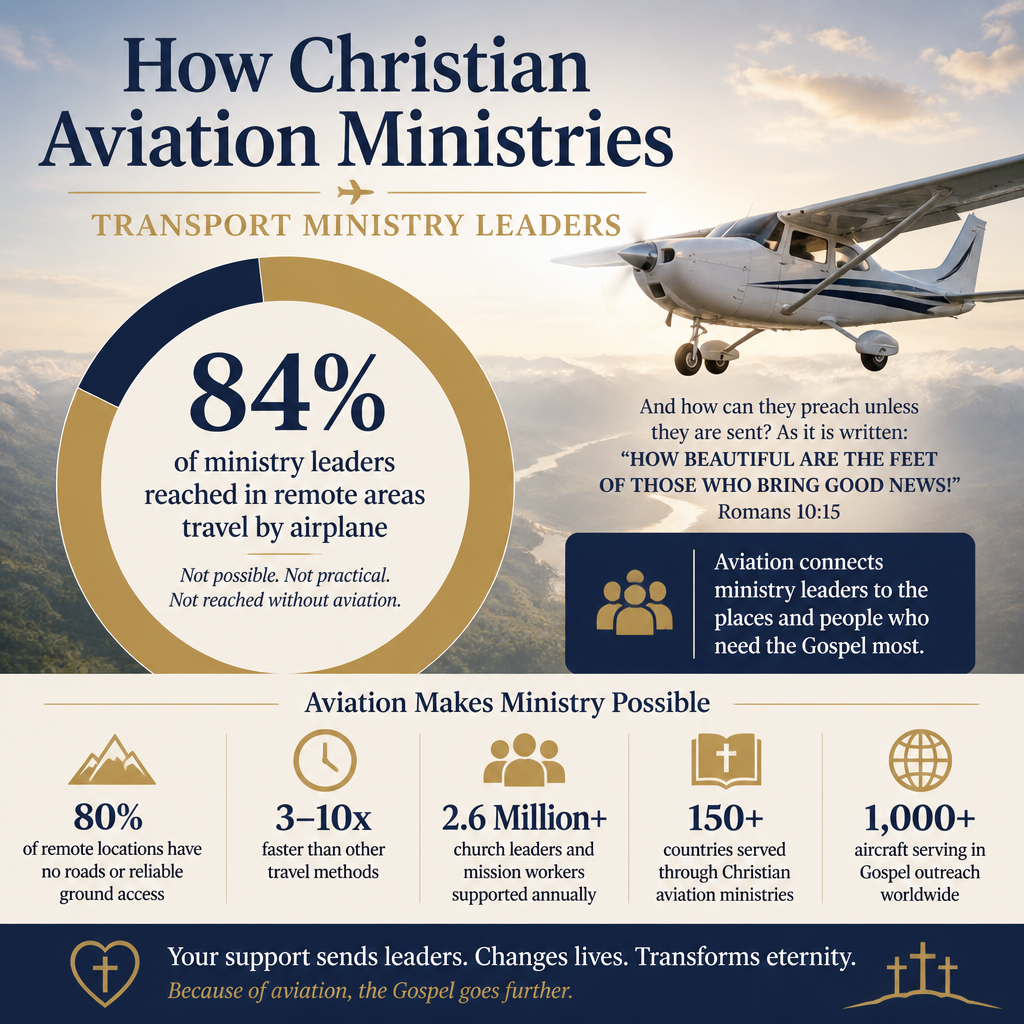
How Christian aviation ministries transport ministry leaders is not a matter of convenience. In much of the world, aviation is the difference between a pastor receiving training this year or next year, between a denominational overseer reaching a fractured region in time to reconcile leaders or arriving after conflict has hardened, and between a medical evacuation that preserves a lifetime of ministry and one that does not. For donors who care about durable gospel work, aviation is a quiet form of infrastructure that multiplies other ministries rather than competing with them.
Yet aviation also concentrates risk. Aircraft are expensive, oversight is technically demanding, and a compelling story can tempt donors to mistake activity for accountability. Mature Christian giving asks a harder question: when aviation is used to transport ministry leaders, what conditions make it faithful, effective, and verifiable?
Transporting leaders is a ministry multiplier, not a celebrity perk
Why leaders travel matters in the Great Commission
The New Testament assumes movement in service of the church’s strengthening and unity. Paul’s letters were carried across distance; his journeys were not tourism but pastoral oversight, theological clarification, and church planting. When aviation ministries move leaders, the best of them are enabling ordinary, unglamorous work: training local pastors, visiting scattered congregations, convening elders, and responding to crisis with physical presence.
What this means in practice is that aviation can strengthen the parts of ministry that are hardest to fund because they are not easily photographed: governance training for national church networks, conflict mediation, doctrinal instruction, and accountability visits to remote partners. Donors who have funded theological education or church networks often find that the limiting factor is not curriculum but access.
The travel problem donors rarely see
Ground travel can be dangerous, slow, or seasonally impossible. Roads wash out, checkpoints multiply, and a “day trip” becomes a multi-day journey with lodging and security costs. Aviation can sometimes reduce overall exposure to risk while increasing the number of meaningful pastoral touchpoints a leader can make in a year.
At the same time, Christians genuinely disagree about how to interpret “simplicity” in ministry travel. Some will argue that leaders should accept the hardship of long journeys as part of identification with their people. Others will argue that stewardship of limited time and health, especially for those overseeing multiple communities, justifies faster transport. Donors should not ignore this tension. They should insist that ministries explain the theological and operational rationale for flights that transport leaders.

Operational integrity in aviation is part of moral integrity
Safety and compliance are discipleship issues
Aviation punishes shortcuts. Weather, maintenance, training, and fatigue do not yield to spiritual sincerity. For a Christian aviation ministry, safety culture is not merely technical competence; it is love of neighbor, humility before reality, and refusal to spiritualize preventable risk.
Donors can legitimately ask whether a ministry’s operations align with recognized safety and maintenance expectations in the jurisdictions where it flies, and whether its pilots receive recurrent training. In the United States, for example, the Federal Aviation Administration maintains accident and incident data and sets regulatory requirements for operators (Federal Aviation Administration). International contexts vary, but the principle does not: Christian missions do not have a moral exemption from rigorous standards.
What good aviation ministries document
A serious aviation operator can usually show clear documentation of aircraft status, maintenance practices, pilot qualifications, and incident reporting processes. The best ministries also show decision discipline: they cancel flights, reroute, or delay without apologizing for caution. When a ministry treats “getting the job done” as the highest virtue, donors should be concerned.

Across our verification work at Most Trusted, we observe that strong ministries do not ask supporters to trust their intentions. They provide evidence of governance and controls that make wise outcomes more likely, especially in high-risk operations.
When aviation transports leaders well, it strengthens local churches rather than bypassing them
Avoiding dependency and privileging local authority
Aviation can easily become a shortcut around local capacity. A foreign leader flown in to “fix” problems can undermine local pastors, create unhealthy dependency, or reinforce the implicit message that authority comes from outside. The When Helping Hurts framework, articulated by Steve Corbett and Brian Fikkert, has reshaped how many Christian organizations evaluate these dynamics, particularly the difference between relief, rehabilitation, and development and the dangers of paternalism (When Helping Hurts).
Responsible aviation ministries have learned to ask: who requested this travel, and for what purpose? Is the flight serving local church governance, or replacing it? Is it strengthening local leadership pipelines, or creating an air-bridged dependency on outside personalities?
Practical patterns donors can look for
Healthy leader transport typically fits within a local strategy that is already owned by local churches and networks. The aviation component should be supportive: getting leaders to a training site, enabling a bishop to visit rural parishes, moving a reconciliation team into a volatile area at the invitation of local elders, or transporting national leaders to respond to disaster in coordination with local congregations.
By contrast, repeated flights that center a single outside speaker, brand, or personality should prompt questions. Some ministries do rely on itinerant teaching for catalytic moments. But donors should expect a clear explanation of how the travel is embedded in local discipleship and governance rather than substituting for it. For readers tracking the wider ecosystem of support work, our coverage of How Christian Aviation Ministries Support Other Mission Work treats these interdependencies more directly.
Stewardship questions donors should ask before funding leader transport
Cost discipline without falling for the overhead trap
Aviation spending can look “high overhead” to donors accustomed to direct program imagery. That reaction is understandable but can become the very error the sector has tried to correct. The Overhead Myth letter, signed by Charity Navigator, GuideStar, and the BBB Wise Giving Alliance, argued that fixation on administrative ratios can punish the very investments that protect outcomes: governance, systems, and accountability (Charity Navigator).
The correct question is not whether aviation is expensive. It is whether the expense is justified by outcomes that could not be achieved safely and consistently by other means, and whether the organization has evidence of disciplined decision-making about when to fly and when not to.
A donor checklist that respects both faith and evidence
Before funding flights that transport ministry leaders, donors can ask for specific answers in a spirit of Christian seriousness. A ministry worthy of trust will not resent these questions.
- Mission fit: What ministry outcomes require leader transport, and how are those outcomes measured or documented?
- Request and authority: Who initiates the travel—local church leadership, a partner network, or the aviation ministry itself?
- Safety governance: What maintenance standards, pilot training cycles, and incident reporting practices are in place?
- Financial controls: How are flight costs allocated, and what prevents donor-restricted funds from being diverted?
- Equity and access: How does the ministry avoid privileging a small set of leaders while neglecting broader pastoral care and training needs?
At Most Trusted, our evaluation work uses The Most Trusted Standard to assess ministries across faithfulness, financial integrity, governance and leadership, and transparency and effectiveness. Aviation is precisely the kind of domain where these categories become tangible: sound theology is not detached from sound controls.
What trustworthy aviation ministries make transparent to donors
Transport narratives are not enough
Stories of remote airstrips and grateful pastors can be true and still incomplete. The question for donors is whether transparency is adequate for informed partnership. In aviation, opaque reporting is not a minor weakness; it can hide avoidable risk, distort real costs, and conceal whether leader transport is serving a coherent ministry strategy.
Trustworthy ministries typically disclose more than inspiration. They publish governance information, audited or reviewed financials when feasible, clear descriptions of programs, and realistic accounts of limitations. They also acknowledge the operational realities: flight cancellations, weather constraints, mechanical issues, and the discipline required to say “no.”
Indicators that transport is producing durable fruit
Donors should look for evidence that leader transport results in strengthened local systems: training cohorts completed, pastoral care visits documented, church network gatherings held, conflict resolution processes supported, or emergency responses coordinated through local structures. These are not always reducible to a single metric, and donors should be wary of simplistic scorekeeping. But neither should aviation be exempted from ordinary expectations of effectiveness.
For donors who want to understand the broader field, Christian Aviation Ministries remains a useful reference point for how different models approach service, partnership, and accountability.
FAQs for How Christian aviation ministries transport ministry leaders
Does funding aviation leader transport divert money from direct evangelism?
It can, if the flights are driven by visibility or outside agendas rather than local church priorities. But when the purpose is pastoral training, oversight, crisis response, or convening leaders for accountability and unity, aviation often functions as infrastructure for direct ministry rather than a competitor to it. Donors should expect a clear theory of ministry impact and transparent reporting that connects flights to outcomes that serve local churches.
What is the most reliable way to evaluate an aviation ministry beyond stories?
Ask for verifiable documentation: governance oversight, financial statements, policies for maintenance and pilot training, and evidence that local partners request and guide leader travel. At Most Trusted, we encourage donors to look for alignment with The Most Trusted Standard, because high-risk operations require more than good intentions; they require controls that are strong enough to bear the weight of mission responsibility.
Funding leader transport with discernment honors both mission and stewardship
Christian aviation ministries can serve the church by moving leaders to the places where presence matters: remote congregations, fractured regions, training centers, and emergency contexts. Done well, this work strengthens local authority and multiplies other ministries’ efforts. Done poorly, it can centralize power, waste resources, and normalize avoidable risk. Donors who give with confidence insist on both theological clarity and operational evidence, because stewardship is not a secondary concern but a form of love.



