
How Christian aviation ministries support local churches is not primarily a question of transportation. It is a question of ecclesiology: whether the work in remote places strengthens the ordinary means God uses to sustain his people—faithful preaching, administered sacraments, disciplined fellowship, and enduring pastoral care (Acts 2:42). Aviation is a tool. The moral and spiritual measure is whether it serves the church rather than substituting for it.
For Christian donors, this distinction matters because aircraft are expensive, logistically demanding, and easy to romanticize. Mature giving requires more than admiration for bravery. It requires clarity about what is being built: a durable local church presence, or a perpetual external dependency. The best aviation ministries have learned to treat flights as scaffolding that is removed once a structure can stand.
Local churches are the center of mission, not the aviation ministry
The New Testament pattern is church-led, not personality-led
The New Testament does not present mission as an entrepreneurial project attached to a charismatic leader. It is a church-sent, church-accountable work. Antioch sends Paul and Barnabas, and the work returns to the church’s discernment and reporting (Acts 13:1–3; 14:26–28). Christian aviation ministries are most faithful when they see themselves as servants of that same pattern: enabling local congregations and denominational structures to do what they are already called to do.
What this means in practice is that aviation ministries should be judged by the health of the churches they serve, not by the number of flight hours alone. Flight logs can be impressive without being spiritually fruitful. A donor’s first question should be: Which local churches and recognized church networks are strengthened because aviation makes pastoral ministry possible where it otherwise would be delayed or dangerous?
Church partnership must be more than a courtesy
In the field, it is easy for a well-resourced aviation operator to become a de facto gatekeeper to entire regions. Aircraft scheduling, fuel access, and safety policies can unintentionally place the ministry “in charge” of other ministries. Wise aviation leaders resist this drift by embedding decision-making into durable relationships with local churches and, where present, national church bodies. They plan routes, priorities, and crisis response in a way that honors the church’s authority in its own context.

Aviation changes the timelines of pastoral care
Regular presence makes ordinary church life possible
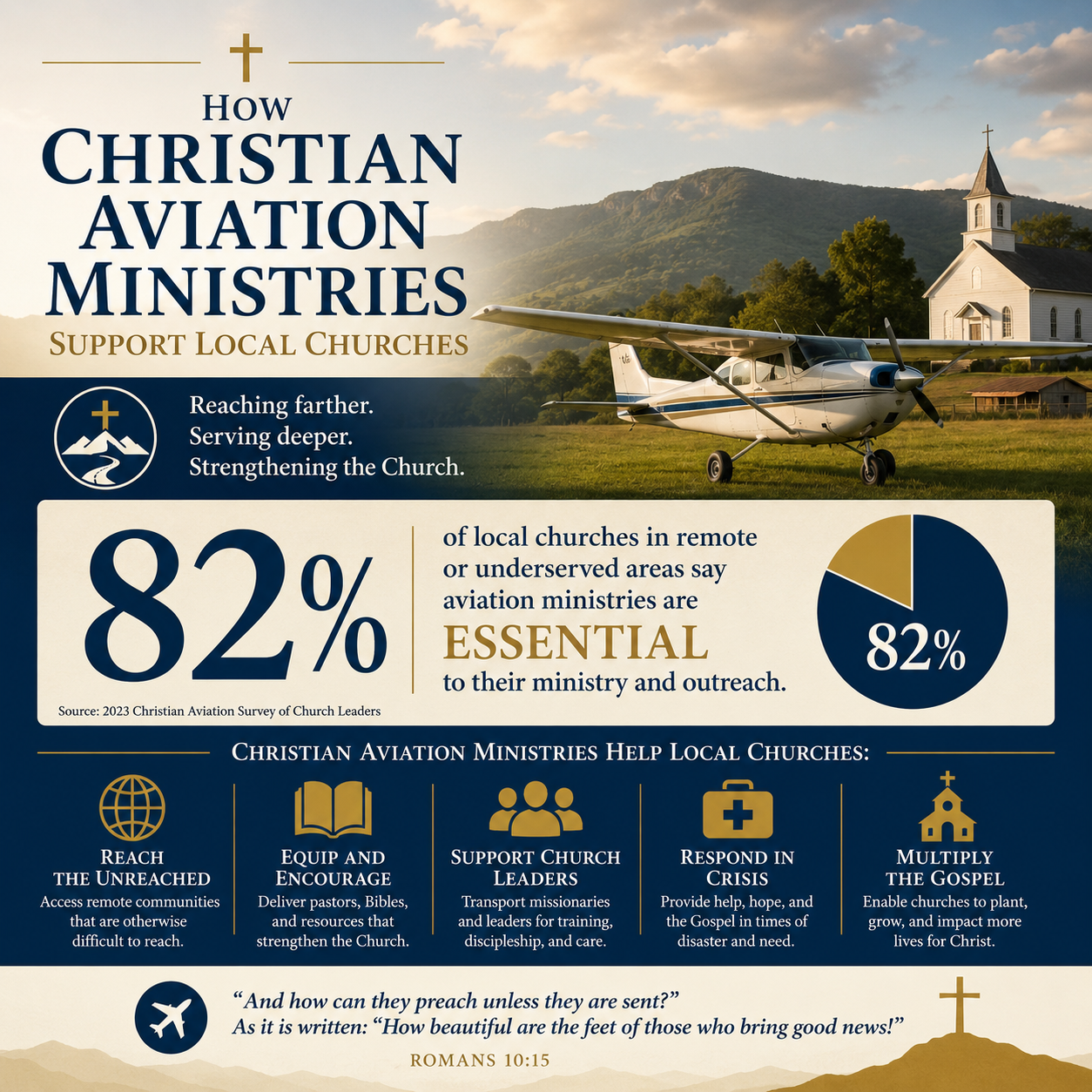
Many of the places served by Christian aviation ministries face geographic barriers that turn a simple pastoral visit into a multi-day journey. Aviation compresses distance. That compression can mean that a pastor attends a funeral, a new believer receives follow-up discipleship, a church planter is not isolated for months at a time, and conflict is addressed before it hardens into division.
Donors sometimes imagine aviation primarily as “getting missionaries in.” In many contexts, its more important work is “keeping shepherds present.” Scripture’s pastoral imagery is unavoidably embodied: elders are to shepherd the flock among them (1 Peter 5:2). When aviation makes “among them” realistic, churches can move from episodic contact to patterned care.
Medical and crisis flights can protect church stability
Churches in remote settings are often one medical emergency away from losing a key leader. An emergency evacuation is not only compassionate; it can preserve congregational continuity and reduce the long-term disruption that follows preventable tragedy. The question for donors is not whether such flights are dramatic; it is whether the ministry has clear medical protocols, appropriate insurance, and sober decision-making under pressure.
Responsible aviation ministries also resist the temptation to turn crisis response into a brand. The work is serious, sometimes traumatic, and often quiet. Donors should look for ministries that communicate with restraint, protect dignity, and avoid using another community’s vulnerability as fundraising material.
Healthy aviation ministries strengthen local capacity rather than replacing it
Training and shared systems are often more strategic than more flights
The deeper question is whether aviation creates a pathway toward local ownership. In some regions, that may mean training national pilots, mechanics, and operations leaders. In others, it may mean investing in communications systems, safety training for local church teams, or coordination that helps local leaders use flights wisely rather than reactively.
Christians genuinely disagree about how fast “localization” should happen in technical fields like aviation. Safety standards are non-negotiable, and competent maintenance culture takes time. But the direction should be clear: the long arc should bend toward local capacity, not endless foreign staffing justified by urgency.
Donors should ask about dependency risks
Aviation can accidentally centralize power. When one aircraft becomes the single artery for supplies, ministry travel, and medical evacuation, the operator’s decisions shape the entire ecosystem. Mature ministries acknowledge this risk and build redundancy where feasible—partnering with other operators, strengthening ground transport when possible, and establishing transparent prioritization policies that are not swayed by donor preference.
Across our verification work at Most Trusted, we observe that ministries most worthy of confidence name their dependency risks directly and document the safeguards they use. They do not treat complexity as a public-relations problem. They treat it as stewardship.
What donors should verify before funding aircraft and flight operations
Aircraft are ministry tools, but they are also governance tests
Aviation spending concentrates risk: safety, fraud, mission drift, and reputational exposure. A donor evaluating a Christian aviation ministry should think less like a spectator and more like a trustee. The ministry must demonstrate that it can manage high-value assets with discipline, and that it is accountable for outcomes beyond activity metrics.
At Most Trusted, we evaluate ministries against The Most Trusted Standard, a 15-criteria framework spanning Faith Foundation, Financial Integrity, Governance and Leadership, and Transparency and Effectiveness. Aviation ministries often excel in courage and sacrifice. Donors still need evidence of controls, board oversight, and honest reporting—especially where equipment and emergency decision-making are involved.
A practical donor checklist
The following questions tend to clarify whether an aviation ministry is strengthening local churches or subtly replacing them:
- Is the ministry’s work requested and shaped by identifiable local churches or church networks, with documented partnership practices?
- Does the board oversee safety, finances, and risk management with clear policies, not informal assumptions?
- Are audited financials, annual reports, and impact reporting readily available and specific about church outcomes?
- Does the ministry avoid “overhead shaming” and explain true costs, consistent with the Overhead Myth statement from leading evaluators (Charity Navigator)?
- Is there a credible plan for training and empowering local leaders in operations, maintenance, or coordination over time?
Donors should also calibrate expectations about what “impact” looks like. Not every fruit is countable, and Scripture itself refuses to reduce faithfulness to measurable outputs (1 Corinthians 3:6–7). Yet aviation ministries can still report meaningful indicators: frequency of pastoral visits enabled, number of Bible training intensives supported, emergency evacuations completed with documented protocols, and partner-church satisfaction.
How aviation partnerships fit within broader mission support
Aviation is often most fruitful as a secondary enabler
Christian aviation ministries rarely produce church growth by themselves. Their contribution is more often catalytic: enabling translation teams to remain in place, helping seminary extension programs reach distant pastors, sustaining regular church planting coaching, and allowing denominational leaders to provide oversight and care across difficult terrain. This is why donors should evaluate aviation ministries alongside the wider mission work they serve.
In that larger ecosystem, wise donors resist the temptation to fund the most visible equipment at the expense of less visible formation. Airframes are tangible; elder training and church discipline are not. Yet the long-term spiritual yield is commonly tied to the slow work of strengthening leaders, families, and congregational practices.
Where to deepen due diligence
Donors comparing aviation ministries should place them within the broader landscape of Christian Aviation Ministries. The relevant questions include theology of the church, partnership posture, and operational competence. The ministry that photographs well is not necessarily the ministry that builds well.
It is also worth examining the specific ways aviation relates to other mission efforts in How Christian Aviation Ministries Support Other Mission Work. Some flight programs primarily serve medical work, others primarily serve Bible translation or pastoral training. Donors can give more confidently when they understand which ecclesial outcomes a ministry is structured to support.
FAQs for How Christian aviation ministries support local churches
Should donors prefer aviation ministries that fly pastors or those that fly supplies and medical teams?
The better question is whether the flight program has a clear theory of service to the local church. In many places, pastor transport directly strengthens congregational life through regular preaching, sacraments, counseling, and oversight. In other places, supply and medical flights stabilize communities in ways that protect the church’s ability to remain present. Donors should ask which local churches are served, how priorities are set, and whether the ministry reports outcomes that reflect church health rather than only operational activity.
What financial signals suggest an aviation ministry is trustworthy?
Because aviation is capital-intensive, transparency is essential. Donors should look for audited financial statements, clear accounting for restricted gifts, realistic budgeting for maintenance and safety, and a board that demonstrates active oversight. Ministries that candidly explain true operating costs and resist simplistic overhead narratives tend to be more reliable stewards. When a ministry makes its governance and reporting easy to inspect, it usually indicates a culture prepared for accountability.
Supporting the church by serving the roads the church cannot travel
Christian aviation is most compelling when it is quietly ecclesial: enabling pastors to shepherd, churches to gather, and leaders to remain accountable across terrain that would otherwise fracture relationships. The aircraft is not the mission. The mission is the faithful presence of Christ’s people, ordered under Christ’s Word, in places where isolation would otherwise win. Donors serve that end best by funding aviation ministries that can demonstrate both operational competence and a humble, verifiable commitment to the local church.



