
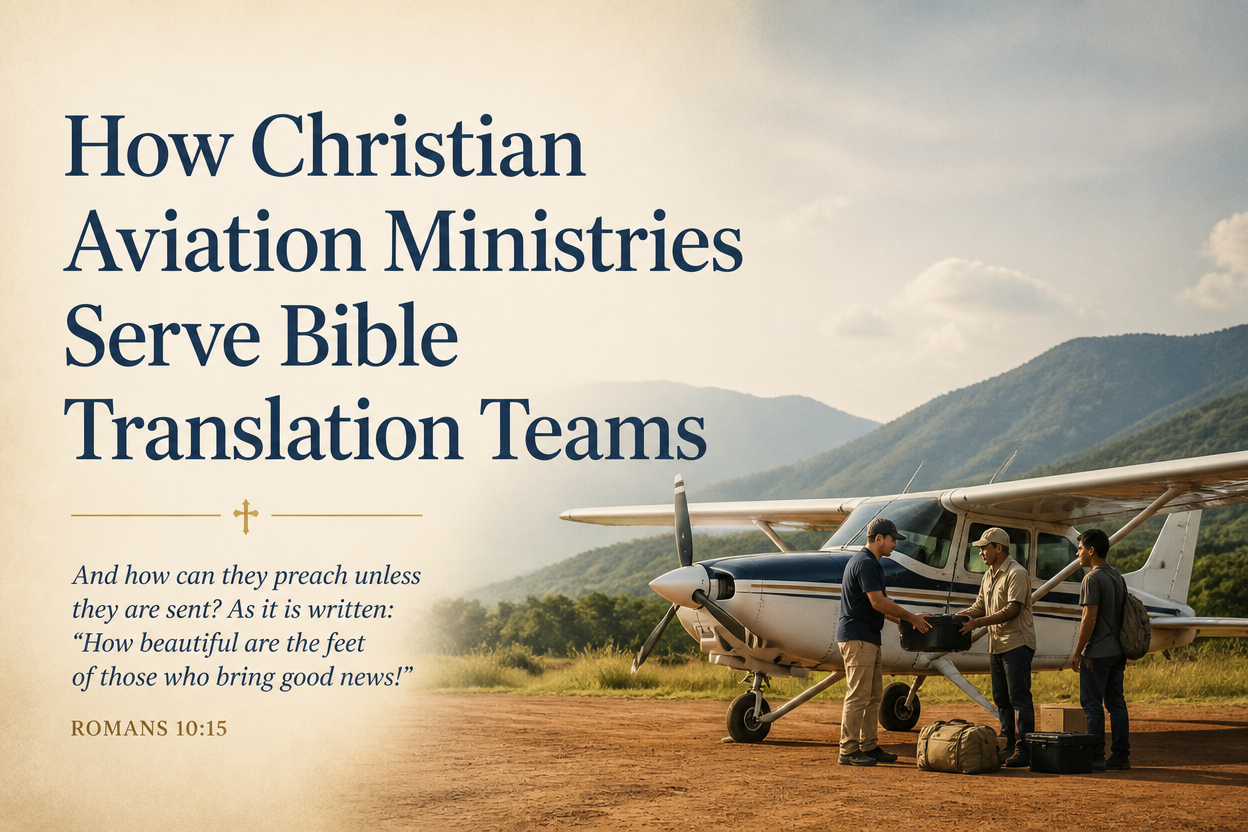
How Christian aviation ministries serve Bible translation teams is not a romantic footnote to missions work; it is often the difference between a translation team that can remain present and one that must withdraw. Translation is painstaking, relational, and time-intensive. In many places, the most faithful work is undone not by theology or linguistics, but by logistics.
Christian donors generally understand the urgency of Scripture access, yet aviation can appear indirect, even secondary. The harder question is whether the infrastructure that makes translation possible is being funded with the same seriousness as the translation itself. When air transport is treated as an afterthought, the cost is not merely inconvenience; it can be delayed community engagement, higher medical risk, fractured team rhythms, and missed windows of trust.
Aviation is often the first and last mile of Bible translation
Translation work depends on reliable presence
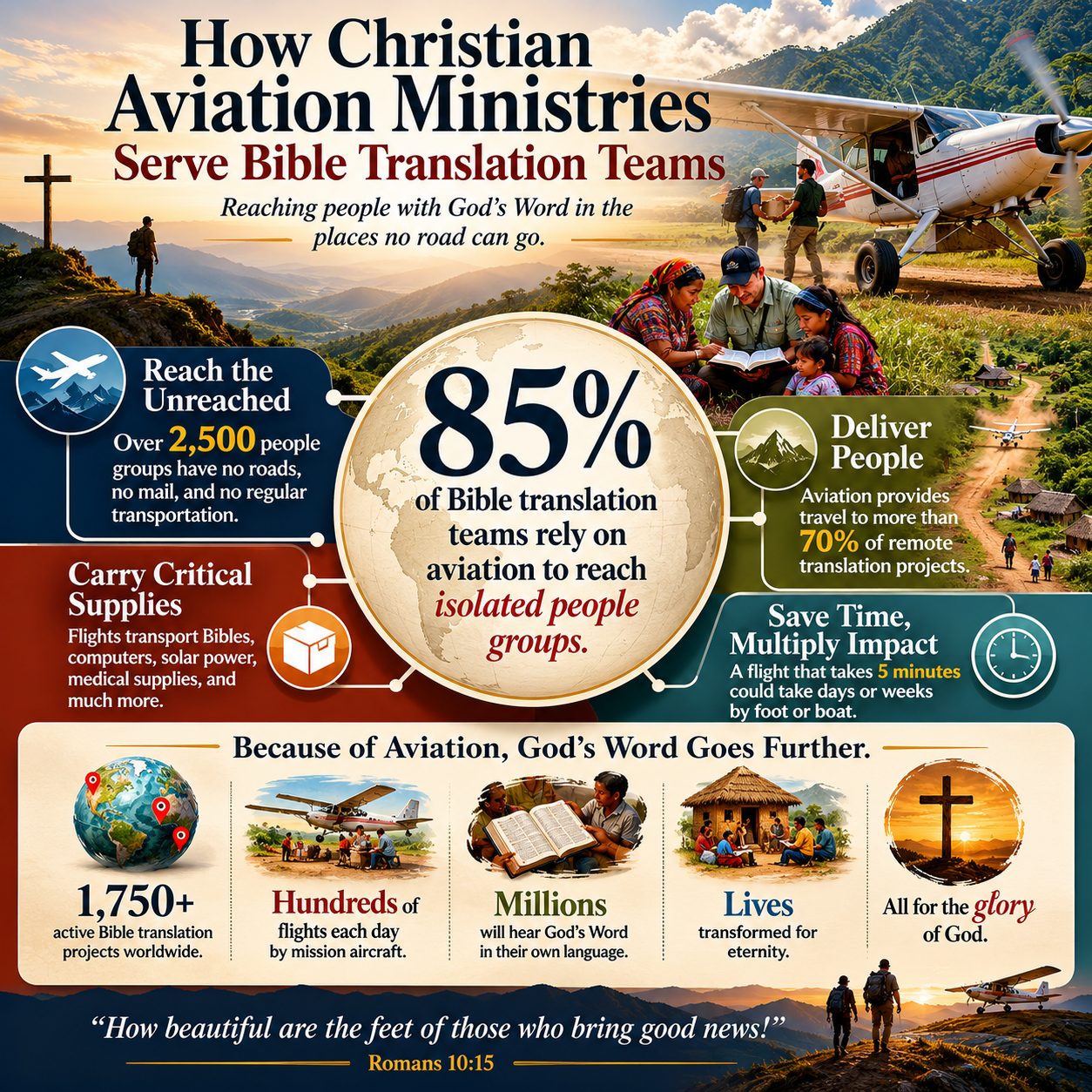
Bible translation teams do not simply arrive, collect data, and leave. They build long-term relationships, learn local languages with humility, and test drafts in real community settings. In remote contexts, the practical question becomes whether translators can return regularly enough to sustain trust and make progress. Aviation ministries provide access that would otherwise take days of overland travel, often through seasonal barriers such as flooding, landslides, or impassable roads.
What this means in practice is that a flight is not primarily a convenience. It is a way to protect the relational continuity of a multi-year project. A missed check-in can mean losing momentum with local review committees. An inability to rotate personnel can mean burnout, early departure, and—over time—higher attrition in a field where language work already demands unusual perseverance.
Transport can be a form of pastoral care for teams
Translation teams carry pressures that are not always visible to donors: long separations from medical care, limited educational options for children, and the constant spiritual strain of cross-cultural labor. Aviation support allows teams to access emergency care, counseling, and rest without abandoning their calling. Scripture itself treats embodied life seriously; Elijah’s exhaustion was met with food and sleep before further instruction (1 Kings 19). The same realism should shape how we fund long-term missions.

What aviation enables across the translation lifecycle
From language survey to Scripture engagement
Many translation efforts begin with language assessment and sociolinguistic work. Aviation can bring specialists to conduct surveys, support local-language literacy efforts, and help establish community-based translation processes. Later, the same air access supports consultant checks, training workshops, and the movement of printed materials or audio devices for Scripture engagement.
These are not interchangeable tasks. A project can stall if a consultant cannot review drafts on schedule or if local facilitators cannot gather. Air transport is often the quiet factor that keeps a complex workflow coordinated across distance and terrain.
Medical readiness, security, and continuity
Donors sometimes assume that the decisive risks in Bible translation are ideological opposition or overt persecution. In some contexts that is true. In others, the persistent threats are medical emergencies, transport accidents, and fragile supply chains. Aviation ministries reduce risk by providing trained pilots, maintained aircraft, and flight operations designed around safety and accountability.
They also provide contingency. When a translator’s child needs urgent care, or when a team must relocate briefly during instability, the ability to move quickly can prevent a permanent exit. Continuity matters because translation is a long obedience in the same direction, and the human cost of disruption accumulates.
The donor question is not only impact but trustworthiness
Complex operations require unusual governance and financial discipline
Aviation is asset-heavy and technically demanding. Aircraft acquisition and maintenance, pilot training, fuel logistics, safety systems, and regulatory compliance create genuine costs. These realities can tempt ministries toward vague storytelling or under-specified budgets. Mature donors should resist both cynicism and naivete: aviation is expensive for reasons that are often legitimate, but “expensive” is not the same as “well-governed.”
Across our verification work at Most Trusted, the ministries that meet The Most Trusted Standard tend to show donors the internal controls behind the mission: clear oversight, documented safety protocols, transparent reporting, and leadership structures capable of managing high-risk operations. Donors should expect aviation ministries to operate with the same integrity in the hangar that they proclaim in the pulpit.
Avoiding the false comfort of overhead debates
Some donors still rely on simplistic overhead ratios to decide whether an organization is “efficient.” The nonprofit sector has rightly challenged that approach, including in the Overhead Myth statement endorsed by major evaluators and accountability organizations Charity Navigator. Aviation ministry makes the issue even clearer: maintenance, safety training, and compliance are not distractions from mission; they are mission-critical safeguards.
The better question is whether spending aligns with the organization’s stated outcomes, whether costs are explained plainly, and whether results are evaluated honestly. Aviation ministries should be able to show how flights correspond to translation milestones, team sustainability, and community partnerships, not merely total hours flown.
How aviation partnerships work with translation organizations
Coordination, not competition, best serves the Church
In healthier ecosystems, aviation ministries do not compete with translation agencies; they coordinate with them. They learn the rhythms of translation projects and align flight schedules with community review sessions, consultant visits, and training cycles. They also integrate with local church leadership where appropriate, recognizing that Scripture translation is not simply a technical achievement but an ecclesial gift to be received and stewarded.
Christians genuinely disagree about the boundaries between specialized mission agencies and local-church authority in the field. Those debates deserve careful treatment. Yet regardless of model, translation teams and aviation operations require shared accountability and clarity about decision-making, security protocols, and expectations in crisis scenarios.
What donors should ask in a partnership model
Donors can strengthen these partnerships by asking questions that honor complexity rather than flatten it. The goal is not suspicion; it is responsible stewardship. A small set of questions can clarify whether an aviation ministry is meaningfully serving translation teams or merely using them as inspirational branding.
- How are flight priorities set when multiple ministries request support?
- What safety management system governs pilot training, maintenance, and incident reporting?
- How does the ministry document outcomes beyond flight counts, such as translation progress supported?
- What local partnerships exist, including with national churches and national aviation personnel?
- How does the organization handle financial transparency for large capital expenses?
For donors who want deeper context on the broader field, we maintain editorial coverage on Christian Aviation Ministries, including how different models approach access, safety, and partnership.
When aviation helps and when it can distort priorities
Guarding against dependency and mission drift
Aviation can serve with humility, or it can unintentionally distort local decision-making. In some contexts, an aircraft becomes the most powerful asset in the region, and power always shapes relationships. If a ministry becomes the gatekeeper of access—controlling who arrives, who receives help, and who is seen—then aviation support can cultivate dependency or resentment.
Donors should listen for how a ministry addresses these risks. A mature organization will speak candidly about boundaries, local leadership, and long-term capacity building, including training national pilots and mechanics where feasible. The aim is not to withdraw help but to ensure help strengthens the Church rather than replacing it.
Measuring what matters in Scripture access
Not every flight is equally strategic. Some are urgent medical evacuations. Others are routine rotations. Still others deliver consultants and materials that keep a translation moving. A wise aviation ministry can explain how it weighs compassion flights and project support, and how it avoids turning “flight volume” into a stand-in for spiritual fruit.
The place to evaluate this is often in transparency and effectiveness reporting: do leaders publish clear activity data, articulate goals, and invite informed scrutiny? For readers assessing this within the broader support ecosystem, our related coverage on How Christian Aviation Ministries Support Other Mission Work addresses how aviation intersects with church planting, medical missions, disaster response, and translation.
FAQs for How Christian aviation ministries serve Bible translation teams
Why not fund Bible translation directly instead of aviation?
Direct translation funding remains essential, but in many contexts translation is constrained by access. Aviation support can be a multiplier when it reduces travel time, improves medical readiness, and allows consistent community engagement over years. The wisest donor posture is not either-or but clarity about which constraints are most limiting in a given project and whether the aviation partner is governed with the seriousness high-risk operations require.
What evidence should donors look for when evaluating an aviation ministry serving translation teams?
Donors should look for transparent reporting that connects flight activity to translation-relevant outcomes, documented safety and maintenance practices, clear governance, and financial disclosures that explain capital expenses plainly. Ministries that align with The Most Trusted Standard typically show donors how decisions are made, how risks are managed, and how impact is evaluated without exaggeration.
Funding the infrastructure that protects the work
Bible translation honors a simple Christian conviction: God speaks, and his people should hear him in their own language. Aviation ministries serve that conviction when they provide safe, accountable access that sustains the long, relational labor of translation. For donors, the question is not whether aviation is glamorous; it is whether it is faithful, well-governed, and truly in service to the Church’s mission of Scripture access.



