

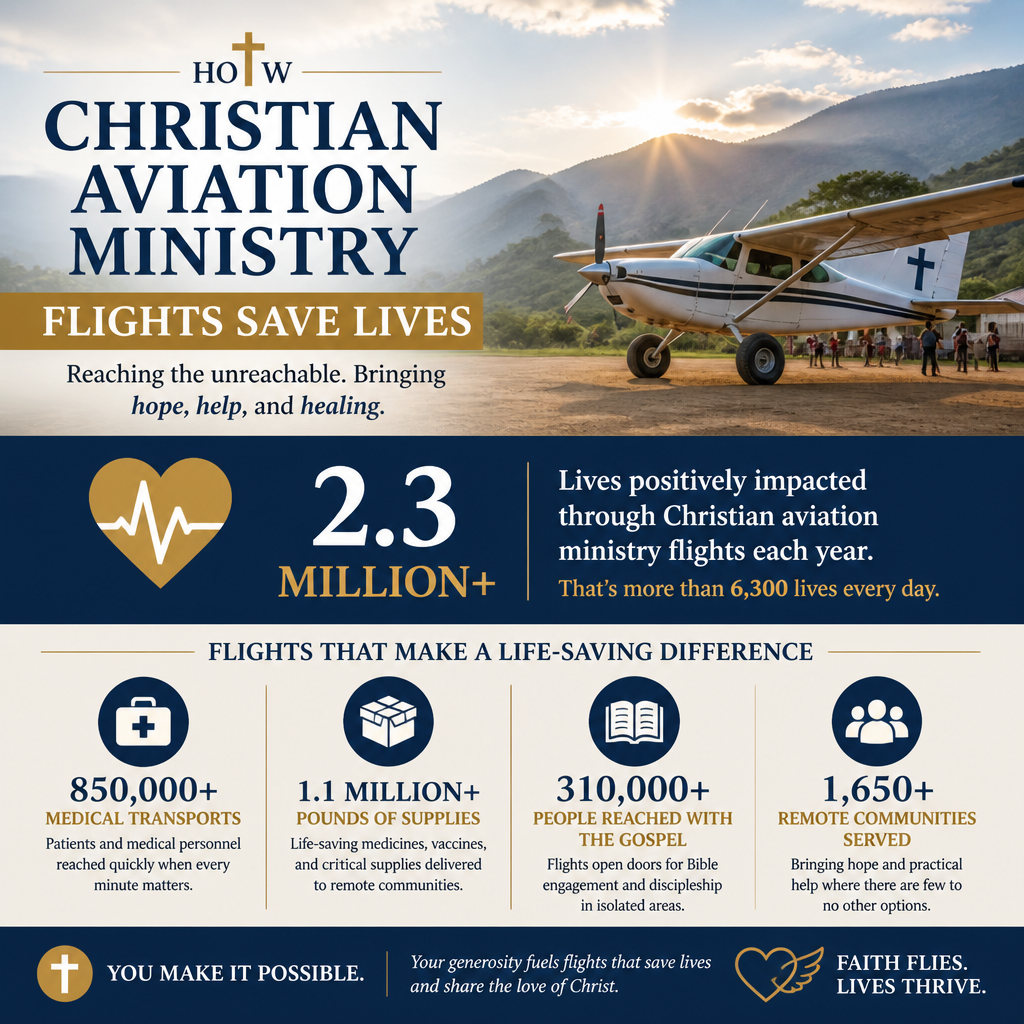
How Christian aviation ministry flights save lives is not primarily a romantic story about small planes and remote airstrips. It is a disciplined answer to a recurring problem in global missions and humanitarian work: geography can turn treatable injuries into fatalities, and ordinary ministry logistics into multi-day delays that compound suffering.
For Christian donors, the question is not whether aviation can be useful, but whether a given aviation ministry is truly life-preserving, spiritually grounded, and operationally accountable. Aircraft compress distance. They also concentrate risk, cost, and ethical responsibility.
When distance becomes a mortal threat
Medical access is not evenly distributed
Aviation ministry exists because some communities have no reliable road access, no all-season bridges, and no emergency transport capacity. The need is not theoretical. The World Health Organization estimates that about half of the world’s people lack access to essential health services, a gap that is especially acute in rural and hard-to-reach regions (World Health Organization).
When labor complications, severe malaria, traumatic injury, or sepsis meet that access gap, the outcome can hinge on hours, not days. A flight that moves a patient to surgical care the same day is not merely “helping”; it can be the decisive factor between recovery and death.
Time sensitivity is the moral weight of air transport
Christian donors are often attentive to visible outcomes: a clinic built, a Bible translated, a church planted. Aviation outcomes can be less visible, but they are no less concrete: a medevac executed safely, a vaccine shipment delivered before spoilage, a midwife transported in time for an obstructed birth, a pastor returned to an isolated congregation before a violent threat escalates.
What this means in practice is that aviation ministry often serves other ministries more than it serves itself. Its effectiveness is measured in lives preserved and in the continuity of gospel presence in places where interruption carries high human cost.

What life-saving aviation ministry actually does
More than emergency evacuations
Donors sometimes equate aviation ministry with dramatic rescues. Those flights matter, but a mature program typically carries a portfolio of mission-critical work. Life-saving impact can come from routine, repeatable service delivered with high safety margins.
Across our verification work at Most Trusted, we find that ministries with stable impact tend to describe their flight work in terms of defined mission categories, documented partners, and clear decision rules for prioritization under scarcity.
Common mission profiles donors should understand
- Medevac and medical referrals: transporting patients from village-level care to regional hospitals with surgical or obstetric capacity.
- Medical team transport: moving clinicians to periodic outreaches where care would otherwise not arrive.
- Medical supply flights: delivering blood products, antibiotics, vaccines, and sterile equipment when roads are impassable.
- Disaster response support: moving relief personnel and high-value cargo into areas cut off by flooding or conflict.
- Missionary and pastor support: sustaining long-term Christian presence by reducing isolation and increasing security options.
These categories also clarify where donors should ask harder questions. Each profile has different safety requirements, different partner dependencies, and different ethical risks, particularly around patient consent, triage fairness, and the potential to displace local systems rather than strengthen them.
The theology that makes this more than logistics
Mercy is commanded and it is accountable
Jesus’ description of faithful discipleship in Matthew 25 is concrete: feeding, welcoming, visiting, clothing, and caring for those in affliction. Christian aviation ministry is a form of presence that makes other works of mercy possible when distance prevents them. The point is not that an aircraft is sacred, but that love of neighbor becomes practical when Christians remove barriers that keep the vulnerable from ordinary care.
James also joins mercy to integrity: the religion God accepts is not sentimental but “pure” (James 1:27). Purity implies more than good intentions. It implies careful stewardship, truthfulness, and restraint where power can do harm.

Stewardship includes the invisible costs
Aviation is expensive, and donors are right to feel the tension. Fuel, maintenance reserves, pilot training, insurance, airstrip upkeep, and regulatory compliance are not optional if a ministry intends to fly safely. The ethical question is not whether overhead exists, but whether spending decisions are aligned with mission and honestly reported.
The charitable sector has repeatedly warned donors against simplistic overhead scoring. The “Overhead Myth” letter, signed by Charity Navigator, Candid, and the BBB Wise Giving Alliance, argues that starving administration can damage program outcomes and mislead donors about what effectiveness actually requires (Candid).
This is especially relevant in aviation. An underfunded maintenance program does not merely reduce efficiency; it can endanger lives. Christian stewardship requires that we fund safety and governance with the same seriousness we fund flight hours.
How to evaluate aviation ministries with donor-level rigor
Safety and governance are not optional add-ons
In practice, the sharpest donor questions are often not about compassion but about controls. Aviation magnifies the consequences of weak governance: a single accident can cost lives, undermine local trust, and compromise gospel witness. Ministries that treat safety as a spiritual obligation tend to document policies, training standards, incident reporting, and external accountability.
When donors explore Christian Aviation Ministries, it is reasonable to look for evidence of board oversight, audited financials, and transparent safety culture. A ministry’s theology of human life should appear in its operational choices, not merely in its fundraising language.
Questions that separate mature work from wishful work
The harder question is how a donor distinguishes high-impact aviation ministry from ministries that are sincere but underdeveloped. In our experience, the clearest signals are specific, verifiable practices:
Mission clarity: Are flight categories defined, prioritized, and measured, or described vaguely?
Partner integration: Are medical flights coordinated with recognized clinics and hospitals, with clear handoff procedures?
Local respect: Does the ministry strengthen local systems and leaders, or create dependency and bypass accountability?
Financial integrity: Are restricted gifts handled carefully, reserves maintained for maintenance, and costs reported plainly?
Incident transparency: Is there evidence the ministry reports failures honestly and learns from near-misses?
These are not bureaucratic preferences. They are expressions of love of neighbor under conditions where error has a body count.
Real tensions donors should name rather than ignore
Access can create dependency if it replaces local capacity
Christians genuinely disagree about how much external infrastructure is wise in fragile contexts. Aviation can function as a bridge while roads and health systems develop, but it can also become a substitute that unintentionally slows local ownership. The best aviation ministries tend to speak in the language of partnership, training, and transition where feasible, not permanent indispensability.
Donors can assess this by looking at how a ministry collaborates with national health authorities, local churches, and regional hospitals, and whether it can articulate what “strengthening” looks like in that setting.
Safety, cost, and urgency pull against one another
Another tension is that the most urgent flights are often the most dangerous: deteriorating weather, nightfall, short runways, limited navigation infrastructure, and pressure from desperate families. A ministry can be tempted to equate risk-taking with compassion. Mature leadership refuses that equation. Christian ethics requires courage, but it also requires prudence, because preventable tragedy is not a sacrament.
Donors should also be wary of simplistic narratives that frame aviation as the only faithful option. Sometimes the right answer is funding a radio network for clinic consultation, equipping local transport, improving referral protocols, or supporting midwife training. Aviation is powerful, but it is not the only way to love wisely.
FAQs for How Christian aviation ministry flights save lives
Are aviation ministry flights mainly about missionary convenience?
Some flights do support missionaries and pastors, and that support can be legitimate when it sustains long-term presence, reduces isolation, and improves security in volatile regions. The stronger life-saving case, however, is typically medical referral and supply transport integrated with credible local health partners. Donors can ask for flight category reporting and examples of partner coordination to understand what proportion of activity is truly time-sensitive care.
What should donors look for beyond compelling rescue stories?
Donors should look for safety culture, transparent finances, and measurable partner outcomes: documented maintenance practices, board oversight, audited statements, and clear reporting on flight types and results. It also helps to see evidence that the ministry learns from incidents and does not pressure pilots into unsafe decisions. For related context, see How Christian Aviation Ministries Serve Mission Fields.
A prudent form of mercy worthy of trust
Christian aviation ministry flights save lives when they shorten the gap between crisis and care, strengthen the work of local clinics and churches, and operate with transparent discipline. For donors, the call is not to be impressed by aviation, but to be faithful stewards of the resources God entrusts to the church.
At Most Trusted, our aim is to help donors give with confidence by evaluating ministries against The Most Trusted Standard, including faith foundation, financial integrity, governance and leadership, and transparency and effectiveness. Aviation ministry is a vivid arena where those standards are not abstract. They protect human life and honor the God in whose image that life is made.



