

How Christian aviation ministries measure flight impact is not a secondary question for serious donors. Aircraft are expensive, aviation is unforgiving, and the stakes are high when ministry work depends on weather windows, fuel drums, and airworthiness directives. If the Church is to give with clear conscience, we need evidence that flights serve the mission of God rather than merely sustaining an impressive operation.
Scripture gives the categories for this evaluation. Stewardship is not a managerial preference; it is a moral obligation under God (Luke 16:10–12). Yet measuring impact in aviation is more complex than counting passengers or miles. Some flights are emergencies where “success” is life preserved. Others are logistical threads that hold together translation projects, church training, or medical supply chains where the fruit is downstream and diffuse. Mature evaluation holds both realities without pretending that every good outcome is immediately measurable.
Impact starts with mission alignment and a theology of presence
Flights are a means, not the ministry
Aviation ministries exist to serve what local churches and long-term workers are already doing: disciple-making, Scripture access, mercy and justice, leadership training, and resilient Christian witness. The aircraft is not the gospel. It is a tool that reduces isolation, increases reliability, and expands the practical reach of the Church’s presence in places where roads are seasonal, dangerous, or nonexistent.
Donors sometimes inherit an unspoken metric that rewards spectacle: dramatic rescue stories, short timelines, and photogenic destinations. The better question is whether the ministry’s flying strategy is governed by clear theological priorities: strengthening local churches, honoring local leadership, and serving the vulnerable without displacing local capacity. When those priorities are absent, flight hours can quietly drift toward whatever is easiest to schedule, easiest to narrate, or most attractive to donors.
Local ownership and authority are impact indicators
Christians genuinely disagree about how much “ownership” is possible in settings with limited infrastructure and fragile institutions. Even so, verifiable evidence suggests that the most durable ministry outcomes occur when local believers are not merely beneficiaries but leaders and decision-makers. For aviation ministries, that shows up in who requests flights, who sets priorities during constrained schedules, and how the ministry handles competing demands.
For donors wanting broader context on the landscape of service models and mission-field realities, How Christian Aviation Ministries Serve Mission Fields is a useful reference point for what faithful service can look like across different geographies and constraints.

Counting flights is necessary but not sufficient
Operational metrics that matter to donors
Aviation produces clean numbers: flights completed, passengers moved, hours flown, tons of cargo delivered, runways served. Those are necessary because they show activity and capacity. But activity is not impact. A donor can fund high utilization while the ministry still fails to serve the most strategic or most vulnerable communities.
Sound measurement begins by tying operational data to a clear theory of service: which outcomes become more likely because these flights happen. For example, if a ministry’s aim is to support rural pastoral training, the question is not merely how many instructors flew, but whether the flight program increased training regularity, reduced cancellations, and improved retention of local leaders over time.
Why cost ratios are not the right headline metric
Many donors, acting in good faith, look for a simple “cost per outcome” number. Aviation resists simplistic unit costs because flights often carry multiple purposes: a medevac patient, medical supplies, and a pastor on the same trip. Weather and maintenance cycles also make costs lumpy. A low “cost per passenger” can even be a sign of overloading schedules and deferring maintenance planning, which is ethically unacceptable.

We also recommend caution with overhead narratives. The sector has repeatedly warned donors that overhead ratios are an incomplete proxy for effectiveness. The joint statement commonly referenced as the Overhead Myth, signed by charity evaluators and giving platforms, argues that administrative cost ratios can mislead donors and can pressure organizations to underinvest in systems that protect results and integrity BBB Wise Giving Alliance.
Outcome measurement in aviation requires downstream evidence
Linking flights to ministry outcomes
The most credible flight-impact measurement connects aviation activity to downstream ministry outcomes that matter in the Kingdom of God: Scripture access, pastoral formation, strengthened local congregations, improved health access for the vulnerable, and disaster response that protects life and neighbor-love.
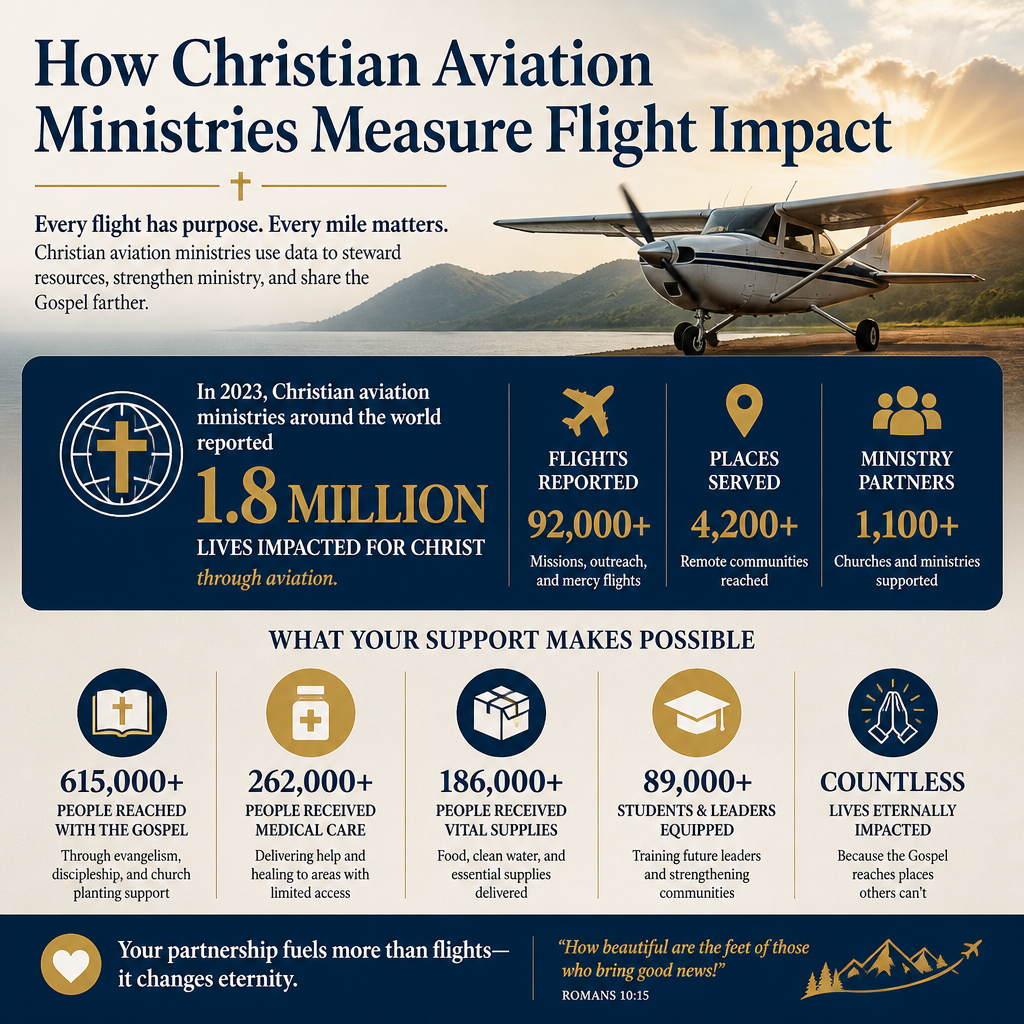
Because these outcomes often depend on partners, aviation ministries should not claim fruit they did not bear. Instead, they can document contribution with discipline. Examples include: a Bible translation team reaching a field site reliably across rainy seasons; a rural church network sustaining consistent training cycles; or a clinic receiving time-sensitive supplies without repeated stock-outs. Those are not always reducible to a single number, but they are verifiable through partner records, schedules, and longitudinal reporting.
Avoiding the illusion of certainty
Donors deserve honest limits. Aviation ministries often operate in places where recordkeeping is difficult, internet is sporadic, and security constraints limit public disclosure. Some outcomes are counterfactual: it is hard to quantify the life not lost because a patient reached care earlier, or the violence not endured because travel shifted from a dangerous road to the air. Mature reporting names what can be measured, what is inferred, and what remains unknown.
When we assess ministries against The Most Trusted Standard, we look for this kind of epistemic humility paired with strong internal discipline: clear claims, documented methods, and transparent limitations. Confidence is built when an organization refuses both exaggeration and vagueness.
Safety, governance, and integrity are part of impact
In aviation, safety is not overhead
In Christian aviation, impact collapses when safety collapses. A single preventable incident can harm lives, damage witness, and disrupt partner communities for years. For donors, the question is not only “How many people did we serve?” but “Did we serve them in a way consistent with the value of human life and the moral demands of stewardship?”
Safety culture is measurable. Ministries can disclose maintenance planning practices, pilot qualification standards, incident reporting processes, and the degree of independent oversight in operational decision-making. When organizations treat safety as a story rather than a system, donors should hesitate. This is an area where transparency may need to be generalized for security reasons, but it should never be empty.
Governance that resists mission drift
Aircraft acquisition, capital campaigns, and expansion into new regions can create powerful institutional momentum. Good intentions do not eliminate the risk of mission drift. Strong governance provides counterweights: independent boards, clear conflict-of-interest practices, and documented processes for evaluating major purchases against mission priority and partner demand.
For donors trying to understand which practices consistently distinguish trustworthy ministries, Christian Aviation Ministries sets the broader context for how this field typically operates and where verification questions tend to concentrate.
What discerning donors should ask for before funding flights
A practical due diligence checklist
Donors do not need to become aviation auditors to give wisely, but they should insist on more than compelling stories. Across our verification work, the ministries that meet The Most Trusted Standard tend to welcome disciplined questions and provide documentation that matches their public claims.
- Clear flight purpose categories tied to ministry outcomes, not only activity counts
- Partner validation: how local churches, clinics, or mission teams confirm the value of routes and scheduling priorities
- Safety systems: maintenance planning, pilot standards, and incident reporting with independent oversight
- Financial clarity on aircraft acquisition and lifecycle costs, including reserves for major maintenance
- Transparent decision rules for constrained capacity: how urgent needs, strategic priorities, and fairness are balanced
How to interpret impact reports without naivete or cynicism
Some donors read aviation reports with uncritical admiration; others read them with suspicion because aircraft seem inherently extravagant. Neither posture is adequate. Christian giving is about love of neighbor expressed through disciplined stewardship. That means receiving testimony with gratitude, asking for evidence where claims are large, and honoring the complexity of ministry in remote places.
When reporting is credible, donors should see a consistent pattern: numbers that reconcile over time, narratives that match documented activity, and outcomes that are affirmed by partners rather than asserted unilaterally. When reporting is thin, ministries often compensate with volume: more photos, more anecdotes, and less verifiable substance.
FAQs for How Christian aviation ministries measure flight impact
What is the most trustworthy metric for aviation ministry impact?
No single metric carries the full weight. The most trustworthy approach is a chain of evidence: operational data such as flight hours and destinations, linked to partner-confirmed outcomes such as sustained access to medical care, consistent training cycles for rural pastors, or reliable support for Scripture access efforts. Donors should also treat safety and governance evidence as part of impact, not as peripheral concerns.
Should donors prioritize cost per flight hour or cost per passenger?
Those figures can inform stewardship, but they are weak headline metrics because aviation costs vary by geography, aircraft type, weather, maintenance cycles, and multi-purpose flights. A better donor question is whether the ministry can explain costs in plain terms, plan for lifecycle expenses responsibly, and demonstrate that flying decisions are governed by mission priorities and partner needs rather than convenience or fundraising pressure.
A faithful measure of flight impact serves truth and neighbor
Christian aviation ministries are often doing quiet work that keeps ministry possible in places where isolation is not a metaphor but a material constraint. The mature donor task is to insist on truthfulness: outcomes anchored in evidence, governance that resists drift, and safety practices that honor the image of God in every passenger and crew member. When flight impact is measured with that kind of integrity, donors can give not merely to keep aircraft in the air, but to strengthen the Church’s witness and mercy where access is hardest.



