

Why stock gifts benefit Christian apologetics ministries is not a question of financial technique alone. It is a stewardship question: how to fund truth-telling work in a way that is both tax-wise and morally serious, so that a ministry can contend for the faith without becoming dependent on manipulative fundraising or unstable cash flow.
Apologetics operates in contested ground. Some donors prioritize evangelism and discipleship metrics; others emphasize cultural engagement, academic credibility, and long-form publishing that rarely produces immediate “countable” outcomes. Wise funding respects that tension. Stock gifts can serve apologetics ministries precisely because they can increase after-tax capacity to give, strengthen a ministry’s financial resilience, and encourage disciplined governance around receiving and liquidating non-cash assets.
Stock gifts align stewardship with long-term ministry funding
Giving appreciated assets can increase what reaches ministry
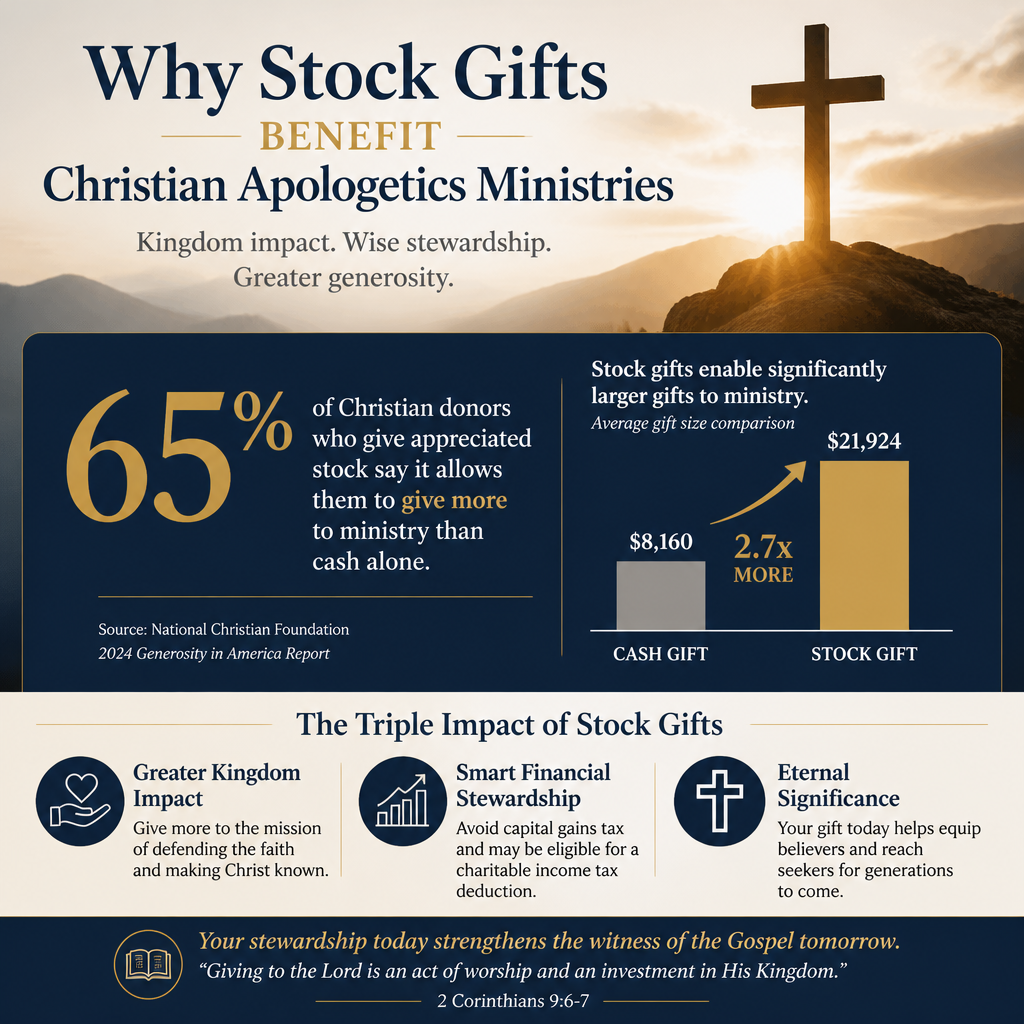
When a donor gives appreciated publicly traded stock held longer than one year, the donor generally may avoid capital gains tax on the appreciation while also receiving a charitable deduction for the fair market value, subject to IRS limits and individual circumstances. The practical effect is straightforward: the same after-tax “cost” to a donor can sometimes result in a larger gift to the ministry than writing a check.
Those limits are not trivial, and sophisticated donors should confirm them with a qualified tax advisor. For reference, the IRS describes charitable contribution limits and the distinct treatment of gifts of capital gain property in its guidance on charitable contributions: IRS Charitable contribution deductions.
Apologetics funding often benefits from patient capital
Many apologetics initiatives have long gestation cycles: research, editorial development, translation, campus partnerships, and media production that must compete for attention without surrendering intellectual integrity. In our verification work at Most Trusted, we see that ministries with stable, diversified funding are better positioned to avoid urgency-driven messaging that erodes trust over time.
What this means in practice is that stock gifts are not merely “more efficient giving.” They can be a form of patient capital that allows a ministry to plan responsibly: retaining qualified staff, maintaining editorial standards, and sustaining public engagement even when cultural winds shift.

Stock gifts can be tax-wise without becoming tax-driven
Tax benefits are servants, not masters
Christian generosity is never reducible to tax outcomes. Jesus’ teaching on treasure and the heart in Matthew 6 presses beyond efficiency into allegiance. Yet Scripture’s call to wise stewardship also refuses a false piety that treats prudence as unspiritual. The question is not whether tax considerations exist, but whether they are ordered properly.
The IRS framework makes clear that donors can give in multiple forms, with different deductibility rules and recordkeeping requirements. Seeing those rules clearly can reduce anxiety and free a donor to focus on purpose rather than paperwork. The IRS publication commonly used by taxpayers for this topic is: IRS Publication 526.
A disciplined approach protects both donor and ministry
Because stock gifts introduce operational steps—broker transfers, valuation, acknowledgment letters, and liquidation timing—they force a ministry to mature in process. That maturation is good when it is tied to accountable governance. It is risky when it is treated casually or handled by a single staff member without oversight.
Christians genuinely disagree about how much a ministry should spend on development capacity, donor communications, and financial infrastructure. The Overhead Myth letter—signed by major charity evaluators—helpfully reminds donors that simplistic overhead ratios can mislead, because effectiveness depends on more than a low administrative line item: GiveWell on the Overhead Myth letter. The same principle applies to stock gifts: competent administration is not waste when it protects integrity.
Stock gifts invite stronger financial integrity and governance
Non-cash gifts require clear policies
A ministry that receives securities should have a written gift acceptance policy and a process for approving and liquidating gifts. Without that discipline, even well-intentioned gifts can create mission drift or reputational risk. For example, concentrated stock positions can introduce volatility, and restricted gifts can create obligations that outlast the funding.
Across our verification work, we observe that ministries that meet The Most Trusted Standard tend to document decision rights and controls, rather than relying on informal trust. That posture is not cynical; it is biblical realism about human limitations and incentives.
What donors should confirm before transferring stock
Before making a stock gift to an apologetics ministry, donors can reasonably ask a few operational questions. These are not hostile questions. They are part of loving a ministry well.
- Does the ministry have a designated brokerage account and clear transfer instructions?
- Is there a written policy on when and how donated securities are liquidated?
- Who approves exceptions, such as holding stock rather than selling promptly?
- How does the ministry receipt gifts for tax purposes, and what documentation will it provide?
- Does the board receive oversight reporting on non-cash gifts and restricted funds?
These questions connect directly to what donors ultimately care about: that the ministry’s public claims about integrity are matched by internal controls that can withstand scrutiny.
For apologetics ministries, stock gifts can protect mission clarity
Apologetics is vulnerable to donor capture
Apologetics ministries often serve multiple audiences at once: skeptical seekers, pastors and lay leaders, students, and the broader public square. With that breadth comes a temptation to shape content to the loudest or most reactive donors rather than to the needs of the church and the demands of truth. Financial fragility intensifies that temptation.
Stock giving, especially when it becomes a stable channel for significant donors, can reduce the pressure to sensationalize. It can help a ministry fund less glamorous work: theological review, careful sourcing, long-form argument, and pastoral sensitivity when addressing people who are not persuaded by Christian claims.
Verification helps donors distinguish conviction from marketing
Not every ministry that uses the language of apologetics is equally careful. Some content is academically serious; other content is polemical, thinly sourced, or built for virality. Donors who care about the credibility of Christian witness should want more than rhetorical confidence. They should want verifiable evidence of faithful theology, responsible leadership, and transparent reporting.
Most Trusted exists to serve that need. We evaluate ministries against The Most Trusted Standard, a 15-criteria framework spanning Faith Foundation, Financial Integrity, Governance and Leadership, and Transparency and Effectiveness. Donors who want to understand the landscape of Christian Apologetics Ministries often find that careful verification clarifies which organizations pair doctrinal clarity with operational trustworthiness.
How stock gifts fit into a coherent planned giving approach
Planned giving is pastoral when it is ordered toward faithfulness
Planned giving can become transactional if it is framed as a technique for donors to “win” tax outcomes. Yet planned giving can also be pastoral: it helps Christians align assets, family obligations, and kingdom priorities in a way that reduces future confusion and conflict. Stock gifts often function as an on-ramp to that broader discipline because they force donors to inventory assets and think in terms of long-term stewardship rather than monthly cash flow.
Within Planned Giving for Christian Apologetics Ministries, we generally see stock gifts used in three common ways: as a substitute for cash giving, as a year-end strategy after a meaningful appreciation event, and as part of a multi-year funding commitment that steadies a ministry’s planning horizon.
Complexity should be named, not concealed
Stock gifts are not universally superior. Some donors do not have appreciated assets. Others face liquidity needs or concentrated positions that require careful risk management. Some ministries are not operationally prepared to receive securities, and a donor’s desire to give stock cannot replace the ministry’s responsibility to handle gifts with diligence.
The harder question is whether the donor and the ministry are prepared to treat the gift as an act of worship and accountability rather than mere efficiency. When that spiritual and organizational alignment exists, stock gifts can serve both donor joy and ministry stability.
FAQs for Why stock gifts benefit Christian apologetics ministries
Is giving stock better than giving cash to an apologetics ministry?
It depends on the donor’s situation and the ministry’s readiness. Donating appreciated publicly traded stock held longer than one year can be tax-advantaged because the donor may avoid capital gains tax and may deduct fair market value within IRS limits, which can increase the amount effectively available for ministry support. The IRS outlines general rules and limits in its charitable giving guidance: IRS Charitable contribution deductions. Donors should confirm specifics with a qualified tax advisor and confirm the ministry can receive and liquidate securities responsibly.
What should a donor ask an apologetics ministry before making a stock gift?
Donors should ask for transfer instructions, confirm whether the ministry typically sells donated securities promptly, and ask what governance oversight exists for non-cash gifts. It is also prudent to ask what acknowledgment letter the ministry will provide for tax records and whether there is a written gift acceptance policy. These questions are consistent with mature stewardship and help protect the credibility of the ministry’s witness.
A gift of stock can strengthen truthful witness when it is governed well
Christian apologetics is ultimately accountable to the truthfulness of God and the integrity of Christian witness. Stock gifts can benefit Christian apologetics ministries because they can increase after-tax giving capacity, stabilize long-term funding for intellectually serious work, and encourage operational discipline that honors donors and protects the mission. When donors pair generosity with verification and clear governance, they help create ministries that can contend for the faith without compromising trust.



