

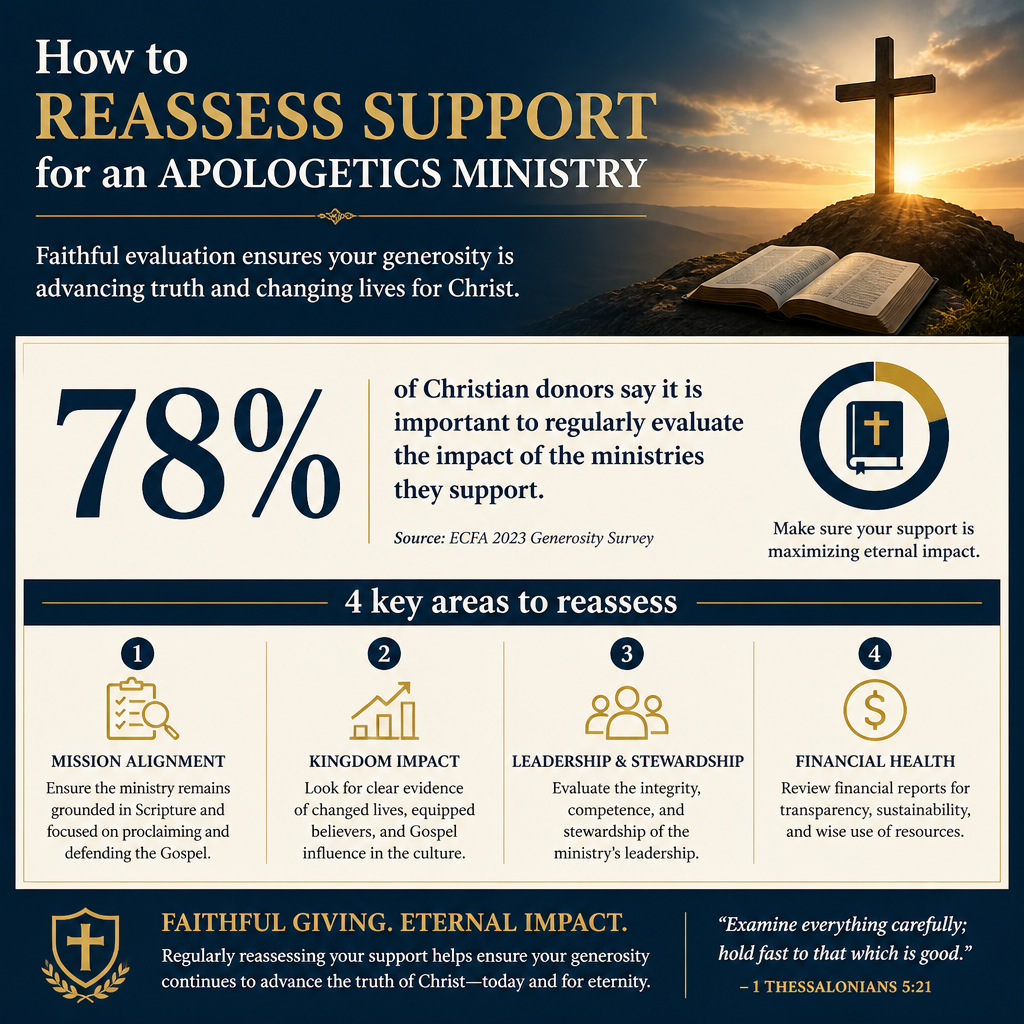
Knowing how to reassess support for an apologetics ministry is not a sign of cynicism; it is a stewardship question. Christian donors fund apologetics because truth matters, because doubts are real, and because Scripture commands the church to be “prepared to make a defense” with gentleness and respect (1 Peter 3:15).
The harder question is whether a particular ministry is defending the faith faithfully, fruitfully, and with integrity. Apologetics can clarify the gospel for seekers, strengthen believers under intellectual pressure, and equip pastors and parents. It can also drift into celebrity dynamics, reactive culture-war posturing, or fundraising that outpaces accountability. A reassessment is often the moment when generosity becomes mature.
Start with the ministry’s theological center of gravity
Apologetics serves the gospel or it becomes a substitute for it
Apologetics is a servant discipline. When it is healthy, it clears obstacles so that Christ is seen more clearly; it does not place the apologist at the center. We recommend beginning a reassessment by asking what the ministry is attempting to produce: deeper worship, repentance, and faithful witness—or merely arguments that win a point.
Paul’s pattern is instructive. He “reasoned” in synagogues and marketplaces, yet he refused to rest ministry credibility on rhetorical dominance: “My speech and my message were not in plausible words of wisdom” (1 Corinthians 2:4). That does not demean careful reasoning; it relativizes it under the cross. An apologetics ministry should be able to state plainly how its content and events serve local churches and actual discipleship.
Look for doctrinal clarity and ecclesial accountability
Donors often assume apologetics ministries are simply “defending orthodoxy.” In practice, the spectrum is wide: confessional Protestant, broadly evangelical, Catholic, Orthodox, and ecumenical expressions all operate under the apologetics banner, and Christians genuinely disagree about boundaries and methods. A responsible reassessment asks whether the ministry’s statement of faith is specific enough to be meaningful, and whether its leaders are accountable to a real church community rather than only to an audience.
As a reference point, many donors treat core historic doctrine—summarized in the Apostles’ and Nicene Creeds—as non-negotiable while allowing methodological diversity (classical, evidential, presuppositional, narrative, and so on). What matters is not that a ministry shares every distinctives list, but that it is transparent about doctrinal commitments and avoids ambiguity that functions as marketing.

Evaluate methods and tone as much as arguments
Truth without charity is not Christian witness
Apologetics is often practiced in contested spaces: online debates, campus dialogues, media interviews, and public criticism of ideologies. The New Testament standard is not merely “accuracy,” but a manner consistent with Christ. Peter’s instruction holds content and posture together: “make a defense… yet do it with gentleness and respect” (1 Peter 3:15). When donors reassess support, it is appropriate to ask whether a ministry’s public tone is routinely marked by contempt, mockery, or the kind of tribal signaling that raises applause but hardens hearers.
What this means in practice is that a ministry’s “wins” should not be defined only by viral clips or decisive takedowns. A mature apologetics posture is willing to concede complexity, represent opponents fairly, correct errors publicly, and invite scrutiny. When a ministry consistently frames dissent as betrayal, the problem is rarely only rhetorical; it often signals an accountability deficit.
Discern the difference between evangelistic engagement and culture-war production
Some apologetics work is explicitly evangelistic: addressing the resurrection, reliability of Scripture, moral realism, and the problem of suffering with an aim toward conversion and discipleship. Other work primarily reinforces in-group identity: it may speak about Christianity, but it is not meaningfully directed toward persuading actual skeptics or equipping Christians to love their neighbors.
Online media economics complicates this. Platforms reward outrage, certainty, and conflict. If a ministry’s incentives are tied to clicks and subscriptions, donor dollars can unintentionally subsidize the most reactive version of apologetics. For donors who want to understand the landscape of ministries and models across the field, Christian Apologetics Ministries can provide a clearer taxonomy for what is being funded.
Ask for verifiable evidence of impact, not only reach
Attendance and views are not discipleship
Apologetics ministries commonly report reach: downloads, views, conference attendance, book sales. Reach can matter, but it is a crude proxy for spiritual fruit. A reassessment should press for evidence that the ministry is producing durable outcomes: local-church partnerships, training that pastors actually use, measured learning gains in participants, or credible testimonies that can be corroborated without being sensationalized.
There is also a baseline reality about Christian formation that should temper expectations. Biblical literacy in American life is not strong, and donors should not assume audiences have the theological and historical grounding to benefit from advanced argumentation. For example, research has long shown widespread confusion about basic Christian claims; in one widely cited study, large majorities of American youth affirmed statements consistent with “Moralistic Therapeutic Deism” rather than historic Christian faith (National Study of Youth and Religion, as reported by Christian Smith and Melinda Lundquist Denton). That environment calls for apologetics that is integrated with catechesis and pastoral care, not only debate content.
Prefer ministries that demonstrate learning, correction, and outcomes
Across our verification work at Most Trusted, we observe that healthier ministries can name what they are learning, where their approach has been corrected, and how they assess whether programs are actually serving people. They are also willing to say what they do not do. An apologetics ministry that claims to be the answer to every cultural shift is rarely being governed by sober strategy.
When you reassess, ask for program-level clarity: What is taught? To whom? By whom? With what safeguards? How does the ministry follow up with churches and participants? If the primary “impact” is a growing brand, the donor is being asked to fund attention, not formation.
Scrutinize financial integrity and governance without cynicism
Apologetics ministries face unique temptations
Because apologetics content is often personality-driven, financial and governance issues can hide behind “anointing” language or urgent crisis narratives. The temptations are familiar: excessive executive compensation justified by celebrity reach, weak boards that function as friends of the founder, restricted gifts moved casually to cover operating gaps, and fundraising that trades in fear rather than truth.
Donors are not wrong to ask about overhead, but mature scrutiny is more precise than a ratio. The “Overhead Myth” letter—signed by Charity Navigator, GuideStar, and the BBB Wise Giving Alliance—warned that overhead percentages can mislead donors and starve organizations of necessary infrastructure (Charity Navigator). What matters is whether the ministry’s spending aligns with mission, whether controls exist to prevent misuse, and whether leadership is accountable.
Use a consistent framework for reassessment
The Most Trusted Standard is our 15-criteria framework for evaluating Christian nonprofits across Faith Foundation, Financial Integrity, Governance and Leadership, and Transparency and Effectiveness. Donors often know how to evaluate theological claims in the abstract, but they have less practice evaluating board independence, conflict-of-interest policies, audited financials, or the clarity of a ministry’s reporting on outcomes.
A practical reassessment can include a short set of document-based questions. The goal is not suspicion; it is integrity.
- Are current financial statements, annual reports, and IRS filings accessible and consistent with each other?
- Does the board have real independence and relevant expertise, with documented conflict-of-interest practices?
- Is executive compensation explained in a way that is proportionate and accountable to the mission?
- Are restricted gifts described clearly, with evidence they are honored as designated?
- Does the ministry report outcomes in a way that can be assessed, not merely celebrated?
For donors who want a wider set of discernment principles for this field, How to Give Wisely to Christian Apologetics Ministries is a helpful place to compare questions across ministry models.
Decide how to respond when concerns are real
Reassessment is not only about withdrawal
Sometimes the conclusion of a reassessment is continued support, but with clearer expectations: designated giving to training programs rather than media expansion, a smaller gift until governance improves, or support contingent on publishing audited statements. In other cases, wisdom requires a change. Donors should not confuse loyalty to a personality with faithfulness to the church.
We recommend distinguishing between three categories of concern. First are doctrinal concerns that touch the heart of the gospel. Second are integrity concerns—financial opacity, manipulative fundraising, abuse of authority—which can disqualify trust even when doctrinal language is orthodox. Third are prudential concerns about approach and tone, where Christians may disagree, but donors still have the responsibility to fund what they can defend before God.
Practice truthful charity in how you act and speak
When donors step back from a ministry, Scripture still governs the manner. “Speak the truth in love” is not a slogan; it is a command (Ephesians 4:15). It is possible to name patterns of concern without gossip, and to ask hard questions without assuming motives. If a ministry responds to honest inquiry with threats, shaming, or access control, that response is itself data.
There is also a constructive path for donors who remain committed to apologetics as a cause. Support ministries that serve pastors, partner with seminaries, submit to credible boards, and report outcomes with clarity. Fund the kinds of apologetics that strengthens ordinary Christians to love God with their minds and love neighbors who disagree, not simply to win arguments.
FAQs for How to reassess support for an apologetics ministry
What warning signs should prompt a reassessment of an apologetics ministry?
Consistent public contempt toward opponents, repeated factual errors without correction, unclear doctrinal commitments, fundraising that trades in fear or urgency without transparency, and governance structures where the founder is effectively unaccountable are all reasons to reassess. A single disagreement about strategy may be prudential; a pattern of opacity or coercion is a trust issue.
How can donors evaluate impact when apologetics results are difficult to measure?
Donors can ask for evidence beyond reach: partnership with local churches, training cohorts with defined curricula, participant assessments, follow-up practices, and credible reporting that acknowledges limitations. Apologetics fruit can be real without being easily quantified, but ministries should still demonstrate disciplined learning and provide verifiable indicators that their work is building the church rather than merely expanding an audience.
A faithful reassessment strengthens giving rather than shrinking it
Reassessing support for an apologetics ministry is one way donors honor the weight of Christian stewardship. The aim is not perfection, and it is not perpetual suspicion. The aim is to fund work that is doctrinally clear, spiritually formed, financially honest, and accountable—so that the defense of the faith remains a witness to Christ rather than an industry built around him.



