

Questions about what credentials matter for Christian apologetics teachers are ultimately questions about trust: trust that the gospel is being handled with reverence, that arguments are being made with intellectual honesty, and that donors are funding work that strengthens faith rather than inflaming faction. Christian apologetics can steady believers in seasons of doubt and clarify the reason for our hope, yet it can also drift into personality-driven controversy if donors and boards do not ask disciplined questions.
Apologetics is not merely a set of debate techniques. Scripture frames it as a form of witness that must be morally congruent with the message. Peter’s instruction is as direct as it is demanding: “Always be prepared to give an answer… yet do this with gentleness and respect” (1 Peter 3:15). Credentials matter because they are one measurable way to test whether a ministry’s teaching is formed by that standard of truthfulness, humility, and accountability.
Credentials are proxies for competence and accountability
Academic training can signal rigor, but it is not sufficient
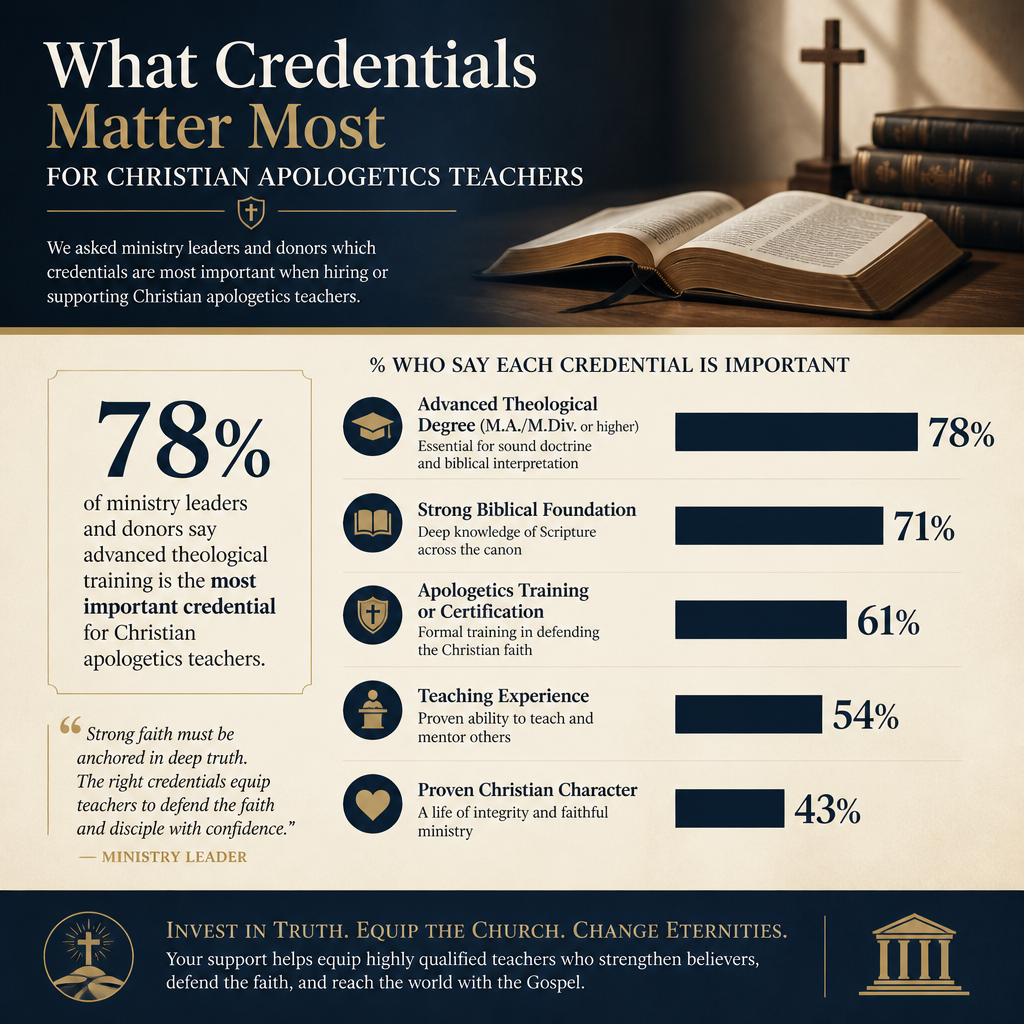
In apologetics, formal education can provide real guardrails: training in logic, philosophy, historical method, biblical languages, and the history of doctrine. Degrees also expose teachers to peer review and to the discipline of arguing from evidence rather than from charisma. A master’s degree in theology or philosophy, a seminary MDiv, or doctoral work relevant to the teacher’s public claims can be meaningful indicators that a ministry is not improvising its intellectual foundations.
At the same time, donors should not confuse academic attainment with spiritual maturity or ecclesial trustworthiness. Some of the most incisive defenders of the faith in recent history have been academics; others have been pastors, evangelists, and writers whose credibility was forged through long obedience, not institutional affiliation. Christians genuinely disagree about how much weight to place on the academy, in part because the academy itself can be hospitable to faith in some places and hostile in others.
Track record and peer recognition can be more revealing than titles
The more public the teacher, the more important it becomes to examine whether they are consistently corrected by reality. Do they cite sources faithfully? Do they retract errors publicly? Do they represent opponents’ views fairly? A teacher who can win an argument but cannot handle correction is a liability to a donor’s intent, because apologetics that trains Christians to overstate claims often damages credibility with the very skeptics it hopes to reach.
In our verification work at Most Trusted, we find that the most dependable ministries treat credibility as a spiritual obligation. They invite informed critique, distinguish between settled doctrine and debatable applications, and avoid monetizing outrage. Credentials can support that posture, but they cannot replace it.

Sound theology is a credential the church must be able to recognize
Confessional clarity and ecclesial accountability
Because apologetics deals with first principles, donors should look for explicit theological commitments. A teacher’s statement of faith should be more than a marketing paragraph; it should locate the ministry within the historic Christian tradition and make plain its doctrinal boundaries. When teachers operate without a confessional center, apologetics can quietly become a platform for private speculation.
Ecclesial accountability is one of the most overlooked “credentials” in this space. Many apologetics teachers are not pastors, but they should be accountable to qualified spiritual oversight: a board with theological competence, a church or denominational context, or an advisory council with real authority. The New Testament’s insistence that teachers will be judged more strictly (James 3:1) is not an argument against teaching; it is an argument for structures that take teaching seriously.
Fidelity to Scripture in method, not only in conclusion
A ministry can affirm orthodox conclusions and still model habits that undermine biblical faithfulness. Donors should attend to method: how Scripture is interpreted, whether historical claims are presented with appropriate confidence levels, and whether the teacher treats truth as a possession to wield or as a reality to serve. “Speaking the truth in love” (Ephesians 4:15) applies to apologetics as much as to pastoral care.
What this means in practice is that donors should listen for intellectual virtues: precision, charity, restraint, and a willingness to say, “We do not know.” Apologetics that requires constant certainty on contested questions often produces brittle disciples.
Subject matter alignment matters more than prestige
Match training to claims
Apologetics is an umbrella term, but donors fund specific kinds of claims. A teacher who regularly addresses the historical reliability of the Gospels should have demonstrated competence in relevant historical and textual questions. A teacher who speaks on science and faith should have a working understanding of scientific method and the relevant literature. A teacher who engages Islam should demonstrate serious study of Islamic sources and history rather than relying on secondhand polemics.
Prestige can distract from fit. A famous speaker with a generic background can be less reliable than a lesser-known teacher with deep expertise in a narrow field. Donors can ask a simple question: “Is this teacher trained for the claims they monetize?” The answer is often clearer than it first appears.
Donors should watch for category errors
A common failure mode in apologetics is the confident crossing of domains: treating philosophy as if it were laboratory science, treating sociology as if it were biblical theology, or treating biblical exegesis as if it were merely a matter of personal intuition. Mature donors do not require omniscience; we should require intellectual honesty about what a teacher actually knows.
Those giving into Christian Apologetics Ministries often carry a pastoral burden even when they are not pastors: concern for children raised in a skeptical culture, for college students losing confidence, for adults wounded by scandal and hungry for coherence. That burden makes it tempting to reward teachers who speak with sweeping certainty. The stronger stewardship move is to reward those who speak with warranted confidence.
Character and governance are credentials donors can verify
A teacher’s platform should not outgrow their oversight
Apologetics ministries frequently concentrate influence in a small number of communicators. That can be effective, but it increases risk. Donors should look for governance that is more than legal compliance: a board that can discipline, a real conflict-of-interest policy, and transparency about how leaders are evaluated. The point is not suspicion; it is moral realism about power.
Financial stewardship is part of the credibility of the message. While donors sometimes fixate on overhead ratios, the more significant questions are whether finances are independently reviewed or audited, whether related-party transactions are disclosed, and whether compensation decisions are governed by accountable processes. Scripture’s warnings about money are not abstract. Jesus taught that money tests the heart (Matthew 6:21), and apologetics teachers are not exempt from that test.
What donors can ask without becoming adversarial
Donors do not need to interrogate ministries as though they are guilty. But donors should ask questions that responsible organizations can answer plainly. A short checklist often surfaces whether a ministry is built for the long term.
- Who has authority to correct or remove the primary teacher if necessary, and how is that authority exercised?
- What theological statement governs the ministry’s teaching, and is it meaningfully connected to a church or tradition?
- Are finances reviewed or audited by an independent CPA firm, and can donors access the most recent financial statements?
- What is the ministry’s policy on retractions, corrections, and citing sources?
- How are donor funds allocated between content production, pastoral care, and organizational administration?
These questions align with the kinds of evidence we look for when evaluating ministries against The Most Trusted Standard. Christian donors should expect more than persuasive speaking; we should expect verifiable accountability.
Red flags that credentials are being used as camouflage
Inflated titles and opaque affiliations
Some ministries present credentials in ways that are technically true but designed to mislead: vague references to “Oxford” that turn out to be a short course, academic-sounding institutes that are not accredited, or honorary degrees presented as earned doctorates. Honorary recognition is not inherently suspect, but treating it as equivalent to formal training is not truthful.
Accreditation is not a perfect proxy for quality, and Christians disagree about its importance. Still, when a teacher is building authority on an academic identity, donors should expect transparent descriptions of where the degree came from, what it required, and how it relates to the subject being taught. This is basic integrity, not elitism.
Outrage economics and the erosion of credibility
Another warning sign is the consistent use of controversy as a fundraising engine. Platforms can be built by targeting opponents, portraying other Christians as enemies, or presenting every cultural question as an existential crisis. That approach may grow an audience, but it often diminishes the witness of the church.
The harder question is whether the ministry’s public output produces humility, courage, and love of truth in its listeners. Donors are not only funding content; we are funding formation. When apologetics trains Christians to treat unbelievers as adversaries rather than neighbors, it conflicts with the biblical command to give an answer “with gentleness and respect” (1 Peter 3:15).
Donors who want a disciplined approach to discernment in this area often benefit from reading How to Give Wisely to Christian Apologetics Ministries, especially when deciding whether a ministry’s governance and transparency match its public claims.
FAQs for What credentials matter for Christian apologetics teachers
Do Christian apologetics teachers need a seminary degree to be credible?
No. A seminary degree can be a meaningful indicator of training, but credibility rests on a broader set of evidence: theological clarity, intellectual honesty, accountability to the church, and a demonstrated pattern of careful sourcing and fair argumentation. Donors should weigh whether the teacher is equipped for the claims they regularly make and whether their ministry has governance that can correct error and restrain excess.
How can donors verify credentials without becoming cynical?
Verification can be straightforward and respectful. Donors can ask for a teacher’s education history in plain terms, confirm whether degrees are earned or honorary, and look for transparent bios that name institutions and programs. More importantly, donors can evaluate whether the ministry discloses governance structures, financial reviews or audits, and correction policies. Responsible ministries treat such questions as part of stewardship, not as personal attacks.
Credentialed for service, not for status
The most consequential credential for a Christian apologetics teacher is not a title but a form of tested trustworthiness: competence joined to character, conviction joined to humility, and public ministry joined to real accountability. Donors can honor the calling of apologetics by funding teachers and ministries who do not merely defend the faith, but who do so in a manner worthy of the gospel they commend.



