
Christian apologetics ministries need volunteers who can do more than show up and share an opinion. They need men and women formed by the church, grounded in Scripture, and willing to serve with patience, intellectual honesty, and pastoral restraint. Donors often ask us whether volunteer capacity is a secondary concern compared to content quality or a prominent speaker. Across our verification work at Most Trusted, we observe the opposite: volunteer culture often determines whether an apologetics ministry becomes a steady witness or a perpetual crisis.
Apologetics is a ministry of truth, but it is never truth in the abstract. The New Testament binds truth to love, knowledge to humility, and speech to accountability. “Always being prepared to make a defense” is paired with doing so “with gentleness and respect” (1 Peter 3:15). Volunteers are frequently the people who either embody that pairing in public or quietly undermine it behind the scenes.
Volunteers are often the public face of the ministry
Many apologetics ministries scale through people rather than platforms: volunteer moderators in online communities, local chapter leaders, conference hosts, event ushers, small-group facilitators, and email responders. The donor implication is straightforward. A ministry can publish faithful, careful materials and still gain a reputation for hostility if volunteer-facing spaces are unmanaged.
Character is not optional infrastructure
Apologetics ministries need volunteers whose spiritual maturity is visible under pressure. The work involves disagreement, sometimes sharp disagreement, and it attracts people who enjoy winning arguments. That is not, by itself, a disqualification. But unexamined competitiveness becomes a disciple-making problem. Volunteers must be able to lose a point, ask a clarifying question, and refuse to caricature opponents.
We recommend donors pay attention to how ministries train volunteers in speech ethics and pastoral boundaries. A volunteer who can quote Athanasius or Alvin Plantinga but cannot practice James 1:19 (“quick to hear, slow to speak, slow to anger”) will eventually create avoidable harm.
Digital spaces require disciplined moderation
Online forums, comment sections, and social channels function like front porches. They signal whether a ministry’s posture is evangelistic or adversarial. Christian apologetics ministries need volunteers who can moderate without favoritism, remove abusive content without vindictiveness, and enforce rules consistently.
For donors, this is not merely reputational. It is a stewardship question: attention is a finite resource, and unmanaged conflict consumes it. The field has had to reckon with how quickly a single viral exchange can redefine an organization’s public identity, especially when volunteers are treated as informal “supporters” rather than trained representatives.

They need volunteers who can handle Scripture and sources responsibly
Apologetics is not the same as Bible teaching, and yet it cannot be severed from Scripture. Volunteers often summarize arguments, recommend resources, and explain difficult passages in pastoral conversations. When volunteers are sloppy with sources, donors can end up funding a ministry that inadvertently spreads misinformation.
Accurate citation is a form of honesty
Christian truth-telling includes intellectual truthfulness. Volunteers should be trained to distinguish between peer-reviewed research, popular summaries, and internet rumors. When a ministry claims a scientific finding or a historical fact, accuracy matters because credibility is part of Christian witness.
The broader public has become more sensitive to misinformation, and trust has eroded across institutions. Pew Research Center has documented a long-term decline in trust in government, media, and other institutions in the United States Pew Research Center. Apologetics ministries do not escape that environment; they speak into it. Volunteers who repeat dubious claims, even with good intentions, make faithful proclamation harder.
They must distinguish between doctrinal essentials and disputed judgments
Christians genuinely disagree about some apologetic strategies: classical evidentialism, presuppositionalism, cumulative-case approaches, and narrative or cultural apologetics all have advocates. Volunteers should be able to say, with confidence, what is core to historic orthodoxy and what is a prudential judgment about method.
This matters for donor alignment. Some ministries serve confessional churches with strong catechesis; others serve a broad evangelical audience. A healthy volunteer culture can operate within doctrinal clarity without treating every disagreement as apostasy. The ministries that meet The Most Trusted Standard tend to communicate doctrinal commitments in a way that is accessible, verifiable, and consistent in practice rather than rhetorical in fundraising.
They need volunteers who strengthen pastoral care, not replace it
Apologetics ministries often receive messages from people in crisis: grieving parents, those leaving atheism, believers shaken by suffering, students destabilized by intellectual doubts, and survivors of spiritual abuse. Volunteers may be the first responders. That is both an opportunity and a risk.
First responses should be relational and bounded
Christian apologetics ministries need volunteers who can treat a questioner as a person rather than a project. A well-crafted argument can be an act of love, but it can also become a shield against compassion. Volunteers should be trained to ask what kind of help is being sought, to listen carefully, and to refer appropriately to local pastors, counselors, or safeguarding channels.
Donors should not assume that a ministry with excellent content is prepared for crisis correspondence. We recommend asking whether the ministry has clear escalation pathways: when a volunteer should stop responding, who handles allegations of abuse, and what safeguarding standards govern communication with minors.
Apologetics must not become a substitute for the local church
Many apologetics ministries want to strengthen churches rather than compete with them, but the temptation toward functional independence is real. A volunteer who becomes someone’s primary spiritual authority through online messages can unintentionally weaken the very ecclesial structures Scripture assumes.
For donors who care about long-term fruit, this is a key question: does the ministry’s volunteer program push people toward faithful participation in a local congregation, the sacraments, and accountable discipleship, or does it create a parallel ecosystem of “answers” disconnected from shepherding?
They need volunteers who respect governance, policies, and accountability
Volunteer enthusiasm can either reinforce a ministry’s integrity or become a point of vulnerability. Apologetics ministries often deal with contentious topics, public controversies, and strong personalities. That makes governance and internal controls especially important, even when much of the work is volunteer-driven.
Clear role definitions prevent avoidable crises
Donors sometimes romanticize volunteerism as inherently pure. In practice, volunteer labor is still labor; it must be supervised. Christian apologetics ministries need volunteers who accept role boundaries: what may be said on behalf of the ministry, how finances are handled at events, what constitutes confidential information, and how to respond when criticism arises.
The National Council of Nonprofits notes that effective volunteer programs include written role descriptions, training, and supervision expectations National Council of Nonprofits. That is not bureaucratic overreach; it is a practical expression of accountability.
Transparency is part of witness
Because apologetics ministries argue publicly for the credibility of Christianity, they have a heightened obligation to be credible in organizational life. Volunteers should be formed to welcome scrutiny rather than resent it. That includes respecting policies on donor privacy, content permissions, safeguarding, and financial procedures.
This is one reason our team at Most Trusted evaluates ministries against The Most Trusted Standard, a 15-criteria framework that examines faith commitments, financial integrity, governance and leadership, and transparency and effectiveness. The goal is not institutional perfection. It is mature, verifiable accountability that protects donors and strengthens Christian witness.
They need volunteers who can serve strategically, not just energetically
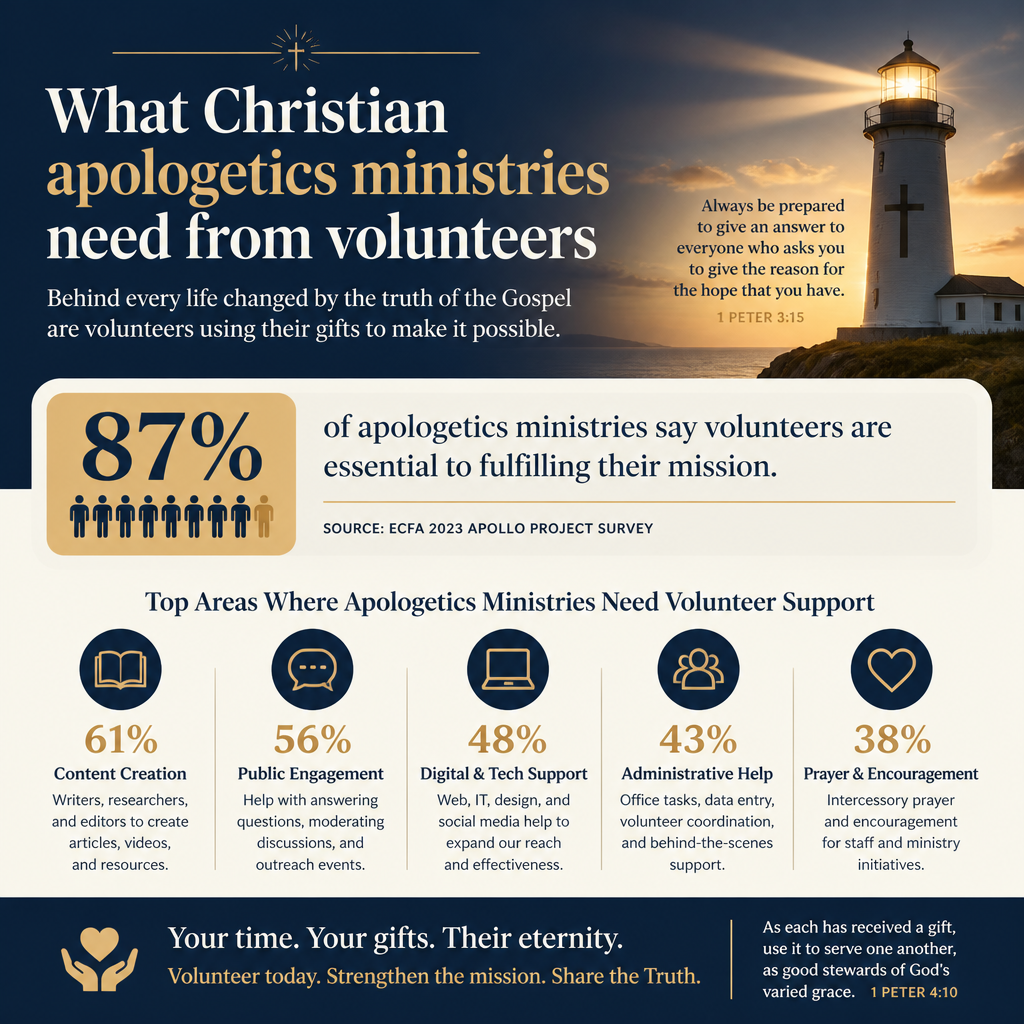
Volunteer labor is not free. It requires recruitment, screening, training, supervision, and ongoing care. Ministries that treat volunteers as an unlimited resource often burn them out, and burnout becomes mission drift with a spiritual vocabulary.
What healthy volunteer contribution looks like
Christian apologetics ministries need volunteers who understand the difference between helpful initiative and unaccountable freelancing. The most effective volunteers tend to do ordinary work consistently, within defined lanes, and with a teachable posture.
- Moderating online discussions with documented standards and consistent enforcement
- Hosting local events with clear financial procedures and reporting
- Editing and proofreading articles for clarity, charity, and factual accuracy
- Coordinating prayer teams with confidentiality and pastoral sensitivity
- Managing logistics for conferences and campus events under staff supervision
Donors can fund volunteer formation, not only content production
Many donors naturally fund outputs: videos, books, and conferences. Those matter. But ministries also need funding for the less visible work of training volunteers, building safeguarding systems, and establishing policies that reduce preventable harm.
What this means in practice is that donor questions should broaden. Beyond “How many views did the video get?” it is reasonable to ask: How are volunteers screened? What is the code of conduct? How are doctrinal boundaries articulated? How are conflicts handled? For a wider view of how these ministries function within the broader field, see Christian Apologetics Ministries.
FAQs for What Christian apologetics ministries need from volunteers
What should donors ask a Christian apologetics ministry about its volunteer program?
We recommend asking for written role descriptions, training expectations, and supervision structures. Donors should also ask how the ministry moderates public-facing spaces, what safeguarding policies govern volunteer interactions, and how doctrinal commitments shape volunteer guidance. These questions are part of responsible partnership, especially in a ministry category that often operates in public controversy.
Is it a red flag if an apologetics ministry relies heavily on volunteers?
Not necessarily. Many faithful ministries depend on volunteers because the work is community-driven and geographically distributed. The concern is not volunteer reliance but unmanaged volunteer authority. A strong ministry can demonstrate screening, training, accountability, and clear escalation paths when problems arise. For donors considering broader partnership patterns and expectations, see Donor Partnerships with Christian Apologetics Ministries.
What faithful volunteerism makes possible
Christian apologetics ministries are called to contend for the faith without becoming contentious, to defend truth without weaponizing knowledge, and to persuade without coercion. Volunteers are often where that calling becomes visible. When volunteers are trained and accountable, they extend a ministry’s reach with integrity and pastoral care.
For donors, this is a sober encouragement. Supporting apologetics is not only supporting arguments; it is supporting people who will embody those arguments in speech, policy, and practice. Ministries that take volunteer formation seriously tend to protect their witness, serve the church, and steward donor trust with clarity that can be evaluated over time.



