

How Christian apologetics ministries respond to deconstruction has become a defining test of both theological integrity and pastoral credibility. Donors who have funded apologetics for decades are now asking whether these ministries can defend the faith without dismissing the wounded, whether they can offer intellectual clarity without rewarding cynicism, and whether they can address real abuses without surrendering historic Christian conviction.
Deconstruction is not one phenomenon. Some people use the word to describe the long, faithful work of distinguishing biblical Christianity from cultural accretions. Others mean a moral protest against hypocrisy or institutional harm. Still others mean a full departure from orthodox belief. A serious apologetics response begins by refusing to flatter any of these paths, while also refusing to treat honest questions as rebellion. Jude’s counsel remains instructive: “Be merciful to those who doubt” (Jude 22), and mercy is not the opposite of truth; it is the manner in which truth is carried.
1. Deconstruction forces apologetics back toward discipleship
Apologetics can win arguments and still lose people
The modern apologetics movement often assumed that the central problem was intellectual plausibility: if we can show Christianity is reasonable, many will return to faith. Deconstruction has exposed a deeper set of losses—trust, belonging, moral credibility, and spiritual formation. A person may concede that the resurrection is historically defensible and still feel unable to inhabit the church without reentering patterns of harm.
Across our verification work at Most Trusted, we see that ministries with durable fruit tend to treat apologetics as a servant of discipleship rather than a replacement for it. They integrate biblical theology, spiritual formation, and pastoral care with intellectual argumentation. The aim is not simply to “answer objections” but to help a questioning Christian remain within reach of Christ, Scripture, and the church, even when certainty feels distant.
What faithful care for doubters requires
Christian donors should expect apologetics ministries to be explicit about the difference between deconstruction as discernment and deconstruction as demolition. The New Testament distinguishes between sincere immaturity and hardened defiance. Yet it also recognizes that some people are caught in confusion rather than malice. Wise apologetics ministries respond with clarity about the gospel, patience toward the struggler, and sobriety about spiritual drift.
In practice, this means prioritizing local-church connection, trained pastoral referral, and a refusal to make online “hot takes” a substitute for spiritual oversight. We recommend donors evaluate apologetics ministries in the broader ecosystem of Cultural Engagement in Christian Apologetics, where tone, method, and ecclesial accountability matter as much as content volume.

2. The strongest responses take lived experience seriously without enthroning it
Trauma, abuse, and hypocrisy are not primarily intellectual problems
A significant portion of deconstruction narratives begin with real pain: spiritual abuse, sexual misconduct, manipulative leadership, racialized contempt, or families fractured by religious control. Apologetics cannot responsibly address such stories by treating them as mere “emotional barriers” to rational belief. Scripture repeatedly condemns leaders who use God’s name to devour the vulnerable (Ezekiel 34). If a ministry defends the church’s truth claims while minimizing the church’s sins, it may be defending an abstraction.
When research describes the prevalence of abuse and misconduct, Christian donors should not avert their eyes. For example, the Associated Press has documented extensive, long-running patterns of sexual abuse within some Protestant church contexts, including Southern Baptist settings, and the institutional failures that allowed harm to persist. Such reporting does not settle theological questions, but it does establish a moral context that apologetics must take seriously.
A credible ministry distinguishes Christianity from its distortions
The Christian faith includes doctrines that cut against modern sensibilities: judgment, repentance, moral limits, and the exclusive claims of Christ. Some deconstruction is simply the refusal of those doctrines. But other deconstruction is a legitimate rejection of distortions—prosperity teaching, celebrity-driven ecclesiology, abusive “authority” language, and politically captive discipleship. The apologetics task is to name those distortions clearly, show their inconsistency with Scripture, and invite people toward the real Christ rather than a caricature.
Donors should listen for ministries that are willing to say, without hesitation, that certain church practices are not merely “unhelpful” but sinful. Yet donors should also expect those ministries to resist the contemporary temptation to grant ultimate authority to personal experience. Christianity cannot be reduced to the story we tell about ourselves. The Lordship of Christ relativizes every story, including our own (Matthew 16:24–26).
3. Better apologetics in a deconstruction era is less reactive and more substantive
Online controversy rewards speed, not truth
Many apologetics organizations now operate in an attention economy shaped by social platforms. Deconstruction content often goes viral because it is personal, emotionally vivid, and morally charged. The counter-response can become equally reactive: rapid rebuttals, public shaming, and rhetorical dominance as a proxy for pastoral concern. This dynamic may build an audience while corroding credibility.
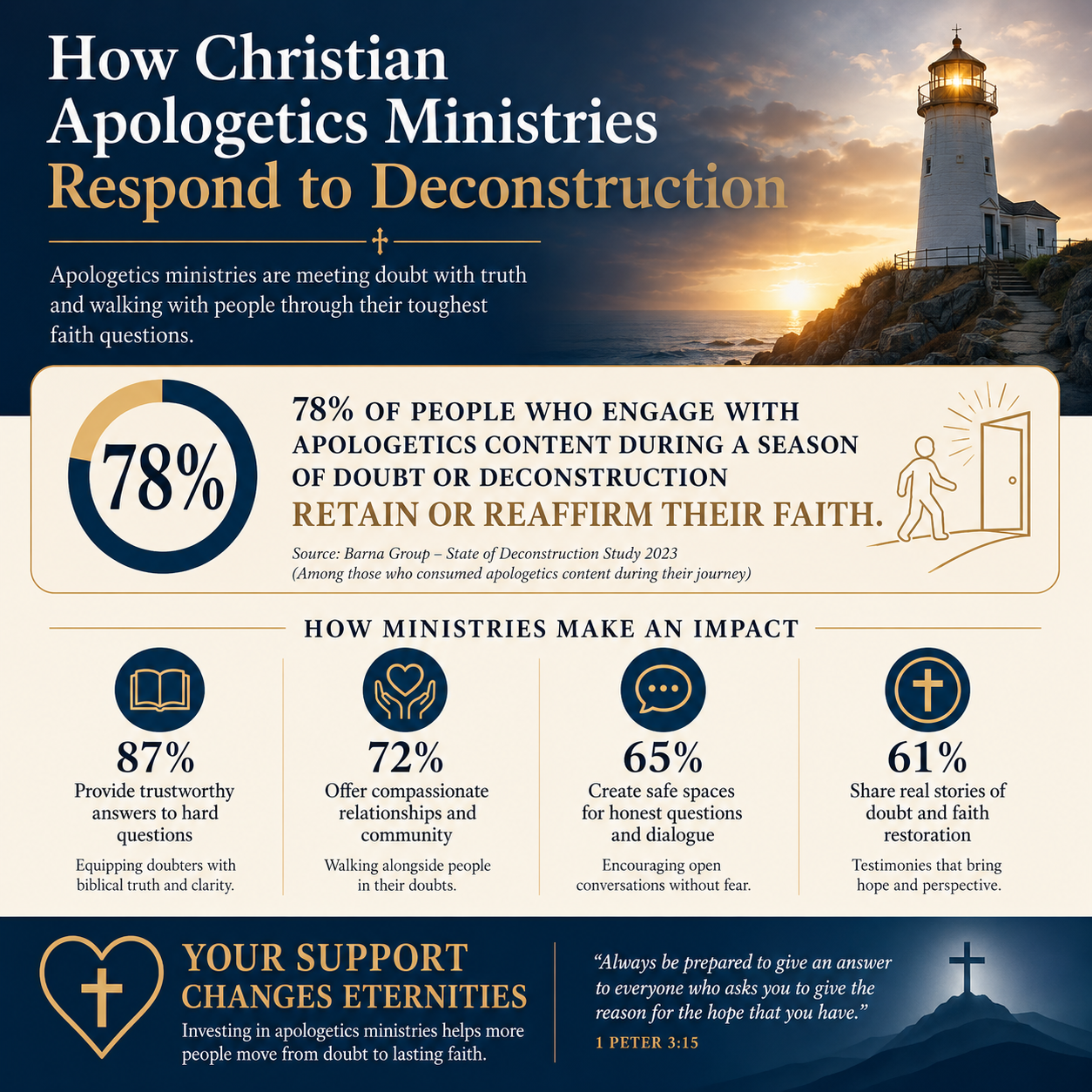
Serious apologetics ministries respond differently. They slow down enough to define terms, clarify what is actually being claimed, and distinguish the core of the faith from defensible but nonessential traditions. They also admit what Christian scholars genuinely debate: for example, interpretive questions about certain passages, the relationship between Scripture and tradition, or the wisdom of particular institutional models. The church’s confidence rests in Christ and the apostolic gospel, not in pretending that every secondary matter is simple.
What donors should look for in content and method
Donors funding apologetics during this moment are not merely underwriting “answers.” They are funding a public moral witness about what Christian truth sounds like when it is spoken under pressure. The following signals tend to correlate with ministries that help rather than harden:
- Careful definition of deconstruction and related terms, avoiding straw men
- Public repentance and institutional learning where harm has occurred
- Long-form teaching that engages Scripture, history, and theology rather than only reaction content
- Clear distinction between essential doctrine and contested secondary issues
- Referrals and partnerships that reconnect people to healthy local churches
These are not matters of personality. They are matters of theological posture. The wisdom literature repeatedly warns that “whoever is quick to speak” will stumble (Proverbs 10:19). A ministry that consistently trades carefulness for speed is not merely adopting a strategy; it is shaping a culture.
4. Institutional trust is part of the apologetics question now
Many skeptics are reacting to leadership failures, not only doctrine
Deconstruction is often framed as an intellectual crisis, but for many it is an institutional crisis. People are asking whether Christian leaders can be trusted with authority, money, and vulnerable lives. This makes governance, financial integrity, and transparency inseparable from apologetics credibility. If a ministry argues for Christian truth while operating with secrecy, conflicts of interest, or unaccountable leadership, its apologetics may be rhetorically impressive and spiritually brittle.
That is one reason our work at Most Trusted focuses on verification, not sentiment. The Most Trusted Standard evaluates ministries across 15 criteria that attend to faith commitments, financial integrity, governance and leadership, and transparency and effectiveness. These are not merely administrative concerns. They are concrete expressions of whether a ministry’s public defense of Christianity is matched by internal practices that honor Christ.
What verification can and cannot do for donors
Verification cannot guarantee that a ministry will never fail. Scripture already tells us that leaders are capable of grievous sin, and Christian history confirms it. What verification can do is reduce avoidable risk: unclear financial reporting, concentrated authority without meaningful oversight, opaque related-party transactions, or public messaging that outruns actual outcomes.
For donors, the question is not simply, “Does this ministry have a strong case for Christianity?” It is also, “Does this ministry operate in a way that makes its case believable?” Trust is not earned by claims. It is earned by patterns.
5. The best ministries make room for complexity without surrendering conviction
Compassion is not capitulation
Christians genuinely disagree about how much accommodation is wise when speaking to people in deconstruction. Some fear that any sympathetic language invites doctrinal drift. Others fear that firm language guarantees unnecessary loss. Both concerns have weight. Yet the New Testament sets a clear pattern: Jesus is both “full of grace and truth” (John 1:14). Apologetics that abandons truth becomes therapeutic religion. Apologetics that abandons grace becomes a defense of identity rather than an invitation to repentance and life.
In the strongest apologetics work, compassion is expressed through patient listening, careful reading, and the willingness to stay with hard questions longer than a debate format allows. Conviction is expressed through explicit affirmation of the resurrection, the authority of Scripture, the reality of sin, and salvation through Christ alone. Donors should not accept a false choice between “pastoral” and “orthodox.” The gospel requires both.
Deconstruction can also be an invitation to deeper doctrine
Some deconstruction narratives expose an anemic faith: Christianity presented mainly as moralism, political identity, or personal success. When those supports collapse, what remains can feel hollow. A ministry that meets this moment well will teach the thicker doctrines that sustain believers under pressure: union with Christ, the priestly ministry of Jesus, the meaning of repentance, the nature of the church, and the hope of bodily resurrection.
This is where apologetics can serve renewal rather than merely defense. If donors want their giving to strengthen the church’s long-term resilience, they should prioritize ministries that are building serious Christian imagination, not merely scoring points. That posture fits within the wider field of Christian Apologetics Ministries, where intellectual credibility must be joined to spiritual maturity.
FAQs for How Christian apologetics ministries respond to deconstruction
Should donors avoid funding apologetics ministries that engage deconstruction publicly?
No. Public engagement is often necessary because deconstruction conversations are already public, and many believers encounter them online before they have pastoral support. The prudent question is whether a ministry engages with theological seriousness, clear ecclesial commitments, and demonstrable accountability in governance and finances. Donors should fund ministries that respond with both conviction and mercy, resisting performative outrage and simplistic dismissals.
What if a ministry’s apologetics content is strong but its transparency is weak?
Donors should treat that gap as a substantive concern, not a cosmetic one. In a deconstruction era, institutional trust is part of the credibility of the message. A ministry can teach true doctrine and still undermine confidence through opaque finances, unclear oversight, or leader-centric authority. Verification against The Most Trusted Standard is designed to help donors distinguish strong communication from trustworthy institutional practice.
Deconstruction reveals what apologetics is ultimately for
How Christian apologetics ministries respond to deconstruction is not only about persuading skeptics; it is about bearing witness to the character of Christ while defending the truth of Christ. The church must not treat doubt as fashionable virtue, and it must not treat wounded questioning as contemptible rebellion. Donors who give wisely in this moment will strengthen ministries that tell the truth without cruelty, name sin without cynicism, and build trust through accountable, transparent practice that accords with the gospel they proclaim.



