

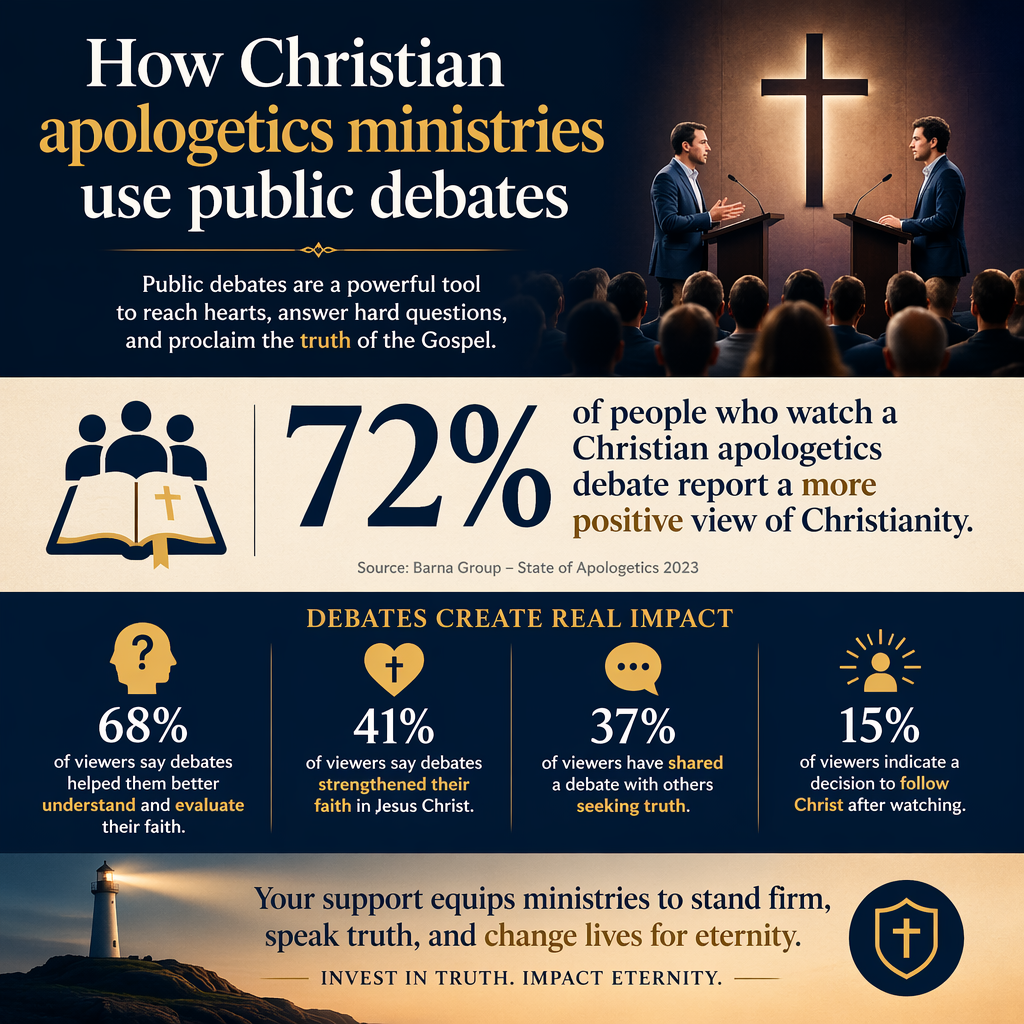
How Christian apologetics ministries use public debates reveals both a public-facing evangelistic strategy and a set of stewardship risks that donors should not ignore. Debates can clarify truth, expose weak arguments, and invite seekers to reconsider Christ, but they can also reward performance, intensify tribalism, and tempt ministries to measure faithfulness by views rather than fruit.
Christian donors are often drawn to apologetics because the need is real: competing worldviews are persuasive, and many believers want reasons that can bear intellectual weight. Yet the Christian tradition has never treated persuasion as mere technique. Scripture binds truth-telling to love of neighbor, and it warns against quarrels that breed pride rather than repentance. A public debate is a tool; it must be governed by a theology of witness.
Why debates remain central to apologetics ministries
Public debate is not new in Christian witness. Paul reasoned in synagogues and public forums, and Luke describes sustained argumentation in Acts where the gospel met sophisticated opposition. Contemporary apologetics ministries use debates because they concentrate attention, force clarity, and allow real-time testing of claims in front of an audience that may never attend a church service.
What this means in practice is that debates function as a form of mass communication with an unusually high perceived credibility. A moderated exchange with opposing viewpoints feels more transparent than a monologue, particularly for younger audiences formed by podcasts, long-form video, and adversarial media.
Debate formats serve distinct evangelistic goals
Not every debate aims at the same outcome. Some are designed for the undecided skeptic who wants a fair hearing; others target Christian confidence, equipping believers to speak without fear. A ministry that treats every debate as “winning” will often miss the pastoral reality that many listeners are looking for intellectual permission to believe, not an opponent’s humiliation.
High-visibility debates can function as a gateway to deeper formation
For mature ministries, the debate is rarely the end of the program. The more credible organizations treat it as an entry point into lectures, reading groups, local church training, and mentorship. Donors should look for a coherent pathway from public argument to durable discipleship rather than a constant cycle of one-off events.

How debates shape audiences and ministry incentives
Debates form people, not only opinions. A ministry’s tone, choice of opponents, and handling of evidence teaches audiences what Christians believe about truth, dignity, and the purpose of intellectual life. When a debate rewards rhetorical dominance, the audience may learn contempt; when it rewards careful listening, the audience may learn courage and patience.
The harder question is how ministries remain faithful when platforms reward outrage and simplification. Digital distribution can multiply reach at low marginal cost, but it can also narrow incentives toward the most polarizing topics and the most combustible soundbites. For donors, this is not merely a question of “style.” It is a question of formation.
Attention economics can distort theological priorities
Public debates are often built around a single proposition. That structure can help clarify an argument, but it can also reduce Christianity to a few contested claims while ignoring the fullness of the gospel: repentance, reconciliation, holiness, and the life of the church. Christians genuinely disagree about where apologetics should sit in the church’s overall mission, and donors should not assume that intellectual defense is identical to discipleship.
Conflict can become a brand identity
Some ministries drift into a posture where the opponent is always “the other side,” and the debate itself becomes a ritual of belonging. That approach may drive engagement, but it can undermine evangelistic credibility when unbelievers perceive that the primary goal is cultural dominance rather than truthful witness. Here the warning of Scripture is direct: “The Lord’s servant must not be quarrelsome but kind to everyone, able to teach, patiently enduring evil” (2 Timothy 2:24).
What responsible debate engagement looks like
Responsible apologetics does not refuse public argument; it disciplines it. The best ministries set standards for evidence, clarify definitions up front, and resist rhetorical shortcuts. They also recognize that persuasion is moral work: it treats the listener not as an audience to capture but as a neighbor to love.
Across our verification work at Most Trusted, we observe that healthy ministries tend to articulate their debate philosophy in writing and embed it into operational decisions. They do not rely on a charismatic debater’s instincts alone. They build accountability into the program.
Marks of a ministry that debates with integrity
- Clear doctrinal boundaries and a stated evangelistic purpose for debate work
- Publicly accessible sourcing, reading lists, and corrections when errors occur
- Respectful engagement that avoids misrepresentation and personal ridicule
- Integration with local church relationships rather than a free-floating platform
- Post-debate follow-up resources that move from argument to discipleship
Why intellectual humility is not optional
Apologetics often trades in philosophy, history, textual criticism, and science—domains where overstatement can be tempting. A credible ministry distinguishes between what is certain, what is probable, and what is conjectural. That posture does not weaken confidence in Christ; it strengthens trustworthiness. When ministries concede a limited point without conceding the gospel, they model something rare in public life: truthfulness under pressure.
Donor diligence for debate-driven ministries
Debates can be expensive, travel-heavy, and production-intensive, especially when events are filmed and edited for broad distribution. Donors should evaluate not only whether a ministry is “effective,” but whether its approach is governable, financially disciplined, and transparent about outcomes that matter.
For donors assessing ministries within Christian Apologetics Ministries, debates are often the most visible surface. The deeper questions sit beneath: Who has authority over message and method? How are controversial engagements vetted? How does the ministry handle donor-restricted funds? How are leaders evaluated when platform incentives conflict with pastoral wisdom?
Financial and governance questions that reveal maturity
A serious apologetics organization can describe the real costs of debate work and why those costs are justified. It can also explain how it avoids the common temptation to chase “impact” metrics that are easy to count but hard to interpret. Views, downloads, and ticket sales may indicate reach, but they do not necessarily indicate spiritual fruit.
When donors ask for evidence, mature ministries can point to measurable outputs (content produced, events held, curriculum distributed) and also to thoughtful proxy indicators (participant feedback, church partnerships, pastoral referrals) without claiming that conversion can be engineered. Pew Research Center, for example, has documented long-term religious switching trends and the complexity of why people leave or join religious communities, cautioning against simplistic cause-and-effect narratives about belief change (Pew Research Center).
Transparency is part of Christian witness
In apologetics, credibility is part of the argument. If a ministry publicly demands rigorous evidence from opponents but offers vague reporting about its own finances or leadership accountability, it undercuts the very virtues it claims to defend. Donors should expect clear disclosure of board oversight, conflict-of-interest practices, and accessible financial reporting. The broader nonprofit sector has repeatedly argued that simplistic financial ratios are not sufficient to judge a charity’s health; the well-known “Overhead Myth” letter emphasized the need to evaluate governance, transparency, and results rather than overhead alone (Charity Navigator).
Debates within the wider calling of cultural engagement
Public debates sit within a larger Christian responsibility to speak truthfully in the public square. Yet cultural engagement is not the same as culture war. Some apologetics ministries treat debate as an instrument for defending a Christian moral vision; others focus more narrowly on the truth of Christianity’s core claims. Both approaches carry risks: moral engagement can become partisan, and narrow evidentialism can become detached from embodied church life.
Within Cultural Engagement in Christian Apologetics, the most credible ministries tend to hold together three commitments: intellectual rigor, spiritual formation, and charitable presence. They understand that a debate win that produces pride is a loss, and a debate loss handled with grace may be a powerful witness.
Why donors should care about tone as a theological issue
Tone is not cosmetic. It signals what a ministry believes about the imago Dei in its opponents and listeners. A combative style may rally a base, but it can also teach believers to treat neighbors as threats. Scripture places truth and love together; separating them is not strategic pragmatism but moral fracture (Ephesians 4:15).
The role of prayer and ecclesial accountability
Apologetics ministries that are accountable to churches, confessional statements, and spiritually mature oversight are better positioned to resist platform temptations. Debate work becomes especially volatile when charismatic leaders operate without meaningful correction. Donors should ask whether the ministry’s public posture is grounded in private submission to Christ and to the church.
FAQs for How Christian apologetics ministries use public debates
Are public debates an effective evangelism strategy?
They can be, particularly as a first point of contact for skeptical audiences who value open exchange. Effectiveness is difficult to measure directly, and responsible ministries avoid claiming that debates “produce” conversions. Donors should look for disciplined follow-up, church partnerships, and a consistent pattern of intellectual honesty rather than inflated impact claims.
What should donors watch for when a ministry’s brand centers on debates?
Watch for incentives that reward conflict: sensational topic selection, disrespectful rhetoric, and an overreliance on platform metrics. Also watch for governance weaknesses that allow a single personality to control strategy, finances, and public tone without oversight. A ministry’s credibility in debate should be matched by credibility in transparency, accountability, and stewardship.
Giving with discernment toward debate-based apologetics
Public debates can serve the church when they are governed by truth, humility, and love of neighbor. They can also deform Christian witness when they become entertainment, tribal signaling, or a substitute for discipleship. Donors are not merely funding content; they are funding a public model of Christian reasoning. Most Trusted encourages donors to support apologetics ministries whose debate work is integrated with accountable leadership, transparent stewardship, and a theology of witness that treats opponents as persons made in God’s image.



