
How Christian anti-trafficking ministries prevent exploitation is a stewardship question before it is a program question. Donors can fund rescue operations and still leave the underlying conditions untouched, or they can fund prevention that reduces the number of people who become vulnerable in the first place. Scripture’s insistence on justice for the oppressed does not permit sentimentality; it requires wise action that protects image-bearers before harm occurs (Isaiah 1:17).
Prevention is also where the field has had to grow up. Christians genuinely disagree about how much attention should go to raids, aftercare, policy, or poverty alleviation. The evidence base is uneven across interventions, and sensational narratives can crowd out sober assessment. The ministries most worthy of donor confidence are usually the ones that speak plainly about these tensions, measure what they can, and refuse to treat human beings as supporting characters in fundraising.
Prevention begins with a biblical doctrine of the person and a sober view of power
Christian prevention is not merely risk management. It is rooted in the imago Dei and the conviction that exploitation is a violent theft of God-given dignity. That theological grounding matters because anti-trafficking work constantly tempts ministries toward functional utilitarianism: do whatever “works,” even if it compromises truthfulness, due process, or the agency of those being served.
What this means in practice is that prevention starts with naming how power operates. Trafficking is rarely a single bad actor snatching a stranger; it is often an accumulation of coercion, debt, fear, unstable housing, and social isolation. The United Nations Office on Drugs and Crime has documented that traffickers frequently use “abuse of a position of vulnerability” as a means of control, not only overt physical force (UNODC).
Language choices shape program choices
When ministries speak as though all exploitation is abduction, they will overfund dramatic interventions and underfund the slow work of stabilizing families and communities. When they speak as though “choice” is always clear, they will miss coercion that operates through addiction, threats, or survival needs. Prevention requires careful language: precise enough to describe coercion without erasing moral agency, and compassionate enough to avoid blaming victims for the conditions that trapped them.
Trauma-informed care is not optional in prevention
Many donors think of trauma care as part of aftercare, but prevention also depends on it. Survivors and at-risk individuals often make decisions under chronic stress, and ministries that ignore trauma dynamics can unintentionally increase risk. A prevention program that pressures disclosure, forces participation, or treats compliance as success may look efficient and still leave people more exposed than before.

Effective prevention targets known vulnerabilities rather than abstract awareness
Awareness campaigns have a place, but prevention that reduces exploitation typically targets concrete vulnerabilities: housing instability, food insecurity, family breakdown, addiction, and unsafe work arrangements. This is where Christian anti-trafficking ministries often overlap with broader mercy ministries, and the overlap is not a distraction. It is frequently the mechanism of prevention.
The harder question is how to prioritize. Trafficking risk factors differ by geography and population. A rural area with limited services may require different interventions than an urban corridor with high runaway and homeless youth. Donors should expect ministries to show they understand local patterns and referral pathways rather than importing a template from another context.
Prevention frequently looks like strengthening families and stability
Family instability is not the only driver of exploitation, but it is a common one. Youth who lack safe adult attachment are easier to recruit, coerce, and isolate. The U.S. Department of Health and Human Services has emphasized that traffickers exploit vulnerabilities such as “lack of stable housing, family conflict, and involvement in the child welfare system” (HHS Administration for Children and Families). Ministries that invest in family stabilization, foster care support, mentoring, and wraparound services are often doing anti-trafficking prevention, even when they do not market it that way.
Economic strengthening is prevention when it reduces coercion
Job training, microenterprise, and financial counseling can be genuine prevention when they reduce dependence on exploitative relationships. But the field has had to reckon with simplistic income narratives. Not every job program protects; some funnel vulnerable people into unstable work without safeguards. Donors should look for ministries that pair economic programs with legal protections, safe transportation planning, and ongoing support.
Prevention requires credible partnerships and disciplined referral systems
No ministry prevents exploitation alone. Prevention depends on schools, churches, social services, healthcare providers, and law enforcement each doing a limited part well. The strongest ministries treat partnerships as a form of accountability: clear roles, clear handoffs, and clear limits on what the ministry will and will not do.
This is also where donor discernment becomes practical. A ministry can claim broad collaboration while operating as a siloed brand. Prevention work should show evidence of real coordination: memoranda of understanding when appropriate, shared protocols, and a willingness to be evaluated by peers.
Church-based prevention that does not confuse discipleship with surveillance
Local churches are uniquely positioned to notice isolation, family crisis, and unsafe living conditions. But churches can also overreach, turning prevention into suspicion and rumor. Healthy ministry training equips congregations to recognize warning signs, respond with care, and refer to qualified professionals without attempting amateur investigations.
Within Christian Anti-Trafficking Ministries, we consistently see that the most trustworthy prevention efforts are those that make referral pathways explicit. They define what requires mandatory reporting, what requires pastoral care, and what requires specialized services.
Coordination with law enforcement without becoming a law enforcement proxy
Christians genuinely disagree about the proper relationship between ministries and law enforcement, often because contexts vary. In some regions, law enforcement is a crucial ally; in others, survivors and immigrant communities fear engagement. Responsible prevention ministries acknowledge this complexity and avoid acting as a covert extension of police work. Their priority is safety, lawful reporting obligations, and survivor agency.
Prevention is measured by reduced vulnerability and safer outcomes, not stories
Anti-trafficking fundraising has been shaped by compelling stories, and stories matter because people matter. But prevention work can be distorted when story becomes the primary proof of impact. A single dramatic testimony does not demonstrate that a model reduces exploitation across a population. Mature donors should expect ministries to measure what prevention can reasonably measure, and to speak honestly about what cannot be proven with certainty.
Across our verification work at Most Trusted, we observe a consistent pattern: ministries that can articulate their prevention theory of change in plain terms are usually better prepared to evaluate it. They know what inputs they control, what outputs they can count, and what outcomes require cautious interpretation.
What donors can reasonably ask prevention ministries to track
Not every program will produce clean metrics, and confidentiality is not negotiable. Still, prevention work can be assessed with disciplined indicators that respect dignity. A short list of reasonable indicators includes:
- Number of at-risk individuals connected to stable housing, counseling, or medical care
- Documented safety plans completed and followed up over time
- School attendance or re-engagement outcomes for vulnerable youth when relevant
- Job placement with retention support and safeguards, not merely training completion
- Quality and timeliness of referrals, including follow-through rates with partner agencies
How ministries avoid the measurement traps unique to trafficking
Prevention measurement is vulnerable to two opposite errors. One is inflating numbers by counting “people reached” through brief presentations as if that were protection. The other is refusing measurement entirely, appealing to complexity as a reason not to evaluate. Credible ministries resist both. They state what they can claim, what they cannot, and why.
For donors, this is where The Most Trusted Standard becomes useful. It does not reward dramatic claims. It asks whether a ministry is transparent about methods, realistic about outcomes, and careful with the people whose lives and stories are at stake.
Wise prevention funding aligns with integrity, governance, and truthfulness
Prevention is morally demanding because it requires patience, and patience is harder to market than urgency. That is precisely why governance and financial integrity matter so much in this space. A ministry under pressure to produce emotionally compelling content may drift toward exaggeration, blurred boundaries, or even unsafe practices.
Donors should not assume that “anti-trafficking” is a self-validating label. The field has seen harm from inexperienced actors attempting interventions that belong to trained professionals. Prevention funding should therefore be shaped by questions of competence and oversight, not only compassion.
Red flags that sophisticated donors should take seriously
Prevention ministries vary widely in maturity. Several warning signs consistently correlate with weak prevention practice:
- Vague claims about “rescues” without clear definitions, documentation standards, or partner attribution
- Training programs that encourage private citizens to confront suspected traffickers
- Public communications that sensationalize trafficking patterns or imply omnipresent abduction risk
- Minimal safeguarding policies for work with minors and vulnerable adults
- Reluctance to name professional standards, licensing boundaries, or reporting obligations
What strong prevention ministries tend to do instead
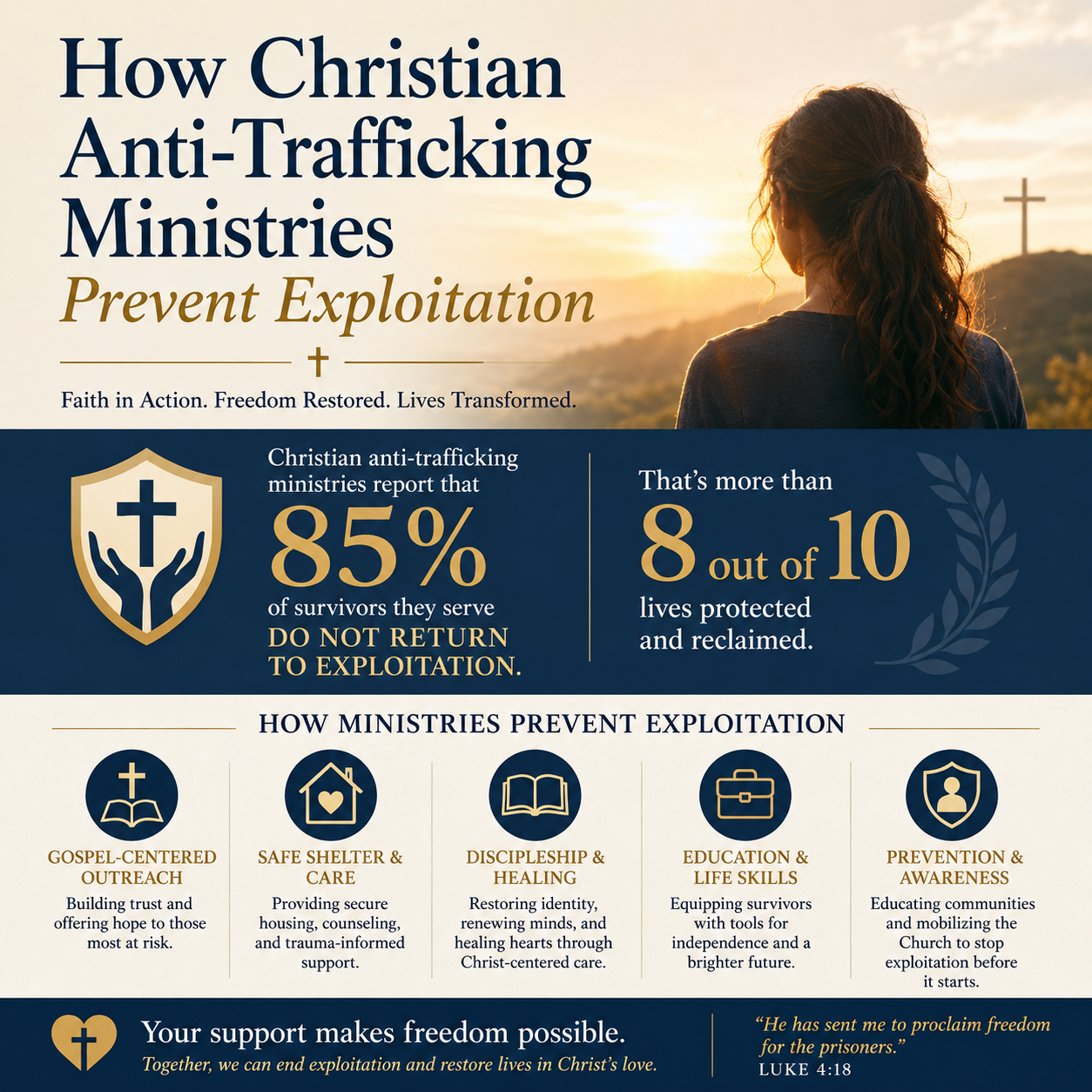
Strong ministries focus on protective factors: stable relationships, safe housing, economic resilience, and access to care. They publish clear safeguarding policies. They train staff and volunteers with appropriate credentials and supervision. They avoid claiming credit for outcomes they did not produce, and they defer publicly to the expertise of specialists when appropriate.
These patterns appear regularly in ministries that align with Prevention and Education in Christian Anti-Trafficking Ministries. They are not glamorous commitments, but they are the kind of commitments that protect people.
FAQs for How Christian anti-trafficking ministries prevent exploitation
Is prevention more effective than rescue in Christian anti-trafficking work?
They are not clean substitutes. Rescue and aftercare respond to immediate harm, and Christians should not treat that as optional. Prevention aims to reduce vulnerability so fewer people are harmed in the first place. Donors can support both, but prevention is often underfunded because its outcomes are slower and less narratively dramatic.
What should Christian donors look for before funding prevention programs?
Donors should look for theological seriousness about dignity and truthfulness, clear safeguarding practices, credible partnerships, and transparent reporting. Prevention programs should describe specific vulnerabilities they address and how they assess progress without exploiting stories. Most Trusted evaluates these questions through The Most Trusted Standard so donors can give with confidence grounded in evidence and integrity.
Prevention that honors the vulnerable is a form of faithful stewardship
Christian anti-trafficking prevention is not primarily a campaign; it is a sustained commitment to protect neighbors before they are harmed. It requires ministries that are theologically grounded, institutionally disciplined, and honest about limits. Donors who fund that kind of work may receive fewer dramatic updates, but they participate in a form of justice that is closer to the scriptural pattern: steady, truthful, and ordered toward the flourishing of image-bearers.



