
How Christian anti-trafficking ministries report impact is not a marketing question; it is a discipleship question. When Christians give to confront exploitation, we are not purchasing a feeling of having helped. We are stewarding resources before God, and we are accountable for whether our giving strengthens what is good, protects those at risk, and avoids unintended harm.
Anti-trafficking work is also unusually vulnerable to inflated claims. The public imagination is shaped by rescue narratives, while much of the daily work is slower: prevention, case management, trauma care, legal advocacy, and long-term restoration. Mature donors can hold both truths at once: God can deliver dramatically, and faithful ministries often serve through patient, costly, evidence-informed care.
Impact reporting begins with biblical accountability and moral clarity
Stewardship demands more than compelling stories
Scripture does not treat money as neutral. Jesus frames stewardship as a spiritual test, and the church has long understood charitable giving as a form of worship and responsibility. That is why responsible impact reporting is not primarily about satisfying donor curiosity; it is about truth-telling. “It is required of stewards that they be found faithful” (1 Corinthians 4:2). Faithfulness includes candor about what can be measured, what cannot, and what remains uncertain.
For anti-trafficking ministries, moral clarity is non-negotiable: exploitation is evil, and the church must not avert its eyes. Yet moral clarity does not justify careless claims. Some outcomes are hard to attribute to a single intervention. Some numbers are ethically inappropriate to publish. Some success is real but not easily quantifiable. Strong reporting names these constraints rather than treating them as inconveniences.
Good reporting refuses to trade dignity for visibility
Trafficking survivors are not props for donor reassurance. Christian ministries that report impact well treat confidentiality as an expression of neighbor-love, not merely a legal requirement. When ministries share stories, they do so with informed consent, careful de-identification, and language that does not sensationalize sexual violence. Donors should expect strong survivor-safeguarding policies and a consistent refusal to publish details that could retraumatize a person or expose them to retaliation.
What this means in practice is that the most credible ministries often look quieter than the most viral ones. Their reporting may be less dramatic, but it will be truer, safer, and more aligned with the Christian conviction that every person bears the image of God.

Trafficking work requires disciplined definitions and honest limits
Clear definitions prevent inflated numbers
One of the most common weaknesses in impact reporting is definitional drift: “trafficking,” “rescue,” “survivor,” “at-risk,” “operation,” and “case” can be used loosely, leading to numbers that sound impressive but mean little. Credible reports define terms in plain language and keep them consistent over time. They also distinguish between direct services and awareness activity, without implying that awareness alone is equivalent to safety.
Even at the level of public statistics, trafficking is difficult to quantify. The U.S. National Human Trafficking Hotline has repeatedly cautioned that its data should not be used to estimate prevalence and does not represent the full scope of trafficking in the United States; it reflects signals and reports received, not total incidence. That caution is important for donors evaluating sweeping claims about “how many victims are out there.” National Human Trafficking Hotline
Attribution is harder than it appears
Anti-trafficking outcomes are often the product of networks: law enforcement, social services, trauma clinicians, churches, courts, employers, and safe housing providers. Ministries that report impact with integrity describe their role in that ecosystem and avoid claiming credit for what others accomplished. They will still report meaningful outcomes, but they will do it with appropriate humility about causality.
Christians genuinely disagree about emphasis: some prioritize immediate intervention, others stress prevention and systems work. Responsible reporting does not flatten these differences; it explains the ministry’s theory of change and why it believes that approach is both biblically faithful and practically effective.
What strong anti-trafficking impact reporting typically includes
Output metrics tied to real activities
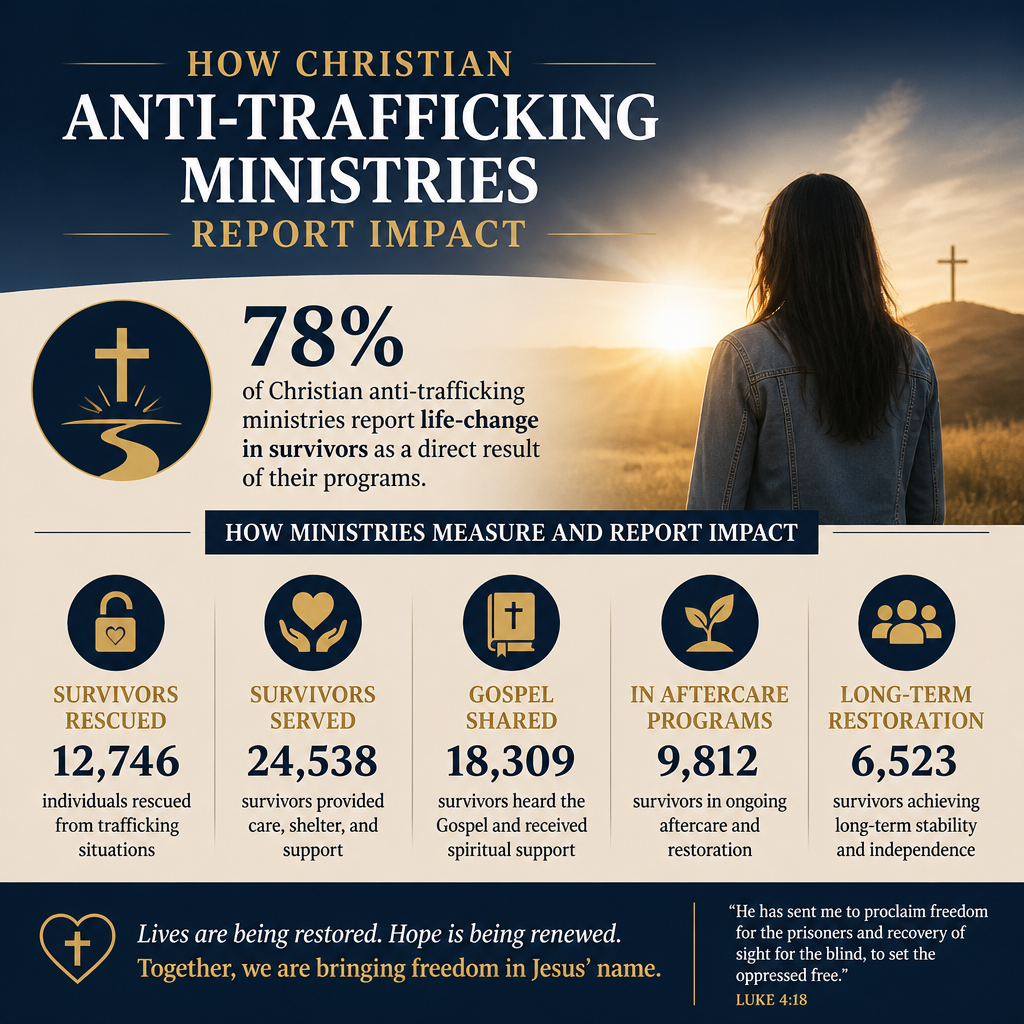
Outputs are not the whole story, but they are a necessary start. They answer the question, “What did you do?” When outputs are reported well, they are specific, time-bounded, and comparable year over year. Examples include: nights of safe housing provided, number of clients who received case management, number of trauma therapy sessions delivered, or number of legal advocacy engagements completed.
Output reporting becomes more trustworthy when ministries explain their capacity constraints and waiting lists rather than masking them. A ministry that can name its bottlenecks is often a ministry that understands its own operations.
Outcome metrics that reflect restoration, not only intervention
Outcomes answer the more important question: “What changed?” For anti-trafficking ministry, credible outcomes commonly include indicators such as housing stability, employment retention, progress on education goals, reduced crisis events, engagement in long-term counseling, or sustained safety planning. Because trauma recovery is nonlinear, mature reports also describe relapse risk and the reality of setbacks without implying failure or blaming survivors.
Strong reporting connects outcomes to time horizons. A 30-day outcome is different from a 12-month outcome. A ministry that reports only short-term changes may be constrained by funding cycles rather than shaped by a restoration vision.
- Definitions that distinguish trafficking, exploitation, abuse, and high-risk contexts
- Service mix with counts tied to specific programs and time periods
- Outcome indicators that fit trauma-informed practice and long-term restoration
- Safeguarding practices for confidentiality, consent, and data security
- Limits and learning that identify what did not work and what changed as a result
Donors assessing a ministry’s reporting will also benefit from reading across the broader field. For additional context on the landscape, we maintain a topical resource on Christian Anti-Trafficking Ministries that reflects patterns our team sees when evaluating organizations for credibility and clarity.
Transparency and effectiveness require more than a single annual report
Governance and financial integrity shape impact credibility
Impact reporting does not stand alone. A ministry can publish polished outcome claims while lacking basic internal controls, independent oversight, or transparent financial statements. The church has learned, painfully, that secrecy and concentrated power create conditions where harm can persist. Donors are right to ask: Who governs this organization? How are leaders evaluated? Are finances independently reviewed? Are related-party transactions disclosed?
External signals help, but they are not substitutes for primary documentation. In the United States, donors can often review a nonprofit’s Form 990 filings through the IRS’s tax-exempt search or other repositories. Internal Revenue Service
The temptation to oversimplify overhead is real
Anti-trafficking ministry requires skilled staff, secure facilities, clinical partnerships, legal expertise, and careful training. That costs money, and it should. Donors sometimes pressure organizations to keep “administration” low in ways that incentivize underinvestment in safeguarding and data quality. The charitable sector has pushed back against simplistic overhead fixation for years, including the well-known joint statement commonly referred to as the “Overhead Myth,” emphasizing that effectiveness cannot be inferred from overhead ratios alone. Charity Navigator
What this means in practice is that credible impact reporting is often paired with clear explanations of why certain administrative costs exist: background checks, secure recordkeeping, staff supervision, audits, clinical training, and survivor safety protocols. Those are not distractions from mission; they are part of moral seriousness.
How Most Trusted evaluates impact reporting under The Most Trusted Standard
We look for coherence between theology, practices, and evidence
Most Trusted exists to help Christian donors give with confidence. In our verification work, we assess ministries against The Most Trusted Standard, a 15-criteria framework that examines faith foundation, financial integrity, governance and leadership, and transparency and effectiveness. Anti-trafficking work especially benefits from this kind of integrated evaluation because impressive narratives can conceal weak systems, and strong systems can sometimes be misread as “less spiritual” because they feel disciplined and procedural.
The ministries that meet The Most Trusted Standard tend to report impact in a way that matches the reality of the work: sober about evil, hopeful about redemption, careful with language, and serious about safeguarding. They also tend to treat reporting as a tool for learning and accountability rather than a fundraising accessory.
What donors should ask when reviewing an impact report
Sophisticated donors do not need to become trafficking experts to ask responsible questions. A small set of disciplined prompts can clarify whether a ministry’s reporting is trustworthy:
- Are key terms defined clearly, and are counts limited to what the ministry can substantiate?
- Does the report distinguish outputs from outcomes, and does it offer time-bound outcome indicators?
- Are survivor stories shared with clear consent and de-identification, or do they read as sensational?
- Is the ministry transparent about partners and attribution, or does it imply sole credit?
- Do governance and financial disclosures support confidence in the numbers being reported?
For donors who want to understand how anti-trafficking ministries typically steward funds across programs, staffing, and safeguards, we publish additional context under How Christian Anti-Trafficking Ministries Use Donations, reflecting what credible transparency looks like in practice.
FAQs for How Christian anti-trafficking ministries report impact
Should we distrust a ministry if it reports fewer numbers than others?
Not necessarily. In anti-trafficking work, smaller or more restrained numbers can reflect careful definitions, confidentiality constraints, and a refusal to exaggerate attribution. The question is whether the reported numbers are tied to specific activities, consistently defined, and accompanied by governance and financial transparency that makes the reporting credible.
What is a red flag in anti-trafficking impact reporting?
Common red flags include undefined terms, dramatic prevalence claims without credible sourcing, “rescue” numbers that lack explanation of what the ministry actually did, and survivor stories that appear identifiable or sensational. Another warning sign is a report that highlights outcomes but provides little public documentation on leadership accountability, financial statements, or safeguarding practices.
A credible report is a form of neighbor-love
Christian anti-trafficking ministry should be marked by courage and compassion, but also by truthfulness. Impact reporting that is careful, verifiable, and survivor-centered honors the people a ministry serves and respects the donors who fund the work. When ministries tell the truth about what they do, what changes, and what remains hard, they offer more than information. They model the kind of integrity the church must bring to the fight against exploitation.



