
Christian anti-trafficking ministries publish audited financials because the work they do is both morally urgent and financially complex. When a ministry asks the church to fund rescue, shelter, legal advocacy, and long-term restoration, donors are right to ask whether the organization is handling sacred resources with competence and restraint.
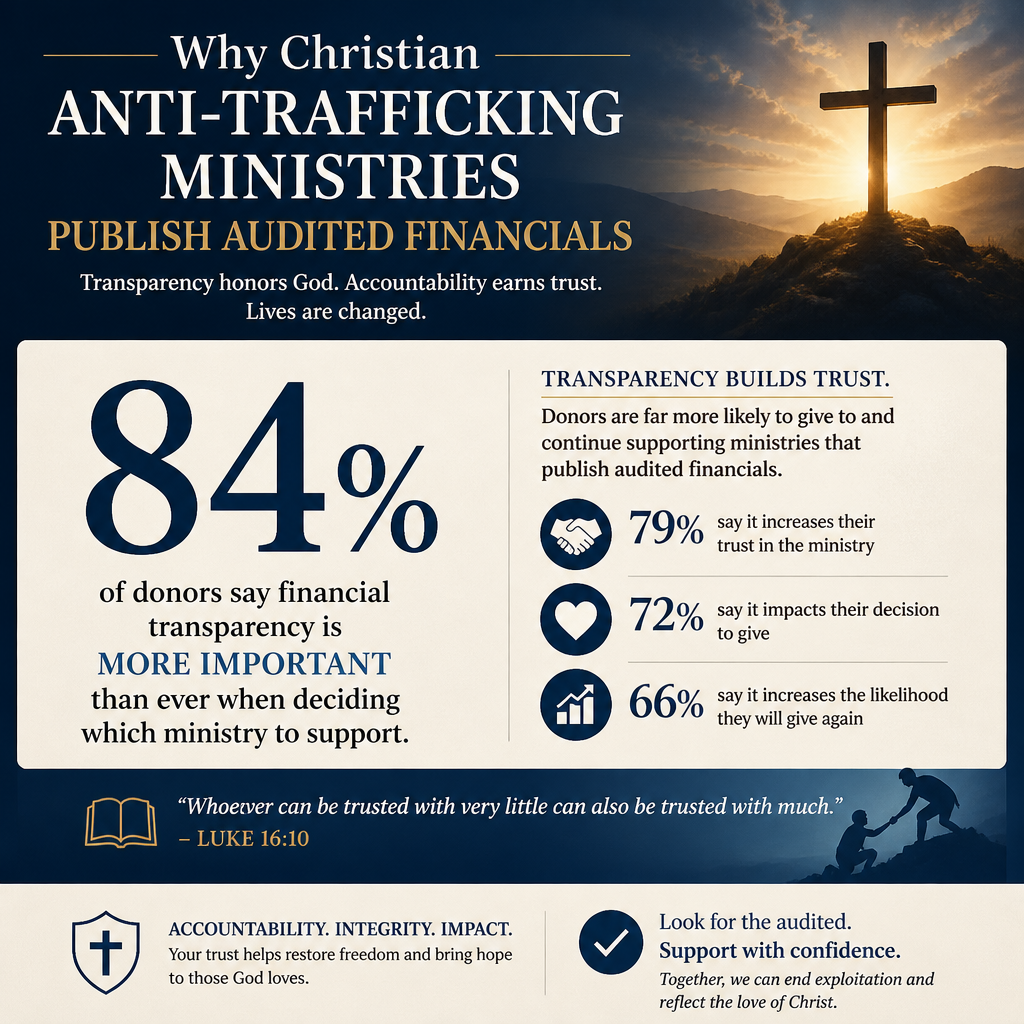
Audit transparency is not a public-relations exercise. It is one practical way a ministry demonstrates that it understands a biblical doctrine of stewardship and is willing to be examined. Scripture treats money as a spiritual matter, and ministry leaders are not exempt from the standards that govern ordinary discipleship (Luke 16:10–12). Audited financial statements are not the only evidence of integrity, but they are one of the clearest forms of verifiable evidence available to donors.
Audits translate stewardship into verifiable evidence
Christian donors regularly carry two responsibilities at once: compassion for survivors and accountability for the funds entrusted to them. Audited financials help donors hold those responsibilities together without reducing the mission to sentiment or suspicion.
Stewardship is a moral category, not an administrative one
The New Testament assumes that financial stewardship will be tested. Paul took pains to administer relief gifts in a way that was “honorable not only in the Lord’s sight but also in the sight of man” (2 Corinthians 8:20–21). That is a theological rationale for external scrutiny. An independent audit is one modern way to embody Paul’s instinct: not merely to be faithful, but to be seen to be faithful through accountable processes.
Anti-trafficking ministries often handle restricted gifts, government grants, program revenue, and in-kind contributions. These complexities are manageable, but they are also where sincere organizations can drift into weak internal controls. An audit does not create virtue; it helps confirm that a ministry’s systems match its stated commitments.
Audited statements answer questions that narratives cannot
Ministry storytelling is necessary, especially when survivors’ dignity requires careful anonymity and restraint. Yet narrative alone cannot show whether revenue is recurring, whether reserves exist, whether donor restrictions are honored, or whether related-party transactions are appropriately disclosed. Audited statements and their accompanying notes are designed to address those issues directly.
For donors comparing ministries within Christian Anti-Trafficking Ministries, audited financials create a shared baseline. They allow wise comparison without forcing ministries to disclose sensitive operational details that could endanger survivors or compromise law-enforcement relationships.

Anti-trafficking work carries higher-than-average financial risk
Trafficking is a crime economy. Ministries engaging it often operate at the intersection of trauma care, housing, employment services, and criminal justice. The more complex the operating environment, the more important it becomes to demonstrate financial controls that can withstand stress.
Complex funding streams increase the importance of strong controls
Many credible organizations use a mix of individual giving, foundation grants, and public funds. Each stream carries different compliance expectations and documentation requirements. A clean audit is not merely a gold star; it signals that the ministry can track restricted funds, apply cost allocation consistently, and maintain records that would withstand external review.
This is not theoretical. Federal oversight has tightened in recent years around internal controls and documentation for entities that expend federal awards. The Uniform Guidance sets expectations for internal controls and audit requirements for many recipients of federal funds (eCFR).
Fraud prevention is part of protecting survivors and donors
Church donors tend to assume goodwill in Christian organizations, and in many cases that trust is warranted. But trust without verification is a pattern Scripture repeatedly warns against. Audits make it harder for financial mismanagement to hide in the margins of goodwill.
The field has also had to reckon with a sober reality: the anti-trafficking brand can attract opportunists. This is one reason mature donors increasingly ask not only whether a ministry “does good,” but whether its financial reporting is credible, consistent, and independently tested. Ministries that welcome audits are not claiming perfection; they are demonstrating a willingness to be accountable under the light.
Audits support governance that can withstand moral pressure
Anti-trafficking work carries intense emotional weight. That weight can make organizations vulnerable to “mission urgency” thinking, where speed and passion quietly displace controls and oversight. Strong governance does not slow ministry; it protects it from predictable failure modes.
Board oversight is more than a formality
An audit engages the board in a way internal reports rarely do. Audit committees, management letters, and required disclosures force leaders to address questions of risk, controls, and sustainability. A ministry’s willingness to publish audited financials is often a proxy for whether the board understands its fiduciary responsibility and acts on it.
For donors, this matters because boards are the primary human safeguard against founder-centric decision-making and unreviewed financial arrangements. An audit does not replace a vigilant board, but it gives a competent board better tools to govern.
Transparency does not require reckless disclosure
Christians genuinely disagree about how much operational detail a ministry should make public, especially when security is at stake. Safe-house locations, survivor-identifying data, and certain investigative partnerships should not be disclosed. Audited financials offer a disciplined alternative: meaningful transparency about finances without compromising survivor safety.
Audits can even help ministries explain why certain information is rightly withheld. Donors are generally willing to accept prudent confidentiality when the organization is forthright about what it can verify and what it cannot publish.
Audited financials serve donors who want formation, not just reassurance
Many Christian donors are not only trying to avoid scandal. They are trying to give in a way that reflects the character of God: truthful, just, and attentive to the vulnerable. Audited reporting becomes part of discipleship in giving because it trains donors to ask better questions than “How moving is the story?”
Sound financial reporting helps donors resist misleading signals
The sector has learned that simplistic ratios can create perverse incentives. The “Overhead Myth” letter signed by major evaluators argued that overhead percentages are a poor stand-alone measure of nonprofit performance (Charity Navigator). Mature anti-trafficking donors can hold two truths together: administrative spending can be wasteful, and administrative capacity can also be essential to safe, effective care.
Audited statements help donors move beyond simplistic heuristics. They make it possible to evaluate whether “administration” includes necessary clinical supervision, compliance staff, and trained case management systems rather than mere bureaucracy. They also reveal whether fundraising costs are stable, whether program expansion is funded responsibly, and whether cash flow is managed without desperation.
Practical signals donors can look for in audited statements
Across our verification work at Most Trusted, we find that audited financials become most useful when donors know what questions to bring to them. The goal is not to become amateur accountants; it is to identify whether the organization’s financial posture supports faithful ministry over time.
- Whether the audit opinion is unmodified and whether any significant deficiencies are disclosed
- Whether revenue is concentrated in a small number of donors or funding sources
- Whether restricted gifts are material and how clearly they are tracked and reported
- Whether related-party transactions are disclosed and appear appropriately governed
- Whether liquidity and reserves suggest stability or chronic fragility
For donors engaging Accountability and Transparency in Christian Anti-Trafficking Ministries, these questions create a disciplined way to pair moral concern with responsible inquiry.
How audits fit into The Most Trusted Standard
Publishing audited financials is not a complete accountability system. It is one component of a broader pattern: a ministry that can be examined without defensiveness and that can substantiate claims with documentation. That is why audits are meaningful within The Most Trusted Standard, which evaluates ministries across multiple dimensions of faithfulness and organizational health.
Audits are necessary, but not sufficient
Some ministries have audited statements and still drift into unhealthy leadership cultures or ungrounded claims about impact. Others are small and early-stage, doing legitimate work, but not yet in a position to afford an annual audit. A serious assessment considers context: organizational size, complexity, funding mix, and the nature of the programs offered.
At the same time, anti-trafficking is not a domain where donors should accept perpetual informality. When an organization’s budget and risk profile grow, accountability should mature with it. The audit becomes a reasonable expectation because it is proportionate to the responsibility being carried.
What audited financials cannot tell you about a ministry
Audited statements do not measure spiritual fruit, trauma-informed clinical quality, or the wisdom of intervention models. They do not tell you whether a ministry is collaborating appropriately with local service providers or whether it is unintentionally drawing survivors into unsafe dependencies. Those are questions of program design, governance, and theological posture, and they require additional sources of evidence.
What audited financials can do is limit the space for financial ambiguity. For donors, that clarity is not secondary to mission; it is one of the ways we refuse to separate compassion from truth.
FAQs for Why Christian anti-trafficking ministries publish audited financials
Is an audit the same as making financials public?
No. An audit is an independent examination of financial statements and related disclosures. Publishing audited financials is the additional step of providing those audited statements to donors and the public. Many ministries commission audits primarily for board oversight or funder requirements, but publishing them signals a higher commitment to transparency.
What if a small anti-trafficking ministry cannot afford an audit?
Cost can be a real constraint. In those cases, donors can still ask for other forms of credible accountability: reviewed financial statements, a current Form 990 for U.S. nonprofits, clear conflict-of-interest and whistleblower policies, and board governance that is demonstrably independent. As budgets and risk increase, a plan to move toward audited financials should be part of responsible organizational maturation.
Stewardship worthy of the mission
Anti-trafficking ministry invites the church to contend for people made in the image of God under brutal exploitation. That calling deserves excellence, not only in compassion but in stewardship. When ministries publish audited financials, they are declaring that the mission is strong enough to endure scrutiny, and that donor trust is not assumed but carefully honored.



