
Questions about how Christian anti-trafficking ministries use donations are not a distraction from the spiritual task of giving. They are part of it. Scripture treats money as moral terrain: “It is required of stewards that they be found faithful” (1 Corinthians 4:2). Donors who ask what funds actually do are not being cynical; they are refusing to separate compassion from truth.
Anti-trafficking work, however, is unusually complex to evaluate. Some of the most important outcomes are intentionally hard to quantify: trust rebuilt, coercion disrupted, a survivor stabilized enough to sleep through the night, a community learning to recognize recruitment tactics. At the same time, the sector has faced legitimate criticism—overstated numbers, sensationalized fundraising, and strategies that create risk for survivors or distort the work of law enforcement. A faithful donor posture demands both urgency and restraint.
Donations do not fund a single activity but a chain of interventions
Christian donors often hope their gift “rescues someone.” Ministries sometimes encourage that expectation because rescue stories are compelling. Yet trafficking is more accurately understood as a system of coercion, vulnerability, and profit. Most effective ministries finance a chain of interventions that range from prevention to restoration, with specialized roles that do not fit neatly into a single narrative.
Government definitions also matter because they shape what programs can responsibly claim. The U.S. Department of State’s Trafficking in Persons framework distinguishes sex trafficking and labor trafficking and emphasizes force, fraud, or coercion (or any commercial sex involving a minor). That definitional clarity influences responsible screening, reporting, and partnership decisions. See the State Department’s definition and framing in its Trafficking in Persons Report.
Prevention and community resilience
Many ministries invest in upstream work because the surest “rescue” is the one that never becomes necessary. Donations may support school-based prevention education, parent training, church mobilization, safe migration counseling, and livelihood initiatives designed to reduce economic desperation that traffickers exploit. In global contexts, some programs include microenterprise support or job placement, not as a generic poverty solution but as a targeted risk-reduction strategy tied to known recruitment pathways.
The harder question is that prevention outcomes are rarely dramatic. A ministry may serve hundreds and still be able to document only a handful of averted cases. Mature organizations resist the temptation to convert prevention into inflated “people saved” numbers. They build programs with clear theories of change and accept that faithful work is sometimes quiet.
Identification and crisis response
Donations also fund the frontline work of recognizing and responding to exploitation: hotline coordination, street outreach, case intake, emergency relocation, short-term housing, transportation, and basic needs. In some models, ministries fund on-call advocates who accompany survivors to forensic exams, interviews, court hearings, or social service appointments.
These functions have high personnel costs because they require trained, available staff. They also carry real risk. Ministries that meet strong standards set boundaries for volunteer involvement, maintain safeguarding protocols, and avoid “raid-and-rescue” theatrics that can endanger survivors, compromise investigations, or retraumatize those being helped.
Long-term restoration and reintegration
Restoration is where many donor dollars should go, and where the work becomes most demanding. Survivors may need trauma-informed counseling, addiction treatment, medical care, legal advocacy, education, job training, childcare, and stable housing over years. Many will require help navigating immigration options, expungement, restitution claims, or protection orders.
Christian ministries often add pastoral care, discipleship opportunities, and church-based community—when welcomed by survivors and offered without coercion. Christian compassion does not require that services become transactional. It requires that spiritual care be offered as genuine ministry rather than a condition for safety or services.

What faithful spending tends to look like in credible ministries
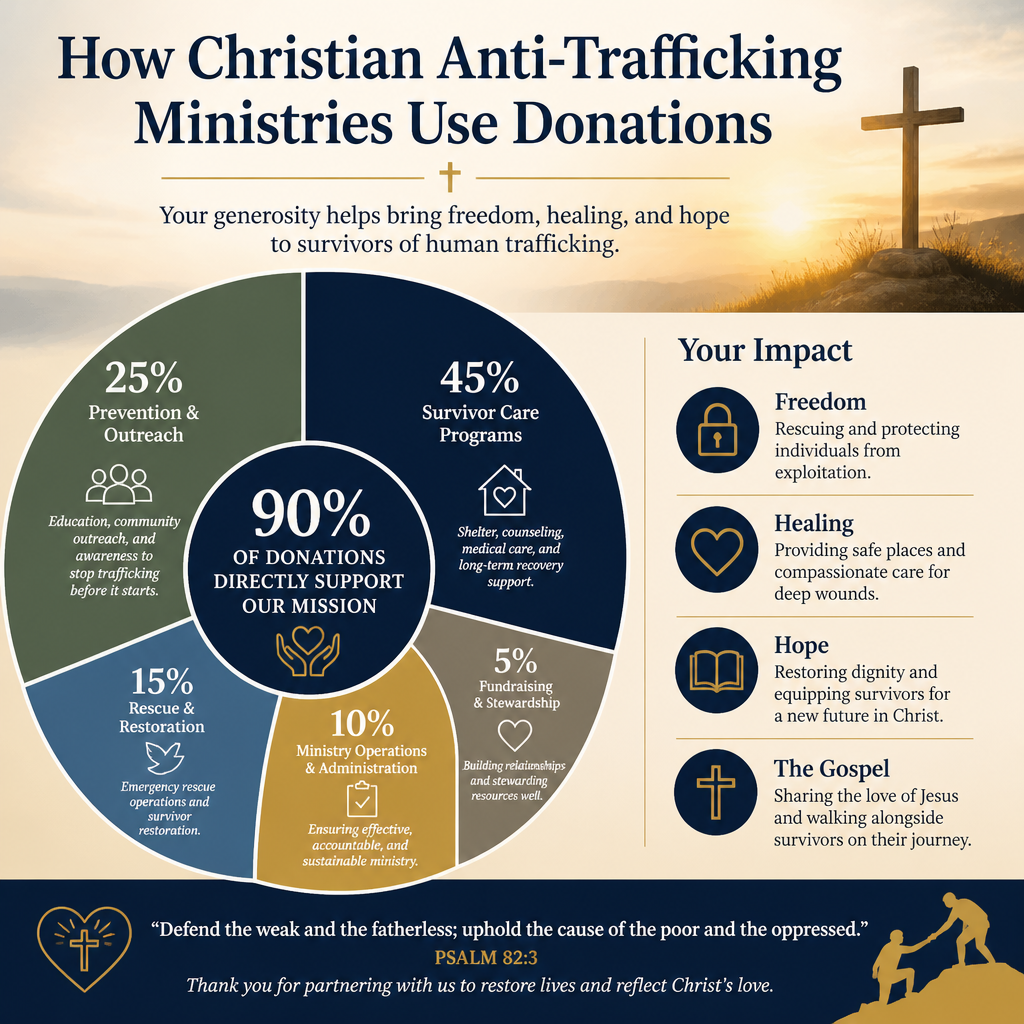
Donors regularly ask what “good ratios” are—how much should go to programs versus overhead. That question is understandable, but it can mislead. Some of the most essential anti-trafficking work is “overhead” by simplistic accounting: supervision, clinical training, secure data systems, legal compliance, and staff care. The right question is not “How low is overhead?” but “Is the organization structured to do the work safely, lawfully, and effectively?” The philanthropic sector has publicly warned against overhead fixation for years; see the “Overhead Myth” statement archived by Candid (GuideStar) at Candid.
Across our verification work at Most Trusted, the ministries that meet The Most Trusted Standard tend to show a consistent pattern: they fund competent staff, they document policies that protect survivors, they budget for accountability, and they communicate with restraint. They do not treat trauma care, governance, or internal controls as optional.
Staffing is not a necessary evil
Anti-trafficking ministries are people-intensive. Competent staff include licensed clinicians, case managers, survivor advocates, program directors, and finance leaders who understand restricted funds and compliance. When donors expect “lean” organizations at all costs, they can inadvertently pressure ministries into understaffing, underpaying, and high turnover—conditions that undermine continuity of care and increase risk.
What this means in practice is that a donor may see a meaningful portion of the budget in personnel costs, and that can be appropriate. The question is whether those staff roles are aligned to mission delivery, properly supervised, and accountable to a board with real governance authority.
Survivor care requires infrastructure that donors rarely see
Safe houses and restoration programs require security, insurance, training, background checks, facility maintenance, confidentiality protocols, and relationships with healthcare providers. Digital security can also be non-negotiable. Survivors can be tracked through phones, social media, and compromised accounts; ministries need systems that reduce that risk.
Wise donors also recognize the cost of doing clinical work responsibly. Trauma-informed care is not simply a ministry preference; it is a professional commitment to practices that reduce retraumatization. Many organizations draw on frameworks such as SAMHSA’s description of trauma-informed approaches; see SAMHSA’s overview at SAMHSA.
Partnerships and referrals can be more effective than building everything
Some ministries rightly choose not to operate every component themselves. Donations may fund referral networks, coalition-building, training for churches and community institutions, or shared services that strengthen a region’s overall response. In many locales, the most responsible approach is to integrate with existing survivor services, domestic violence shelters, healthcare systems, and law enforcement victim advocacy units.
This can disappoint donors who equate effectiveness with owning programs end-to-end. Yet partnership models can reduce duplication, improve continuity of care, and keep a ministry focused on what it does best.
Why monthly support matters and why “impact reports” are often imperfect
Trafficking does not follow a predictable calendar, and the needs of survivors rarely fit a single gift cycle. Ministries often need flexible funding to keep trained staff on the payroll, maintain emergency capacity, and respond to sudden casework without waiting for a seasonal appeal. This is why many organizations ask for monthly support: not because one-time gifts are unhelpful, but because continuity is part of faithful care.
Christians genuinely disagree about what kind of “impact” should be reported. Some donors want simple counts: rescues, arrests, convictions. Others want measures of stability and flourishing. The field has had to reckon with the reality that certain numbers are either outside a ministry’s control or ethically risky to publicize.
Program outputs are easier than outcomes
Outputs include meals served, hotline calls answered, nights of shelter provided, counseling sessions delivered, or trainees equipped. These are legitimate indicators of activity, but they are not the same as long-term change. Outcomes—sustained safety, reduced exploitation, stable employment, healed relationships—are harder to measure and can take years.
Responsible ministries state clearly what they can verify, what they cannot, and why. They avoid implying that every contact equals a “saved” person, and they refuse to turn confidential stories into marketing assets.
Law enforcement statistics are not ministry statistics
Some organizations work closely with police or federal agencies; others deliberately do not, either because their focus is survivor services or because of the risks that certain enforcement approaches can carry for victims. When an organization claims credit for arrests or convictions, donors should ask how that attribution is made.
For donors seeking a grounded view of the scale and complexity of trafficking data, the National Human Trafficking Hotline publishes signals and trends while acknowledging the limitations of hotline-based data. See its data approach through Polaris at Polaris.
Seasonality and the funding gap
Many ministries experience predictable giving spikes near year-end, while survivor needs remain constant. Others face shortfalls when grants end or when economic conditions tighten. A monthly donor base can keep a safe house staffed, keep clinical services stable, and prevent the “start-stop” pattern that is especially harmful in trauma recovery.
Wise donors treat steady support as a form of covenant faithfulness—less like a transaction and more like sustained solidarity. That posture aligns with the long obedience that restoration often requires.
How donors can evaluate anti-trafficking ministries with moral clarity
Because the work involves vulnerable people, donor discernment is not merely a financial exercise. It is a question of neighbor love ordered by truth. The ministries most worthy of Christian confidence are usually not those with the most dramatic storytelling, but those that show restraint, competence, and humility.
In practice, we recommend donors examine four areas: theological integrity, financial integrity, governance strength, and evidence of transparency and effectiveness. At Most Trusted, we assess ministries against The Most Trusted Standard, a 15-criteria framework that looks for verifiable signs of faithfulness and trustworthiness across these domains.
Ask whether the ministry’s theology protects, rather than consumes, survivors
Christian anti-trafficking work should reflect the imago Dei in more than rhetoric. Donors can ask how the organization prevents spiritual coercion, how it handles repentance and forgiveness language in cases of abuse, and whether it centers survivor agency. Scripture’s concern for the oppressed never licenses exploitation of testimony. “Speak up for those who cannot speak for themselves” (Proverbs 31:8) is a mandate for advocacy, not a permission slip for extracting stories.
Ask what is governed, not merely what is promised
Credible organizations have boards that govern meaningfully: approving budgets, overseeing leadership, reviewing audited financials when appropriate, managing conflicts of interest, and requiring safeguarding policies. Donors should be cautious when a ministry’s public persona is indistinguishable from its founder, or when accountability mechanisms are vague.
Financial reporting should be accessible and intelligible. A Form 990, audited statements when scale warrants, clear restricted-fund language, and consistent program descriptions are not bureaucratic hurdles; they are basic acts of truth-telling.
Ask what the ministry refuses to do
One of the clearest marks of maturity is the presence of well-defined limits. Responsible ministries can name practices they avoid: exposing survivor identities, staging “rescues” for content, pressuring survivors into public testimony, exaggerating numbers, or bypassing qualified professionals. Boundaries are not a lack of faith; they are a form of wisdom.
Donors seeking a broader frame for the wider ecosystem of ministries and models can consult Christian Anti-Trafficking Ministries and then press into the specific questions of spending, reporting, and governance that separate compelling messaging from credible practice.
Giving that strengthens the work rather than the narrative
Christian donors rightly want their gifts to interrupt evil and protect the vulnerable. The most faithful giving, however, is not driven by the need for dramatic confirmation. It is governed by stewardship, truthfulness, and patient love. Anti-trafficking ministries use donations best when they fund trained people, survivor-safe systems, and long-term restoration—and when they report their work with restraint rather than spectacle.
When donors hold ministries to clear standards and support the unglamorous costs of doing the work responsibly, generosity becomes more than a reaction to suffering. It becomes a disciplined participation in justice and mercy, offered in the fear of the Lord and for the good of neighbors who deserve more than our sentiment.



