
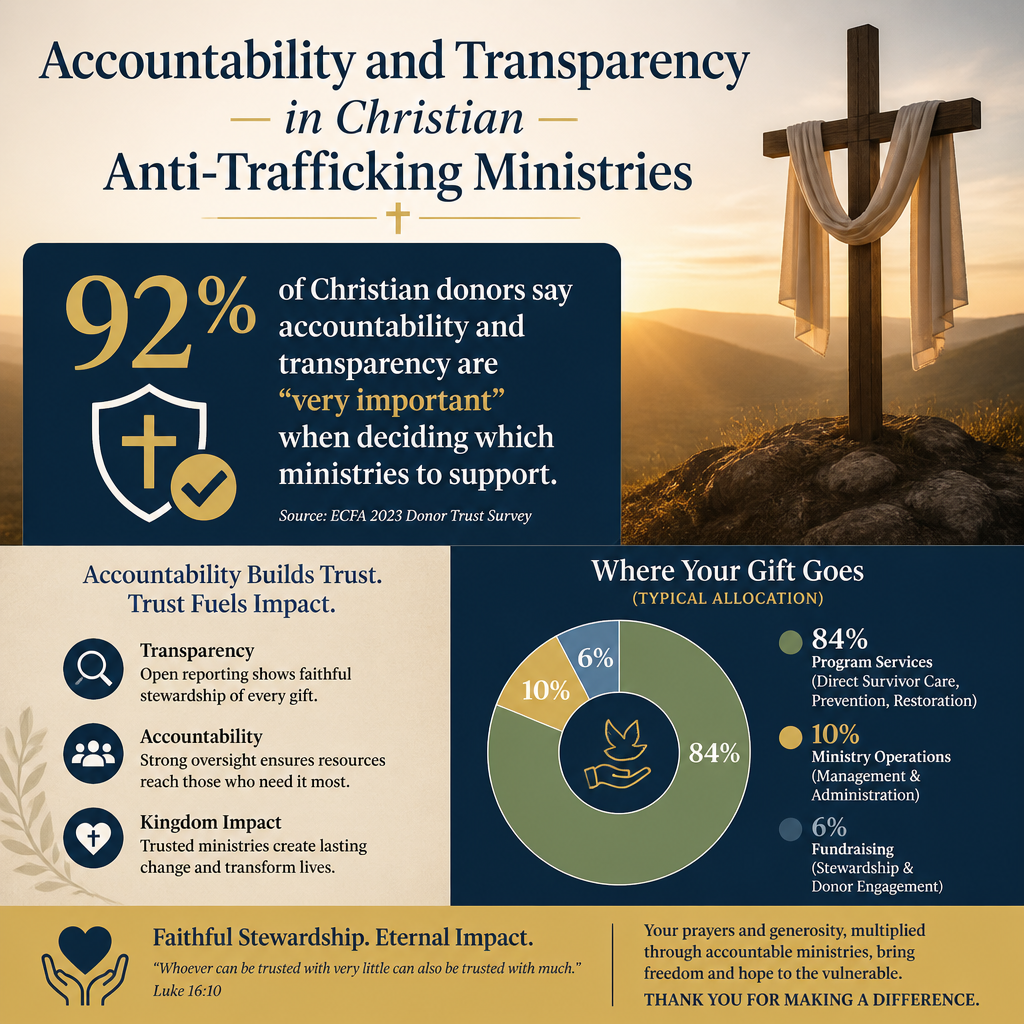
Accountability and transparency in Christian anti-trafficking ministries are not secondary concerns for careful donors; they are central to faithful stewardship. Trafficking is a field where secrecy is sometimes necessary for survivor safety and law-enforcement integrity, and yet secrecy can also become a shelter for inflated claims, weak governance, and financial confusion. Christian donors are right to ask for verifiable clarity without demanding disclosures that would endanger people made in the image of God.
Scripture does not treat stewardship as a private virtue. Jesus repeatedly binds money to discipleship, and the New Testament requires integrity that can withstand scrutiny: “we take this course so that no one should blame us” (2 Corinthians 8:20). The question is not whether a ministry is doing “some good,” but whether its practices are ordered toward truth, protection of the vulnerable, and accountability before God and the public.
Why accountability in anti-trafficking work is uniquely difficult
Anti-trafficking ministries operate in a contested and emotionally charged space. Some organizations are primarily service providers: shelter, case management, trauma care, job readiness, legal aid. Others focus on prevention, training, or policy. Others work alongside law enforcement in ways that require operational security. These differences shape what transparency should look like. A shelter should not publish details that enable traffickers to locate residents, but it should publish audited financials, governance practices, and outcome measures that respect confidentiality.
One of the field’s ongoing challenges is measurement. Donors naturally want to know: How many people were “rescued”? Yet rescue counts can incentivize sensationalism, over-claiming, and harmful interventions that treat survivors as props for fundraising rather than neighbors to be served with dignity. The U.S. Department of State has repeatedly emphasized that anti-trafficking efforts must be “victim-centered” and “trauma-informed,” and that identification and assistance require careful coordination, not simplistic metrics (U.S. Department of State).
Confidentiality is real, but it is not a blank check
Some ministries equate transparency with operational exposure. Mature transparency distinguishes between information that would harm survivors and information that protects donors, staff, and beneficiaries. Program addresses, survivor names, and active investigative tactics should remain confidential. Board oversight, conflict-of-interest controls, executive compensation processes, audited statements, and the boundaries of ministry authority should not be hidden. The ministries most worthy of trust are usually those that can say, with precision, what they cannot disclose and why—and then disclose the rest fully.
Trauma can create pressure toward dramatic storytelling
Christian donors often encounter anti-trafficking work through stories. Stories matter; Jesus taught in parables, and Scripture records testimony. But trauma-informed practice sets limits. Survivors can be re-harmed when ministries extract details for fundraising or publish identifiable narratives. Ethical organizations rely on informed consent, avoid gratuitous details, and increasingly shift from individual stories to aggregated data and program descriptions. That is not marketing caution; it is love of neighbor expressed as restraint.
Partnership complexity can obscure responsibility
Anti-trafficking ministries commonly partner with churches, police, social services, and international networks. Partnerships can be a strength, but they can also blur accountability: who is responsible for screening volunteers, reporting abuse, protecting data, or ensuring funds are spent as designated? Strong ministries publish clear partnership policies, define decision rights, and do not use “we partner with…” as a substitute for evidence of internal controls.

What transparency should look like for Christian donors
Transparency is not a mood; it is a set of verifiable practices. Mature donors are not looking for perfection. They are looking for a ministry that can withstand ordinary questions without defensiveness and can document its claims without exaggeration. That expectation aligns with the biblical requirement that leaders be “above reproach” (1 Timothy 3:2), not sinless, but rightly ordered and accountable.
Financial documents that are intelligible and complete
At minimum, donors should be able to find recent financial statements, a Form 990 for U.S. nonprofits, and a clear explanation of revenue sources and major expense categories. When a ministry says “most funds go to the mission,” the responsible question is: what does “mission” include? In anti-trafficking work, “program” may legitimately include licensed clinicians, survivor stipends, security, legal support, and training. It may also conceal vague categories that are difficult to audit. Clarity is the point.
For larger organizations, an independent audit is a meaningful signal because it subjects financial reporting to external testing. It is not a guarantee of holiness, but it is a disciplined practice that reduces the risk of hidden liabilities, misstatements, and weak controls. Donors should also expect a ministry to explain restricted funds, major grants, and any related-party transactions in plain language, not in euphemisms.
Governance that is more than a list of names
A board roster is not governance. Donors should look for evidence that the board is active, independent, and qualified to oversee high-risk work. In practice, that includes conflict-of-interest policies, documented meeting cadence, independent review of executive compensation, and a mechanism for whistleblowing and complaints. Anti-trafficking work involves vulnerable populations, high staff stress, and sometimes significant cash flow from donors moved by urgency. Those realities require governance that is vigilant, not ceremonial.
Outcomes that resist both cynicism and hype
Effective anti-trafficking work is often slow and relational: stabilization, legal processes, relapse prevention, long-term discipleship offered without coercion, and economic resilience. Donors should expect ministries to publish outcome measures that fit their model: length of stay, case plan completion, referrals to services, job placement retention, counseling engagement, re-exploitation prevention efforts, and similar indicators. The harder question is whether outcomes are defined in a way that respects agency and avoids “success” narratives that pressure survivors to perform gratitude for supporters.
Many donors have heard the “overhead” debate and worry about administrative costs. The sector’s leading evaluators have argued for years that overhead ratios can mislead donors into rewarding underinvestment in systems and staff. Charity Navigator, Candid (formerly GuideStar), and the BBB Wise Giving Alliance publicly urged donors to move beyond overhead as the primary measure of effectiveness (Charity Navigator). In anti-trafficking work, underfunded finance teams, weak HR, and poor data security are not efficiencies; they can become pathways to harm.
Red flags that often accompany weak accountability
Christian donors should not have to become forensic accountants to give wisely. Still, certain patterns recur across the nonprofit landscape, and anti-trafficking is not immune. Identifying these signals early is not cynicism; it is prudence in a domain where vulnerable people pay the price for institutional failure.
Vague claims and unverifiable numbers
Be wary of ministries that lead with dramatic statistics without describing methods, definitions, or sources. “Rescued,” “freed,” and “saved” are morally weighty words, and they can be operationally ambiguous. Responsible ministries define what they mean: identified as a victim by whom, served for how long, and with what kind of follow-up. When a ministry cannot explain its numbers, or when its numbers scale implausibly without corresponding staffing and expense growth, donors should pause.
Secrecy about leadership and decision-making
Some organizations withhold basic governance information under the banner of “security.” There are legitimate contexts where staff identities should be protected, especially in hostile regions. But in most U.S.-based ministries, donors should be able to identify senior leadership, board oversight, and how decisions are made. Secrecy that extends to compensation practices, related-party transactions, or board independence is rarely about safety.
Manipulative fundraising and spiritualized pressure
Anti-trafficking fundraising can drift into moral coercion: if a donor hesitates, the donor is framed as indifferent to suffering. That posture is not consistent with Christian teaching on cheerful, voluntary generosity (2 Corinthians 9:7). Mature ministries invite accountability, encourage donors to ask hard questions, and refuse to weaponize images or stories. When messaging becomes dependent on shock, urgency, and guilt, it often correlates with weaker internal discipline.
Financial reporting that is technically available but practically opaque
Posting a PDF is not the same as being transparent. A ministry may publish a 990 or an annual report while still avoiding clarity about cash reserves, debt, fundraising costs, or the true cost of programs. Donors should watch for inconsistent categorization year to year, unexplained jumps in consulting expenses, or repeated “other” line items that remain undefined. Complexity is sometimes legitimate; chronic opacity is not.
How Most Trusted evaluates accountability under The Most Trusted Standard
Most Trusted exists because Christian donors routinely face a dilemma: they want to respond to real suffering, but they also want to avoid funding confusion, exaggeration, or harm. Our verification work evaluates ministries against The Most Trusted Standard, a 15-criteria framework that examines faith commitments, financial integrity, governance and leadership, and transparency and effectiveness. The point is not to create a new celebrity economy for ministries; it is to strengthen the conditions under which trust can be responsibly granted.
Across our verification work, we observe that organizations with strong accountability tend to share several habits. They welcome independent review, rather than treating questions as disloyalty. They document policies that protect beneficiaries and staff, including safeguarding, reporting pathways, and data security. They present financial information that a serious donor can understand without insider access. And they measure what they actually do, resisting both inflated “rescue” rhetoric and cynical minimalism.
Accountability also requires theological clarity. Christian anti-trafficking work easily becomes a battlefield of competing visions: activism versus discipleship, proclamation versus protection, punitive models versus restorative models, raids versus long-term services. Christians genuinely disagree about some tactics, and the field has had to reckon with cases where poorly designed interventions harmed the very people they intended to help. The ministries that merit donor confidence do not pretend these debates do not exist. They articulate their model, name its limits, and submit it to external critique.
For donors seeking to place anti-trafficking giving in a broader context, we also maintain resources on Christian Anti-Trafficking Ministries that reflect the same commitment to verifiable evidence and Christian moral seriousness.
Giving with confidence without funding harm
Accountability and transparency in Christian anti-trafficking ministries are ultimately about love ordered by truth. Donors are not only financing programs; they are endorsing the moral credibility of the Church’s public witness. When ministries handle money carefully, report plainly, govern responsibly, and measure outcomes honestly, they honor survivors, protect staff, and strengthen confidence that Christian compassion is not merely sincere but trustworthy.
The wise donor posture is neither suspicion nor naïveté. It is tested trust: asking for clear documents, coherent claims, and governance that can bear weight. That standard is not an obstacle to mercy. It is one of the ordinary ways Christian stewardship refuses to do evil that good may come.



