
Why Christian addiction recovery ministries need clear policies is not a bureaucratic question. It is a discipleship question, because addiction exposes the places where human vulnerability and institutional power meet, and Scripture is unambiguous about how God judges the strong who mishandle the weak. Donors who love the Church’s mercy ministries rightly want to know whether a program’s compassion is disciplined by truth.
Policies cannot create spiritual renewal. The Holy Spirit does not need paperwork. Yet Christian ministries that work with relapse, trauma, co-occurring mental illness, and family fracture operate in conditions where good intentions are not enough. Clear, enforceable policies are one of the primary ways a ministry makes its love concrete: protecting participants, forming staff and volunteers, and giving boards the tools to govern faithfully.
Policies are not red tape they are a form of pastoral care
Addiction recovery ministry often describes itself as a “safe place.” That promise is moral, not merely emotional. When the Apostle Paul instructs the church to do “all things decently and in order” (1 Corinthians 14:40), the concern is not institutional tidiness. The concern is that disorder harms people and dishonors the gospel. In recovery work, disorder predictably concentrates risk on those with the least capacity to protect themselves.
Clear policies establish what care looks like when pressure rises: when someone relapses, when a resident becomes aggressive, when a volunteer oversteps relational boundaries, or when a family member alleges harm. Without agreed-upon rules, decisions tend to be made by charisma, urgency, and exhaustion. Over time, that pattern produces the same outcomes donors have learned to fear: avoidable harm, disillusioned staff, and a ministry that becomes defined by crisis management rather than formation.
Recovery settings intensify normal ministry risks
Many churches have policies for child protection, harassment, and financial controls. Recovery ministries need all of those, and more. The clinical and spiritual complexities are distinctive: medication management, emergency referrals, overdose response, self-harm risk, relapse protocols, and boundaries around romantic relationships. Participants may arrive with criminal histories, untreated psychiatric conditions, and housing insecurity. A ministry that treats these realities as peripheral will eventually learn about them through an incident.
Donor confidence is spiritual stewardship, not suspicion
Christian donors are not wrong to ask hard questions. Jesus praised faithful stewardship, not vague goodwill. When donors support recovery ministries, they are funding a community of care that will make consequential decisions about vulnerable people. That is a sacred trust. Clear policies give donors verifiable reasons to believe that trust is being honored.

Policies clarify authority and boundaries in a ministry built on trust
Addiction recovery requires relational trust. It also requires clear authority. Those truths are not in conflict, but confusion between them is one of the most common pathways to harm. Participants often have histories of manipulation, exploitation, and broken promises. Staff and volunteers may feel called to extraordinary levels of personal involvement. Without boundaries that are both written and enforced, ministries drift into informal, personality-driven governance.
Across our verification work at Most Trusted, we observe that ministries meeting The Most Trusted Standard tend to define authority in writing and make those definitions operational. They do not assume that “family culture” will carry them through conflict. They prepare for conflict with clarity, because love that refuses clarity is often love that refuses accountability.
Boundary failures are rarely about malice
In many cases, the people who cross lines are sincere Christians who want to help. But recovery contexts produce predictable boundary pressures: late-night crisis calls, transportation needs, one-on-one mentoring, and the strong temptation to “rescue” someone from consequences. Clear policies create a shared standard that protects both participants and helpers from relationships becoming possessive, secretive, or coercive.
Referral and partnership policies prevent quiet mission drift
Christian recovery programs commonly partner with churches, employers, halfway houses, clinics, and local agencies. Each partnership introduces shared risks: data sharing, transport, employment placement, housing referrals, and public representation. A ministry without partnership policies may unintentionally become a de facto shelter, a job placement agency, or a crisis psychiatric response team without the competence, staffing, or insurance to carry that burden responsibly.
Donors trying to understand the broader field of Christian Addiction Recovery Ministries often discover that programs with similar spiritual language operate with very different operational assumptions. Policies make those assumptions visible.
Safety and dignity require written, practiced procedures
Christian recovery ministries should resist two distortions at once: treating participants as problems to manage, and treating participants as fragile exceptions to every rule. Dignity requires neither harshness nor permissiveness. It requires consistent, transparent expectations that are communicated before crisis.
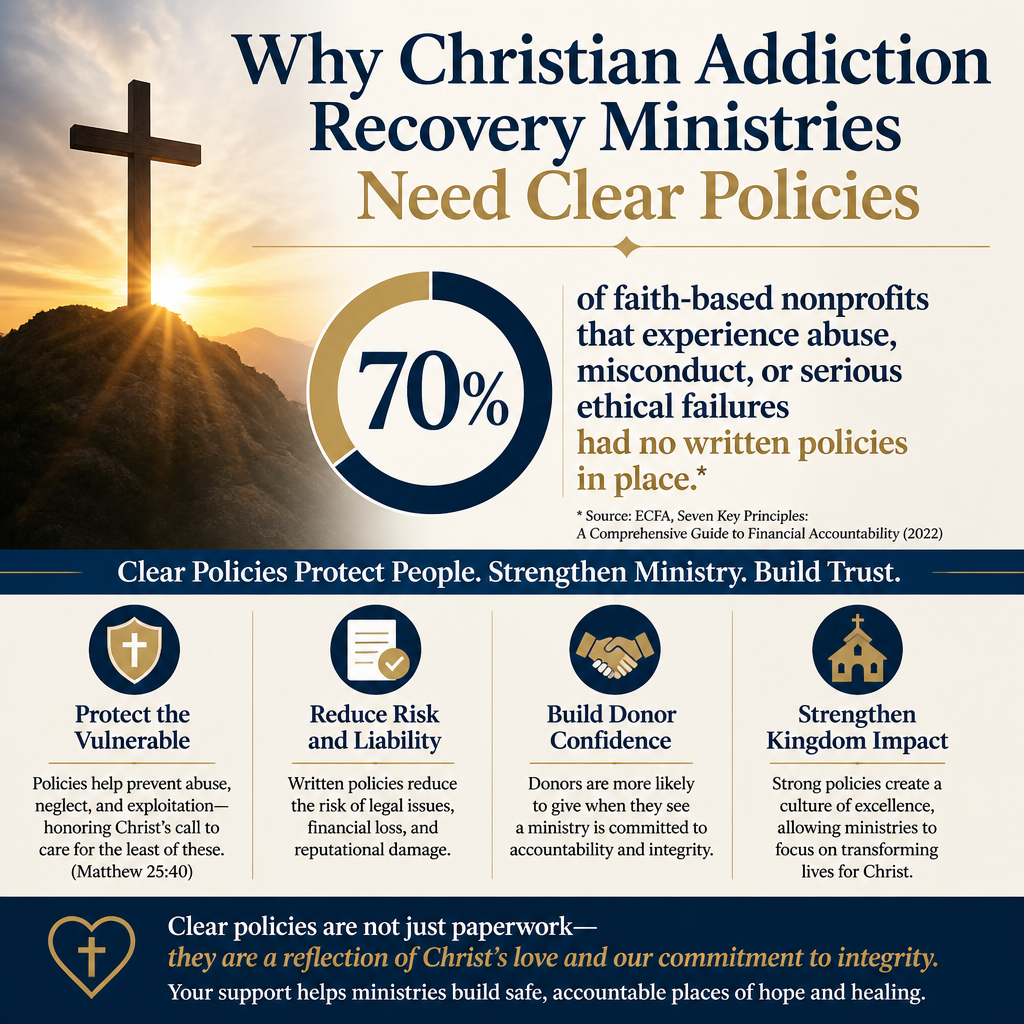
Policies are where a ministry states, in writing, how it will protect life and honor image-bearing dignity under stress. In a residential setting, the difference between “we care deeply” and “we care well” is often a procedure that is both humane and enforceable.
Essential policy areas donors should expect to see
We recommend that donors look for clear documentation in a few baseline areas. The exact list varies by program model and state law, but ministries that take safety seriously typically address the following:
- Screening and intake: eligibility criteria, medical clearance, and what conditions require referral.
- Relapse response: how relapse is assessed, when a participant is removed from housing, and what restoration steps exist.
- Medication and health: rules for storing/administering medications, and when emergency services are contacted.
- Boundaries and relationships: staff-participant contact rules, transportation, social media, and romantic relationship policies.
- Incident reporting: how allegations are documented, escalated, and reviewed by leadership and the board.
Safeguarding includes more than physical harm
Many donors associate safeguarding primarily with child protection. Adult recovery programs must also guard against spiritual coercion, manipulative fundraising stories, and public “testimony” practices that pressure participants to disclose sensitive histories before they are ready. Scripture treats the tongue as a moral instrument with the power to bless or destroy (James 3). Policies around storytelling, confidentiality, and consent help prevent a ministry’s communications from becoming a second trauma.
Financial and governance policies protect donors and participants alike
Recovery ministries often face unstable revenue, urgent needs, and emotionally compelling stories. Those conditions can tempt even faithful leaders toward financial shortcuts: commingled funds, unclear restricted giving practices, informal benevolence disbursements, or staff using personal accounts to cover gaps. The problem is not merely technical. Financial disorder makes a ministry more vulnerable to scandal, and scandal reliably injures the very people the ministry serves.
Christian donors are increasingly alert to financial integrity concerns across the nonprofit sector. For context, the Internal Revenue Service receives tens of thousands of Form 990 returns each year from tax-exempt organizations, a scale that underscores why governance systems matter, even when a particular ministry is small and relational (Internal Revenue Service).
Written controls reduce temptation and ambiguity
Most financial failures do not begin with grand theft. They begin with ambiguity: no clear expense policy, inconsistent receipts, unclear separation of duties, and leaders who are both compassionate and overextended. Strong policies reduce the likelihood that a ministry’s internal trust becomes a substitute for accountability. That is not cynicism; it is sobriety about human nature.
Board governance must be more than supportive
Addiction recovery ministries sometimes recruit boards primarily for encouragement, prayer support, or fundraising access. Those are legitimate functions, but they are not governance. A board must be able to ask hard questions, review incidents, and insist on corrective action when something goes wrong. Policies are the board’s instrument for oversight: they define what leaders are accountable to, and they provide a standard for discipline when needed.
The principles behind the “Overhead Myth” letter—signed by leaders including Charity Navigator, Candid, and the BBB Wise Giving Alliance—helpfully remind donors that simplistic spending ratios are not a reliable measure of effectiveness (Candid). For recovery ministries, the implication is direct: adequate administrative capacity, including policy development and compliance, is often part of what makes frontline care responsible rather than reckless.
Clear policies are part of credible Christian witness
Christian ministries proclaim good news. They also create environments that either reinforce or contradict that proclamation. When a ministry’s internal life is opaque, improvised, or dismissive of accountability, the gospel message can be undermined in the eyes of participants, families, and the watching public. This is not about appeasing critics. It is about integrity that withstands scrutiny.
Christians genuinely disagree about how closely recovery ministries should align with clinical models. Some programs are explicitly church-based and discipleship-oriented; others are hybrid partnerships with licensed providers. These debates are real, and donors should not demand uniformity. But whatever a ministry’s theological and programmatic approach, clear policies are the place where conviction meets practice: how authority is exercised, how safety is protected, and how truth is told.
Transparency is not the same as disclosure
Some ministries respond to donor concern by publishing more stories, more photos, and more urgent appeals. That can increase disclosure without increasing transparency. Transparency, in the meaningful sense, includes accessible policies, clear lines of responsibility, and evidence that the board reviews what matters. It is one reason donors engage with independent verification services like Most Trusted: not to replace relationships, but to strengthen them with facts.
What donors can ask without becoming adversarial
Responsible questions do not assume guilt. They assume that faithful ministries welcome accountability. Within the broader work of Leadership and Operations in Christian Addiction Recovery, we encourage donors to ask for policies or summaries in three categories: safeguarding and incident response, financial controls and restricted funds, and governance oversight. A ministry that cannot describe its policies clearly is often a ministry that cannot execute them consistently.
FAQs for Why Christian addiction recovery ministries need clear policies
Do clear policies make a recovery ministry feel institutional and unwelcoming?
They can, if policies are treated as weapons or if compassion is replaced by rule enforcement. Mature ministries learn to hold both: warmth in relationships and clarity in expectations. In practice, policies often make environments more welcoming to participants who have been harmed by chaotic or manipulative systems, because they reduce uncertainty and favoritism.
What policies matter most for donors evaluating a Christian recovery program?
Donors should prioritize policies that protect people when something goes wrong: incident reporting and escalation, relapse response, boundaries between staff and participants, and financial controls around cash handling and restricted gifts. Those areas tend to reveal whether a ministry has the operational maturity to match its spiritual ambition.
Faithful mercy requires defined commitments
The Church is called to bear one another’s burdens, including the heavy burdens of addiction. Yet bearing burdens is not the same as carrying risks blindly. Clear policies are one of the primary ways a recovery ministry tells the truth about the people it serves, the power it holds, and the accountability it owes. Donors who insist on that clarity are not obstructing mercy; they are strengthening it.



