
Sponsoring Christian recovery scholarships is one of the most direct ways donors can help men and women pursue sobriety with spiritual formation rather than mere behavior modification. It is also one of the easiest funding mechanisms to misdesign, because addiction recovery sits at the intersection of trauma, relapse risk, employment disruption, family fracture, and the slow work of sanctification.
Christian donors tend to ask two questions at once: whether a scholarship will actually reach someone who cannot pay, and whether the program itself is faithful and competent. Those questions belong together. Money can widen access, but it can also subsidize weak care, confused theology, or unaccountable leadership if donors do not ask for verifiable evidence.
What a recovery scholarship is funding in Christian terms
Scholarships are access to formation, not only services
A recovery scholarship is rarely just a bed, a counselor, or a class. In Christian programs it typically funds a structured community where Scripture, repentance, confession, and accountability are integrated with clinical wisdom and daily rhythms. Donors should expect a ministry to articulate how it understands addiction: not simply as moral failure, not simply as disease, but as a complex bondage that requires truth-telling, wise care, and a credible path toward new life.
The New Testament does not treat embodied struggles as spiritually irrelevant. Paul’s language of slavery and freedom helps explain why willpower alone fails, and why community matters (Romans 6). At the same time, Christian donors should resist simplistic categories. Many people entering recovery carry histories of abuse, mental illness, or untreated grief. Mature ministries do not excuse sin, but they do not deny suffering either.
Recovery scholarships can correct a real financial barrier
Substance use disorder often dismantles a person’s finances before they ever seek help. National data consistently shows that treatment is frequently unaffordable without third-party support. For example, the Substance Abuse and Mental Health Services Administration publishes national treatment data indicating many clients rely on public coverage or have no insurance at all; affordability is not a marginal issue in the field (SAMHSA).
What this means in practice is that scholarships can be the difference between continued use and the first credible step toward stability. But donors should be careful: “covering cost” is not the same as “funding outcomes.” A scholarship strategy should aim at sustained recovery and long-term discipleship, not just intake.

Designing scholarships that strengthen, rather than replace, responsibility
A healthy scholarship model includes dignity and participation
Christians genuinely disagree about how much “skin in the game” a participant should have. Some emphasize grace as an unearned gift; others warn that free services can encourage passivity. The wisest programs generally hold both truths: the scholarship removes a barrier the person cannot overcome alone, and it also invites meaningful participation as soon as it is realistically possible.
Many ministries operationalize this through a graduated approach: the scholarship may cover most or all of the initial phase, while later phases involve work requirements, job placement, or incremental fees. This is not a merit system; it is a discipleship posture that treats adults as moral agents. Donors should ask ministries to explain their philosophy plainly and show how it is applied consistently rather than selectively.
Guardrails that protect both recipient and donor intent
Scholarship money can be structurally vulnerable to misuse when rules are unclear. We recommend asking for written scholarship policies: eligibility, selection authority, documentation requirements, and what happens in the case of relapse or program dismissal. Relapse is a clinical and pastoral reality, but it does not eliminate the need for stewardship.
- Eligibility criteria that include financial need and readiness indicators
- Clear decision rights on who approves awards and how conflicts of interest are handled
- Defined covered costs such as tuition, housing, counseling, or transportation
- Relapse and reentry policy that balances mercy, safety, and program integrity
- Documentation and reporting appropriate to privacy laws and donor stewardship
The goal is not to impose suspicion. It is to ensure that compassion remains tethered to accountability, which is a biblical concern as well as a financial one.
Choosing ministries with credible theology and competent care
Integrated care requires clarity on what the ministry is and is not
The addiction recovery landscape includes licensed clinical treatment, peer-led recovery communities, residential discipleship programs, and hybrid models. Donors should not assume a ministry is clinically licensed because it uses clinical language, and donors should not assume a ministry is spiritually serious because it uses Christian vocabulary. Each model has strengths and limitations; the important question is whether the ministry is honest about its scope and competent within it.
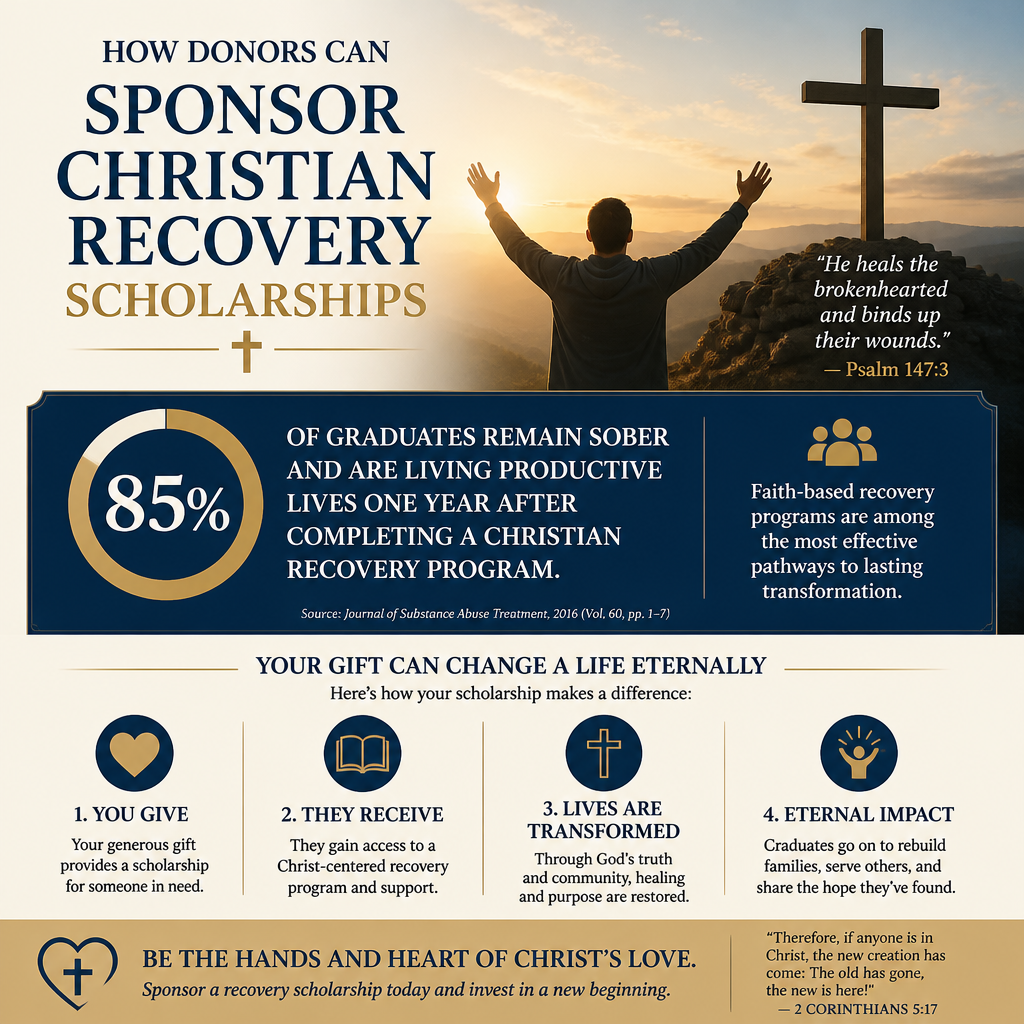
A helpful starting point is to ask whether the program uses established recovery frameworks and how it relates those frameworks to Christian discipleship. Many programs incorporate 12-step principles; others use curricula shaped by biblical counseling traditions or trauma-informed approaches. The mere presence of a curriculum is not proof of effectiveness, but vagueness is a warning sign.
What verification should cover before a donor sponsors scholarships
Across our verification work at Most Trusted, we find that scholarship programs are safest when the underlying organization demonstrates consistency in doctrine, governance, financial controls, and public reporting. In other words, the scholarship is only as trustworthy as the institution administering it.
That is why our evaluations use The Most Trusted Standard, a 15-criteria framework across Faith Foundation, Financial Integrity, Governance and Leadership, and Transparency and Effectiveness. Donors do not need to become auditors, but donors should insist on evidence: audited or reviewed financials when feasible, conflict-of-interest policies, clear board oversight, and accurate descriptions of outcomes that do not overpromise.
For donors who are broadly assessing the field, it is often useful to start with the larger landscape of Christian Addiction Recovery Ministries and then evaluate a specific scholarship opportunity within that context.
Structuring scholarship funding so it produces lasting fruit
Restricted versus unrestricted scholarship gifts
Donors commonly prefer restricted gifts: “This is for scholarships only.” That impulse can be faithful stewardship, but it can also create brittleness. Recovery ministries need stable staffing, supervision, facilities, transportation support, and administrative capacity to manage scholarships responsibly. If donors restrict too tightly, ministries can fall into under-resourcing the very systems that keep participants safe.
The field of philanthropy has had to reckon with the “overhead” debate for years. Major charity evaluators and standards-setters have warned donors away from simplistic overhead ratios and toward a more holistic view of performance and accountability (Charity Navigator). In recovery work, that counsel is especially relevant: responsible care is labor-intensive, and thin staffing is not a virtue.
A wise approach is often a blended strategy: fund scholarships with clear boundaries, and also contribute to the ministry’s capacity to deliver those scholarships with integrity. Donors can do this by supporting a scholarship fund plus a portion of program infrastructure explicitly tied to participant care and reporting.
Scholarship reporting that is truthful, specific, and privacy-protecting
Donors should ask for reporting that respects the dignity of participants. Testimonies can be encouraging, but they should never become marketing pressure applied to vulnerable people. We recommend requesting aggregated reporting that includes admissions, completion rates by program phase, relapse or dismissal policies in action, and next-step outcomes such as employment, housing stability, and church connection.
The harder question is attribution: recovery is not linear, and no ministry can claim sole credit for a person’s long-term sobriety. The most trustworthy organizations acknowledge this complexity. They report what they can responsibly know, avoid inflated success rates, and describe failures without defensiveness.
Due diligence questions donors should ask before sponsoring scholarships
Questions that reveal governance and financial integrity
A scholarship can be emotionally compelling, but donors should not let urgency displace discernment. Before making a significant scholarship commitment, we recommend asking:
Who decides? Is scholarship selection made by a team, with documented criteria, or by a single charismatic leader?
Who oversees? Does the board review scholarship activity and program performance in a meaningful way?
What controls exist? Are there basic safeguards such as separation of duties for payments, documented approvals, and restricted-fund tracking?
Questions that reveal theological seriousness and care competence
Christian donors are not only buying services; they are supporting a spiritual ecology. The program’s theology of the human person, sin, suffering, and sanctification will shape daily care decisions. Donors should ask how Scripture is taught, how repentance is framed, and how the ministry handles confession, discipline, and restoration without coercion.
It is also appropriate to ask how the ministry approaches co-occurring disorders. A significant share of people with substance use disorder also experience mental health conditions, and a ministry that refuses any collaboration with licensed care should be able to explain why that is responsible rather than reactive (National Institute of Mental Health).
Many donors will want a broader framework for giving decisions in this space; How to Give Wisely to Christian Addiction Recovery Ministries is where we see donors gain the clarity needed to fund scholarships with both compassion and rigor.
FAQs for How donors can sponsor Christian recovery scholarships
Should we sponsor one person or fund a scholarship pool?
In most cases, a scholarship pool is more responsible. It reduces favoritism, protects privacy, and allows the ministry to allocate aid according to consistent criteria. If donors sponsor an individual, the ministry should still control selection and reporting boundaries so that the participant is not placed under donor pressure.
What outcomes should we expect from a scholarship-funded recovery program?
Expect credible, modest claims rather than guaranteed transformations. Responsible ministries can often report near-term indicators such as program completion, participation in counseling or recovery groups, employment placement, and housing stability. Long-term sobriety is a worthy hope, but it is influenced by factors beyond any single program; integrity requires ministries to speak with measured confidence.
Scholarships as stewardship and mercy
Christian recovery scholarships are a concrete expression of mercy, and mercy deserves structures that can bear its weight. When donors fund scholarships inside ministries that are theologically clear, operationally accountable, and transparent about outcomes, scholarship dollars become more than charity; they become a disciplined form of hope. The task is not to give less emotionally, but to give with the kind of discernment Scripture commends.



