

Designated giving supports Christian recovery care when it protects the ministry’s spiritual and clinical integrity while funding the real costs of long obedience in the same direction. Donors often designate because they want clarity: a dollar for counseling, a dollar for beds, a dollar for a mentor. That instinct is not wrong. But in addiction recovery ministries, designation can either strengthen the whole work of restoration or unintentionally pressure programs into distorted choices.
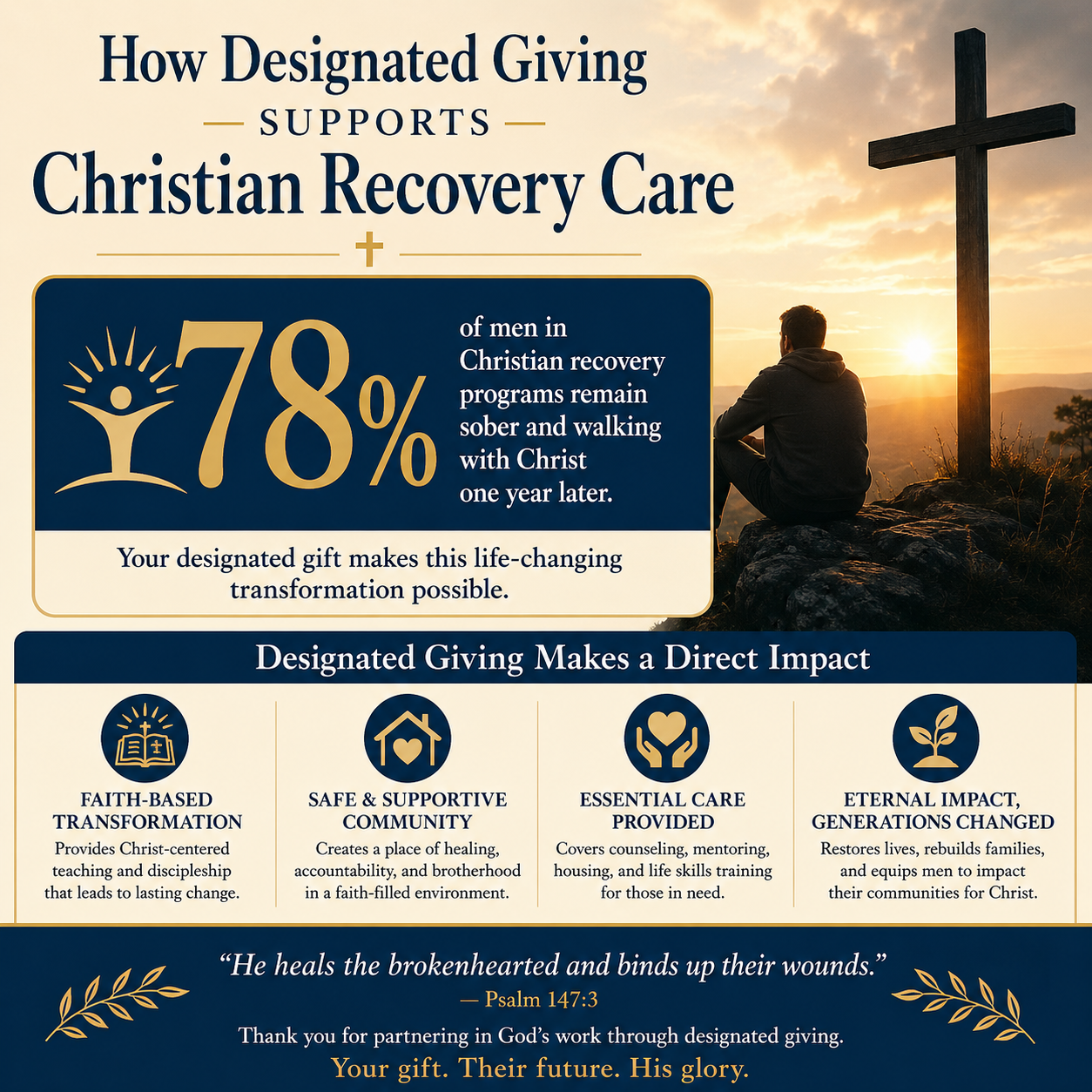
Christian recovery is not a single service delivered at a single moment. It is frequently a sequence: crisis stabilization, detox referral, residential or intensive outpatient care, relapse prevention, community reintegration, and the slow rebuilding of family and vocation. Scripture names this kind of rebuilding without sentimentality—God “heals the brokenhearted and binds up their wounds” (Psalm 147:3), a picture that assumes both compassion and skilled, sustained care. Designated giving has the power to underwrite that sustained work, provided it is practiced with rigor.
Why designation matters in Christian recovery care
Most Christian recovery ministries operate with two realities in constant tension: the urgency of immediate need and the complexity of lasting change. Donors rightly want their giving to meet real people in real suffering. Ministries must also keep the lights on, retain qualified staff, maintain safe facilities, and remain accountable to boards, regulators, and churches. Designation can either reconcile those realities or sharpen the strain between them.
Addiction is also intertwined with co-occurring mental health conditions, trauma histories, housing instability, and legal consequences. SAMHSA’s national survey data consistently shows that many people with substance use disorders also experience mental illness, which makes integrated care and competent referral networks non-negotiable for responsible ministries.SAMHSA
Designation can clarify mission and protect the ministry’s center
Some ministries drift because unrestricted revenue is scarce and every funding opportunity becomes determinative. Thoughtful designation can protect the core: biblically grounded discipleship, accountable community, evidence-informed care, and careful reentry support. When designation is anchored to a ministry’s stated mission and measurable program aims, it can help leadership resist donor-driven fads.
Designation can also create distortions when donors fund only what is visible
Bed counts, meals served, and “graduation” ceremonies are easy to picture. Staff training, clinical supervision, background checks, data systems, and facility maintenance are less visible but often more determinative of safety and quality. The well-known “Overhead Myth” critique—advanced publicly by major charity evaluators—helped the broader sector name how simplistic overhead fixation can harm effectiveness by underfunding essential infrastructure.Charity Navigator

What designated giving should fund in a faithful recovery ministry
Designated giving serves donors best when it is tethered to the actual cost structure of Christian recovery care. Addiction recovery is labor-intensive. It depends on trained people, stable environments, and long-term pastoral and programmatic accompaniment. When designation ignores those realities, ministries become tempted to promise more than they can deliver, or to deliver less than care requires.
Direct program care and the less visible supports that make it possible
Many donors want to fund “program,” but a mature view of program includes the supports that keep program honest: training, supervision, compliance, and safe facilities. In practice, designations that reflect a ministry’s real operating model are more faithful to the people served than designations that mirror donor imagination.
Scholarships without starving the program
Scholarship funds are among the most common designations in Christian recovery. They can be profoundly mercy-shaped, reducing financial barriers for men and women who have burned through resources or face consequences that prevent employment. But scholarships should be structured so they do not push the ministry into the “starvation cycle,” where chronic underfunding forces staff turnover, weak systems, and reduced outcomes over time—an organizational dynamic described in the social sector literature with clarity and warning.Stanford Social Innovation Review
A sound scholarship designation usually includes not only a resident’s direct costs but also an appropriate share of the staffing and infrastructure needed to serve that resident safely and well.
How designated funds can strengthen accountability without controlling the ministry
Donors are not wrong to seek accountability. The New Testament commends transparent handling of gifts so that “no one should blame us about this generous gift” (2 Corinthians 8:20). Yet transparency is not the same as donor control, and recovery care is one of the fields where controlling restrictions can quietly undermine the very outcomes donors hope to see.
Healthy designation has measurable intent and flexible execution
The best designations describe a purpose that can be verified—counseling hours delivered, residents housed, transportation provided for work or court obligations, training completed—while leaving day-to-day implementation to qualified leadership. Recovery ministries regularly face changing client needs, clinical recommendations, and legal constraints. A designation that cannot accommodate those realities becomes a liability.
Accountability that respects pastoral and clinical judgment
Christians genuinely disagree about how to relate “faith-based” language to evidence-based practice. Some fear that clinical frameworks will dilute discipleship; others fear that spiritual language can become a substitute for competent care. The wiser approach is not a false choice, but integration with clear boundaries: discipleship that is genuinely Christian, and care practices that are competent, supervised, and appropriately referred when cases exceed the ministry’s scope.
Across our verification work at Most Trusted, the ministries that meet The Most Trusted Standard tend to document their program model clearly, state referral and safety policies plainly, and report results with humility rather than triumphalism. Those are signals that a designation will be handled with integrity rather than used as a marketing line.
Designated giving and the real economics of recovery
Recovery is expensive because human beings are not interchangeable. The work depends on staff who can hold boundaries, maintain sobriety-informed community standards, manage crisis episodes, and shepherd people back into church, work, and family life. Many ministries also serve people who have no ability to pay. Donors who designate well help ministries remain accessible without becoming financially brittle.
Why unrestricted support often determines whether designated programs succeed
Even when donors designate to an excellent program, outcomes can be undermined if the ministry cannot fund administrative competence. That includes financial controls, HR processes, incident reporting, legal compliance, and board governance. These may feel distant from “ministry,” but they are part of loving our neighbor in concrete ways—especially when the neighbor is vulnerable and the stakes include safety.
What this means in practice is that some donors should designate, and some should fund the conditions that make designation viable. Mature portfolios often include both: targeted gifts for program expansion and consistent unrestricted support to maintain integrity.
A practical framework donors can use
When donors are considering designated gifts to recovery ministries, we recommend asking for clarity in five areas before assigning restrictions:
- Whether the ministry can clearly explain how the designated activity fits its stated theory of recovery and discipleship.
- Whether the budget for the designation includes an appropriate share of staffing, supervision, and facilities.
- Whether the ministry can report on the designation with credible measures rather than only testimonials.
- Whether the ministry has written safeguarding practices, referral pathways, and incident-response protocols.
- Whether the board and leadership are positioned to refuse funding that would compromise mission or safety.
These questions are not suspicion; they are stewardship. They also honor the ministry by treating its leaders as accountable professionals rather than as recipients of benevolent sentiment.
How donors can designate faithfully and still give with confidence
Designation is most faithful when it is aligned with a ministry’s mission and grounded in verifiable practice. For donors who are deciding where to give in this field, it helps to keep the wider landscape in view. Some ministries are church-based and relationally intensive but limited in clinical scope. Others operate licensed treatment programs but struggle to cultivate long-term Christian community after discharge. Donors should not assume that one model fits every person in recovery.
Choose designations that serve the ministry’s whole pathway of care
A designation that funds only “intake” may create a pipeline into a program that cannot sustain care. A designation that funds only “graduation” celebrations may inflate the visible moment and underfund the months of formation that make graduation meaningful. Strong designations often target a vulnerable seam in the pathway—transportation for work and court compliance, relapse-response support, family counseling, pastoral care capacity, sober-living transition assistance—where modest funding can prevent derailment.
For donors who want to understand the broader field of Christian Addiction Recovery Ministries, we encourage attention to how ministries define success: not merely sobriety for a season, but sustained transformation marked by truthfulness, restored relationships where possible, and ongoing participation in the life of the church.
Use verification to reduce the guesswork
Designation cannot substitute for trustworthiness. If a ministry lacks financial integrity, sound governance, or transparent reporting, a restricted gift may simply restrict the paperwork rather than improve the outcomes. Most Trusted exists to help donors give with confidence by evaluating ministries against The Most Trusted Standard, a 15-criteria framework across Faith Foundation, Financial Integrity, Governance and Leadership, and Transparency and Effectiveness.
When donors are weighing designated gifts, we recommend beginning not with the restriction, but with the ministry’s demonstrated capacity to steward any gift. In recovery care, the costs of weak stewardship are borne by people who are already at risk.
FAQs for How designated giving supports Christian recovery care
Should we avoid designated giving and give only unrestricted gifts?
No. Designated giving can be a faithful form of stewardship when the designation matches the ministry’s real costs and documented model of care. Many recovery ministries also need unrestricted support to maintain governance, staffing stability, and safeguarding practices. A mature approach often includes both: targeted designations for specific program aims and unrestricted giving that strengthens the conditions under which those programs remain safe and effective.
What is a wise designation for a Christian recovery ministry when outcomes are hard to measure?
Designations tied to clear, verifiable activities usually serve donors and clients better than designations tied to promised outcomes. Examples include funding licensed counseling hours, staff training and supervision, resident scholarships with full-cost coverage, transportation support tied to employment and legal compliance, or sober-living transition assistance with documented criteria. For donors seeking a disciplined approach to decision-making, How to Give Wisely to Christian Addiction Recovery Ministries is a helpful category frame for aligning restrictions with accountability.
Designations that honor both mercy and truth
Christian donors are right to want their giving to land on real needs in real lives. Christian recovery ministries are right to insist that restoration requires stable structures, competent care, and spiritual seriousness. Designated giving supports Christian recovery care best when it funds the true work of recovery rather than a simplified picture of it—mercy shaped by stewardship, and compassion governed by truth.



