

How Christian addiction recovery centers measure success is not a technical question first. It is a theological and pastoral question with financial implications, because donors are not only funding services; they are supporting a claim about what human change is and what it costs in time, truth, and grace.
Addiction does not submit to simplistic scorekeeping. A faithful recovery ministry must hold together two realities Scripture never separates: the dignity of the person made in God’s image (Genesis 1:27) and the honesty that sin and suffering can entangle a life so thoroughly that real freedom often comes through a long and contested path (Romans 7:15–25). When centers reduce “success” to a single number, they usually mislead donors and, more importantly, they pressure participants into appearances rather than repentance and healing.
Success begins with a defined mission and a defined person
Before any metric, a serious center clarifies what it believes is actually wrong and what it believes counts as restoration. Christian recovery work is not merely symptom reduction, and it is not mere moralism. It is an integration of spiritual formation, clinical wisdom, and community life ordered toward truthful freedom.
What the program is trying to produce
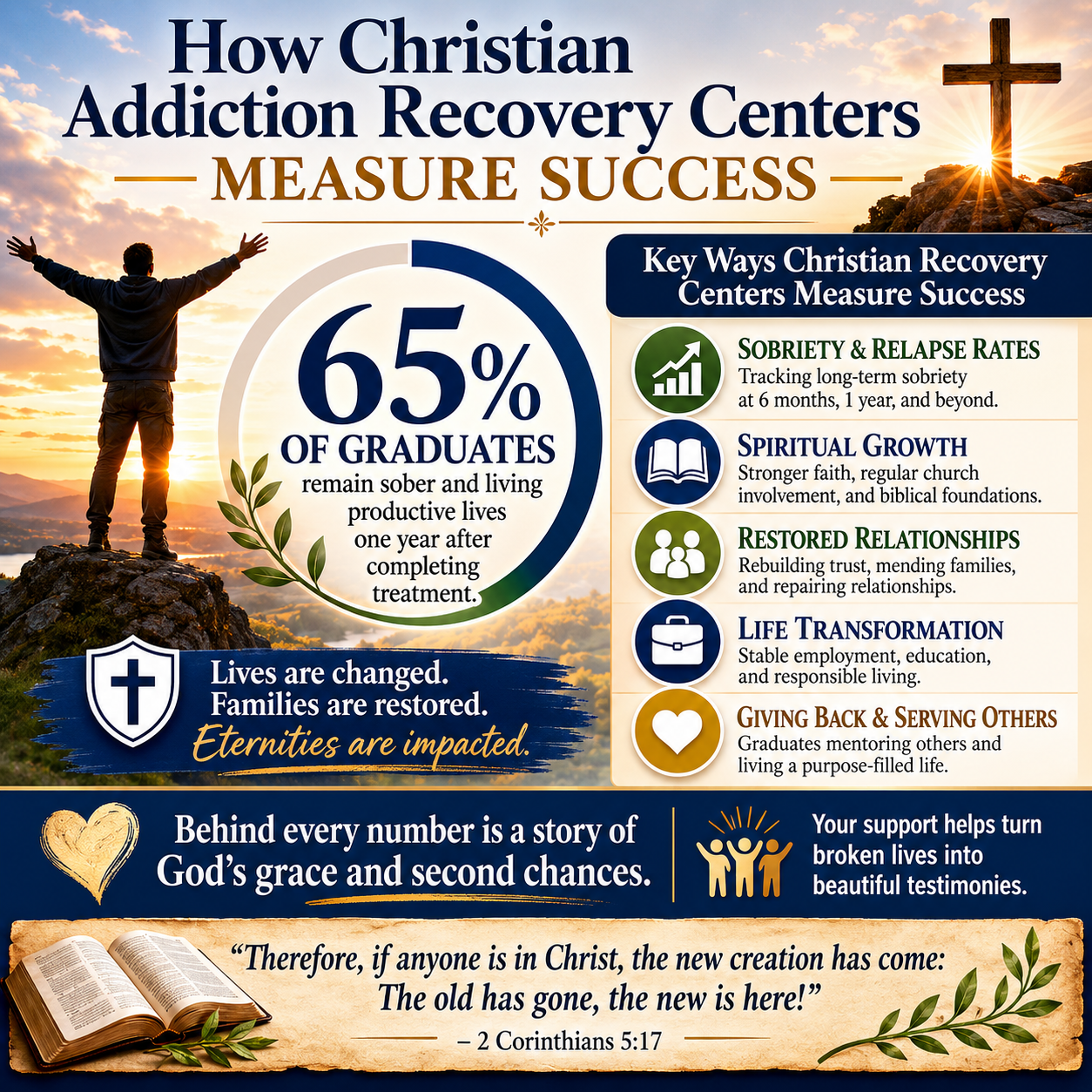
The clearest programs articulate outcomes in three categories that correspond to the human person as Scripture presents him: spiritual, relational, and embodied. Spiritual outcomes include repentance, renewed worship, and growing confidence in the mercy of God in Christ (Psalm 51). Relational outcomes include repaired family trust where possible, healthier boundaries where necessary, and durable belonging in the local church rather than dependence on the residential setting alone (Hebrews 10:24–25). Embodied outcomes include sobriety, reduced risk behaviors, stabilization of sleep and work patterns, and appropriate medical and psychiatric care.
Donors should not assume every center is measuring all three. Some programs are explicit that they are primarily a residential discipleship community, while others are clinical treatment centers with a Christian worldview and chaplaincy. Both can be legitimate. The key is whether the center tells the truth about its model and evaluates itself accordingly.
What counts as evidence of change
Responsible measurement distinguishes between proximate indicators and ultimate aims. A negative drug screen is proximate; a rebuilt life is the aim. A center that collapses these categories tends to oversell impact. Conversely, a center that refuses any measurable indicators often places donors in the position of funding a moving target.
Across our verification work at Most Trusted, the ministries that align best with The Most Trusted Standard usually define success in ways that are both biblically serious and operationally verifiable: they can describe what they hope God will do, and they can show what they track, why they track it, and how they respond when results are weak.

Sobriety is necessary, but it is not the whole story
Most donors understandably start with abstinence. Substance use has immediate consequences, and some programs are built around a clear sobriety covenant. Yet Christian faithfulness requires more than celebrating clean days. It requires pursuing truth, repair, and holiness without turning recovery into a performance.
Measuring sobriety with clarity and humility
Drug and alcohol use can be measured in concrete ways: toxicology screens where clinically appropriate, documented relapses, treatment compliance, and medical follow-up. But even here, integrity matters. Centers should disclose whether abstinence is verified, self-reported, or inferred from participation. They should also disclose what “relapse” means in their context, because programs define it differently.
The wider field recognizes that relapse is common, particularly early in recovery. The National Institute on Drug Abuse has long framed addiction as a chronic condition with relapse rates comparable to other chronic illnesses, while noting that relapse is not inevitable and treatment outcomes vary by substance, severity, and support structures (National Institute on Drug Abuse).
Separating marketing claims from meaningful outcomes
Donors should be cautious when a center advertises a single “success rate” without defining the denominator, the time horizon, and the follow-up method. A graduation rate is not the same as sustained recovery. A 30-day outcome is not a one-year outcome. And one-year outcomes can be distorted if a program loses contact with those doing poorly.

What this means in practice is that credible programs publish definitions, not just numbers. They can explain who is counted, when, and how missing data is handled. They are also willing to report hard realities: discharges against advice, relapse after graduation, or participants who disappear from contact. Donors can bear hard truths; they cannot steward around soft claims.
Durable recovery shows up in relationships and community stability
Christian centers should measure more than individual behavior. Addiction isolates. The gospel reconciles. If recovery is real, the person’s relationships, commitments, and patterns of life begin to change in observable ways—often unevenly, but meaningfully.
Family repair and appropriate boundaries
Not every family relationship can be restored, and not every relationship should be. Wise programs measure progress with nuance: mediated family sessions completed, safety plans established, restitution steps taken where appropriate, and reductions in domestic conflict. They also measure boundary formation for participants coming out of coercive or enabling environments.
Centers that are attentive here typically coordinate with churches, employers, probation officers when relevant, and clinical providers. That coordination can be measured: documented referrals, follow-through rates, and whether participants remain connected to a community of accountability after discharge.
Housing, employment, and legal stability
Stability metrics are sometimes criticized as “secular,” but they align with biblical concern for faithful work and ordered life. A participant who gains stable housing, consistent employment, and reduced legal exposure is usually experiencing real change, even if sanctification is still contested.
Programs can track these outcomes without pretending they are the gospel. Common measures include: housing at 3/6/12 months, employment or job training completion, compliance with court requirements, and reduced emergency-room utilization where that data can be ethically and legally accessed. For context on the public-health cost of opioid overdoses and the importance of sustained intervention, the Centers for Disease Control and Prevention maintains ongoing surveillance and reporting (Centers for Disease Control and Prevention).
Donors evaluating ministries in the broader space of Christian Addiction Recovery Ministries should look for centers that treat these stability measures as evidence of love of neighbor and responsible care, not as a substitute for spiritual renewal.
Spiritual formation is measurable, but not reducible
Christians genuinely disagree about how to measure spiritual growth. Some fear that measurement turns discipleship into technique; others fear that refusing measurement permits vague claims and unexamined fruit. A wise center refuses both errors.
What can be tracked without trivializing faith
Spiritual formation can be evaluated with mixed methods: structured assessments, pastoral interviews, and observable commitments. The goal is not to quantify holiness, but to test whether the program’s spiritual aims are being pursued with integrity.
- Participation in Scripture study, worship, and prayer rhythms, with attendance recorded as formation exposure rather than virtue.
- Pastoral or chaplaincy notes that document themes of repentance, hope, confession, and reconciliation.
- Connection to a local church before discharge, with a specific plan for membership or regular participation.
- Completion of curricula that address shame, forgiveness, and identity in Christ alongside relapse prevention.
- Post-discharge follow-up that includes spiritual support, not only crisis intervention.
Safeguards against spiritual coercion
Donors should also ask about safeguards. Vulnerable people can be pressured into outward conformity, including forced testimony or premature leadership. Centers that take discipleship seriously will have clear policies on spiritual authority, counseling boundaries, trauma-informed care, and referral pathways for complex psychiatric needs.
In our assessment work, the strongest ministries are candid about where spiritual formation belongs and where clinical expertise is required. They do not spiritualize psychosis or minimize medication management. They also do not outsource all spiritual care to a weekly chapel service. They build an integrated model with transparent limits.
Donors should examine the integrity of the measurement system
Because donors rarely have direct access to participant records or longitudinal data, success claims must be evaluated through the credibility of the system producing them. This is where governance, financial integrity, and transparency converge with program effectiveness.
Definitions, data quality, and follow-up
Reliable outcome reporting requires basic disciplines: written definitions, consistent data collection, and a plan for follow-up after discharge. A center that only reports “decisions for Christ” or “beds filled” is not measuring recovery. A center that reports outcomes but cannot explain how data is collected is not yet trustworthy.
Donors can ask several questions that reveal whether the measurement is serious:
- What is the time horizon for outcomes: 30 days, 6 months, 12 months?
- What percentage of graduates are successfully contacted at each follow-up point?
- How are relapses counted, and how are partial relapses treated?
- What outcomes are verified externally, and which are self-reported?
- What changes has the center made because the data revealed weakness?
Transparency about costs and trade-offs
It is tempting to demand maximal outcomes at minimal cost. The field has had to reckon with the damage caused by simplistic overhead expectations, particularly in people-intensive work like recovery. When a center is pressured to underfund staff training, clinical supervision, or follow-up, the program’s ability to sustain participants after discharge often suffers.
At the same time, donors have a right to financial clarity. Programs should report what portion of expenses supports direct care, what portion supports administration, and why those costs exist. They should also address conflicts of interest, related-party transactions, and the independence of the board. These are not peripheral concerns. They are part of whether the ministry’s claims deserve trust.
Most Trusted exists to help donors evaluate these questions consistently. We review ministries against The Most Trusted Standard, a 15-criteria framework that examines faith commitments, financial integrity, governance, and program transparency. For donors considering the mechanics of care and evaluation in How Christian Addiction Recovery Programs Work, the most reliable ministries are those that can show both a coherent theology of change and an auditable approach to outcomes.
FAQs for How Christian addiction recovery centers measure success
Should donors prioritize abstinence rates when evaluating a Christian recovery center?
Abstinence matters, but it must be interpreted carefully. Donors should ask how abstinence is defined, whether it is verified or self-reported, what the follow-up window is, and what percentage of alumni are actually reached for follow-up. A center that reports a single “success rate” without definitions is usually offering marketing rather than stewardship-grade evidence.
How can a center measure spiritual growth without turning discipleship into a scoreboard?
By using measures that are modest, mixed, and accountable. Attendance in formation activities, documented pastoral goals, connection to a local church, and post-discharge spiritual support can be tracked as indicators of exposure and engagement, not as proofs of holiness. The center should also have safeguards against coercion and should be transparent about the limits of what can be measured.
What faithful measurement makes possible
When Christian addiction recovery centers measure success with theological clarity and operational honesty, donors are freed to give with both compassion and discernment. The goal is not to control outcomes that ultimately belong to God, but to refuse false confidence and fund what is true. In a field marked by relapse, trauma, and spiritual warfare, the ministries most worthy of support are rarely those with the smoothest claims. They are those with the clearest definitions, the most transparent evidence, and the humility to repent, adjust, and endure.



