
How Christian recovery ministries address codependency is not a niche question for families living near addiction; it is a discipleship question with direct consequences for safety, finances, church health, and long-term restoration. Donors who fund recovery work are often, in effect, funding an entire relational ecosystem: the person struggling with substance use, the spouse and children managing chaos, and the congregation trying to respond with both mercy and wisdom.
Codependency is contested language in some Christian circles, and the field has had to reckon with its limits. At its best, the term names a pattern: love that becomes entangled with control, rescue, and self-protection; boundaries that collapse; and accountability that is replaced by enabling. Christian recovery ministries that serve families well do not treat codependency as a clinical slogan or a moral insult. They treat it as a form of disordered love that the gospel can re-order over time.
Why codependency matters to Christian recovery work
Codependency as a spiritual and relational pattern
Christian recovery ministries typically address codependency by distinguishing care from control. Scripture calls Christians to bear one another’s burdens (Galatians 6:2) and also warns against patterns that deceive, conceal, and perpetuate sin (Ephesians 5:11). Codependency often thrives where fear replaces truth-telling: fear of conflict, fear of abandonment, fear of losing reputation in the church, or fear that consequences will destroy the person we love.
Ministries grounded in historic Christian teaching will name that the heart can attach itself to outcomes it cannot guarantee. The attempt to manage another person’s sobriety, emotions, or choices can become a functional replacement for trust in God. That does not remove responsibility; it rightly locates responsibility. Repentance and faith are personal acts, and recovery requires the willing participation of the person in need.
The family system is often the primary recovery environment
Addiction rarely confines its damage to the individual. Families frequently adapt to survive, and those adaptations—hiding, rescuing, smoothing over, paying debts, making excuses—can inadvertently make the addiction more sustainable. Christian recovery ministries that understand family systems will treat those adaptive patterns with compassion while also inviting change.
This is one reason donors should not evaluate recovery work only by whether a program offers classes for the addicted person. A ministry may have a sound curriculum and still fail families if it does not provide a parallel pathway for spouses, parents, and adult children to rebuild discernment, boundaries, and spiritual stability.

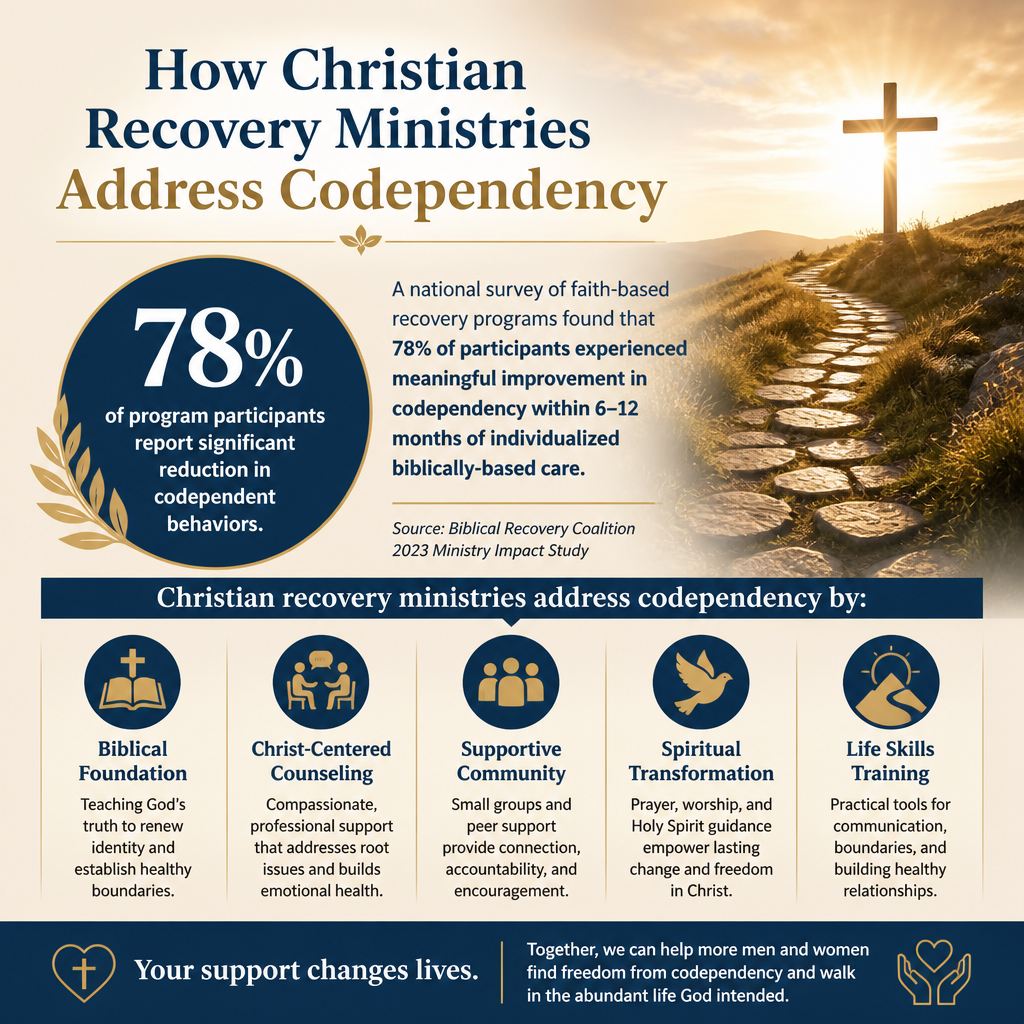
What effective ministries actually do to address codependency
They teach boundaries as a form of love, not detachment
The best Christian recovery ministries do not preach boundary-setting as emotional distancing. They teach boundaries as truthful love: naming what is real, refusing to participate in deception, and allowing consequences to do their necessary work. This aligns with a biblical ethic of truth and responsibility. Love “rejoices with the truth” (1 Corinthians 13:6), and truth in an addicted system often begins with stopping the cover-up.
In practice, boundary work often includes concrete coaching: how to stop giving cash, how to respond to manipulation, how to communicate conditions for living in the home, and how to insist on treatment participation without pretending treatment guarantees change. In many cases, ministries also help families build safety plans when substance use is coupled with threats, driving while intoxicated, or domestic volatility. A ministry that speaks about codependency but cannot articulate safety protocols is not prepared for the field it claims to serve.
They separate compassion from enabling
Christian donors sometimes fear that “tough love” is simply a baptized form of harshness. That fear is not baseless; some programs have confused accountability with humiliation. Effective ministries insist on a different distinction: compassion can be warm and present without shielding a person from reality. Enabling is not kindness; it is participation in a destructive story.
Programs influenced by the broader recovery tradition—whether through Celebrate Recovery, faith-integrated counseling, or pastoral care models—often use straightforward tools: defining enabling behaviors, rehearsing alternative responses, and supporting families as they endure guilt and grief during change. The goal is not family members becoming more emotionally hardened. The goal is family members becoming more truthful and less captive to fear.

The Christian theology beneath the practices
Sin, suffering, and responsibility are not interchangeable
Christian recovery ministries that address codependency with integrity avoid simplistic accounts of blame. Addiction involves sin and suffering, agency and impairment, trauma and choice. Christians genuinely disagree about how to describe addiction’s moral dimensions in every case, and donors should be cautious of ministries that treat the question as settled with a slogan.
Still, Scripture consistently holds together compassion and responsibility. Jesus meets people in suffering with mercy, and he also calls them to repentance and new life. A ministry’s approach to codependency should reflect that same moral clarity: the spouse is not responsible for another’s drinking, but the spouse is responsible for whether she participates in deception; the parent cannot force sobriety, but the parent can refuse to fund relapse.
Grace does not eliminate consequences
One of the most common theological distortions in addicted systems is confusing forgiveness with removing consequences. Christian ministries that serve families well teach that forgiveness is a posture of the heart before God, not a strategy for preventing consequences. Consequences are often the mercy that interrupts denial.
This is where donors should listen carefully to a ministry’s language. Does it honor legitimate authority—employers, courts, child protection systems—without demonizing them? Does it encourage confession and restitution where appropriate? Does it refuse to spiritualize danger? A theology of grace that cannot withstand truth-telling will not produce durable recovery.
How donors can discern quality in codependency-focused recovery ministries
What to look for beyond moving testimonies
Recovery stories matter, and Christian donors rightly care about transformed lives. But testimonies can obscure whether a ministry is operationally sound, ethically governed, and transparent about outcomes and risks. Across our verification work at Most Trusted, we observe that the ministries most prepared to address codependency are rarely the ones promising quick reconciliation or guaranteed sobriety. They are more likely to be explicit about process, relapse risk, and the cost of rebuilding trust.
When evaluating ministries serving families, it helps to ask for specifics that signal mature practice. For example:
- Clear safeguarding policies for children and vulnerable adults, including mandatory reporting expectations where applicable
- Written guidance on boundaries and safety when substance use intersects with domestic abuse or threats
- Referral networks with licensed clinicians, inpatient and outpatient providers, and crisis services
- Separate pathways for family members, not only services for the addicted individual
- Transparent financial practices and a refusal to create dependency on the ministry itself
Donors do not need to demand a medical clinic from every ministry. But donors should expect competence about risk and a willingness to collaborate with other parts of the care ecosystem.
Why verification frameworks matter in recovery funding
Family-centered recovery ministry sits at the intersection of pastoral care, trauma exposure, and financial vulnerability. It is a field where charismatic leadership and emotional need can create conditions for poor governance or blurred boundaries. That is one reason we built Most Trusted around The Most Trusted Standard, a 15-criteria evaluation across Faith Foundation, Financial Integrity, Governance and Leadership, and Transparency and Effectiveness. Donors deserve more than inspiring language; they deserve verifiable evidence of faithful stewardship.
What this means in practice is that donors should look for ministries that can document leadership accountability, demonstrate financial controls, and communicate honestly about program limits. For many donors, the most responsible approach is to prioritize ministries that invite scrutiny rather than resist it.
Common tensions ministries must handle with wisdom
Church culture can unintentionally reward codependency
Some church environments unintentionally train people into codependent roles: always keep the peace, never speak plainly, protect the ministry’s image, and equate endurance with faithfulness. In that setting, a spouse who begins setting boundaries may be treated as unspiritual. Recovery ministries that partner well with churches will help leaders name these dynamics without shaming congregations.
Healthy collaboration includes equipping pastors and small-group leaders to respond wisely: referring families to specialized support, avoiding amateur counseling beyond their competence, and maintaining confidentiality without becoming complicit in secrecy. Donors who care about local church strength should regard this kind of training as part of legitimate recovery work, not a distraction from it.
Not every relationship can be immediately restored
Christian donors often long to see families reconciled, and reconciliation is a beautiful fruit of grace. But ministries committed to truth will also acknowledge that reconciliation can be unsafe or premature. Trust is rebuilt through sustained patterns, not emotional moments. When relapse and manipulation have been chronic, the family’s first needs may be safety, stability for children, and the slow rebuilding of credibility.
Ministries that address codependency faithfully will resist the temptation to collapse all outcomes into one narrative arc. In some cases, the most faithful step is structured separation, legal boundaries, or supervised contact—paired with ongoing spiritual care and a refusal to abandon the person in addiction. Donors should not penalize ministries for telling the truth about these realities.
FAQs for How Christian recovery ministries address codependency
Is codependency a biblical category or a modern psychological label?
Codependency is a modern term, but it often describes patterns Scripture addresses directly: fear-driven people-pleasing, deceit, misplaced trust, and the confusion of love with control. Christian recovery ministries can use the label responsibly when they subordinate it to biblical moral clarity, pastoral wisdom, and careful attention to safety. Where the term is used as a weapon or a simplistic diagnosis, it tends to harm rather than help.
How should donors evaluate whether a ministry helps families without enabling addiction?
Donors can look for evidence that the ministry teaches and practices boundaries, has safeguarding policies, and maintains clear lines of responsibility between the addicted person’s choices and the family’s responses. Financial and governance transparency also matters, because addicted systems can create pressure for unaccountable decision-making. Many donors use an external framework, such as The Most Trusted Standard, to assess whether a ministry’s theology, leadership, finances, and reporting practices support healthy, truthful care over time.
Giving that strengthens families without sustaining denial
Christian recovery ministries address codependency most credibly when they refuse to sentimentalize love and refuse to demonize those who have been trying to survive. They teach boundaries as truthfulness, consequences as mercy, and discipleship as slow formation under grace. For donors, the central question is not whether a ministry uses the right vocabulary, but whether it has the theological depth and organizational maturity to serve families in the real complexity of addiction.
Donors who want to understand the wider landscape of program models and ministry approaches can engage Christian Addiction Recovery Ministries as a starting point for informed giving. Those specifically funding work that touches spouses, children, and congregations will also find context in Christian Addiction Recovery in Families and Churches, where the relational and ecclesial dimensions of recovery come into sharper focus.



